

TL;DR:
- A continuous, AI-aware compliance stack that integrates runtime visibility and enforcement closing key maturity gaps.
- Effective compliance transforms from audit preparation to operational discipline, prioritizing controls like discovery and audit trails.
Adopt a continuous, AI-aware compliance stack that combines runtime visibility, intent-based enforcement, and GRC integration — that single architectural decision closes the largest maturity gaps facing regulated U.S. enterprises today. Treating compliance as audit preparation rather than an operational discipline is the most common and costly mistake security leaders make.
Three things to act on now:
- Priority controls: Enable continuous asset and AI agent discovery, immutable audit trails, and IAM integration before any other capability.
- Board KPIs to report: Percent of high-risk AI use cases under active control, audit evidence completeness score, and mean time to remediate policy violations.
- Immediate action: Scope a 30-day pilot with a partner like Heightscg to baseline your AI exposure and map gaps to NIST CSF, SOC 2, or CMMC before your next audit cycle.
Table of Contents
- What do enterprise compliance tools actually do?
- What capabilities must every enterprise compliance tool include?
- How do you choose the right compliance tools for your organization?
- Which deployment model fits your organization?
- How should you fold AI governance into your existing compliance program?
- What does a three-phase compliance roadmap look like?
- Which metrics actually prove your compliance program is working?
- How do compliance tools handle regulatory changes and updates?
- How do training programs integrate with compliance tools?
- How do compliance tools connect to incident response workflows?
- What data privacy features should enterprise compliance tools provide?
- How do compliance tools scale across divisions and global environments?
- Heightscg accelerates AI-aware compliance for regulated enterprises
- Key Takeaways
- An executive note on AI-aware compliance
- Authoritative sources and references
What do enterprise compliance tools actually do?
Modern compliance tools for enterprises go well beyond checklist management. They deliver continuous runtime visibility, automated policy enforcement, and GRC integration that feeds directly into board-level reporting on risk posture and audit readiness.
The functional flow looks like this: runtime visibility surfaces assets, AI agents, and data flows in real time; policy enforcement applies controls at the point of use; a risk register scores and prioritizes findings; and a GRC integration layer packages evidence for auditors and executives. Each layer depends on the one before it.
Primary functional areas every enterprise platform must cover:
- Discovery and inventory (assets, cloud workloads, AI agents)
- Policy orchestration and enforcement
- Continuous monitoring and alerting
- Immutable evidence collection and audit trail
- Remediation orchestration and workflow automation
- Vendor and third-party risk integration
What capabilities must every enterprise compliance tool include?
Must-have capabilities
- Continuous discovery and inventory covering physical assets, cloud workloads, SaaS applications, and AI agents
- Immutable audit trails that cannot be altered after the fact, satisfying SOC 2 and CMMC evidence requirements
- IAM integration for automated access review and least-privilege enforcement
- Policy-as-code or policy orchestration so controls are machine-enforceable, not just documented
- Automated evidence collection mapped to specific framework controls (NIST, HIPAA, PCI DSS)
- Vendor and SaaS data flow mapping for third-party risk visibility
- Integrated risk scoring that prioritizes findings by business impact
Should-have capabilities
- Intent-based DLP for conversational AI interactions — legacy DLP and CASB are structurally blind to bidirectional model traffic
- Runtime tokenization to prevent sensitive data from reaching external LLMs
- Automated remediation workflows with assignable ownership
- GRC platform integration (ServiceNow GRC, Archer, or equivalent)
- Role-based access review automation on a defined cadence
Optional capabilities
- Built-in training modules tied to specific policy violations
- Industry-specific pre-mapped controls for HIPAA, PCI DSS, and CMMC
- Advanced forensics integrations for post-incident analysis
Pro Tip: When evaluating a vendor's AI-aware runtime inspection claims, ask for a live demonstration of bidirectional traffic inspection on a conversational AI session. Vendors who can only show policy configuration screens — not live traffic analysis — have not operationalized the capability.
How do you choose the right compliance tools for your organization?
Decision criteria
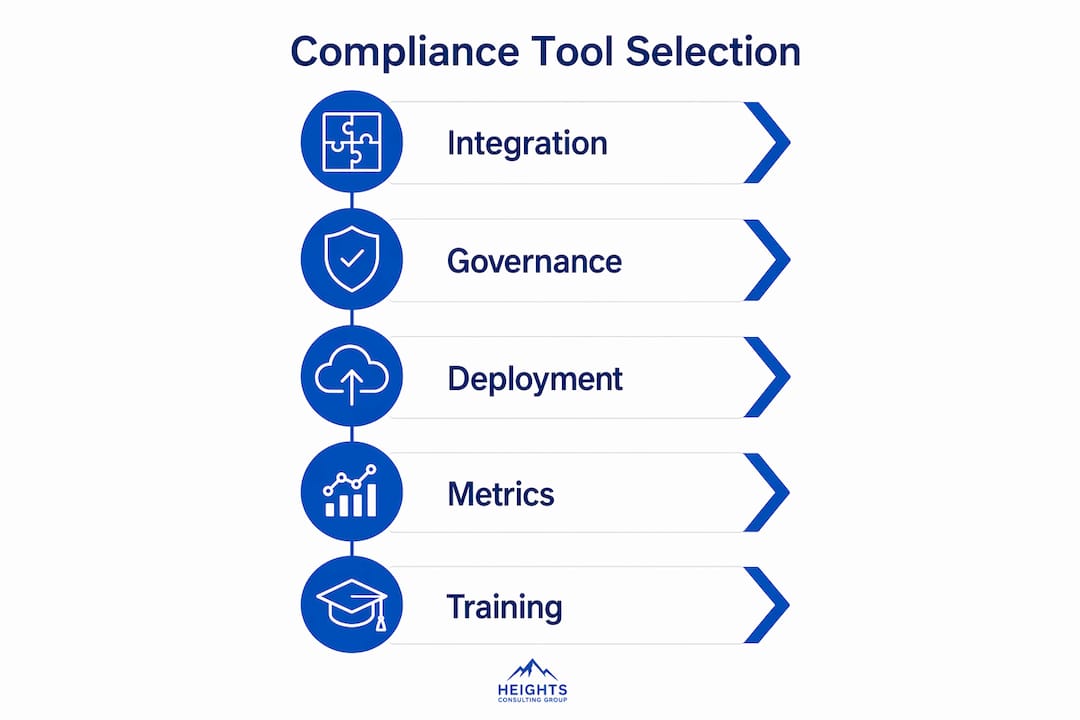
The table below maps the key evaluation dimensions to the business outcomes they protect.
| Criterion | Why It Matters |
|---|---|
| GRC and SIEM integration | Avoids siloed evidence and duplicate workflows |
| AI-aware runtime inspection | Closes the gap legacy DLP cannot address |
| Scale (users, LLM types) | Prevents tool sprawl as AI adoption grows |
| Evidence automation | Reduces audit preparation time and human error |
| Vendor transparency on model use | Protects data residency and regulatory standing |
| Framework mapping (SOC 2, NIST, CMMC) | Accelerates certification and audit cycles |
Governance model
Sponsorship belongs with the CISO, General Counsel, or COO depending on the primary regulatory driver. Security operations owns day-to-day monitoring; the compliance team owns framework mapping and evidence packages. A cross-functional AI governance committee should meet at least quarterly to approve high-risk use cases and review decommissioning decisions.

Timeline and cost drivers
A typical engagement runs: weeks 1–4 for scoping and tool selection; weeks 5–12 for phased deployment and integration; month 4 onward for continuous monitoring and managed operations. Licensing costs scale with user count and the number of frameworks tracked. Managed-service models carry higher monthly fees but eliminate internal staffing requirements and transfer SLA accountability to the partner. Aligning cybersecurity with business objectives from the start prevents scope creep that inflates both timelines and costs.
Key procurement questions to ask vendors:
- Where is data processed and stored, and does that satisfy your residency requirements?
- Is your data used to train or fine-tune any model?
- What is the formal decommissioning process for AI agents or deprecated integrations?
- How are framework control mappings updated when regulations change?
Which deployment model fits your organization?
| Model | Time to Value | Control | Operational Burden | Evidence Ownership |
|---|---|---|---|---|
| Managed service | Fast (weeks) | Lower | Minimal | Partner-held, exportable |
| Self-managed platform | Slower (months) | Full | High | Internal team |
| Hybrid | Moderate | Shared | Moderate | Shared |
Managed service suits regulated healthcare, defense contractors, and financial institutions with small security teams. The partner absorbs monitoring, evidence packaging, and framework updates. Self-managed platforms fit large enterprises with mature security operations centers that need full configuration control. Hybrid models work when an organization has strong internal GRC capability but lacks the headcount for 24/7 monitoring.
Recommended use cases:
- Small healthcare security team under HIPAA + HITRUST pressure → managed service
- Large bank with existing SIEM and GRC infrastructure → hybrid
- Defense contractor pursuing CMMC Level 2 certification → managed service or hybrid with a certified partner
Pro Tip: Before signing a managed-service agreement, confirm that audit evidence is exportable in a format your auditors accept and that you retain ownership of all evidence packages after contract termination. Evidence portability is a contractual term, not a default.
How should you fold AI governance into your existing compliance program?
Treat AI as another technology layer and operationalize controls rather than writing policies and stopping there. Schellman's 2026 State of AI Governance report found that 27% of organizations report fully mature AI governance programs, while 74% believe they could pass an AI compliance audit, revealing a maturity gap between confidence and operationalization.
AI risk checklist for regulated enterprises:
- Model provenance documented for every AI tool in use
- Training data lineage reviewed for sensitive data exposure
- Formal decommissioning workflows for AI agents and deprecated models
- Intent-based controls on conversational AI sessions
- Bidirectional inspection of model traffic, not just outbound requests
- Runtime tokenization for sensitive data categories
- Approval workflows for high-risk use cases (clinical decision support, financial modeling)
More than 30 states now regulate AI in different ways, and the deployer carries exposure across every jurisdiction where employees use AI tools. Mapping AI use cases by jurisdiction is an operational necessity, not a legal formality.
What does a three-phase compliance roadmap look like?
Phase 1: Discover (weeks 1–4)
- Deploy live asset and AI agent inventory across all environments
- Run shadow AI detection to surface unsanctioned tools
- Complete a baseline risk assessment against your primary framework (NIST, SOC 2, or CMMC)
Quick win: Freeze the top five highest-risk AI use cases pending control deployment.
Phase 2: Integrate controls (weeks 5–12)
- Deploy intent-based enforcement on conversational AI traffic
- Complete IAM and SSO integration with automated access reviews
- Activate automated evidence collection mapped to framework controls
- Conduct vendor risk assessments for top-tier SaaS and AI providers
Quick win: Automate policy enforcement for the ten highest-risk data flows identified in Phase 1. Pairing this with continuous vulnerability management closes the most common audit gaps before they become findings.
Phase 3: Assurance and scale (month 4 onward)
- Activate continuous monitoring dashboards with executive-ready reporting
- Establish periodic AI model evaluations using standardized scoring rubrics
- Implement formal decommissioning workflows for AI agents
- Automate audit evidence packaging for each framework
Quick win: Deliver a board-ready evidence bundle before the next scheduled audit, demonstrating measurable risk reduction from Phase 1 baseline.
Which metrics actually prove your compliance program is working?
Measure risk reduction and audit velocity, not activity volume. The number of policies written or controls documented tells a board nothing about actual exposure.
Executive KPIs:
- Mean time to detect AI-related data exposure
- Percent of high-risk AI use cases under active control
- Audit evidence completeness score (target: 95%+)
- Time-to-evidence for auditors (target: under 48 hours)
- Reduction in policy violations month over month
- Remediation mean time for critical findings
| Metric | Audience | Reporting Cadence |
|---|---|---|
| Audit evidence completeness | CISO | Weekly |
| High-risk AI use cases under control | CISO, COO | Monthly |
| Policy violation trend | Security ops | Weekly |
| Remediation mean time | CISO, Board | Quarterly |
| Time-to-evidence | CISO, Auditors | Per audit cycle |
Connecting these metrics to business outcomes converts the compliance program from a cost center into a demonstrable risk-reduction asset.
How do compliance tools handle regulatory changes and updates?
Regulatory change management is where many enterprise platforms fall short. A capable tool monitors authoritative sources — federal agency publications, state AI legislation, and framework revision notices — and maps incoming changes to the specific controls your organization has deployed. When a new requirement lands, the platform flags affected controls, generates a gap assessment, and triggers a remediation workflow automatically.
For U.S. regulated enterprises, this means tracking NIST CSF updates, HHS guidance for HIPAA, PCI DSS version transitions, and the accelerating pace of state AI legislation. Banking and financial institutions face additional layers of privacy regulation that require the same automated change-tracking discipline. The compliance team's role shifts from manually scanning regulatory feeds to reviewing pre-mapped gap analyses and approving remediation plans.
How do training programs integrate with compliance tools?
Compliance training works best when it is triggered by behavior, not scheduled by calendar. Modern enterprise compliance software ties training assignments directly to policy violations, access anomalies, or failed control checks. An employee who attempts to upload sensitive data to an unsanctioned AI tool receives a targeted training module at the point of violation, not six months later during annual awareness training.
This integration also generates evidence. Completion records, assessment scores, and remediation acknowledgments feed directly into the audit trail, satisfying training documentation requirements under HIPAA, PCI DSS, and CMMC. The result is a training program that produces both behavioral change and auditable proof.
How do compliance tools connect to incident response workflows?
Compliance tools and incident response workflows must share data bidirectionally. When a compliance tool detects a policy violation or anomalous data flow, it should automatically open an incident ticket, attach the relevant evidence, and trigger the appropriate response playbook. Integrating compliance tooling with incident response shortens remediation cycles and ensures every incident generates auditable evidence without manual documentation.
The practical requirement: your compliance platform must integrate with your SIEM, SOAR, or ticketing system (ServiceNow, Jira, Splunk SOAR) so that evidence, ownership, and resolution status are synchronized. Heightscg's incident response services are built to connect directly with compliance monitoring outputs, so findings move from detection to remediation without falling into a manual handoff gap.
What data privacy features should enterprise compliance tools provide?
U.S. regulated enterprises operate under a fragmented privacy landscape: CCPA and its amendments in California, sector-specific rules under HIPAA and GLBA, and growing state-level privacy laws that now cover a majority of the U.S. population. Globally operating divisions also carry GDPR obligations for EU data subjects.
A capable compliance platform maps data flows to the specific regulation that governs each category, enforces data residency controls, automates subject rights request workflows, and generates jurisdiction-specific audit evidence. The key capability is data classification at ingestion — tagging data by type, sensitivity, and applicable regulation before it moves through any system, including AI tools. Without that classification layer, privacy compliance becomes reactive rather than built in.
How do compliance tools scale across divisions and global environments?
Multi-division enterprises need a compliance platform that supports separate policy sets, evidence repositories, and risk registers for each business unit while giving the CISO a consolidated view across the enterprise. The architecture requirement is role-based tenancy: division compliance teams manage their own controls; the enterprise security team sees aggregate risk posture and cross-division audit readiness.
Global environments add jurisdictional complexity. A platform deployed across U.S. and EU operations must enforce CCPA rules for California residents, GDPR rules for EU data subjects, and sector-specific requirements for each regulated division — simultaneously, without manual configuration for each new jurisdiction. Compliance-by-design methodologies embed these controls at the architecture level so that scaling into a new market or acquiring a new business unit does not require rebuilding the compliance program from scratch.
Heightscg accelerates AI-aware compliance for regulated enterprises
Regulated enterprises that need to move from reactive audit preparation to continuous, AI-aware compliance have a concrete alternative to assembling point solutions internally.
Heightscg delivers advisory, technical implementation, and managed compliance services purpose-built for regulated U.S. organizations. The engagement model follows the three-phase roadmap described above: a scoped discovery pilot (typically 30 days) that baselines AI exposure and maps gaps to NIST, SOC 2, HIPAA, PCI DSS, or CMMC; a phased controls integration that deploys intent-based enforcement, IAM integration, and automated evidence collection; and an ongoing managed operations model with defined SLAs for monitoring, evidence packaging, and regulatory change management.
Heightscg's framework coverage spans the full stack of U.S. regulatory requirements, and the firm's technical consulting team has direct experience implementing AI governance controls alongside traditional security frameworks. For executives under tight audit timelines, the technical consulting approach compresses the path from gap assessment to audit-ready evidence. Contact Heightscg to scope a pilot engagement or request a framework gap assessment for your organization.
Key Takeaways
Continuous, AI-aware compliance requires runtime visibility, intent-based enforcement, and GRC integration working together — no single control or policy document substitutes for that operational stack.
| Point | Details |
|---|---|
| Continuous over episodic | Embed controls into daily operations; audit-prep-only programs leave real risk gaps. |
| AI governance maturity gap | 27% of organizations have fully mature AI governance programs, while 74% believe they could pass an AI compliance audit, per Schellman's research. |
| Runtime enforcement is non-optional | Legacy DLP and CASB cannot inspect conversational AI traffic; intent-based controls are required. |
| Measure risk reduction, not activity | Track audit evidence completeness, high-risk AI use cases under control, and remediation mean time. |
| Heightscg as implementation partner | Heightscg delivers discovery, controls integration, and managed compliance with defined SLAs for regulated U.S. enterprises. |
An executive note on AI-aware compliance
The compliance programs that hold up under scrutiny share one characteristic: the people running them stopped treating governance as a documentation exercise and started treating it as an operational discipline. Policies matter, but they do not stop a sensitive record from reaching an external LLM. Controls do.
What concerns me most in conversations with security leaders is the confidence gap. Organizations believe they are audit-ready because they have written policies and allocated budget. Schellman's research puts that at 74% believing they could pass an AI compliance audit, but only 27% have actually operationalized AI governance. The gap between confidence and operationalization is where breaches and audit failures live. The answer is not a larger policy library. It is runtime visibility, enforced controls, and a governance committee with the authority to freeze high-risk use cases until controls are in place. Executives who sponsor that structure — not just fund it — are the ones whose organizations come out of audits with findings they can defend.
Authoritative sources and references
These sources were selected for their direct relevance to AI governance maturity, runtime controls, regulatory fragmentation, and compliance operationalization for regulated U.S. enterprises. Use them when validating vendor claims and preparing board briefings.
- Schellman: New AI Research Report — Primary source for AI governance maturity benchmarks; the 27%/74% maturity gap finding is the most cited data point in current board briefings.
- CIO: Why AI Governance Is Failing — Practical analysis of why policy-only governance fails and what technical enforcement actually requires.
- WitnessAI: AI Governance Challenges — Detailed technical coverage of shadow AI discovery, intent-based enforcement, and agent decommissioning requirements.
- TechTarget: Managing AI Regulation Gaps — Authoritative guidance on jurisdictional fragmentation across more than 30 state AI laws.
- Adaptive Security: AI Governance Challenges — Covers ISO/IEC 42001 and ISO/IEC 27001 mapping as a practical path to AI governance certification.
- Windes: Cybersecurity Compliance Advisory — Practical advisory guidance on embedding compliance into operations and integrating with incident response workflows.
- Heightscg Regulatory Compliance Guide — Executive-focused strategic playbook for navigating regulatory compliance in regulated U.S. industries.