

TL;DR:
- Regulatory compliance in 2025 involves real-time monitoring, AI-driven assessments, and adaptable governance structures.
- Building a successful program starts with a risk assessment to prioritize controls and assign clear ownership for ongoing management.
Regulatory compliance in 2025 is defined as a proactive, continuous process of identifying, controlling, and documenting adherence to applicable laws, standards, and frameworks across your organization. Knowing how to ensure regulatory compliance 2025 requires more than annual audits. It demands real-time monitoring, AI-driven risk assessment, and governance structures built to absorb regulatory change without breaking. Frameworks like SOC 2, ISO 27001, NIST, and CMMC now serve as the operational backbone for regulated industries. The global compliance market is projected to reach $32.2 billion by 2029, growing at a compound annual growth rate of 8.7%. That growth reflects how seriously organizations are treating compliance as a core business function.
What prerequisites and tools are essential for effective compliance in 2025?
A mature compliance program rests on three foundational pillars: documented policies, technical controls, and evidence mechanisms. Without all three, your program will fail an audit or collapse under regulatory scrutiny. Standard compliance programs require 15 to 25 distinct policies to cover core obligations. That range reflects the complexity of operating across multiple regulatory regimes simultaneously.

The technology layer matters as much as the policy layer. A Compliance Management System (CMS) centralizes policy management, automates control testing, and maintains audit trails in real time. Cloud-based CMS platforms enable continuous access to updated regulatory policies and use AI for training accessibility. This is a direct operational advantage over on-premises systems that require manual updates and produce stale evidence.
Key technology enablers for 2025 compliance programs include:
- AI-powered risk assessment tools that detect anomalies before they become violations
- Automated evidence collection that pulls directly from source systems rather than relying on manual report generation
- Real-time regulatory monitoring that flags rule changes and maps them to affected controls
- Cloud-based CMS platforms with integrated policy libraries and audit-ready dashboards
- Text-to-video training tools that convert policy documents into accessible employee training content
Governance is the non-negotiable foundation underneath all of this technology. Effective compliance programs require governance committees that meet at least quarterly with multi-department representation to review risk registers and approve policies. Without executive sponsorship and cross-functional ownership, even the best technology stack produces compliance theater rather than compliance substance.
Pro Tip: Assign a named control owner to every control in your library before you deploy any monitoring tool. Technology surfaces problems. Ownership determines who fixes them.
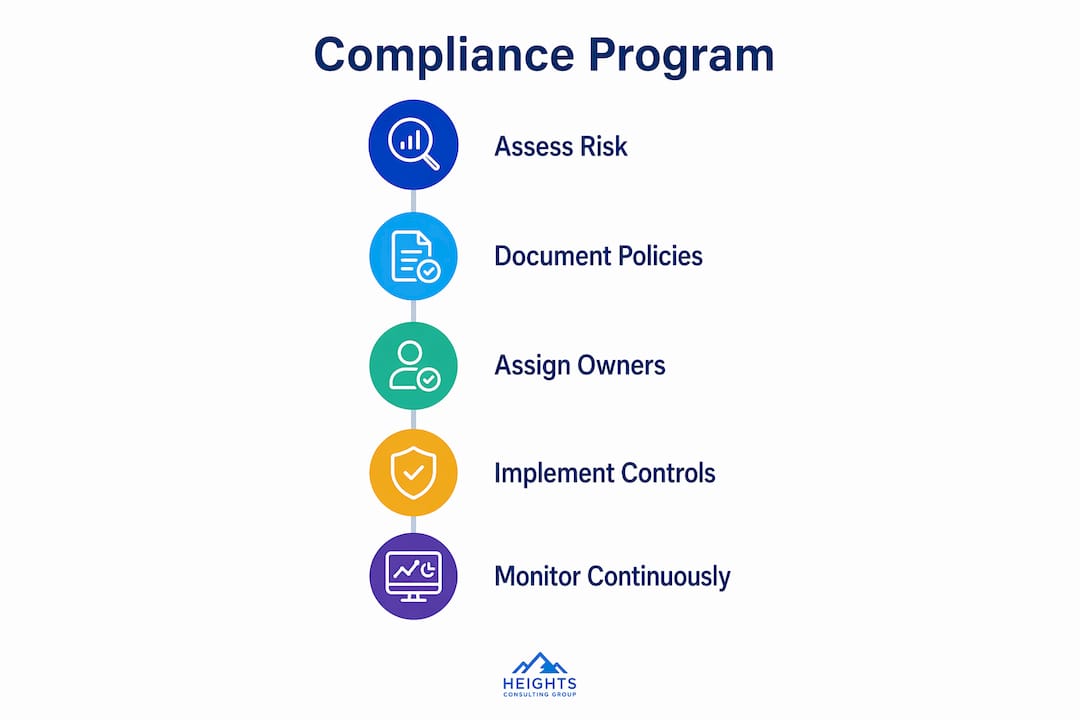
How to build and implement a compliance program to meet 2025 standards
Building a compliance program that holds up in 2025 starts with risk assessment, not framework selection. Starting with a risk assessment instead of a framework prevents program bloat and prioritizes sustainability for long-term compliance management. Organizations that start by selecting a framework often end up with hundreds of controls they cannot resource or evidence. Start with what can hurt you most.
The implementation sequence that produces durable results follows this order:
- Conduct a risk assessment. Identify your highest-risk data types, processes, and third-party relationships. Prioritize controls based on impact and likelihood, not framework completeness.
- Map controls to specific regulations. Each control should link directly to the regulatory requirement it satisfies. Vague mappings create audit gaps.
- Set five attributes per control. Every control needs a named owner, a testing cadence, a trigger condition, a documented procedure, and a defined evidence artifact.
- Shift from annual to quarterly evidence collection. Annual audits create point-in-time snapshots that miss ongoing failures. Quarterly cycles catch drift before it compounds.
- Automate control testing where possible. Automated testing produces consistent, timestamped evidence that auditors trust more than manually assembled reports.
The table below shows how control attributes translate into operational accountability:
| Control Attribute | Purpose | Example |
|---|---|---|
| Named owner | Accountability for control performance | "CISO owns access review control" |
| Cadence | Frequency of testing or review | Quarterly for access logs, monthly for patch status |
| Trigger | Event that activates the control | New employee onboarding, system change |
| Procedure | Step-by-step execution instructions | Documented runbook in the CMS |
| Evidence artifact | Proof the control operated | Screenshot, log export, signed attestation |
This structure converts compliance from a project into an operating rhythm. Teams stop scrambling before audits and start maintaining continuous readiness. The transition from annual audits to continuous quarterly evidence collection is the single most impactful operational change a compliance team can make in 2025.
What technology and AI solutions enhance compliance effectiveness?
By 2025, 90% of companies utilize AI-powered risk assessment tools for real-time compliance monitoring, enabling early anomaly detection. That adoption rate signals that AI-driven compliance monitoring is no longer a competitive advantage. It is table stakes for regulated industries. Organizations still relying on manual monitoring are operating with a structural disadvantage.
The most impactful AI and automation capabilities for compliance teams include:
- Automated evidence collection from source systems. Automated evidence collection cuts audit preparation time significantly and improves accuracy by replacing manual report pulling with direct system integration.
- Real-time alerts for control failures. AI monitoring platforms flag deviations the moment they occur, giving compliance teams hours to respond rather than discovering failures during an audit.
- Integration with global regulatory databases. Platforms that connect to regulatory feeds automatically update policy libraries when rules change, eliminating the lag between regulatory publication and internal policy revision.
- AI-driven training delivery. Text-to-video tools convert dense policy documents into short, accessible training modules that improve employee comprehension and completion rates.
The AI-driven risk management capabilities now available to compliance teams also create new governance obligations. When AI systems flag anomalies or generate compliance reports, someone must own the output. AI without human accountability is a liability, not an asset. Boards and compliance committees need to define who reviews AI-generated findings and what authority those findings carry.
For financial institutions and digital asset firms, digital asset risk frameworks are becoming a required component of the compliance architecture. These frameworks address the specific regulatory exposure created by tokenized assets, smart contracts, and decentralized finance operations.
What are common compliance program pitfalls and how do you fix them?
Most compliance programs do not fail because of bad intentions. They fail because of structural problems that accumulate quietly until an audit or incident exposes them. Knowing the failure patterns in advance is the most direct path to avoiding them.
The four most common compliance program failures and their fixes:
- Static control libraries. Controls written once and never updated decay rapidly as regulations change. Maintaining live mapping between regulations and specific controls is critical. Lack of maintenance causes rapid program decay as regulations change. Schedule a quarterly control review tied to your governance committee meeting.
- Siloed compliance efforts. When legal, IT, and operations each manage their own compliance activities without a shared platform, evidence gaps and duplicate work multiply. Consolidate into a single CMS with cross-functional access and shared dashboards.
- Manual evidence collection. Manual evidence collection leads to audit trail reconstruction, which increases risk and consumes disproportionate staff time. Automate evidence pulls from source systems as the first technology investment.
- Activity-based KPIs. Measuring how many policies were reviewed or how many training sessions were completed tells you nothing about whether your controls are working. Measure control effectiveness: failure rates, remediation time, and audit findings per cycle.
Pro Tip: Before your next governance committee meeting, pull your three highest-risk controls and verify that evidence artifacts exist for the last two testing cycles. If they do not, you have a structural gap, not a documentation gap.
Regulatory priorities in 2025 include increased state activity focusing on fraud model management, customer authentication, and investigation protocols. These areas are precisely where manual processes and siloed teams produce the most exposure. Organizations in financial services and healthcare face the highest concentration of new requirements in these categories.
Sustained compliance maturity also requires that your compliance strategies adapt to the regulatory environment continuously, not just at renewal time. Build regulatory monitoring into your governance calendar, not just your audit cycle.
Key takeaways
Ensuring regulatory compliance in 2025 requires a risk-first approach, continuous evidence collection, AI-powered monitoring, and governance structures with named ownership at every control level.
| Point | Details |
|---|---|
| Start with risk, not frameworks | Conduct a risk assessment first to prioritize controls and prevent program bloat. |
| Assign control ownership | Every control needs a named owner, cadence, trigger, procedure, and evidence artifact. |
| Automate evidence collection | Direct system integration replaces manual report pulling and improves audit accuracy. |
| Meet quarterly as a governance committee | Multi-department governance reviews catch risk register drift before auditors do. |
| Map controls to regulations continuously | Live regulation-to-control mapping prevents program decay as rules change. |
Compliance as a competitive signal, not just a requirement
The compliance teams I respect most stopped treating frameworks as finish lines years ago. They treat compliance as a signal. When a company can demonstrate continuous control effectiveness, not just a clean audit report, it tells regulators, customers, and investors something that a checkbox never can: this organization has built accountability into how it operates.
The shift I find most consequential right now is the move toward embedding compliance by design into product and operational workflows from the start. Organizations that bolt compliance on after the fact spend three times the effort for half the coverage. Those that build it in from the architecture stage accelerate go-to-market timelines and reduce audit friction at every stage of growth.
AI is accelerating this shift in ways that are genuinely useful, but also creating new accountability gaps that most governance structures have not caught up with yet. When an AI system flags a compliance anomaly, who owns that finding? What happens if the AI is wrong? These are not hypothetical questions. They are live governance problems that compliance leaders need to answer before regulators ask them.
My advice to compliance leaders entering 2025: start your next program review with a risk assessment, not a framework gap analysis. Identify what can actually hurt your organization, map your controls to those risks, and then verify that every control has a human owner who can be held accountable. The technology will surface the problems. Governance determines whether anyone fixes them.
— Dan
How Heightscg supports your compliance program in 2025
Regulated organizations need more than policy documents and annual audits. They need continuous visibility into control performance, threat activity, and regulatory change.
Heightscg delivers managed cybersecurity services that provide 24/7 organizational protection, continuous threat detection, and compliance-aligned monitoring for organizations in highly regulated industries. The firm's compliance consulting practice covers frameworks including NIST, CMMC, and SOC 2, with advisory support tailored to the specific risk profile of each client. For organizations building or maturing a compliance program, Heightscg offers the technical depth and executive-level guidance needed to convert compliance requirements into operational controls that hold up under scrutiny. Contact Heightscg to assess your current compliance posture and identify the gaps that matter most.
FAQ
What does regulatory compliance mean in 2025?
Regulatory compliance in 2025 is the continuous process of meeting applicable laws, standards, and frameworks through documented controls, real-time monitoring, and governance structures. It goes beyond annual audits to require ongoing evidence collection and risk management.
How many policies does a compliance program require?
Standard compliance programs require 15 to 25 distinct policies to cover core obligations across applicable regulatory regimes. The exact number depends on the industries and jurisdictions the organization operates in.
Why do compliance programs fail?
Most compliance programs fail due to static control libraries, siloed team efforts, manual evidence collection, and KPIs that measure activity rather than control effectiveness. Addressing these structural problems is the fastest path to program maturity.
How does AI improve regulatory compliance?
AI-powered tools detect anomalies in real time, automate evidence collection from source systems, and integrate with regulatory databases to flag rule changes automatically. These capabilities reduce audit preparation time and improve the accuracy of compliance reporting.
What is the first step to building a compliance program?
The first step is conducting a risk assessment, not selecting a framework. Starting with risk prioritizes the controls that matter most and prevents program bloat from framework requirements that do not match your actual risk profile.