

TL;DR:
- Continuous compliance involves real-time, automated monitoring of controls, replacing traditional periodic audits. It provides faster detection, comprehensive coverage, and stronger regulatory and cyber insurance credibility in 2026. Implementing it effectively requires phased prioritization of high-risk controls, integration with existing systems, and executive ownership.
Continuous compliance is defined as the practice of maintaining real-time, automated adherence to regulatory and security requirements through ongoing control validation rather than periodic audit events. Unlike traditional annual audits against frameworks such as ISO 27001, SOC 2, or DORA, this approach treats compliance as an always-on operational function. Organizations that rely on point-in-time assessments accept months-long blind spots between reviews. Those blind spots are where breaches occur, fines accumulate, and regulators lose confidence. Understanding why continuous compliance has become a strategic imperative in 2026 requires examining how infrastructure, regulation, and AI governance have fundamentally changed the risk calculus for decision-makers in regulated industries.
Why continuous compliance outperforms traditional audits
Traditional compliance audits operate on a sampling model. Auditors review a selection of controls, examine documentation snapshots, and issue a finding that reflects a moment in time. The problem is that modern infrastructure changes hourly, making any static audit obsolete almost immediately after completion. A cloud configuration that passed review in January may have drifted by March. A privileged access control that was documented correctly may have been modified by an automated deployment pipeline within days.

Continuous compliance replaces the sampling model with full coverage. 100% of transactions and system events are tracked in real time, with deviations caught within seconds or minutes rather than discovered months later during the next audit cycle. That shift in detection speed changes the entire remediation equation. A control failure caught in minutes carries a fraction of the legal, financial, and reputational cost of one discovered during an external audit.
Periodic audits also fail to verify operational effectiveness against real attack conditions. They confirm that documentation exists, not that controls actually work under pressure. Continuous compliance platforms generate live evidence of control performance, which satisfies both regulators and cyber insurers with far greater credibility than a binder of policies.
| Dimension | Periodic audits | Continuous compliance |
|---|---|---|
| Coverage | Sample-based snapshots | 100% of events monitored |
| Detection speed | Months between reviews | Seconds to minutes |
| Evidence quality | Documentation at a point in time | Live, audit-ready control data |
| Remediation window | Weeks to months | Hours |
| Regulatory posture | Reactive | Proactive and demonstrable |
Pro Tip: Start continuous monitoring on your highest-risk controls first, such as privileged access management and encryption key rotation. Building confidence in those alerts before expanding to lower-risk controls prevents alert fatigue and builds organizational trust in the program.
What are the key benefits of continuous compliance?
The business case for ongoing compliance oversight is grounded in measurable outcomes, not theory. The most direct benefit is time. Automating continuous compliance reduces audit preparation time by 60 to 80% compared to traditional methods. For organizations where annual audit preparation consumes hundreds of engineering and security hours, that recovery translates directly into capacity for product development, threat response, and strategic initiatives.
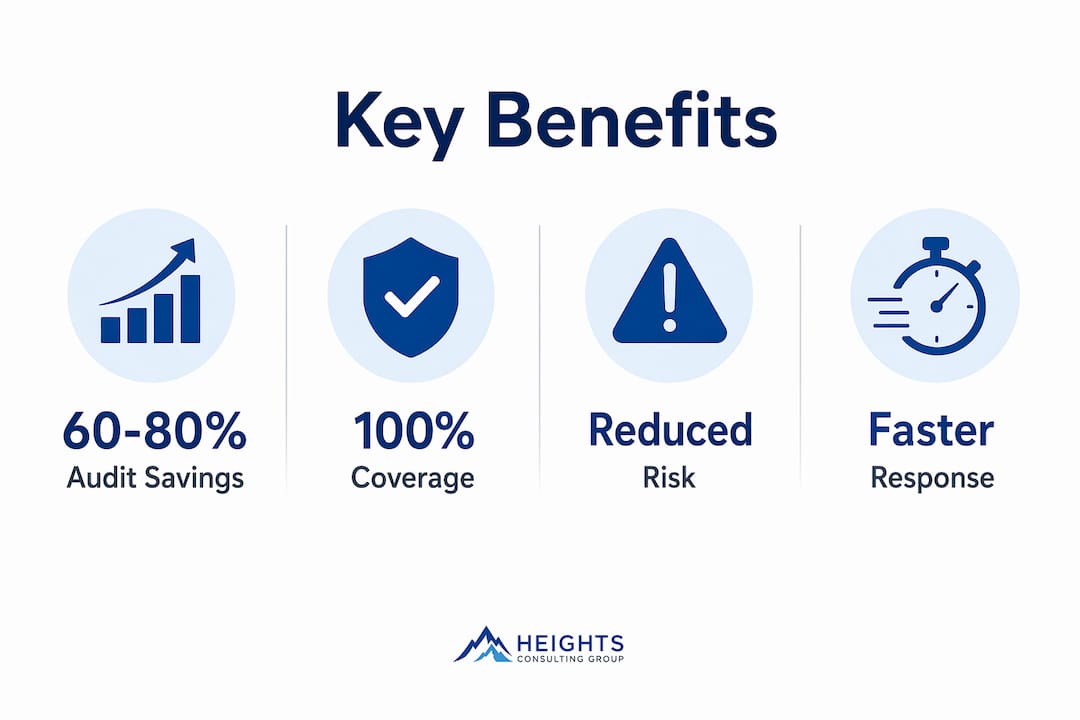
The financial argument is equally clear. Non-compliance costs run approximately three times higher than the cost of automated governance, risk, and compliance maintenance, with regulatory fines reaching up to 4% of global annual turnover under frameworks like GDPR. Prevention through automation is not a cost center. It is a hedge against penalties that dwarf the investment.
Beyond efficiency and cost avoidance, the benefits of continuous compliance extend to executive visibility and market positioning:
- Board-level KPIs: Continuous compliance platforms generate a Compliance Score metric that gives boards and C-suites a quantified view of control health, replacing qualitative reports with data-driven indicators.
- Cyber insurance leverage: Documented, real-time control evidence strengthens underwriting positions and can reduce premium costs.
- Customer and partner assurance: Enterprise buyers and regulated partners increasingly require proof of continuous control effectiveness, not just annual certifications.
- M&A due diligence: Organizations with mature continuous compliance programs present lower risk profiles during acquisition reviews, accelerating deal timelines.
- Reduced burnout: The compliance cognitive tax imposed by periodic audit scrambles reduces morale and increases team turnover. Automation removes that recurring burden.
Each of these outcomes compounds over time. An organization that builds continuous compliance into its operating model accumulates evidence, refines controls, and demonstrates maturity in ways that periodic audit cycles structurally cannot replicate. For executives accountable to regulators, boards, and customers simultaneously, that compounding advantage is the core value proposition.
How AI and regulatory change are reshaping compliance in 2026
AI integration has introduced a category of compliance risk that annual audits were never designed to address. Machine learning models deployed in credit decisioning, fraud detection, or clinical support systems can drift in ways that produce biased or non-compliant outputs within weeks of deployment. The EU AI Act mandates continuous monitoring of high-risk AI systems for drift and bias, with documentation and oversight requirements that only automated compliance platforms can satisfy at scale. Organizations deploying AI without continuous oversight are not just taking a technical risk. They are accumulating regulatory exposure that compounds with every inference cycle.
Regulatory frameworks themselves are also moving toward always-on requirements. DORA, which applies to financial entities and their critical ICT providers across the EU, mandates operational resilience testing and real-time incident reporting that presuppose continuous monitoring infrastructure. NIS2 extends similar requirements across essential and important entities in critical sectors. BFSI organizations in 2026 face operational resilience mandates that treat compliance as an always-on operational function rather than an annual documentation exercise. Regulators in financial services and fintech sectors are increasingly mandating continuous monitoring as a core requirement, not a best practice.
Infrastructure complexity amplifies all of these pressures. Hybrid cloud environments, multi-vendor API ecosystems, and containerized workloads create configuration surfaces that change continuously. A Kubernetes cluster can spin up a misconfigured node in seconds. A third-party integration can introduce a data residency violation without any human action. Static audits have no mechanism to catch these events. Continuous compliance platforms, integrated with cloud providers like AWS, Azure, and Google Cloud, monitor configuration state in real time and alert on deviations before they become findings. For compliance by design to work in these environments, monitoring must be embedded in the infrastructure itself, not layered on top after the fact.
How to implement continuous compliance effectively
Effective implementation follows a phased approach, not a wholesale transformation. Organizations that attempt to automate every control simultaneously typically produce unreliable alerts, overwhelm their teams, and abandon the program within months. The proven path is narrower and more deliberate.
- Map your highest-risk controls first. Identify the controls that carry the greatest regulatory and operational consequence if they fail. Privileged access, encryption, audit logging, and data classification are common starting points across NIST CSF, SOC 2, and CMMC frameworks.
- Integrate with existing platforms. Continuous compliance tools must connect to the systems where evidence lives: cloud providers, identity platforms like Okta or Azure Active Directory, ticketing systems like Jira or ServiceNow, and endpoint detection tools. Manual evidence collection defeats the purpose.
- Assign control ownership to engineering and IT. Successful implementation requires engineering and IT teams to own control status in real time, not just compliance officers. Compliance becomes a shared operational responsibility, not a quarterly handoff.
- Establish executive dashboards with compliance scores. The C-suite values quantified compliance KPIs over qualitative reports. Build dashboards that surface control health, open exceptions, and remediation velocity as metrics leadership can act on.
- Expand scope incrementally. Once high-risk controls are stable and alert reliability is established, extend coverage to medium-risk controls and then to third-party and supply chain obligations. Each phase should produce measurable improvement before the next begins.
For organizations building or refining their programs, the regulatory compliance checklist for executives published by Heightscg provides a structured starting point aligned with 2026 regulatory expectations.
Pro Tip: Avoid the common mistake of treating continuous compliance as a technology purchase rather than a program. The platform is the enabler. The program requires defined ownership, escalation paths, and executive sponsorship to sustain itself past the initial deployment.
Key takeaways
Continuous compliance is the only model that matches the speed of modern infrastructure, regulatory change, and AI-driven risk, making periodic audits structurally inadequate for regulated organizations in 2026.
| Point | Details |
|---|---|
| Audit preparation savings | Automation reduces audit preparation time by 60 to 80%, freeing engineering capacity for higher-value work. |
| Financial risk reduction | Non-compliance costs three times more than automated GRC maintenance, with fines reaching 4% of global turnover. |
| AI governance requirement | EU AI Act mandates continuous monitoring of high-risk AI systems, making automated oversight a legal obligation. |
| Cultural ownership | Engineering and IT must own control status in real time; compliance cannot remain a compliance-team-only function. |
| Phased implementation | Starting with high-risk controls builds alert reliability and organizational confidence before scaling. |
The compliance mindset shift executives cannot afford to delay
From my experience working with regulated organizations across financial services, healthcare, and critical infrastructure, the most common failure mode is not a technology gap. It is a governance gap. Organizations invest in compliance platforms and then treat them as audit preparation tools rather than operational systems. The alerts fire, the dashboards populate, and nobody owns the remediation workflow. The platform becomes expensive shelfware.
The shift that actually produces resilience is treating compliance status the same way a CFO treats cash flow: as a live metric with named owners, escalation thresholds, and board-level visibility. When a control fails at 2 a.m. on a Tuesday, someone needs to know within the hour and have the authority to act. That is not a technology problem. It is an organizational design problem.
AI makes this more urgent, not less. Organizations deploying AI systems in regulated contexts without continuous oversight of model behavior are accumulating liability that will not surface until a regulator or a plaintiff's attorney finds it. The EU AI Act is not aspirational. It is law, and it requires the kind of continuous documentation and monitoring that only an embedded compliance program can provide. The executives I work with who have made this shift describe it the same way: compliance stops feeling like a tax and starts feeling like a control system they actually trust.
How Heightscg supports continuous compliance programs
Heightscg works with regulated organizations to design and implement continuous compliance programs that align with frameworks including ISO 27001, SOC 2, DORA, NIST CSF, and CMMC. The firm's advisory and technical teams help organizations move from periodic audit cycles to always-on control monitoring, integrating compliance evidence collection directly into cloud, identity, and security operations platforms. For organizations managing AI governance obligations under the EU AI Act or NIS2, Heightscg provides the technical cybersecurity consulting needed to build audit-ready transparency logs and continuous oversight workflows. To discuss your organization's compliance maturity and where continuous monitoring can reduce your regulatory exposure, contact Heightscg directly.
FAQ
What is continuous compliance?
Continuous compliance is the practice of monitoring and validating regulatory and security controls in real time through automated systems, replacing periodic point-in-time audits with always-on oversight.
Why is compliance ongoing rather than annual?
Modern infrastructure, cloud environments, and AI systems change faster than annual audit cycles can track. Continuous monitoring catches control failures within minutes rather than months, which is the detection window regulators and risk frameworks now expect.
What are the main benefits of continuous compliance?
The primary benefits include 60 to 80% reduction in audit preparation time, financial protection against fines that can reach 4% of global turnover, and board-level compliance score visibility that supports insurance, investment, and M&A decisions.
How does continuous compliance work with AI systems?
The EU AI Act requires continuous monitoring of high-risk AI systems for model drift and bias. Continuous compliance platforms automate the collection of audit-ready transparency logs, satisfying documentation requirements that manual processes cannot sustain at scale.
Where should an organization start with continuous compliance strategies?
Start with your highest-risk, highest-frequency controls such as privileged access management and encryption. Building reliable alerts on those controls first establishes organizational trust before expanding coverage to broader control sets.
Recommended
- Compliance by Design: Strategies for Regulated Industries | Heights Consulting Group
- Why regulatory compliance matters for business resilience
- Unified Compliance by Design: Improve Your Strategy - Heights Consulting Group
- Unlock Success: Compliance Consulting Benefits for Regulated Industries - Heights Consulting Group.