

TL;DR:
- Security policy frameworks establish standards and procedures to manage cybersecurity risks and ensure organizational compliance. They translate broad risk goals into measurable controls, improving security posture, communication, and accountability, especially with AI deployment. Effective implementation needs leadership support, stakeholder collaboration, and regular policy reviews to adapt to changing threats and regulations.
Security policy frameworks are structured sets of standards, policies, and procedures designed to systematically manage cybersecurity risks and compliance obligations across an organization. They serve as the operational foundation for every cybersecurity decision, from how access is granted to how a breach is reported. Frameworks like NIST CSF, ISO/IEC 27001, and CIS Controls give security leaders a recognized structure for translating broad risk goals into measurable controls. Understanding why security policy frameworks exist, and what they actually accomplish, is the difference between a security program that holds up under pressure and one that collapses when it matters most. AI adoption has added a new layer of urgency: organizations deploying AI systems without governance frameworks face regulatory exposure and accountability gaps that no single tool can fix.
Why security policy frameworks outperform ad-hoc security programs
Framework-aligned policies reduce breach probability significantly compared to patchwork controls. That gap exists because frameworks function like an operating system for security strategy, converting risk appetite into specific, measurable controls rather than leaving teams to improvise.
Without a framework, organizations tend to buy tools reactively after incidents. Each tool addresses a specific symptom, but no one owns the broader risk picture. The result is overlapping coverage in some areas and dangerous blind spots in others. A framework forces leadership to define security objectives before selecting technology, which prevents wasted spend on solutions that do not address actual risk priorities.
Frameworks provide a shared language across technical teams, executives, and boards. That shared language matters enormously when a CISO needs to justify a budget request or explain a risk decision to a board that does not speak in technical terms. Aligning activities with NIST or ISO 27001 gives those conversations a common reference point that both sides can use.
AI adoption has made this communication gap worse. When organizations deploy AI systems without a governance framework, no one can clearly define who owns the risk, what controls apply, or how a failure would be detected. A security policy framework creates the structure needed to assign accountability and set boundaries before an AI-related incident forces the issue.
- Defined ownership: Frameworks assign responsibility for each control domain, eliminating the "someone else's problem" dynamic that causes incidents to go undetected.
- Measurable outcomes: Controls tied to a framework produce metrics that leadership can track, rather than vague assurances that security is "being handled."
- Insurer confidence: Cyber insurance underwriters increasingly require documented security postures. A framework gives organizations the evidence trail insurers need to assess risk accurately.
- Procurement leverage: Documented security policies are an automatic disqualifier check in enterprise vendor evaluations when absent. Framework alignment turns that requirement into a competitive advantage.
Pro Tip: Before selecting any security tool or platform, map the purchase to a specific control in your chosen framework. If you cannot make that connection, the tool is likely solving a problem you have not formally defined.
How do NIST, ISO 27001, and CIS Controls compare?
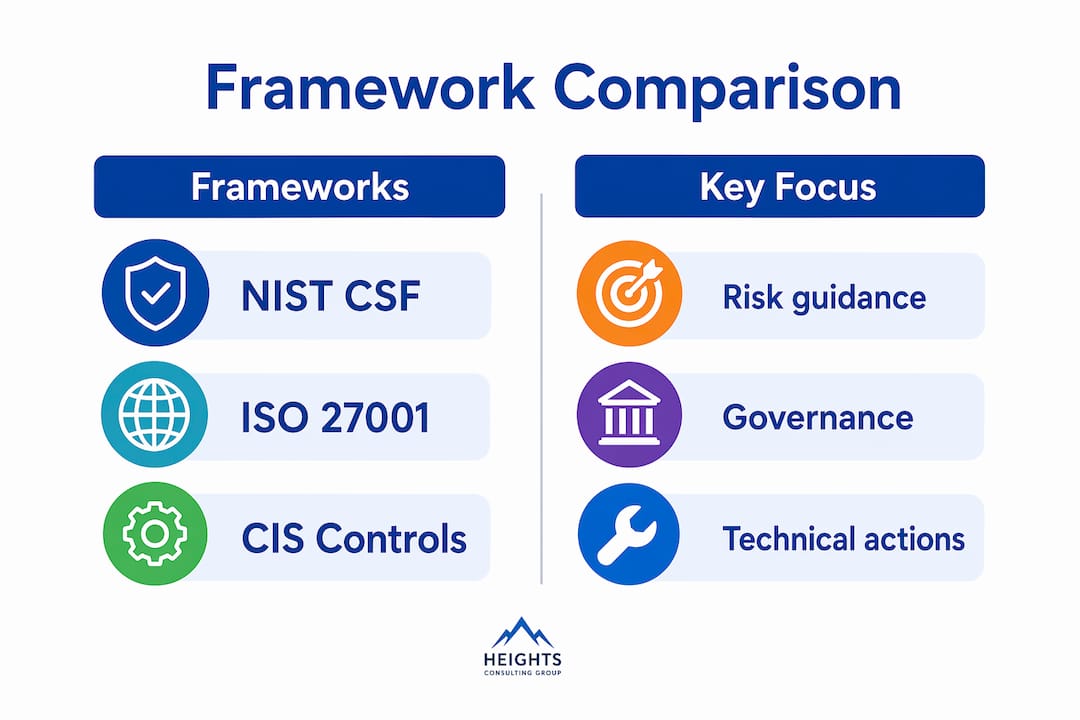
Choosing the wrong framework wastes time and creates a false sense of security. Selecting based on popularity rather than purpose leads to what practitioners call "framework confusion," where organizations invest heavily in a structure that does not match their actual needs or regulatory environment.
| Framework | Primary focus | Best suited for | Key outcome |
|---|---|---|---|
| NIST CSF | Risk-based strategic guidance | U.S. federal contractors, risk-mature organizations | Flexible risk management structure with measurable tiers |
| ISO/IEC 27001 | Formal management system and certification | Organizations needing international assurance or third-party audits | Accredited certification demonstrating security governance |
| CIS Controls | Prioritized technical implementation | Organizations needing prescriptive, actionable security steps | Rapid reduction in attack surface through specific controls |
NIST CSF works best when an organization needs a flexible, risk-based structure it can adapt to its own threat environment. It does not prescribe exact controls but provides a framework of functions, categories, and subcategories that map to business outcomes. You can review a practical NIST compliance checklist to understand what implementation actually requires at the operational level.
ISO/IEC 27001 suits organizations that need to demonstrate security governance to external parties, including international clients, regulators, or enterprise procurement teams. The certification process requires a formal information security management system, which means documented policies, defined roles, and regular audits. That rigor is its strength and its cost.
CIS Controls take a different approach entirely. They provide a prioritized list of specific technical actions, starting with the most critical, that organizations can implement in sequence. For teams that need to reduce risk quickly without building a full governance program first, CIS Controls offer a clear starting point.
Successful organizations combine frameworks pragmatically to capture complementary benefits. A common approach uses NIST CSF for risk management structure, ISO 27001 for certification and external assurance, and CIS Controls for technical implementation guidance. This governance, risk, and compliance approach converts security from a reactive activity into a repeatable business discipline.
Pro Tip: Map your regulatory obligations first. If you operate under CMMC, HIPAA, or SOC 2 requirements, those mandates will narrow your framework choices before you even begin evaluating options.
Why security policies are the constitution of your security program
Security policies act as the strategic north star aligning every security action with business goals. They are not compliance paperwork. They are the document that defines what the organization protects, why it protects it, and who is accountable when something goes wrong.

Without written policies, security behavior becomes inconsistent across teams and locations. One department enforces multi-factor authentication on classified systems while another does not. One team follows an incident response process while another improvises. Those inconsistencies are where breaches find their entry points. Policies eliminate that variance by setting explicit boundaries that apply organization-wide.
Consider the practical impact on three critical areas:
- Access control: A policy that requires MFA for all systems handling regulated data removes ambiguity. Engineers do not debate whether a system qualifies. The policy defines the threshold, and the control follows automatically.
- Incident response: Documented policies help demonstrate regulatory compliance with GDPR, ISO 27001, and SOC 2 during audits. An incident response policy that defines roles, escalation paths, and notification timelines gives teams a script to follow under pressure rather than improvising during a crisis.
- Vendor management: Policies define what security requirements third parties must meet before accessing your systems. Without that standard, vendor risk assessments become subjective and inconsistent.
"Most security failures stem from disconnects between policy, operations, and risk decisions. Frameworks integrate these elements to define ownership, metrics, and expected outcomes clearly."
AI governance is now a fourth critical area where policies are non-negotiable. Organizations deploying AI tools without written policies governing data access, model outputs, and human oversight are creating accountability gaps that regulators and insurers are beginning to scrutinize directly. A policy that defines who approves AI tool deployment and what data those tools can access is no longer optional for organizations in regulated industries.
Cyber insurance premiums increasingly depend on documented security posture, including written policies and incident response plans. Insurers treat the absence of written policies as a material risk factor. Organizations with mature policy programs negotiate from a stronger position during underwriting.
How to implement and sustain a security policy framework
Effective framework implementation requires leadership commitment as its first condition. Without executive sponsorship, policies become aspirational documents that no one enforces. The CISO or vCISO must have the authority and budget to translate framework requirements into operational reality.
Practical implementation follows a clear sequence:
- Start with a gap assessment. Map your current controls against your chosen framework to identify where you have coverage and where you do not. This prevents the common mistake of building policies around what you already do rather than what the framework requires.
- Engage stakeholders across business units. Security policies that legal, HR, and operations teams helped write are policies those teams will actually follow. Policies written in isolation by the security team tend to sit unread in a shared drive.
- Write for usability, not comprehensiveness. A policy that employees can read and understand in five minutes is more effective than a 40-page document that no one opens. Treating security policies as dynamic documents with regular review cycles embeds security culture throughout the organization.
- Automate compliance monitoring. Use governance, risk, and compliance platforms to track policy adherence, flag exceptions, and maintain version control. Manual tracking at scale fails consistently.
- Schedule formal reviews. Policies tied to a framework should be reviewed at least annually and after any significant incident, regulatory change, or major technology adoption, including AI tool deployments.
- Use audit and incident data. Every security incident reveals a policy gap or an enforcement failure. Feed that data back into the policy review cycle rather than treating incidents as isolated events.
Organizations that follow this approach report measurable improvements in compliance posture, reduced incident frequency, and stronger negotiating positions with both insurers and enterprise procurement teams. The five-step compliance framework implementation process used by mature security programs reflects this same sequence. For organizations without an internal security leader, a virtual CISO can own framework implementation and policy governance without the cost of a full-time hire.
Key Takeaways
Security policy frameworks are the foundation that converts cybersecurity from reactive spending into a measurable, governed program aligned with business risk and regulatory requirements.
| Point | Details |
|---|---|
| Frameworks reduce breach risk | Organizations without frameworks rely on reactive tool purchases that leave structural gaps in coverage. |
| Framework selection must match purpose | NIST suits risk-based guidance, ISO 27001 suits certification needs, and CIS Controls suit technical implementation priorities. |
| Policies enforce consistent behavior | Written policies eliminate variance across teams and create the evidence trail required for audits and insurance underwriting. |
| AI governance requires policy coverage | Deploying AI without written policies creates accountability gaps that regulators and insurers are actively scrutinizing. |
| Implementation requires leadership commitment | Executive sponsorship, stakeholder collaboration, and automated monitoring determine whether a framework succeeds or stalls. |
The gap I keep seeing in organizations that think they are covered
After working with organizations across regulated industries, the pattern I see most often is not a lack of security tools. It is a lack of the policy layer that connects those tools to actual risk decisions. Teams have endpoint detection, SIEM platforms, and vulnerability scanners. What they do not have is a written policy that defines who reviews the alerts, what constitutes a reportable incident, or which systems are in scope for which controls.
The frameworks themselves are not the hard part. NIST CSF, ISO 27001, and CIS Controls are well-documented and widely supported. The hard part is getting leadership to treat policy development as a business priority rather than a compliance exercise that gets delegated to a junior analyst and forgotten.
AI has made this gap more dangerous. I have seen organizations deploy AI tools across finance and HR functions with no written policy governing data access, no defined approval process, and no mechanism for detecting misuse. When I ask who owns the risk, the answer is usually silence. That silence is the gap a framework is designed to close.
My honest view is that organizations treating their security policies as static documents are not actually managing risk. They are managing the appearance of risk management. A policy that has not been reviewed since the last major regulatory change is a liability, not an asset. The organizations that get this right treat their policy program the way a legal team treats its contracts: reviewed regularly, enforced consistently, and updated when the environment changes.
— Dan
How Heightscg helps organizations build and sustain security policy frameworks
Heightscg works with organizations that need more than a framework template. The firm's advisory team helps clients select the right framework for their regulatory environment, develop policies that are actually usable, and build the governance structures that keep those policies current. For organizations in highly regulated industries, that includes integrating AI governance requirements into existing policy programs before regulators or insurers force the issue.
If your organization is evaluating its security posture or preparing for an enterprise procurement review, contact Heightscg to discuss a structured approach to framework implementation. For organizations that need technical depth alongside policy governance, the technical cybersecurity consulting practice covers both layers.
FAQ
What is a security policy framework?
A security policy framework is a structured set of standards, policies, and procedures that guides how an organization manages cybersecurity risk and compliance. Common examples include NIST CSF, ISO/IEC 27001, and CIS Controls.
Why do organizations need security policy frameworks?
Framework-aligned programs reduce breach probability, satisfy insurer requirements, and create a shared language for risk communication across technical teams and leadership. Without a framework, security programs default to reactive tool purchases that leave structural gaps.
How does a security policy framework differ from a security policy?
A framework is the overarching structure that defines categories of controls and risk management functions. A security policy is a specific written document within that framework that defines rules, responsibilities, and boundaries for a particular area, such as access control or incident response.
Which security framework should my organization use?
The right framework depends on your regulatory obligations and organizational goals. NIST suits risk-based guidance, ISO 27001 suits certification needs, and CIS Controls suit organizations that need prescriptive technical steps. Many mature programs blend all three.
How often should security policies be reviewed?
Security policies should be reviewed at least annually and after any significant incident, regulatory change, or major technology adoption. Treating policies as dynamic documents with regular review cycles is what separates effective programs from compliance theater.