

Why security documentation matters more than ever
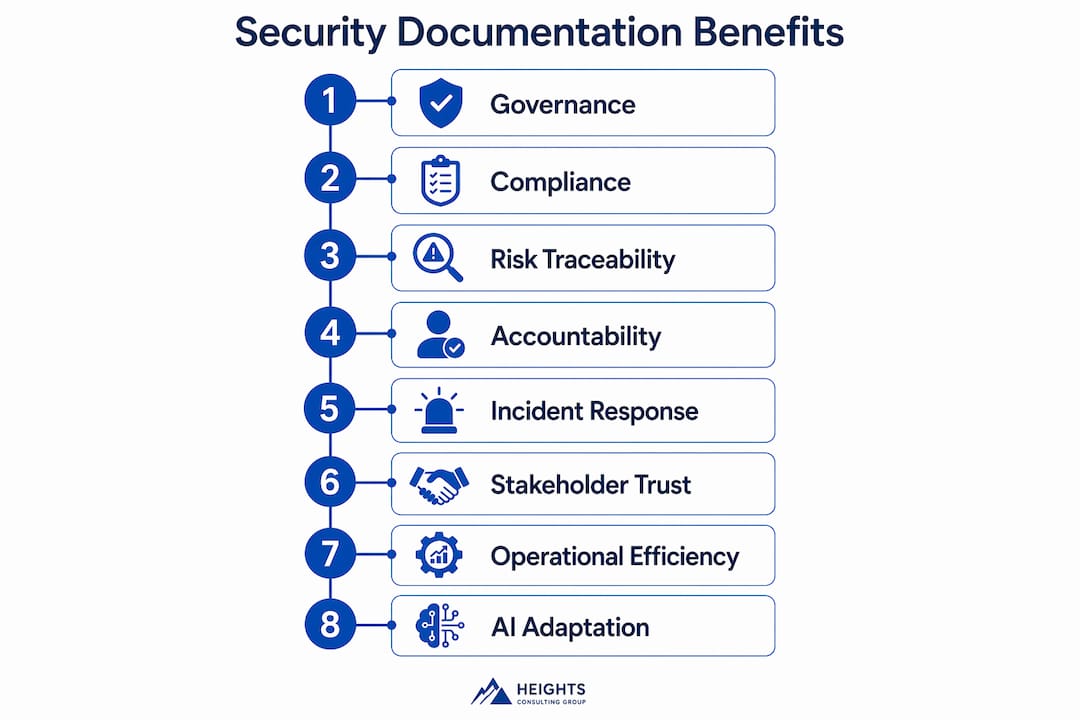
Security documentation is the body of records that proves your organization's controls work, your decisions were defensible, and your risk management practices meet regulatory expectations. It is not an administrative formality. Regulators, auditors, boards, and procurement teams now treat it as primary evidence infrastructure of business conduct, and gaps in that record can block contracts, fail audits, and expose security leaders to personal liability.
The core value of thorough security documentation comes down to five outcomes:
- Compliance and audit readiness: Documented controls give auditors traceable evidence that requirements under frameworks like NIST, CMMC, SOC 2, HIPAA, and PCI DSS are actually met, not just claimed.
- Risk management: Written records of risk decisions, accepted exposures, and compensating controls create the audit trail that separates a defensible posture from an indefensible one.
- Consistency and accountability: Documented policies and approval chains prevent security outcomes from depending on individual memory or tribal knowledge.
- Incident response: Playbooks, timelines, and decision logs support the 72-hour breach disclosure requirements that regulators enforce across multiple jurisdictions.
- Stakeholder trust: Boards, customers, and partners increasingly demand documented evidence of security maturity before extending trust or signing contracts.
With AI systems now embedded in core business operations, the documentation obligation has expanded. Organizations deploying high-risk AI must produce model cards, data cards, and software bills of materials (SBOMs) as part of their security record. The absence of those artifacts is no longer a minor gap. It is a procurement blocker and a regulatory liability.
How security documentation strengthens governance and risk management
Compliance and audit support
Auditors do not take your word for it. They examine records. Whether the assessment is a SOC 2 Type II, a CMMC Level 2 evaluation, or a HIPAA Office for Civil Rights review, the examiner's first request is documentation: policies, access logs, change records, and evidence that controls were operating as described. Organizations that maintain current, well-organized documentation move through audits faster and with fewer findings. Those that scramble to reconstruct records after the fact often discover that undocumented controls are treated as absent controls.
Compliance frameworks like ISO 27001 and NIST CSF are built on the assumption that controls are documented, reviewed, and updated on a defined cycle. Documentation gaps cause blocked procurement deals and failed security questionnaires because the record itself is what regulators and buyers evaluate.
Risk management and decision traceability
Good risk management requires more than identifying threats. It requires recording what decisions were made, who approved them, and what compensating controls were accepted in place of full remediation. CISOs now face personal liability risk and must document executive risk acceptance decisions clearly to survive regulatory scrutiny after breaches. A risk register that captures the approver's identity, the justification, and the residual exposure is not bureaucracy. It is legal protection.
Pro Tip: Link every executive risk acceptance decision to a named approver, a date, and the specific compensating controls in place. That record is what separates a defensible CISO from a liable one when regulators investigate a breach.
Consistency and accountability across teams
Security programs that rely on undocumented expertise are fragile. When a senior analyst leaves or a team restructures, undocumented procedures leave gaps that attackers can exploit and auditors will flag. Documented policies and procedures create repeatable outcomes regardless of personnel changes. They also establish clear accountability: when a policy requires a named owner and a review date, responsibility cannot be diffused across a team.

Incident response and regulatory disclosure
Effective incident response documentation supports the 72-hour disclosure requirements by capturing incident scope, containment, and decision logic in real time. Teams that document as they respond, rather than reconstructing events afterward, produce records that satisfy regulators and hold up under legal scrutiny. The difference between a well-documented incident and a poorly documented one often determines whether a regulator treats the organization as a victim or a negligent actor.
Stakeholder trust and commercial value
Boards want evidence that risk is managed, not just managed. Customers in regulated industries routinely send security questionnaires that require documented policies, procedures, and control evidence before signing contracts. Partners conducting due diligence expect to see a mature documentation posture. Organizations that can produce current, well-structured security records close deals faster and face fewer objections during procurement reviews.
Operational efficiency and error reduction
Clear documentation reduces errors by giving teams a single authoritative reference for how tasks are performed. New staff onboard faster when procedures are written down. Incident response accelerates when playbooks exist. Duplicate work decreases when standards are centralized. The efficiency gains are not theoretical. They compound across every team that touches security operations, from the SOC analyst following a triage procedure to the compliance officer preparing for an annual audit.
Adaptation to evolving threats and AI-specific risks
Threat landscapes shift. Technologies change. Documentation that was accurate two years ago may no longer reflect current controls or current risks. A living documentation program treats records as artifacts that must be updated when systems change, when new threats emerge, or when regulations are revised. For organizations deploying AI, this obligation is acute. AI systems introduce novel risks including data poisoning and indirect prompt injection that require their own documented controls, and those records must be maintained continuously, not created once at deployment.

What types of security documentation your program needs
A mature security documentation program covers several distinct categories, each serving a different function in governance, operations, and compliance.
-
Policies set the high-level principles and management directives that govern security behavior across the organization. An acceptable use policy, an information security policy, and a data classification policy are examples. Policies define what is required; they do not specify how to do it.
-
Standards translate policy requirements into specific, mandatory controls and configurations. A password standard that requires a minimum of 16 characters and MFA for privileged accounts is a standard. Standards give technical teams clear, measurable targets and give auditors concrete criteria to evaluate.
-
Procedures provide the step-by-step operational instructions for carrying out security tasks. A vulnerability patching procedure, a user access provisioning workflow, or a backup verification checklist are all procedures. They are the documents that reduce errors and enable consistent execution across shifts and personnel changes.
-
System documentation captures the technical architecture, data flows, network diagrams, and configuration baselines for systems that process or store sensitive data. This category is frequently underinvested. When an incident occurs, the absence of accurate system documentation slows containment and complicates forensic investigation.
-
Risk and assessment documentation includes risk registers, business impact assessments, vulnerability assessment reports, and penetration test findings. These records show that the organization actively identifies and evaluates threats, and that risk decisions are made deliberately rather than by default. Identity governance documentation falls squarely in this category, given that credential compromise remains the leading breach path.
-
Incident response documentation covers playbooks, runbooks, communication templates, and post-incident reports. A documented incident response plan aligned with the 72-hour regulatory disclosure window must capture detection, containment, scope, and decision timelines in real time. Organizations with mature incident response programs treat these records as living artifacts, updated after every significant event.
-
Employee training and awareness materials are often overlooked as a documentation category, but they serve a dual function. They deliver security knowledge to staff and they demonstrate to auditors that the organization has a formal awareness program. Training completion records, curriculum outlines, and phishing simulation results all belong in the documentation program.
-
AI-specific documentation has become a required category for any organization developing or deploying AI systems. Model cards, data cards, and SBOMs capture training data sources, intended scope, limitations, guardrails, and potential failure modes. These documents mitigate AI-specific risks like data poisoning and indirect prompt injection. Without them, organizations cannot demonstrate responsible AI deployment to regulators, auditors, or procurement teams.
-
Vendor and supply chain documentation records the security posture of third parties with access to your systems or data. Vendor risk assessments, contract security requirements, and third-party audit reports belong here. Supply chain attacks have made this category a priority for regulators and insurers alike.
Security documentation best practices that actually hold up under scrutiny
Treat documentation as a governance process, not a project
The most common failure mode is treating documentation as a one-time effort. Organizations produce a policy set for a compliance audit, file it, and never revisit it. Two years later, the policies describe controls that no longer exist and miss controls that were added. Effective documentation is integrated into governance workflows: policies have review dates, owners, and approval chains. Changes to systems trigger updates to system documentation. Incidents generate post-incident reports that feed back into procedures.
- Assign a named owner to every document with a defined review cycle.
- Use version control so that the history of changes is traceable.
- Tie documentation updates to change management processes so that system changes automatically trigger documentation reviews.
- Establish a documentation inventory so that gaps are visible rather than assumed to be filled.
Balance transparency with security
Not all documentation should be equally accessible. Detailed network architecture diagrams and vulnerability assessment reports contain information that could assist an attacker if exposed. Organizations must balance operational transparency to maintain legal defensibility and security posture simultaneously. The practical approach is tiered access: high-level policies are broadly available, while technical procedures and assessment reports are restricted to those with a need to know.
Build AI documentation into the development lifecycle
AI documentation must be created as a by-product of the system build process, versioned and linked to AI lifecycle evidence, to avoid compliance failures under regulations like the EU AI Act. Retrofitting documentation after deployment is both harder and less credible to auditors. The documentation should link design decisions to deployed behavior, capturing what the model was trained on, what guardrails were applied, and what failure modes were identified during testing.
Pro Tip: Treat AI documentation artifacts like model cards and SBOMs as version-controlled engineering outputs, not compliance afterthoughts. Auditors under the EU AI Act and NIST AI RMF will look for evidence that documentation evolved with the system, not that it was written to describe a finished product.
Use automation to reduce documentation overhead
Manual documentation processes are slow and error-prone. Governance, risk, and compliance (GRC) platforms can automate evidence collection, map controls to multiple frameworks simultaneously, and flag documentation that is approaching its review date. The efficiency gain is real: a single evidence base can satisfy multiple regulatory frameworks including the EU AI Act, ISO 42001, and the NIST AI Risk Management Framework at once, rather than producing separate documentation sets for each.
Document incident response in real time
Post-incident reconstruction is unreliable. Memory degrades, timelines compress, and the pressure to minimize apparent response delays distorts records. Teams that document detection, containment decisions, and communication actions as they happen produce records that satisfy regulators and hold up under legal review. This discipline is particularly important for meeting the 72-hour disclosure window that applies under GDPR, HIPAA breach notification rules, and several state-level laws.
How AI governance is reshaping security documentation requirements
AI has changed what security documentation must cover, how it must be structured, and what it must prove. The shift is not incremental. Regulations enacted in 2025 and 2026 have made documentation a prerequisite for deploying high-risk AI systems, not a post-deployment obligation.
Regulatory mandates driving AI documentation
The EU AI Act requires technical documentation for high-risk AI systems before market deployment, covering nine specific sections in Annex IV. That documentation must be continuously maintained and is central to regulatory audits and transparency reviews. In the United States, OMB M-26-04 establishes federal agency requirements for AI governance documentation. Colorado SB 24-205 imposes documentation obligations on developers and deployers of high-risk AI systems affecting consequential decisions. California's SB 53 requires disclosure of critical safety incidents within defined timeframes.
Beyond direct regulation, AI compliance documentation is increasingly demanded through procurement clauses, extending regulatory reach to vendors who are not directly regulated. Federal and state contracts now routinely require system cards, model evaluation artifacts, and governance policies as contract deliverables.
What AI documentation must include
For security professionals and compliance officers, the AI documentation obligation covers a specific set of artifacts:
- Model cards: Describe the model's intended use, training data sources, performance characteristics, known limitations, and failure modes.
- Data cards: Document dataset provenance, labeling methodology, known biases, and data governance controls.
- SBOMs (Software Bills of Materials): Enumerate the software components, libraries, and dependencies in the AI system, enabling vulnerability tracking across the supply chain.
- System cards: Provide a higher-level description of the deployed system, including how the model is integrated, what safeguards are in place, and how the system behaves in edge cases.
- Impact assessments: Evaluate the potential consequences of system errors or misuse on affected individuals and organizations.
- Evaluation artifacts: Record the testing methodology, datasets used, and results from pre-deployment evaluations, including adversarial testing.
Documentation as personal liability protection
Security documentation has become a determinant of personal accountability for security leaders. CISOs who document executive risk acceptance decisions, including who approved a risk, what compensating controls were in place, and why full remediation was deferred, have a defensible record when regulators investigate a breach. Those who cannot produce that record face the inference that decisions were made carelessly or without proper authority.
The practical implication is that documentation governance is now a career-level concern for security executives, not just a compliance function. Organizations that treat documentation as a low-priority administrative task are exposing their security leaders to liability that proper governance would have prevented.
Integrating AI documentation with broader security governance
AI documentation does not exist in isolation. It connects to the same governance infrastructure that supports traditional security documentation: version control, ownership assignment, review cycles, and audit trails. The AI security strategy that treats AI documentation as a separate workstream from the broader security program will produce fragmented records that satisfy neither AI-specific regulators nor general security auditors. The more defensible approach integrates AI artifacts into the existing documentation framework, applying the same controls, the same access restrictions, and the same review discipline that govern all security records.
Organizations that get this right gain a compounding advantage: a single, well-maintained evidence base that satisfies multiple regulatory frameworks simultaneously, reduces audit preparation time, and gives boards and procurement teams the documented assurance they increasingly require.
Working with Heightscg to build a defensible documentation program
Security documentation gaps do not stay invisible. They surface during audits, procurement reviews, breach investigations, and regulatory examinations, often at the worst possible moment. Heightscg works with security leaders and compliance officers to build documentation programs that are current, defensible, and integrated into governance workflows rather than assembled under pressure.
From compliance framework implementation to AI governance documentation and incident response planning, Heightscg's advisory approach connects documentation to the decisions that matter most to your organization's risk posture and regulatory standing. If your documentation program has gaps, the time to address them is before the next audit, not during it.
Contact Heightscg to assess your current documentation posture and build a program that holds up under scrutiny.
Key Takeaways
Security documentation is the primary evidence infrastructure that determines whether an organization's security controls are defensible to regulators, auditors, boards, and procurement teams in 2026.
| Point | Details |
|---|---|
| Documentation is legal evidence | Regulators treat security records as evidence of business conduct; gaps can block procurement and expose CISOs to personal liability. |
| AI systems require specific artifacts | Model cards, data cards, SBOMs, and impact assessments are now required documentation for high-risk AI deployments under the EU AI Act and U.S. regulations. |
| Incident response depends on real-time records | Capturing detection, containment, and decision timelines as they happen supports the 72-hour disclosure window regulators enforce. |
| One evidence base, multiple frameworks | A well-structured documentation program can satisfy the EU AI Act, ISO 42001, and the NIST AI RMF simultaneously, reducing duplication. |
| Executive risk decisions must be documented | Named approver, justification, and compensating controls must appear in writing to create an audit-defensible record for security leaders. |