

Security policies are formal documents that define how an organization protects its information assets, governs access, and responds when things go wrong. They are not compliance checkboxes. They are the operational backbone of a defensible security program, and organizations that treat them as such consistently outperform those that do not when a breach or audit arrives.
The core reasons to adopt security policies come down to five realities:
- Risk reduction: Policies establish standards and boundaries that limit exposure before an incident occurs, giving security teams a defined baseline to enforce and measure against.
- Regulatory compliance: Frameworks like NIST, HIPAA, and PCI DSS require documented policies as evidence of control; without them, organizations face fines and failed audits regardless of their technical controls.
- Incident response clarity: Well-crafted policies detail corrective actions, assign response roles, and specify notification steps that limit damage when a security event occurs.
- Cultural alignment: Policies endorsed by executive leadership signal that security is an organizational priority, not an IT department concern, which drives consistent employee behavior across every function.
- AI governance readiness: As organizations deploy AI tools, policies must evolve to address new attack vectors, data governance gaps, and accountability questions that traditional security documents do not cover.
Without security policies, organizations lack the direction and standards needed to manage cyber threats and compliance obligations. The consequences range from data breaches and regulatory fines to reputational damage that takes years to recover from.
Table of Contents
- What makes an effective security policy work
- How security procedures turn policy into practice
- Keeping security policies current and enforceable
- Who owns security policy governance inside your organization
- Why AI governance must be built into your security policies now
- Key Takeaways
What makes an effective security policy work
A security policy is only as useful as its clarity and coverage. Vague, overly technical, or incomplete policies create ambiguity that employees exploit unintentionally and auditors penalize deliberately. Effective security policies include scope, user roles, acceptable use, access control, incident response procedures, data classification requirements, and compliance obligations aligned with regulations like NIST, HIPAA, and PCI DSS.
The structural elements that distinguish a policy that holds up under scrutiny from one that does not:
- Scope and objectives: Define which systems, data, users, and locations the policy covers. Ambiguity here creates gaps that attackers and auditors both find.
- Roles and responsibilities: Assign ownership explicitly. Every control needs an accountable party, not a department.
- Access control standards: Specify who can access what, under what conditions, and how access is revoked when roles change.
- Acceptable use provisions: Clarify permitted and prohibited behaviors for employees, contractors, and third parties interacting with organizational systems.
- Data classification and handling: Establish tiers (e.g., confidential, internal, public) and define how each tier must be stored, transmitted, and disposed of.
- Incident response integration: Reference the organization's incident response plan and define the policy-level obligations that trigger it.
- Version control and review dates: A policy without a version number and scheduled review date is already becoming obsolete.
Alignment with business goals and risk tolerance matters as much as technical completeness. A policy that security teams cannot operationalize, or that leadership will not enforce, provides no real protection. The NIST SP 800-12 framework offers a practical reference for structuring policies that balance technical rigor with organizational usability.

How security procedures turn policy into practice
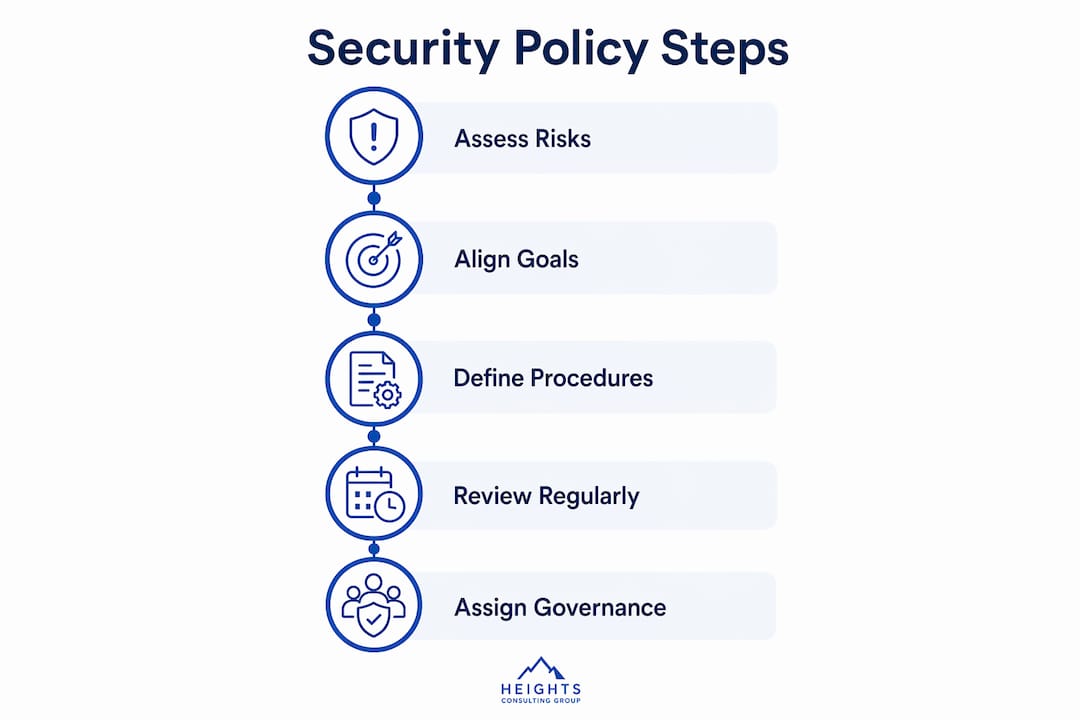
Policies state what must happen. Procedures define how. That distinction is critical, and many organizations blur it to their detriment, particularly during compliance assessments. Auditors require a clear chain from policy to procedure to evidence; organizations that have strong technical controls but lack documented procedures routinely fail compliance reviews because they cannot demonstrate that controls operate as intended.
Procedures that operationalize security policies typically cover:
- User authentication protocols: Step-by-step requirements for multi-factor authentication enrollment, password complexity, and session management.
- Network access controls: Procedures for granting, modifying, and revoking network access, including remote access and third-party connections.
- Data encryption standards: Specific algorithms, key management processes, and conditions under which encryption is required in transit and at rest.
- Patch management routines: Defined timelines for applying critical patches, testing procedures, and escalation paths when patching is delayed.
- Incident reporting steps: Who reports what, to whom, within what timeframe, and what documentation is required at each stage.
- Audit trails and monitoring: Requirements for log retention, review frequency, and the evidence format auditors will accept.
- Employee training and enforcement: How training is delivered, tracked, and what happens when employees violate policy.
AI adoption adds a new layer of procedural complexity. When employees use AI tools, whether sanctioned or not, procedures must address data input restrictions, output validation, and escalation paths for anomalous model behavior. Organizations that have not updated their procedures to reflect AI usage are operating with a governance gap that grows more consequential as AI becomes embedded in daily workflows.
Keeping security policies current and enforceable
A policy written in 2022 and never revisited is not a security policy. It is a liability. Security policies are living documents that require scheduled reviews to remain effective against evolving threats and to reflect changes in business processes, technology, and regulation.
What an effective policy maintenance program looks like in practice:
- Scheduled review cycles: Annual reviews at minimum, with triggered reviews when a significant incident occurs, a new regulation takes effect, or a major technology change is introduced.
- Version control discipline: Every revision carries a version number, effective date, and summary of changes. This is not administrative overhead; it is the evidence auditors look for.
- Threat landscape integration: Reviews should incorporate current threat intelligence, including emerging attack patterns relevant to the organization's sector.
- Regulatory change tracking: HIPAA, CMMC, SOC 2, and PCI DSS all evolve. Policy owners must monitor regulatory updates and translate them into policy revisions before the next audit cycle.
- AI-specific governance updates: As AI models are deployed or updated, policies must address new data handling requirements, model risk, and accountability structures that did not exist when the original policy was written.
- Stakeholder communication: Policy updates are meaningless if employees and contractors do not know they occurred. A defined communication and acknowledgment process closes that gap.
- Leadership involvement: Executive sponsors must review and endorse updated policies. A policy that lacks leadership sign-off carries no organizational authority.
The organizations that handle this well treat policy review as a standing agenda item in their security governance calendar, not a reactive task triggered by a breach or a failed audit.

Who owns security policy governance inside your organization
Accountability gaps are where security programs fail. When no one owns a policy, no one enforces it, no one updates it, and no one answers for it when something goes wrong. Security policies are usually endorsed by upper management, which is what gives them organizational authority and drives cooperation across teams. But endorsement is not the same as ownership.
A functional governance structure distributes responsibility across defined roles:
- Executive leadership and the CISO: Set the security vision, approve policies, and provide the organizational authority that makes enforcement credible. Without this sponsorship, policies are suggestions.
- Security and IT teams: Draft, maintain, and operationalize policies. They translate business risk decisions into technical controls and documented procedures.
- Compliance and audit functions: Verify that policies meet regulatory requirements, assess adherence, and identify gaps before external auditors do.
- Department managers: Enforce policy within their teams, communicate updates, and escalate violations through defined channels.
- All employees and contractors: Acknowledge policies, complete required training, and report suspected violations. Accountability at this level is what makes a policy real rather than theoretical.
- AI governance roles: As AI systems become operational assets, organizations need designated owners for AI risk, whether a dedicated AI risk officer or an expanded CISO mandate. These roles are responsible for ensuring AI-related policies are current, enforced, and aligned with broader security governance.
The compliance framework implementation process works best when governance roles are defined before policies are written, not after. Retrofitting accountability onto an existing policy structure is significantly harder and produces weaker results.
Why AI governance must be built into your security policies now
AI introduces risks that traditional security policies were not designed to address. Data poisoning, model drift, and adversarial attacks like prompt injection do not fit neatly into existing access control or acceptable use frameworks. Organizations that assume their current policies cover AI are taking on unquantified risk.
The governance gaps that appear most often when AI is deployed without policy coverage:
- No defined risk ownership: AI systems operate without a named accountable party, which means no one is responsible when a model produces harmful outputs or leaks sensitive data.
- Missing data handling controls: Employees input confidential information into AI tools without restrictions, because no policy prohibits it.
- No monitoring or testing requirements: Models are deployed and left to run without validation cycles, creating exposure to model drift and degraded outputs over time.
- Absent incident response provisions: When an AI system is compromised or produces a security-relevant failure, there is no defined response path because the incident response plan does not account for AI-specific events.
- Regulatory misalignment: Aligning AI-specific policies with existing cybersecurity frameworks like the NIST Cybersecurity Framework is what ensures comprehensive risk management and regulatory compliance as AI regulations mature.
Leadership must define clear risk ownership and accountability in AI governance to shift AI systems from unmanaged experimental tools to governed business assets. That shift requires policy language, not just technical controls. The NIST AI RMF's GOVERN function provides a practical structure for embedding AI accountability into existing security policy frameworks, covering culture, responsibilities, and risk management across organizational roles.
Pro Tip: When updating security policies for AI, map each AI system in use to a policy owner, a data classification tier, and a monitoring requirement before drafting new policy language. Starting with the asset inventory prevents the common failure of writing AI policies that do not match what the organization actually deploys.
Organizations that want to understand how AI governance connects to broader compliance and emerging technology risks will find that the policy layer is consistently where governance programs succeed or break down. Technical controls without policy backing are unverifiable. Policy without AI-specific provisions is incomplete. The two must be built together.
Key Takeaways
Security policies are the foundational governance layer that connects technical controls, regulatory compliance, and organizational accountability into a defensible and auditable security program.
| Point | Details |
|---|---|
| Policies reduce risk and clarify response | Documented policies assign incident response roles and corrective actions that limit damage when a security event occurs. |
| Effective policies require defined components | Scope, roles, access control, data classification, and version control are all required for a policy to hold up under audit. |
| Procedures bridge policy and evidence | Auditors require a documented chain from policy to procedure to operational evidence; missing any link causes compliance failures. |
| Policies must be reviewed and updated regularly | Scheduled reviews, version control, and regulatory change tracking keep policies enforceable against evolving threats. |
| AI governance requires explicit policy coverage | AI risk ownership, data handling restrictions, and monitoring requirements must be written into policy before AI systems are deployed. |