

Digital risk protection (DRP) is the cybersecurity practice of continuously monitoring and mitigating threats to an organization's digital assets outside its traditional perimeter. Where firewalls and endpoint agents watch internal infrastructure, DRP watches everything else: the dark web marketplaces where employee credentials sell for a few dollars, the lookalike domains registered overnight using your company's logo, the fake executive profiles crafting messages to your finance team. None of those threats touch your SIEM. All of them can cause serious damage before your internal tools ever see a signal.
A mature DRP program operates across three core functions:
- Map: Catalog your full digital footprint, including domains, brands, executive identities, and online assets across the open, deep, and dark web.
- Monitor: Continuously watch external sources, including criminal forums, paste sites, social media, and data leak repositories, for risks tied to those specific assets.
- Mitigate: Neutralize detected threats through automated takedown workflows, credential resets, and coordinated incident response.
The deliverable from DRP is not a threat intelligence report. It is an actionable alert tied to an asset: "47 of your employee accounts are compromised and for sale on the dark web." That specificity is what separates DRP from broader threat intelligence disciplines and makes it operationally useful even for teams without deep analyst capacity.
Table of Contents
- What is digital risk protection, and why does it matter now?
- Key benefits organizations realize from digital risk protection
- Who benefits most from a DRP program?
- Core components of an effective DRP program
- Common use cases where DRP adds real operational value
- Operational requirements for running a mature DRP program
- How AI adoption is reshaping digital risk exposure
- Challenges and limitations of digital risk protection
- Heightscg brings structure to your external digital risk program
- Key Takeaways
What is digital risk protection, and why does it matter now?
Traditional security tools defend assets you control. DRP defends assets and exposures you do not control, and that distinction has become critical as attackers increasingly operate entirely outside the perimeter.
Your firewall has no visibility into a phishing domain registered three hours ago using your brand. Your SIEM cannot detect employee credentials circulating on a Telegram channel. Your endpoint detection and response (EDR) agent will never see a fake LinkedIn profile impersonating your CFO. These threats are external by design, and they represent the pre-attack phase where disruption is cheapest and most effective.
The consequences of ignoring external digital exposure compound quickly:
- Compromised credentials enable account takeover before any internal alert fires.
- Brand impersonation erodes customer trust and generates fraud losses that land on your balance sheet.
- Phishing infrastructure built on lookalike domains converts employees and customers into entry points.
- Dark web discussions naming your organization as a target give attackers a coordination advantage your team never sees.
Resource-constrained security teams gain particular value here. Because DRP alerts are asset-specific and require no deep analyst interpretation, a lean team can act immediately without manual correlation.
Key benefits organizations realize from digital risk protection
DRP's primary value is converting invisible external exposure into a list of things you can fix today. The benefits are concrete and operational, not theoretical.
- Immediate credential response: When compromised accounts surface on criminal forums, DRP delivers the specific list. Security teams reset credentials before attackers use them.
- Brand protection at scale: Monitoring for impersonation, fraudulent apps, and phishing domains enables takedown requests before customers are defrauded.
- External attack surface visibility: Organizations deploying DRP for the first time routinely discover brand impersonation, lookalike domains, and fake executive profiles they had no prior knowledge of.
- Reduced analyst burden: Actionable, asset-specific alerts eliminate the need for manual correlation across raw threat feeds.
- Compliance support: Early detection of data leaks tied to regulated data categories gives compliance teams time to respond before breach notification deadlines trigger.
The FBI's 2024 Internet Crime Report documented billions in losses from phishing, business email compromise, and fraud schemes that DRP programs are specifically designed to detect and disrupt. Organizations with external monitoring in place can intercept these attack chains at the staging phase rather than the execution phase.
Who benefits most from a DRP program?
DRP delivers value across multiple organizational roles, though the nature of that value differs by function.
- CISOs and security leadership: Gain outside-in visibility into how the organization appears as a target, enabling more accurate risk posture assessments.
- Security operations teams: Receive direct, actionable alerts that feed remediation workflows without requiring additional intelligence analysis.
- Risk and compliance officers: Use DRP findings to support breach notification decisions, vendor risk assessments, and regulatory reporting.
- Marketing and communications teams: Benefit from brand monitoring that catches impersonation campaigns before they reach customers.
- Executive leadership: Understand external risk exposure in business terms, connecting digital threats to revenue, reputation, and regulatory standing.
Industries with high digital exposure and strict regulatory environments, including financial services, healthcare, and critical infrastructure, face the most acute need. For organizations in these sectors, data security and compliance requirements make early external threat detection a regulatory necessity, not just a security preference. Smaller organizations with limited analyst headcount often find DRP delivers the highest return of any security investment precisely because it requires no interpretation layer to act on.
Core components of an effective DRP program
A DRP program is built on three functional layers, each requiring specific technologies and data sources.
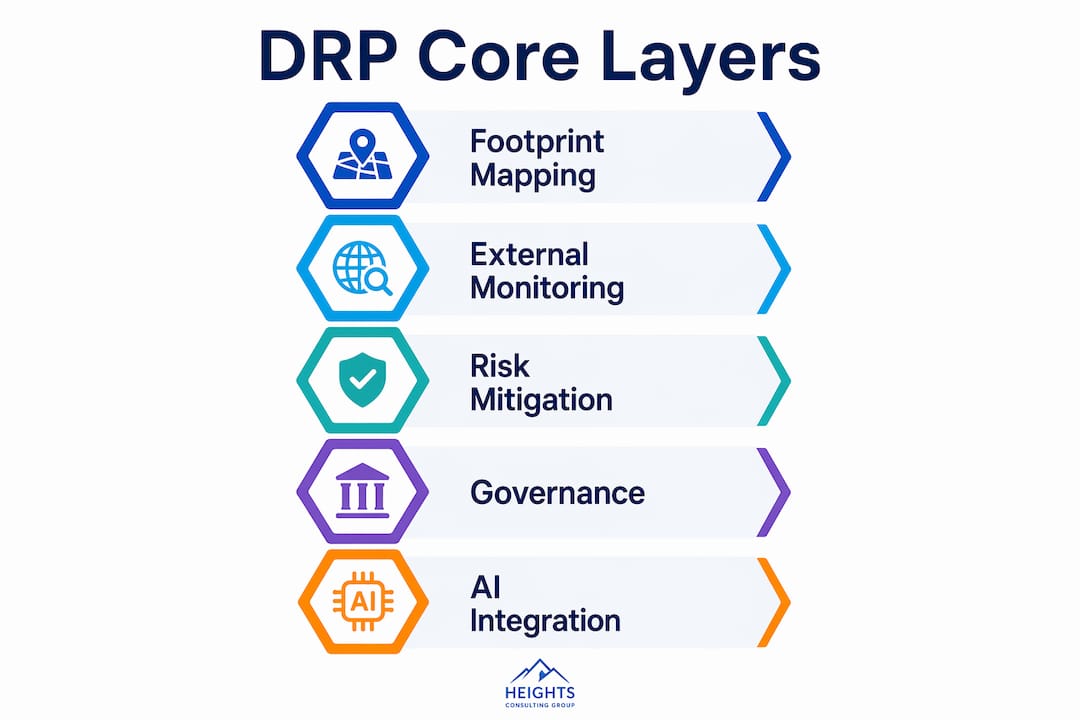
Digital footprint mapping is the foundation. Before you can monitor for threats, you need a complete inventory of what you are protecting: domains, subdomains, brand names, executive identities, social media handles, third-party integrations, and any digital asset that could be impersonated or abused. Most organizations discover gaps in this inventory during their first DRP deployment.

Continuous external monitoring covers the sources where threats originate. These include dark web forums and marketplaces, paste sites, social media platforms, fraudulent website registries, data leak repositories, and criminal Telegram channels. The monitoring scope must extend beyond owned infrastructure to include external threats surrounding the organization, such as phishing domains and impersonation accounts on platforms the organization does not control.
Automated risk detection and mitigation is where AI and machine learning deliver measurable operational value. Machine learning models reduce false positives by distinguishing genuine threats from noise across high-volume external data sources. Automated workflows then route confirmed threats to the appropriate response action, whether that is a domain takedown request, a credential reset, or an escalation to legal counsel.
Pro Tip: DRP, external attack surface management (EASM), and cyber threat intelligence (CTI) are distinct disciplines. DRP monitors active abuse of your assets. EASM finds exposed assets you own. CTI studies adversary tactics. Running all three without clear separation creates blind spots; treat each as a separate function with defined ownership.
Common use cases where DRP adds real operational value
The practical applications of DRP map directly to the attack patterns most likely to affect your organization.
- Compromised credential monitoring: Detecting employee or customer credentials circulating on dark web forums or infostealer logs, enabling immediate account remediation before attackers use them.
- Brand impersonation and phishing detection: Identifying lookalike domains, fraudulent mobile apps, and phishing pages built on your brand before they reach customers.
- Social media threat management: Monitoring for fake executive profiles, misinformation campaigns, and unauthorized brand accounts across LinkedIn, X, and other platforms.
- Supply chain and third-party exposure: Detecting when a vendor or partner's compromise creates downstream exposure for your organization through shared credentials or data.
- Regulatory breach support: Surfacing data leaks involving personally identifiable information (PII) or protected health information (PHI) early enough to meet breach notification timelines under regulations like HIPAA and state privacy laws.
Each of these use cases shares a common characteristic: the threat originates entirely outside the organization's infrastructure, making it invisible to internal security tools until the attack is already underway. Building resilient cybersecurity strategies requires closing that external visibility gap as a deliberate program priority.
Operational requirements for running a mature DRP program
DRP intelligence without the organizational infrastructure to act on it is an expensive report that sits in a queue. The operational requirements for a mature program are as important as the technology itself.
- Assigned ownership across functions: DRP alerts touch IT, security, legal, marketing, and communications. Each function needs a defined role and response authority before an incident occurs.
- Integration with incident response workflows: Alerts must feed directly into incident response playbooks with predefined escalation paths, not land in a generic inbox.
- Continuous asset inventory updates: Digital footprints change constantly through acquisitions, new product launches, and personnel changes. The asset inventory driving DRP monitoring must be updated on the same cadence.
- Automated takedown capabilities: Without machine-speed disruption workflows connected to legal and hosting providers, DRP intelligence rarely translates into actual threat removal.
- Cross-functional incident playbooks: Scenarios including executive impersonation, AI-generated deepfakes, and phishing campaigns require pre-approved response procedures that do not require real-time legal review to execute.
The cyber risk management discipline that underpins DRP is fundamentally a governance challenge, not just a technology one. Organizations that treat DRP as a tool purchase without addressing ownership and workflow integration consistently underperform on response times.
How AI adoption is reshaping digital risk exposure
AI has introduced a new category of external digital risk that most DRP programs were not designed to address. The problem is structural.

According to the Cloud Security Alliance, A significant portion of organizations do not know whether they experienced an AI-related breach in the past year. That figure reflects an institutional failure: AI tools are being deployed by employees and business units outside IT oversight, creating "shadow AI" exposures that generate untracked data leaks, credential exposure, and intellectual property loss. Traditional DRP platforms were built to monitor corporate assets. They were not built to detect sensitive data leaking through an unauthorized AI tool an employee installed last Tuesday.
The specific AI-related risks that DRP programs must now address include:
- Shadow AI data leaks: Employees entering proprietary data into unsanctioned AI platforms, creating external exposure with no audit trail.
- AI-generated deepfakes: Synthetic audio and video impersonating executives, used to authorize fraudulent transactions or manipulate employees.
- Unauthorized AI platform usage: Third-party AI tools connecting to enterprise systems through employee credentials, creating access paths outside any governance framework.
Closing these gaps requires more than technology. Formalizing AI security ownership through a designated AI Security Lead and an AI Governance Review Board gives the DRP program a defined escalation path when AI-related threats surface. Without that structure, even a well-configured DRP platform cannot trigger a response because no one owns the decision.
Pro Tip: Build an AI asset registry that captures every AI tool deployed in your organization, the data it accesses, and the team responsible for it. This registry becomes the asset inventory that extends your DRP monitoring scope to cover AI-generated exposure, not just traditional digital assets.
Challenges and limitations of digital risk protection
DRP is a powerful discipline, but it operates within real constraints that security leaders should understand before building program expectations.
False positive volume is the most common operational friction. External monitoring across the dark web, social media, and open web generates high signal volume, and not every alert represents a genuine threat to your organization. Without well-tuned detection logic and clear triage criteria, analyst teams spend significant time on noise rather than confirmed risks.
Coverage gaps in emerging channels: DRP platforms built around traditional dark web forums and paste sites may lack coverage of newer criminal communication channels, encrypted messaging platforms, and AI-generated content distribution networks. The threat surface evolves faster than most platform vendors update their data sources.
Takedown limitations: DRP can identify a fraudulent domain or impersonation account, but the actual removal depends on the responsiveness of hosting providers, domain registrars, and platform trust and safety teams. Takedown timelines vary widely, and some jurisdictions offer minimal cooperation.
Scope creep without governance: As DRP expands to cover AI-related risks, supply chain exposure, and third-party digital presence, the program scope can grow faster than the organizational capacity to respond. Without clear prioritization criteria, teams risk monitoring everything and acting on nothing.
Integration complexity: DRP delivers its highest value when it feeds directly into SIEM, SOAR, and incident response platforms. Achieving that integration requires technical configuration and ongoing maintenance that many organizations underestimate at the outset.
Heightscg brings structure to your external digital risk program

Understanding external digital risk is one challenge. Building the governance, workflows, and monitoring infrastructure to act on it consistently is another. Heightscg works with security leaders and executive teams to design and implement DRP programs that connect external threat monitoring to operational response, not just reporting.
For organizations navigating AI governance gaps, supply chain exposure, or regulatory pressure from frameworks like NIST, CMMC, and SOC 2, Heightscg provides the cross-functional structure that turns DRP intelligence into measurable risk reduction. The work spans digital footprint mapping, incident response integration, and the ownership frameworks that make automated disruption workflows actually function under pressure.
Security leaders who want a clear picture of their external digital exposure and a defined path to closing it can start with a consultation with the Heightscg team.
Key Takeaways
Digital risk protection delivers its full value only when external monitoring, defined ownership, and automated disruption workflows operate together as a coordinated program.
| Point | Details |
|---|---|
| DRP monitors external threats | DRP watches dark web, social media, and open web sources that internal tools like firewalls and SIEM cannot reach. |
| Actionable alerts drive response | DRP delivers asset-specific alerts, such as compromised credential lists, that teams can act on without deep analyst interpretation. |
| AI expands the exposure surface | Shadow AI tools and deepfakes create external risks that traditional DRP platforms were not designed to detect without governance extensions. |
| Ownership determines effectiveness | Without assigned roles across IT, legal, and security, DRP intelligence rarely converts into actual threat removal at the speed required. |
| Heightscg structures DRP programs | Heightscg helps organizations connect external threat monitoring to incident response workflows and AI governance frameworks for measurable risk reduction. |