

TL;DR:
- Security architecture integrates security controls into systems to meet regulatory demands and protect digital assets. Continuous, automated evidence collection and AI-enhanced monitoring enable organizations to reduce breach risks and streamline compliance efforts. Proper data classification and a shift to continuous assurance are essential for effective, scalable security compliance architecture.
Security architecture is defined as the strategic design and integration of security controls within an organization's infrastructure to meet regulatory requirements and protect digital assets. The role of security architecture in compliance has grown from a technical concern into a board-level priority, driven by frameworks like NIST 800-53, PCI DSS, HIPAA, and CMMC, each demanding that controls be built into systems rather than added after the fact. Regulatory pressure intensified sharply through 2025 and continues into 2026, with AI adoption creating new governance gaps that existing compliance programs were never designed to address. Organizations that treat security architecture as the foundation of their compliance program consistently outperform those that treat compliance as a periodic audit exercise.
How security architecture reduces compliance risks through integrated design
Organizations using integrated and automated GRC tools within their security architecture experience 19 percentage points lower data breach rates compared to reactive risk management approaches. That gap, 41% breach rate with integrated architecture versus 60% with reactive programs, represents a measurable, quantifiable argument for building compliance into the design layer from day one.
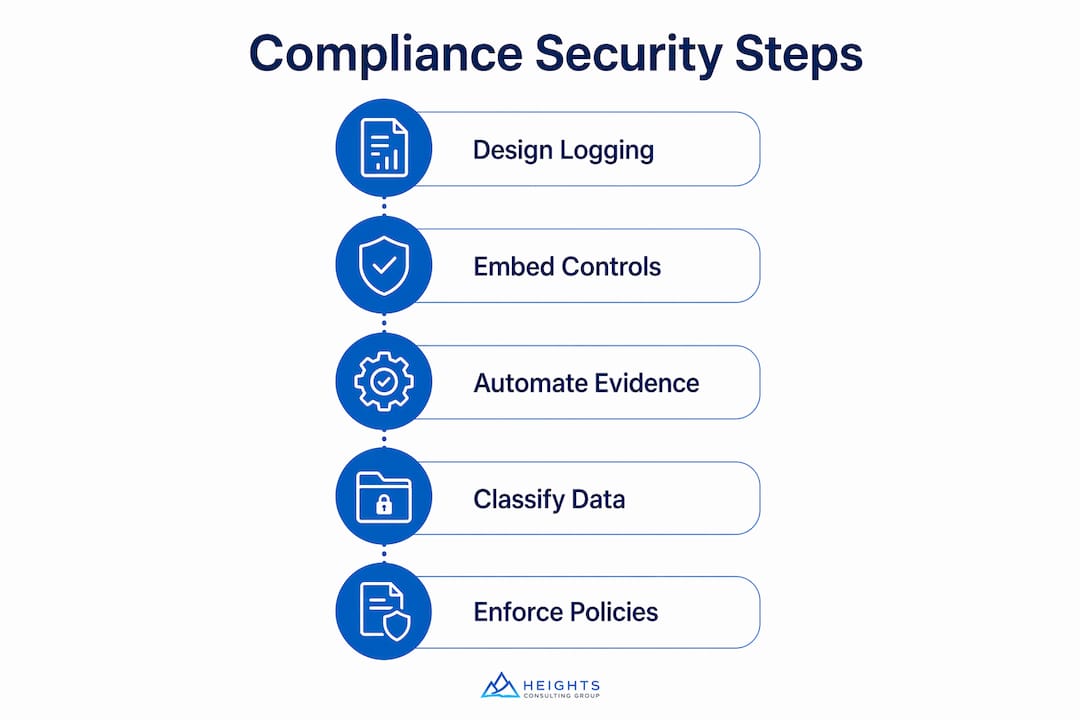
Integrated design means embedding logging, encryption, and role-based access control (RBAC) at the system level before any user touches the environment. When these controls exist in the architecture itself, they generate evidence continuously rather than requiring manual collection before an audit. The compliance team stops scrambling and starts reporting.
AI-enhanced monitoring adds another layer of precision. Behavioral anomaly detection tools, when wired into the architecture at the network and endpoint level, flag deviations from baseline patterns in real time. This shifts the compliance posture from reactive audit readiness to continuous assurance, which is the standard regulators are increasingly expecting in 2026.
Key capabilities that integrated security architecture delivers for compliance:
- Continuous log generation tied to immutable audit trails, satisfying SOC 2 and HIPAA evidence requirements automatically
- Encryption enforcement at the infrastructure layer, removing human error from data-in-transit and data-at-rest requirements
- RBAC policies defined at provisioning, not patched in after access incidents occur
- AI-driven anomaly detection that surfaces policy violations before they become reportable breaches
- Centralized policy enforcement across on-premises, hybrid, and cloud environments
Pro Tip: Design your logging architecture before you design your application. Audit trails built into the infrastructure layer satisfy multiple frameworks simultaneously and cost a fraction of what retroactive logging projects require.
What is the role of data classification in compliance architecture?
Compliance is entirely dependent on correct data classification. Without it, architectural controls cannot ensure regulatory adherence to PCI DSS, HIPAA, or GDPR, regardless of how sophisticated the surrounding security stack appears.
Data classification determines which controls apply to which systems. Credit card data triggers PCI DSS scope. Protected health information triggers HIPAA. Personal data belonging to EU residents triggers GDPR. When classification is absent or inconsistent, the architecture cannot enforce the right controls on the right data, and audit scope expands unpredictably.
A well-designed security architecture implements classification at the data layer and enforces it through the access control layer. The practical steps follow a clear sequence:
- Identify all data types across every system, including shadow IT and AI-generated data stores that often go unclassified.
- Assign classification labels that map directly to regulatory categories: public, internal, confidential, and restricted.
- Apply deny-by-default access policies so that only explicitly authorized roles can reach restricted data.
- Enforce encryption requirements at rest and in transit for all data classified as confidential or restricted.
- Audit access logs continuously to detect classification drift, where data moves to less-controlled environments without authorization.
The deny-by-default principle deserves particular emphasis. Most organizations default to permissive access and then try to restrict it. Architecture-first compliance programs invert that model. Access is denied until a business justification and role assignment are formally approved, which is the approach NIST 800-53 and CMMC both require.
Pro Tip: Treat AI-generated outputs as a distinct data classification category. Large language models and AI analytics tools create data that may contain sensitive information derived from restricted inputs. Without a classification policy covering AI outputs, that data sits outside your compliance boundary.
How does automated evidence collection simplify compliance management?
Centralized evidence collection through compliance-aware architecture reduces duplicate compliance efforts by over 60%, because common frameworks like SOC 2 and NIST 800-53 share a 60–70% control overlap. That overlap means a single architectural action can satisfy multiple frameworks at once.

The clearest example: one log entry proving an encrypted data transfer simultaneously satisfies controls across SOC 2, HIPAA, and CMMC. When evidence collection is centralized and automated, that log entry is captured, stored immutably, and mapped to the relevant control without human intervention. Audit preparation time drops by up to 70% as a result.
Security as Code (SaC) takes this further. Version-controlled firewall rules, IAM policies, and encryption configurations stored in repositories like Git shift audit proof from documents to the process itself. Auditors review the code and the deployment pipeline rather than chasing down screenshots and spreadsheets.
| Architecture approach | Evidence method | Audit preparation time | Framework coverage |
|---|---|---|---|
| Manual collection | Spreadsheets, screenshots | High | Single framework per effort |
| Centralized logging | Automated log aggregation | Reduced significantly | Multiple frameworks simultaneously |
| Security as Code (SaC) | Code repositories, CI/CD pipelines | Minimal | Continuous, version-controlled proof |
| API-first modular design | Automated control testing | Near-zero manual effort | Adapts to new frameworks quickly |
API-first and modular architecture designs add flexibility that matters when regulations change. When a new control requirement appears in an updated framework, a modular architecture allows compliance teams to add or modify a single component rather than redesigning the entire system. That adaptability is the difference between a compliance program that scales and one that breaks under regulatory pressure.
- Immutable audit trails prevent log tampering, which satisfies integrity requirements across NIST, PCI DSS, and FedRAMP
- Automated control testing in CI/CD pipelines catches configuration drift before it reaches production
- Centralized policy management reduces the risk of inconsistent control application across business units
What frameworks and strategies drive compliance-focused security architecture?
Security architecture acts as the strategic bridge between high-level business goals and tactical security controls, supporting resilience and compliance across all operating environments. That bridge requires specific artifacts to function: control catalogs, threat models, reference architectures, and governance frameworks that connect regulatory requirements to technical implementation.
Security architecture artifacts such as control catalogs, threat models, and governance frameworks provide the structure that keeps compliance accountable across organizational layers. Without these artifacts, security decisions remain informal and inconsistent, which is exactly what regulators penalize during assessments.
Three roles are non-negotiable in a compliance-driven architecture program. The security architect translates regulatory requirements into technical design decisions. The compliance officer maps those decisions back to specific framework controls. The executive sponsor provides the authority and budget to enforce both. When any of these roles is absent, the architecture drifts from its compliance intent.
Practical use cases where this framework delivers measurable results include cloud migration, digital transformation programs, and regulatory-driven modernization. A healthcare organization migrating to a hybrid cloud environment, for example, must redesign its HIPAA controls to cover both on-premises data stores and cloud workloads. Without a security architect leading that redesign, the migration creates compliance gaps that may not surface until an audit or a breach.
Legacy systems present the most persistent challenge. Many organizations carry technical debt in the form of systems that were never designed with compliance in mind. Retrofitting controls onto legacy infrastructure is expensive and unreliable. The correct approach is to build a cybersecurity strategy that phases legacy systems out of compliance scope through enclave isolation or planned modernization, rather than attempting to patch them into compliance indefinitely.
Treating regulations like GDPR and NIST as blueprints for security architecture enables continuous compliance and turns compliance mandates into competitive advantages. Organizations that embed regulatory controls from day zero build self-proving systems. Those systems generate the evidence, enforce the policies, and adapt to new requirements without requiring a compliance sprint before every audit.
Incomplete scoping in compliance assessments causes audit scopes to expand unexpectedly, as seen in CMMC assessments where enclave boundary errors pulled additional systems and users into scope. Precise boundary definitions in architecture documents prevent that expansion and protect the organization from audit overruns that consume time and budget.
For compliance professionals working across regulated industries, the practical guidance is direct: document your architecture boundaries before your next assessment, not during it.
Key Takeaways
Security architecture is the most cost-effective compliance investment an organization can make, because it generates continuous evidence, enforces controls automatically, and reduces audit preparation time by up to 70%.
| Point | Details |
|---|---|
| Integrated architecture cuts breach rates | Organizations with integrated GRC architecture experience a 19-point lower breach rate than reactive programs. |
| Data classification drives control accuracy | Without correct classification, architectural controls cannot enforce PCI DSS, HIPAA, or GDPR requirements. |
| Centralized evidence reduces duplicate work | Automated evidence collection cuts duplicate compliance efforts by over 60% across overlapping frameworks. |
| Security as Code shifts audit proof | Version-controlled policies in Git repositories replace manual document collection with continuous, testable proof. |
| Precise scoping prevents audit expansion | Defined enclave boundaries in architecture documents stop compliance scope from expanding unexpectedly during assessments. |
Why compliance architecture is the wrong place to cut corners
The financial case for building compliance into architecture is not subtle. Non-compliance costs an average of $14.82 million per incident, compared to $5.47 million to maintain compliance. That 2.71x cost differential is the number I return to whenever an executive questions the investment in architecture-first compliance design.
What I have seen repeatedly in practice is that organizations treat compliance architecture as a one-time project rather than a continuous discipline. They build the controls, pass the audit, and then let the architecture drift as systems change and new services get added. By the next audit cycle, the gap between the documented architecture and the actual environment is wide enough to fail on.
The AI dimension makes this worse. AI systems introduce data flows, model outputs, and third-party integrations that most existing architectures were not designed to govern. When an organization deploys a large language model without classifying the data it processes or logging its outputs, that system sits outside the compliance boundary entirely. Regulators are beginning to treat that omission as a material control failure, not a technical oversight.
The shift I advocate for is from audit readiness to continuous assurance. Audit readiness means you can prove compliance when asked. Continuous assurance means your architecture proves it automatically, every day, without a compliance sprint. The difference in organizational resilience between those two postures is significant. The compliance framework implementation work that matters most happens between audits, not before them.
Collaboration across security architects, compliance officers, legal counsel, and executive sponsors is what sustains that posture. No single team owns compliance architecture. The organizations that get this right treat it as a shared accountability, not a handoff.
— Dan
How Heightscg helps organizations build compliance-ready security architecture
Heightscg works with compliance professionals and IT security leaders to design and implement security architectures that meet regulatory requirements from the ground up. The firm's consulting approach aligns technical controls with NIST, CMMC, SOC 2, HIPAA, and emerging AI governance requirements, so organizations stop treating compliance as a separate workstream and start generating audit evidence as a natural output of normal operations.
For organizations facing cloud migration, regulatory-driven modernization, or AI governance gaps, Heightscg provides the technical cybersecurity consulting expertise to architect systems that prove compliance continuously. The team brings security architects, compliance specialists, and executive advisors together to close the gap between regulatory intent and operational reality. To discuss your organization's compliance architecture needs, contact Heightscg directly.
FAQ
What is the role of security architecture in compliance?
Security architecture embeds regulatory controls, access policies, and audit logging directly into system design, so compliance is a continuous output rather than a periodic effort. Organizations with integrated security architecture experience significantly lower breach rates than those using reactive compliance approaches.
How does security architecture reduce audit preparation time?
Automated evidence collection and centralized logging, built into the architecture, can reduce audit preparation time by up to 70% by eliminating manual document collection and mapping controls across frameworks simultaneously.
Why does data classification matter for compliance architecture?
Without correct data classification, architectural controls cannot enforce the right requirements on the right data. Misclassification leads to direct non-compliance with PCI DSS, HIPAA, and GDPR, regardless of the sophistication of surrounding security controls.
What is Security as Code and how does it support compliance?
Security as Code stores firewall rules, IAM policies, and encryption configurations in version-controlled repositories like Git, shifting audit proof from documents to the deployment process itself. This approach makes compliance controls testable, repeatable, and continuously verifiable.
How does AI affect security architecture compliance requirements?
AI systems create new data flows and model outputs that most existing architectures were not designed to classify or govern. Organizations that deploy AI without extending their compliance architecture to cover AI inputs, outputs, and integrations create unmonitored gaps that regulators increasingly treat as material control failures.