

TL;DR:
- Compliance officers play a strategic role in risk management, cybersecurity, and regulator communication.
- They translate regulations into operational controls and oversee continuous monitoring and audits.
- Effective, independent compliance programs reduce legal liability and influence board-level decision-making.
Compliance officers are frequently mischaracterized as bureaucratic gatekeepers whose primary function is generating paperwork and enforcing policy checklists. That framing significantly undervalues what these professionals actually do. In regulated industries, the compliance officer sits at the intersection of legal obligation, operational security, and strategic risk management. Compliance officer responsibilities include building structured programs that span risk assessment, monitoring, training, investigations, and board reporting. This article examines how compliance officers directly shape cybersecurity posture, translate complex regulations into executable controls, and deliver measurable governance value to C-level leadership.
Table of Contents
- What does a compliance officer really do?
- Translating regulations into practical cybersecurity controls
- Navigating overlapping regulations and modern risk challenges
- The boardroom impact: Governance, risk, and measurable value
- Compliance officers: Strategic partners, not corporate hall monitors
- Level up your compliance and cybersecurity strategy
- Frequently asked questions
Key Takeaways
| Point | Details |
|---|---|
| Strategic governance partner | Modern compliance officers are business enablers who drive risk reduction, not just rule enforcers. |
| Framework to controls mapping | They translate regulatory requirements into operational cybersecurity procedures and evidence. |
| Handling complexity | Effective compliance officers unify overlapping frameworks and address new tech challenges like AI. |
| Board-level influence | Direct board access and ongoing oversight boost organizational trust and measurable value. |
| Proactive over procedural | True impact comes from early, strategic involvement rather than reactive compliance policing. |
What does a compliance officer really do?
The Chief Compliance Officer (CCO) is not simply a policy administrator. At the executive level, the role demands an independent perspective on organizational risk, a structured approach to regulatory adherence, and direct communication with the board of directors. Compliance officer responsibilities extend across daily operational functions and long-range strategic planning, making the CCO one of the most cross-functional leaders in any regulated organization.
What distinguishes the CCO from peers in the C-suite is a mandated independence that other roles do not carry. The CCO is distinct from the CISO (who focuses on operational security), legal counsel (who focuses on strategy and litigation), and internal audit (who tests after the fact). The CCO's authority includes a direct line to the board, dedicated budget allocation, and the ability to escalate concerns without organizational interference, all as defined under United States Sentencing Guidelines (USSG) §8B2.1.
This independence is not a technicality. It directly affects whether a compliance program is credible in the eyes of regulators, federal prosecutors, and the board itself. Building trust through compliance is especially critical for financial institutions and healthcare organizations where enforcement actions can carry catastrophic financial and reputational consequences.
A compliance officer's core responsibilities in practice include:
- Risk assessment: Identifying regulatory gaps, evaluating likelihood and impact, and prioritizing remediation by business unit
- Policy development: Drafting, revising, and enforcing internal controls aligned to applicable regulatory frameworks
- Training programs: Designing role-specific awareness and compliance training for staff, managers, and executives
- Continuous monitoring: Tracking control performance, flagging anomalies, and triggering investigations when warranted
- Incident investigations: Leading or co-leading root cause analysis when compliance failures or suspected violations occur
- Board reporting: Presenting risk posture, program health, and remediation status directly to executive leadership and the board
See compliance frameworks in action for a detailed look at how these responsibilities map to specific healthcare regulatory requirements.
"Effective compliance programs reduce an organization's culpability score by up to 3 points under USSG §8C2.5(f), a reduction with direct financial and legal consequence."
The NIST framework overview offers additional context on how structured programs align with established cybersecurity standards that compliance officers routinely manage.
Translating regulations into practical cybersecurity controls
Understanding what a compliance officer does in theory is one thing. Seeing how they operationalize that function inside a complex regulatory environment is where the real strategic value becomes clear. In cybersecurity, compliance officers map regulatory requirements such as NIST SP 800-53, HIPAA, and FISMA to specific technical and administrative controls, oversee audit readiness, manage critical documentation like System Security Plans (SSPs) and Plans of Action and Milestones (POA&Ms), and report program health to governance structures.
This is not a linear task. Mapping a single regulation like HIPAA to operational controls requires cross-referencing administrative safeguards (policy), physical safeguards (access management), and technical safeguards (encryption, audit logs) simultaneously. Compliance officers coordinate with IT, HR, legal, and operations to ensure those controls are implemented correctly and can withstand external audit scrutiny.

| Regulatory framework | Primary focus area | Key control categories |
|---|---|---|
| NIST SP 800-53 | Federal information systems | Access control, audit and accountability, incident response |
| HIPAA Security Rule | Protected health information | Administrative, physical, and technical safeguards |
| FISMA | Federal agency cyber programs | Continuous monitoring, authorization to operate (ATO) |
| PCI DSS | Payment card data | Network security, encryption, access management |
| CMMC | Defense contractor environments | Practice maturity, process institutionalization |
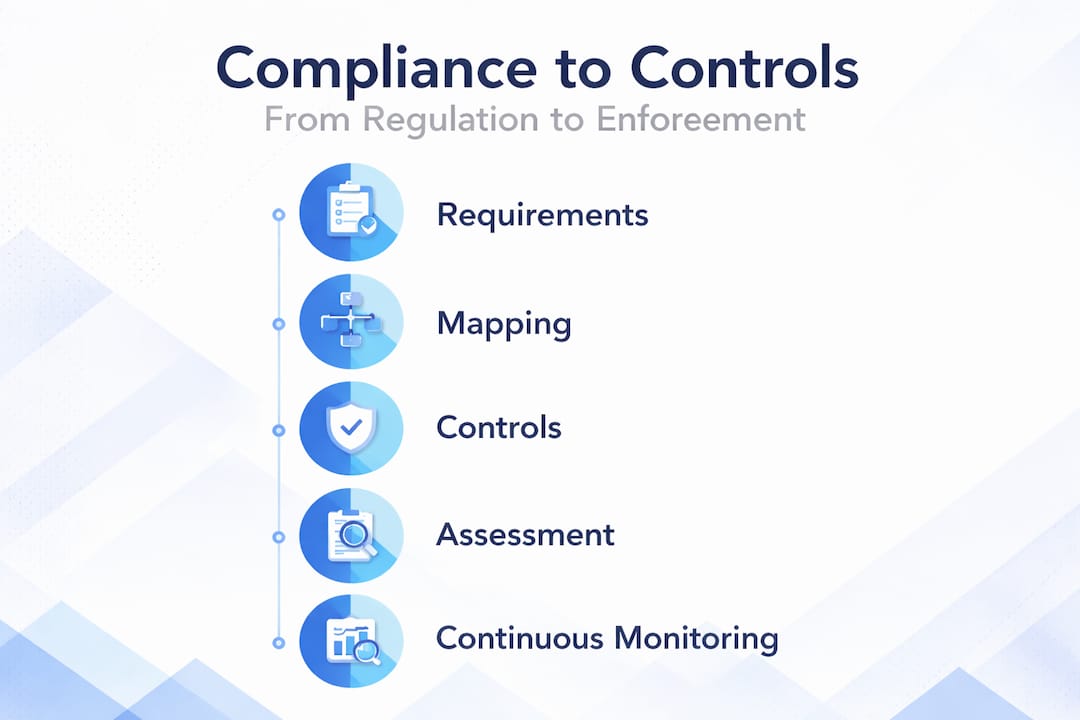
The compliance lifecycle that officers manage follows a consistent pattern, regardless of the specific framework involved:
- Requirement mapping: Cross-reference regulatory language against existing controls using structured crosswalk documents
- Documentation: Develop or update SSPs, risk assessments, and POA&Ms to reflect current control posture
- Control oversight: Assign ownership to technical and operational teams, establish evidence collection protocols
- Assessment cycles: Execute or coordinate periodic audits, such as annual FISMA Authorization to Operate (ATO) renewals or HIPAA compliance reviews
- Remediation tracking: Log deficiencies, prioritize fixes based on risk, and report progress to the board until controls meet standard
Key methodologies in this lifecycle include requirement mapping via crosswalks, periodic risk assessments aligned to NIST SP 800-37, and structured remediation tracking that ties every finding to an accountable owner and a resolution date.
Executives looking for practical execution guidance will find key steps for leaders useful for understanding how to translate compliance strategy into operational reality. Similarly, security frameworks for CISOs provides a side-by-side comparison of how different frameworks align or conflict in practice.
Pro Tip: When your organization operates under two or more regulatory frameworks simultaneously, invest in a formal crosswalk document that maps overlapping requirements to a single control set. This eliminates redundant audits, consolidates evidence collection, and dramatically reduces the operational burden on both the compliance and security teams. Review the framework implementation steps for a proven methodology to build this capability.
Emerging compliance technology, including AI-driven compliance controls, is beginning to automate portions of the mapping and monitoring lifecycle, though human oversight of these tools remains a regulatory and ethical requirement in most frameworks.
Navigating overlapping regulations and modern risk challenges
The compliance landscape for regulated industries rarely involves a single framework. Most organizations operate under two, three, or even more sets of overlapping regulations, each with distinct terminology, control requirements, and audit timelines. This is where many compliance programs fracture under pressure.
Multi-framework overlap situations, such as organizations managing both HIPAA and PCI DSS simultaneously, create real operational drag when compliance officers lack the crosswalk infrastructure to identify shared requirements. Without a unified view, organizations duplicate effort, misallocate budget, and create audit fatigue across technical teams.
| Overlapping frameworks | Common compliance challenge |
|---|---|
| HIPAA + PCI DSS | Separate audit timelines for shared technical controls |
| NIST 800-53 + FISMA | Documentation redundancy across ATO packages |
| CMMC + DFARS | Defense contractor multi-level maturity conflicts |
| SOC 2 + ISO 27001 | Overlapping trust service criteria and evidence requirements |
Beyond framework overlap, structural independence failures represent one of the most overlooked causes of enforcement action. When a compliance officer reports to the General Counsel or the CFO rather than directly to the board, their ability to escalate unaddressed risks without organizational retaliation is compromised. Regulators have increasingly scrutinized these reporting lines during enforcement reviews, and in several high-profile cases, the absence of genuine CCO independence contributed directly to consent orders and civil monetary penalties.
The four most common pitfalls when regulations overlap or evolve rapidly include:
- Control duplication: Teams build separate control sets for each framework, creating redundant work and inconsistent evidence
- Audit fatigue: Multiple external audit cycles in a single year overwhelm security and IT staff, degrading control quality
- Independence erosion: Compliance leadership gets absorbed into legal or finance structures, reducing their authority to escalate
- AI oversight gaps: Automated systems make compliance decisions without adequate human review, creating liability under frameworks like the EU AI Act
That last point deserves particular attention for organizations investing in automation and AI. The EU AI Act's human oversight principles make it explicit that automated decision-making in regulated functions must include meaningful human control checkpoints. Compliance officers who allow AI tools to fully automate policy checks or access decisions without audit trails create a structural vulnerability that regulators are increasingly equipped to identify.
Unified compliance strategies offer a design approach that addresses these challenges at the architecture level rather than patching them reactively. Executives managing AI-integrated environments should also explore AI compliance strategy resources before deploying automation into any compliance-critical workflow.
Pro Tip: Do not rely on checklist-based compliance audits as your primary assurance mechanism. Invest instead in layered controls that generate continuous, timestamped evidence. This approach satisfies auditors, supports investigations, and creates the audit trail necessary to defend human oversight obligations under AI-specific regulations. Reviewing compliance technology tools can help your team select platforms that support this evidence-first model.
The boardroom impact: Governance, risk, and measurable value
Compliance officers do not simply manage programs in the background. When positioned correctly, they shape how the board understands organizational risk, influences resource allocation decisions, and creates accountability structures that protect the organization from enforcement and reputational harm.
The governance cycle that a well-functioning compliance office drives follows a structured sequence:
- Assessment: Conduct baseline and periodic risk assessments to establish the current compliance and cybersecurity posture
- Oversight: Monitor control performance and vendor compliance across the enterprise in real time
- Gap reporting: Present findings to executive leadership and the board in clear, risk-quantified terms, not technical jargon
- Remediation tracking: Assign ownership to identified gaps, set milestones, and report progress until each deficiency is resolved
This cycle produces something that most audit functions cannot: forward-looking risk intelligence. Internal audit looks backward, examining what already happened. The CCO looks forward, identifying where the organization is likely to fail before it becomes a finding. That distinction is not semantic. It is the difference between preventing a regulatory action and managing the aftermath of one.
The numbers reinforce this. Effective compliance programs reduce an organization's culpability score by up to 3 points under USSG §8C2.5(f). In federal sentencing calculations, that reduction can translate to tens of millions of dollars in fine mitigation. For organizations facing DOJ investigation, this is a direct, measurable financial return on compliance investment.
The CCO's board access per USSG §8B2.1 is not incidental. It is the mechanism by which compliance findings reach decision-makers who have the authority and the accountability to act on them. Without that access, compliance programs become advisory in name only.
"Technology sector CCOs command total compensation of approximately $770,000, reflecting the market's recognition that compliance leadership generates strategic and financial value proportional to organizational risk exposure."
For executives building or restructuring compliance functions, compliance strategies for 2026 provides a current assessment of where regulated industries are focusing compliance investment and why.
Compliance officers: Strategic partners, not corporate hall monitors
Here is the uncomfortable truth most organizations avoid: compliance programs fail not because of regulatory complexity, but because compliance officers are brought in too late, given too little authority, and treated as reactive validators rather than proactive partners.
The tick-the-box mentality is not just operationally inefficient. It is strategically dangerous. When compliance is treated as a final-stage quality check rather than an early-design discipline, organizations build systems, processes, and vendor relationships that require expensive remediation to bring into conformance. The compliance officer then spends organizational capital fixing what early partnership would have prevented.
True compliance leadership is front-loaded. The CCO should be in the room when new technology initiatives are scoped, when vendor contracts are negotiated, and when data governance policies are drafted. Not to block progress, but to shape it in ways that preserve both operational velocity and regulatory defensibility. This is the compliance by design principle in practice, and it is what separates mature compliance programs from reactive ones.
Independence is not a structural nicety. It is the mechanism that gives compliance its authority. When CCOs report to functions with conflicting interests, such as legal or finance, their ability to surface unwelcome findings without organizational consequence is compromised. The organizations that have faced the most damaging enforcement actions are frequently those where compliance leadership lacked genuine independence and board access.
The resource neglect issue is also real. Research consistently shows that a significant majority of organizations underinvest in compliance infrastructure relative to risk exposure. This is particularly acute in AI and automation environments, where the speed of deployment routinely outpaces the development of human oversight mechanisms. Compliance officers who are resourced appropriately and empowered to act early are the best defense against the gap between what AI systems do and what regulations require of them.
Pro Tip: Engage your compliance officer at the strategy table, not just the post-incident review. Organizations that treat the CCO as a design partner consistently demonstrate stronger audit outcomes, lower remediation costs, and more credible board reporting than those that deploy compliance as a final filter.
Level up your compliance and cybersecurity strategy
If the compliance functions described in this article are not fully operational in your organization, the gap between where you are and where regulators expect you to be is likely larger than your current risk assessments reflect.
Heights Consulting Group works with C-level executives and compliance leaders across regulated industries to assess compliance maturity, build integrated cybersecurity controls, and implement frameworks that satisfy audit requirements without creating operational paralysis. Whether you are establishing a new compliance program or restructuring an existing one, our technical cybersecurity consulting services are designed to accelerate your path to defensible, board-ready compliance. Explore our compliance frameworks guide for sector-specific insight, or contact Heights CG directly to schedule an executive advisory session tailored to your organization's risk profile and regulatory obligations.
Frequently asked questions
How do compliance officers reduce cyber risk?
They map regulatory requirements such as NIST SP 800-53, HIPAA, and FISMA to specific technical controls, oversee audit readiness, and ensure continuous monitoring that directly reduces organizational risk exposure. Their documentation and oversight functions create the accountability structures necessary to sustain those controls over time.
What distinguishes a CCO from other executive roles?
A CCO holds a mandated independence and board access under USSG §8B2.1 that CISOs, legal counsel, and internal audit leaders do not carry, giving the CCO unique authority to escalate unresolved risks directly to governance without organizational interference.
How do compliance officers navigate multiple regulatory frameworks?
They use structured crosswalk methodologies to map overlapping requirements from frameworks like HIPAA, NIST, and PCI DSS to a unified control set, eliminating duplication and consolidating audit evidence into a single defensible program.
What value does effective compliance deliver in measurable terms?
Effective compliance programs can reduce organizational culpability scores by up to 3 points under USSG §8C2.5(f), which translates directly to reduced financial penalties in federal enforcement proceedings and measurable protection of executive compensation and legal standing.
Recommended
- Navigating Regulatory Compliance in 2026: Insights for Executives - Heights Consulting Group
- CISOs and regulatory compliance success: 5 key roles
- Cybersecurity Leadership Workflow for Compliance Success
- Cybersecurity Compliance: Strategies & Insights for 2026 - Heights Consulting Group.
- AML & KYC for Digital Asset Lenders: What Institutions Need to Know | CR Equity AI