

Start with a complete device inventory tied to a Software Bill of Materials (SBOM) for every connected device, then map that inventory to an operational postmarket vulnerability program and your quality management system (QMS). That single step reduces patient-safety exposure and positions your organization for 21 U.S.C. §360n–2 compliance faster than any other action.
Here is the executive-ready checklist to bring to your next leadership briefing:
- Own the inventory. Assign a named owner for every cyber device and its associated software components.
- Build your SBOM baseline. Prioritize highest-risk devices first; document all third-party and open-source components.
- Identify the short-list risk. Run a triage pass against known CVEs using your SBOM; flag critical and high findings immediately.
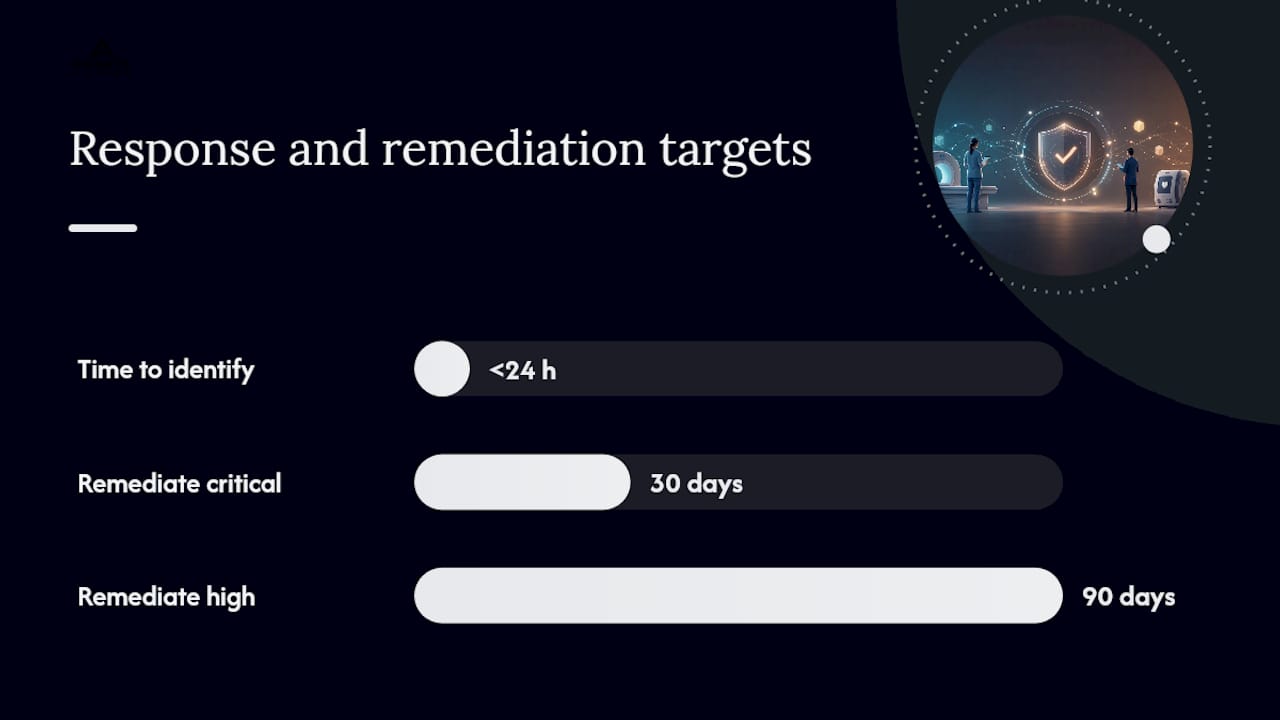
- Set patch cadence. Define SLAs: critical vulnerabilities within 30 days, high within 90 days, with an emergency out-of-cycle process documented.
- Establish a reporting channel. Confirm who notifies FDA, HHS, and CISA when a safety-relevant incident occurs.
- Benchmark your maturity. Use the MDIC cybersecurity benchmarking framework to measure where your program stands against industry peers.
Pro Tip: Present the inventory gap — the number of devices without a current SBOM — as a patient-safety exposure metric, not an IT gap. Executives approve resources faster when the framing is clinical risk.
Key Takeaways
A complete device inventory paired with an operational SBOM program and a postmarket vulnerability process is the single highest-leverage action for reducing patient-safety risk and achieving regulatory alignment under 21 U.S.C. §360n–2.
| Point | Details |
|---|---|
| Inventory and SBOM first | Assign ownership to every networked device and generate a verified SBOM before any other control takes priority. |
| Regulatory floor is statutory | 21 U.S.C. §360n–2 mandates postmarket monitoring plans, SBOMs, and patch processes for covered cyber devices — non-compliance triggers FDA Refuse to Accept decisions. |
| Operational metrics over documentation | MDIC benchmarking shows that manufacturers with active telemetry-to-patch feedback loops outperform those with documented-only programs; FDA inspectors now ask for evidence of performance, not just policy. |
| QMS integration is non-negotiable | ISO 13485 is the vehicle for embedding device security into design controls and supplier management — treating it as an IT overlay creates audit friction and longer remediation cycles. |
| Heightscg for program execution | Heightscg supports device inventory, SBOM programs, postmarket monitoring, incident response, and KPI dashboards for healthcare organizations and device manufacturers. |
Table of Contents
- What does medical device security actually cover?
- What U.S. regulations and standards govern device cybersecurity now?
- What technical and operational controls does your program need?
- How do you integrate device security into QMS and enterprise risk governance?
- How should you test devices and manage vulnerabilities across the lifecycle?
- What does a medical device incident response plan look like?
- How do you manage supply chain risk and build a defensible SBOM program?
- Which KPIs actually prove your device security program is working?
- What does a 90-day, 6-month, and 12-month implementation roadmap look like?
- What security leaders must watch: AI, operational metrics, and the next inspection cycle
- How Heightscg supports your medical device security program
- Sources
What does medical device security actually cover?
The term "medical device security" covers more than the physical device. Under FDA's current framework, a "cyber device" is any device that includes software, has the ability to connect to the internet or a network, or contains technology that could be vulnerable to cybersecurity threats. That definition pulls in infusion pumps, imaging systems, patient monitors, implantable devices with wireless interfaces, and the clinical software platforms that aggregate their data.
Security professionals often draw the boundary too narrowly, focusing on the device itself while leaving the surrounding ecosystem unprotected. The ecosystem includes the network segment the device operates on, the integration layer connecting it to the EHR, the cloud services receiving its telemetry, and the third-party servicers who access it for maintenance. A breach at any of those points carries the same clinical consequence as a breach of the device directly.
The three core security goals map directly to clinical outcomes:
- Confidentiality. Unauthorized access to device data exposes protected health information (ePHI). A compromised patient monitor that streams unencrypted vitals to an attacker is a HIPAA violation and a patient-safety event simultaneously.
- Integrity. Corrupted or manipulated device data is arguably the most dangerous failure mode. An attacker who alters insulin dosing parameters or falsifies diagnostic imaging results can cause direct patient harm without triggering an obvious alarm.
- Availability. Ransomware that takes a fleet of ventilators or infusion pumps offline forces clinical staff into manual workarounds, delays care, and in documented cases has contributed to adverse outcomes.
Cybersecurity failures in medical devices are patient-safety failures. The HHS Healthcare Industry Cybersecurity Practices (HICP) framework makes this explicit: it frames cyber safety as patient safety and maps device-specific controls directly to clinical impact, including asset management, vulnerability management, and network-connected device controls.
Stakeholder boundaries matter here. Manufacturers own premarket design controls and postmarket monitoring obligations. Healthcare providers own network segmentation, access control, and the operational environment. Third-party servicers who connect to devices for maintenance introduce a separate risk surface that neither party fully controls by default. Clarifying those boundaries in writing, before an incident, is a governance prerequisite. SBOMs and postmarket monitoring programs are the connective tissue between all three parties.
What U.S. regulations and standards govern device cybersecurity now?
The regulatory picture has consolidated significantly since 2023. Security leaders need to track five layers: federal statute, FDA guidance, HHS coordination, CISA coordination, and voluntary frameworks that regulators treat as de facto expectations.
The statutory floor: 21 U.S.C. §360n–2
Section 360n–2 requires manufacturers of covered cyber devices to submit postmarket cybersecurity monitoring plans, coordinated vulnerability disclosure procedures, SBOMs, and documented processes for timely updates and patches as part of premarket submissions. This is not guidance — it is statute. Manufacturers who cannot demonstrate these capabilities face Refuse to Accept (RTA) decisions from FDA before their submission is even reviewed. The FDA's RTA policy for device cybersecurity has real teeth: submissions lacking SBOM documentation or a postmarket monitoring plan are returned without substantive review.
FDA's total product lifecycle guidance
FDA's final guidance on cybersecurity in medical devices supersedes all prior guidance and introduces the total product lifecycle (TPLC) model. Under TPLC, security is not a premarket checkbox — it is a continuous obligation from design through decommission. The guidance recommends the Secure Product Development Framework (SPDF) for premarket design controls and expects manufacturers to maintain postmarket vulnerability monitoring, communicate with researchers through coordinated disclosure, and provide timely patches and updates throughout the device's supported life.
Premarket compliance checklist:
- Threat model documented and submitted
- SBOM provided at machine-readable and human-readable levels
- Security architecture and design controls described
- Penetration test evidence included
- Postmarket monitoring and patch plan submitted
- Coordinated vulnerability disclosure policy referenced
Postmarket compliance checklist:
- Active CVE monitoring against SBOM components
- Triage process with clinical-impact scoring
- Patch deployment and validation records maintained
- Coordinated disclosure intake mechanism operational
- FDA notification process defined for safety-relevant vulnerabilities
HHS, CISA, and provider obligations
HHS coordinates device security guidance through the HICP Technical Volumes under the 405(d) program, which maps cybersecurity practices to clinical settings. CISA coordinates sector-wide threat intelligence and issues advisories on device-specific vulnerabilities. For healthcare providers, the HIPAA Security Rule's requirement to conduct security risk analyses extends to devices and their EHR integrations — HHS/ONC guidance ties ePHI protection and administrative, physical, and technical safeguards directly to device and endpoint security.
Frameworks: NIST, ISO 13485, and MDIC
The NIST Secure Software Development Framework (SSDF) provides the technical vocabulary for secure development practices that FDA's SPDF references. ISO 13485 is the QMS framework most device manufacturers operate under; ISO guidance is explicit that the standard should be used to identify and incorporate jurisdiction-specific regulatory requirements, including cybersecurity. The MDIC benchmarking framework provides an industry maturity scorecard across Organization, Risk Management, and Design Control dimensions — and regulators increasingly treat participation as evidence of a mature postmarket program.
Statistic callout: The MDIC 2025 benchmarking report found that manufacturers who shift from document-centered maturity scoring to implementation-focused operational metrics achieve measurably better real-world resilience — a finding that aligns with FDA's own inspection emphasis on demonstrated capability, not just documented policy.
What technical and operational controls does your program need?
The controls that matter most in a medical device security program span the device itself, its network environment, and the development process that produced it. The table below maps each control to its primary owner and the measurable outcome that proves it is working.
| Control | Primary Owner | Measurable KPI |
|---|---|---|
| Device and software asset inventory | Provider / Manufacturer | % of devices inventoried with current SBOM |
| SBOM generation and SCA | Manufacturer | SBOM completeness rate; time to identify vulnerable component |
| Secure product development (SPDF/SSDF) | Manufacturer | % of new releases with threat model and pen test evidence |
| Strong authentication and authorization | Manufacturer / Provider | % of devices with MFA or certificate-based auth enabled |
| Network segmentation | Provider | % of clinical device VLANs isolated from general IT |
| Least privilege access | Provider / Servicer | % of service accounts with scoped, time-limited access |
| Patch management | Manufacturer / Provider | Mean time to patch critical CVEs; % devices on current firmware |
| Logging, monitoring, and telemetry | Provider | % of devices with active log forwarding to SIEM |
| Endpoint detection (EDR/OT-aware) | Provider | Alert-to-triage time; % of devices with active EDR coverage |
Understanding how medical device networking works is a prerequisite for designing effective segmentation — clinical devices often use proprietary protocols and legacy connectivity patterns that standard IT segmentation tools do not handle correctly.
Pro Tip: Patch cadence breaks down most often at the validation step, not the deployment step. Build a pre-approved test environment that mirrors your clinical fleet so out-of-cycle emergency patches can be validated in hours, not weeks. Document the validation protocol once and reuse it.
AI and machine learning components in devices
AI is embedded in an expanding share of clinical devices: diagnostic imaging platforms, sepsis prediction tools, continuous glucose monitors with adaptive algorithms, and robotic surgical systems all carry ML components. Each introduces risks that standard security controls do not fully address. Model drift can degrade diagnostic accuracy without triggering a traditional security alert. Data poisoning during training can introduce systematic bias that persists through the device's operational life. And most current SBOMs do not capture model provenance, training data sources, or version history for embedded ML components.
Governance controls for AI-embedded devices should include a model inventory (parallel to the software component inventory), explainability requirements for clinical decision support outputs, periodic model validation against current patient population data, and supplier attestations on training data provenance. These are not theoretical concerns — FDA has published guidance on AI/ML-based software as a medical device (SaMD) and expects manufacturers to address model change management in their postmarket monitoring plans.
How do you integrate device security into QMS and enterprise risk governance?
The most common governance failure is treating device cybersecurity as an IT function rather than a QMS obligation. ISO 13485 is not a product-level security checklist — it is the vehicle for integrating cybersecurity requirements into design controls, supplier management, and postmarket complaint handling. When security lives outside the QMS, audit findings accumulate, remediation cycles lengthen, and regulators see a program that cannot demonstrate systematic control.
Governance structure checklist:
- Board/executive oversight. Device security risks are reported to the board or a board-level risk committee at least annually, framed as patient-safety and operational risk.
- Single accountable owner. One named individual (CISO, VP of Product Security, or equivalent) holds accountability for the device security program across premarket and postmarket.
- Cross-functional product security committee. Engineering, regulatory affairs, clinical, legal, and IT security meet on a defined cadence to review vulnerability findings, patch decisions, and disclosure obligations.
- Supplier oversight. Vendor contracts require SBOM delivery, vulnerability disclosure timelines, patch support windows, and maintenance commitments. Supplier security is reviewed at least annually.
- Internal audit cadence. Device security controls are included in ISO 13485 internal audits, not assessed separately by IT.
Roles by stakeholder:
Manufacturers own threat modeling, SPDF implementation, SBOM generation, coordinated disclosure intake, and postmarket monitoring. Healthcare providers own network segmentation, access control, patch deployment for provider-managed components, and incident response for their environment. Third-party servicers must operate under contractual security requirements, provide evidence of access controls, and report vulnerabilities discovered during service activities.
Benchmarking against the MDIC maturity framework gives the cross-functional committee an external reference point. Internal audit findings mapped to MDIC dimensions convert governance activity into audit evidence that satisfies both FDA inspections and ISO 13485 certification reviews. For a practical framework on integrating device security into enterprise risk management, the governance structure above provides the starting architecture.
How should you test devices and manage vulnerabilities across the lifecycle?
Premarket security testing
Before a device reaches a premarket submission, the security testing record should include threat modeling (STRIDE or equivalent), static application security testing (SAST), dynamic application security testing (DAST), software composition analysis (SCA) against the SBOM, fuzz testing for communication interfaces, and at least one penetration test conducted by a team independent of the development team. Each test generates evidence that maps to specific submission sections under FDA's TPLC guidance.
Postmarket vulnerability lifecycle
Once a device is on the market, the vulnerability lifecycle runs continuously. The stages are discovery (internal monitoring, researcher reports, NVD/CVE feeds, CISA advisories), intake and triage, risk scoring with clinical impact weighting, remediation planning, patch development and validation, deployment, and closure verification.
The triage matrix below provides recommended SLAs based on severity and clinical impact:
SCA tooling paired with your SBOM automates the identification step significantly. Tools like Dependency-Track, FOSSA, or Black Duck can ingest an SBOM and flag components against the NVD in near real-time. The operational discipline that determines whether this works is the SLA assignment: who owns the fix, by when, and what escalation path applies when a deadline is at risk.
What does a medical device incident response plan look like?
Device-specific incident response differs from enterprise IR in one critical dimension: clinical continuity is a non-negotiable constraint. You cannot simply isolate a ventilator or an infusion pump the way you would isolate a compromised workstation.
Device IR checklist:
- Clinical triage first. Before any technical containment action, confirm with clinical leadership whether the affected device can be safely isolated or must remain operational with compensating controls.
- Isolate where safe. Remove affected devices from the network segment where clinical continuity permits; implement manual workarounds per clinical protocols.
- Preserve integrity evidence. Capture device logs, firmware versions, and configuration state before any remediation action that could overwrite forensic evidence.
- Validate clinical data integrity. Confirm that data recorded by the affected device during the incident window is accurate; flag any records that may have been corrupted for clinical review.
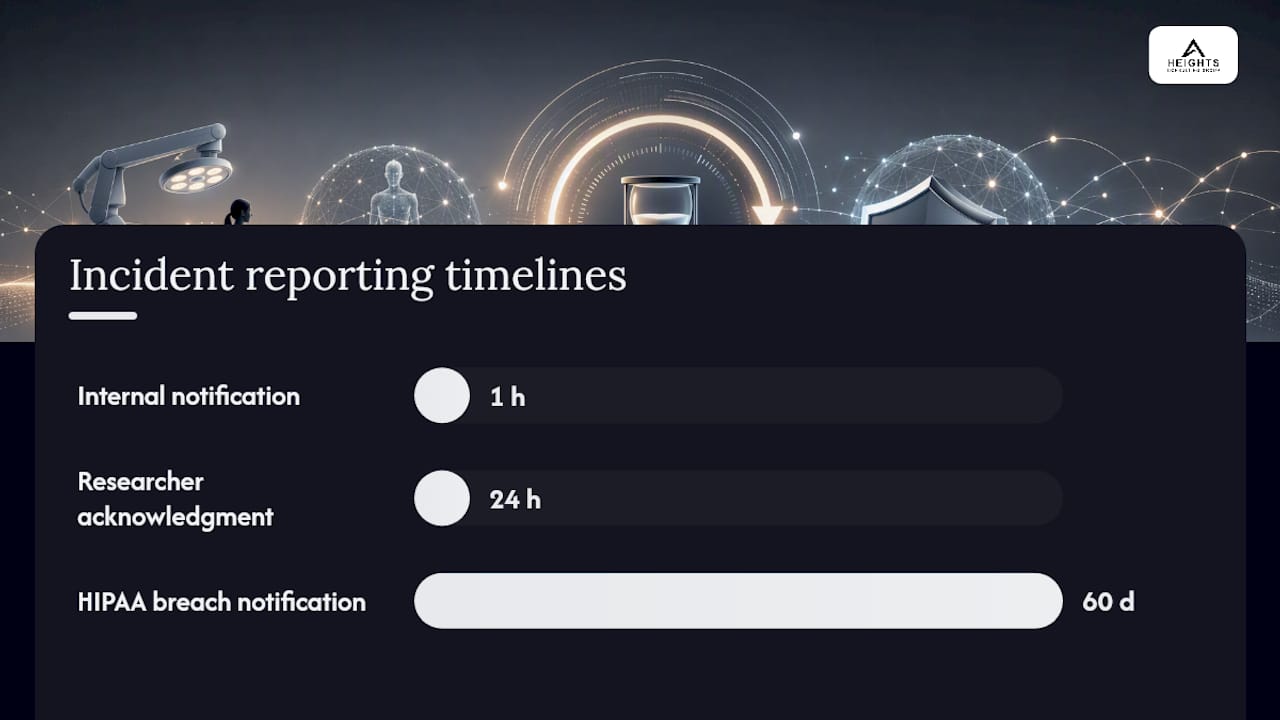
- Notify internal stakeholders. Escalate to the CISO, clinical leadership, legal, and the cross-functional product security committee within the first hour.
- Assess regulatory reporting obligations. Determine whether the incident meets FDA's threshold for a Medical Device Report (MDR) or a safety notification; confirm whether CISA or HHS notification is required.
- Engage coordinated disclosure if researcher-reported. Acknowledge receipt within 24 hours, provide a timeline for triage, and maintain communication through resolution.
Regulatory reporting flow: FDA expects manufacturers to report malfunctions that could cause or contribute to serious injury or death. For safety-relevant cybersecurity incidents, the MDR pathway applies. CISA coordinates sector-wide notifications for vulnerabilities that affect multiple manufacturers or device classes. HHS receives notification under HIPAA's Breach Notification Rule when ePHI is compromised. Timelines are tight: HIPAA breach notification to HHS is required within 60 days of discovery for breaches affecting 500 or more individuals, with media notification required in the affected state.
Patient-safety messaging during an incident requires clinical leadership involvement. Security teams should not communicate directly with patients or clinical staff about device safety without clinical and legal review of the messaging.
How do you manage supply chain risk and build a defensible SBOM program?
An SBOM is only as useful as its completeness and currency. A defensible SBOM program requires more than generating a file at release — it requires automation, verification, and contractual backing from every supplier in the component chain.
SBOM best practices:
- Use machine-readable formats (SPDX or CycloneDX) that SCA tools can ingest directly.
- Include all required fields: component name, version, supplier, license, and known vulnerabilities at time of release.
- Regenerate and verify the SBOM at every release, not just at initial submission.
- Maintain a historical SBOM archive so you can reconstruct the component state of any deployed device version.
Supplier contract requirements:
| Requirement | Minimum Standard |
|---|---|
| SBOM delivery | Machine-readable SBOM provided at each release |
| Vulnerability disclosure | Supplier notifies promptly after confirmed CVE affecting delivered components |
| Patch support window | Minimum support commitment stated in contract (e.g., 5 years from last shipment) |
| Maintenance escrow | Source code or maintenance rights held in escrow for end-of-life scenarios |
| Security attestation | Annual attestation that development practices meet SSDF or equivalent |
Third-party risk controls should include SCA against supplier-provided SBOMs, periodic supplier security questionnaires mapped to NIST SSDF practices, and remediation SLAs written into contracts rather than left to negotiation at incident time. Censinet's benchmarking analysis confirms that SBOM completeness paired with operational SLAs — not SBOM generation alone — is what reduces mean time to identify and remediate vulnerable components.
AI and ML components deserve specific attention in supply chain risk management. Supplier attestations should cover model training data provenance, version history for embedded models, and the process for notifying customers when a model is retrained or updated. Most current supplier agreements do not address these points, which creates a governance gap that regulators are beginning to examine.
Which KPIs actually prove your device security program is working?
Metrics that matter to regulators and executives are not the same as metrics that matter to engineering teams. The most effective programs maintain both layers and translate between them.
Prioritized KPI list:
- SBOM completeness rate — percentage of deployed device versions with a current, verified SBOM. Target: 100% for devices in active support.
- Device inventory coverage — percentage of networked clinical devices with a confirmed owner, location, and risk classification. Target: 100%; gaps are patient-safety exposure.
- Time to identify vulnerable components — from CVE publication to confirmation that the CVE affects a device in your fleet. Target: under 24 hours with SCA automation.
- Time to remediate critical vulnerabilities — from confirmed triage to validated patch deployment. Target: 30 days for critical; 90 days for high.
- Patch currency rate — percentage of devices running current approved firmware. Track by device class and clinical setting.
- Mean time to respond (MTTR) for incidents — from detection to containment decision. Track separately for device-specific incidents vs. enterprise incidents.
- Postmarket coverage ratio — percentage of device models in the field with an active postmarket monitoring process (CVE feed, SBOM monitoring, disclosure intake).
- Coordinated disclosure response time — time from researcher report receipt to initial acknowledgment and triage completion.
Pro Tip: When briefing executives, lead with three numbers: the percentage of devices with no current SBOM (patient-safety exposure), the number of unpatched critical CVEs in the fleet (operational risk), and the MTTR for the last device incident (response capability). Those three figures tell the board everything they need to approve resources.
The MDIC benchmarking framework maps these KPIs to its maturity dimensions, which means your dashboard can serve double duty as both an operational tool and audit evidence. Translating NIST SSDF practices into measurable program goals follows the same logic: each SSDF task maps to a control, each control maps to a KPI, and each KPI has a named owner and a data source. For a practical approach to defining cyber maturity for healthcare executives, that translation layer is where most programs stall.
What does a 90-day, 6-month, and 12-month implementation roadmap look like?
| Phase | Priority Deliverables | Key Milestone |
|---|---|---|
| 90 Days | Device inventory + SBOM baseline for highest-risk devices; emergency patch SLAs documented; executive briefing with resource request | Inventory gap report delivered to leadership; critical CVE backlog identified |
| 6 Months | SBOM automation deployed; patch and vulnerability triage workflow operational; baseline KPIs established; MDIC benchmarking initiated | First KPI dashboard reviewed by cross-functional committee |
| 12 Months | Device security integrated into QMS (ISO 13485 design controls and supplier management); mature postmarket monitoring; continuous improvement cycle tied to metrics | Internal audit includes device security controls; MDIC benchmark score documented |
90-day priorities:
- Complete device discovery scan and assign ownership to every networked clinical device.
- Generate SBOM for the ten highest-risk device models (by clinical criticality and connectivity exposure).
- Document emergency patch SLA and out-of-cycle update process.
- Brief executive leadership with the inventory gap metric and resource request.
- Confirm FDA notification and CISA reporting contacts.
6-month priorities:
- Deploy SCA tooling integrated with your SBOM repository.
- Operationalize the vulnerability triage matrix with named owners and SLAs.
- Publish baseline KPI dashboard to the cross-functional product security committee.
- Submit MDIC benchmarking self-assessment.
- Complete first supplier security questionnaire cycle for top-tier component vendors.
12-month priorities:
- Map device security controls to ISO 13485 design control and supplier management clauses.
- Include device security in the annual QMS internal audit scope.
- Publish postmarket monitoring coverage ratio and confirm 100% of supported device models are covered.
- Review MDIC benchmark score against prior period and set improvement targets.
- Conduct tabletop exercise for a device-specific ransomware or integrity-attack scenario.
What security leaders must watch: AI, operational metrics, and the next inspection cycle
The most consequential shift in device security right now is not a new threat vector — it is the regulatory and industry move from documented plans to demonstrated operational performance. The MDIC 2025 benchmarking report makes this explicit: manufacturers who operationalize their postmarket programs — meaning the telemetry-to-triage-to-patch feedback loop is actually running, not just documented — achieve measurably better resilience. FDA inspectors are asking the same question: show me the last three vulnerability findings, how you triaged them, and when they were patched. A policy document does not answer that question.
The AI dimension is where governance gaps are most acute. Device manufacturers are embedding ML components into diagnostic imaging, clinical decision support, and continuous monitoring systems at a pace that outstrips their security and QMS processes. The specific risks are concrete: model drift that degrades diagnostic accuracy silently, data poisoning during training that introduces systematic error, and the near-total absence of model provenance in current SBOMs. When an AI-embedded device produces a clinically significant error, the investigation will ask who owned the model, when it was last validated, and what the training data provenance was. Most organizations cannot answer those questions today.
The governance response is not complicated, but it requires deliberate ownership. Inventory every ML component in every device, the same way you inventory software libraries. Establish model-specific validation cadences tied to clinical performance metrics, not just software release cycles. Require supplier attestations on model training data provenance and update notification processes. And treat model version changes as a change control event under your QMS — because regulators increasingly will.
Security leaders who build these capabilities now will be ahead of the next inspection cycle. Those who wait for explicit regulatory mandates will find themselves in the same position device manufacturers were in 2022: scrambling to retrofit controls that should have been designed in from the start.
How Heightscg supports your medical device security program
Building a defensible medical device security program requires expertise across regulatory compliance, technical implementation, and operational security — simultaneously. Heightscg works with healthcare organizations and device manufacturers to close the gap between documented policy and operational capability.

Specific engagement areas include device inventory and SBOM program design, QMS integration for ISO 13485 alignment, postmarket vulnerability monitoring and triage workflow implementation, incident response planning and tabletop exercises, and KPI dashboard development tied to MDIC maturity benchmarks. For organizations that need ongoing operational coverage, Heightscg's managed cybersecurity services provide continuous monitoring, vulnerability triage support, and regulatory reporting assistance without the overhead of building a dedicated internal team.
If your organization needs a structured starting point, a focused workshop can produce a prioritized 90-day plan, an executive briefing package, and a resource request that leadership can act on immediately. To discuss your specific situation and where your program stands, contact Heightscg for a direct conversation with an advisor who works in this space.
Sources
- U.S.C. Title 21 - FOOD AND DRUGS 21 U.S.C. United States Code, 2023 Edition Title 21 - FOOD AND DRUGS CHAPTER 9 - FEDERAL FOOD, DRUG, AND COSMETIC ACT SUBCHAPTER V - DRUGS AND DEVICES Part A - Drugs and Devices Sec. 360n-2 - Ensuring cybersecurity of devices
- Mdic
- Hhscyber
This article is general information, not a substitute for advice from a qualified doctor. Consult a qualified healthcare professional about your own circumstances before acting on anything here.
Recommended
- Mastering regulatory compliance: Essential guide for IT leaders
- Data Protection Measures 2025: The Compliance Leader's Playbook
- FDA Medical Device Cybersecurity Guidance 2023: Healthcare Organization Requirements | Heights Consulting Group
- FDA May 2024 Medical Device Cybersecurity Guidance: What Healthcare Leaders Must Know | Heights Consulting Group