

TL;DR:
- Healthcare organizations must prioritize a complete asset inventory and enforce phishing-resistant multi-factor authentication to block high-probability attack paths. Implementing network segmentation, tailored endpoint protection, and strict vendor control policies significantly reduces the risk of breaches and device compromise. A structured 90-day plan with clear priorities can help organizations achieve compliance and strengthen security defenses efficiently.
Start with a full asset inventory and enforce phishing-resistant MFA on every account that can change device state. Those two controls, executed before anything else, close the highest-probability attack paths in most healthcare environments. Everything else in this guide builds on that foundation.
Immediate actions — begin within 48 hours:
- Launch a passive network discovery scan to identify every connected device, including IoMT and legacy clinical equipment
- Isolate vendor management planes from the enterprise network using VLANs or software-defined segmentation
- Require phishing-resistant MFA (FIDO2 or certificate-based) for all admin and vendor accounts — SMS and push are insufficient against modern vishing attacks
- Enable EDR telemetry on every endpoint where an agent is deployable; use network-based host protection where it is not
- Validate that backups are current, encrypted, and tested for restoration within your recovery time objective
Governing frameworks: HHS 405(d) endpoint protection guidance prescribes encryption, automatic updates, MFA, and suspicious-activity reporting as base-level controls. The NIST Cybersecurity Framework and NIST SP 800-series provide the risk management structure. HIPAA's Security Rule sets the compliance floor. Heightscg works with healthcare organizations to translate these frameworks into prioritized, auditable programs.
TL;DR for executives: Medical endpoints are the most exploitable entry point in most hospital networks; a compromised vendor management plane can affect every device in a fleet simultaneously. Prioritize identity controls and inventory now.
Table of Contents
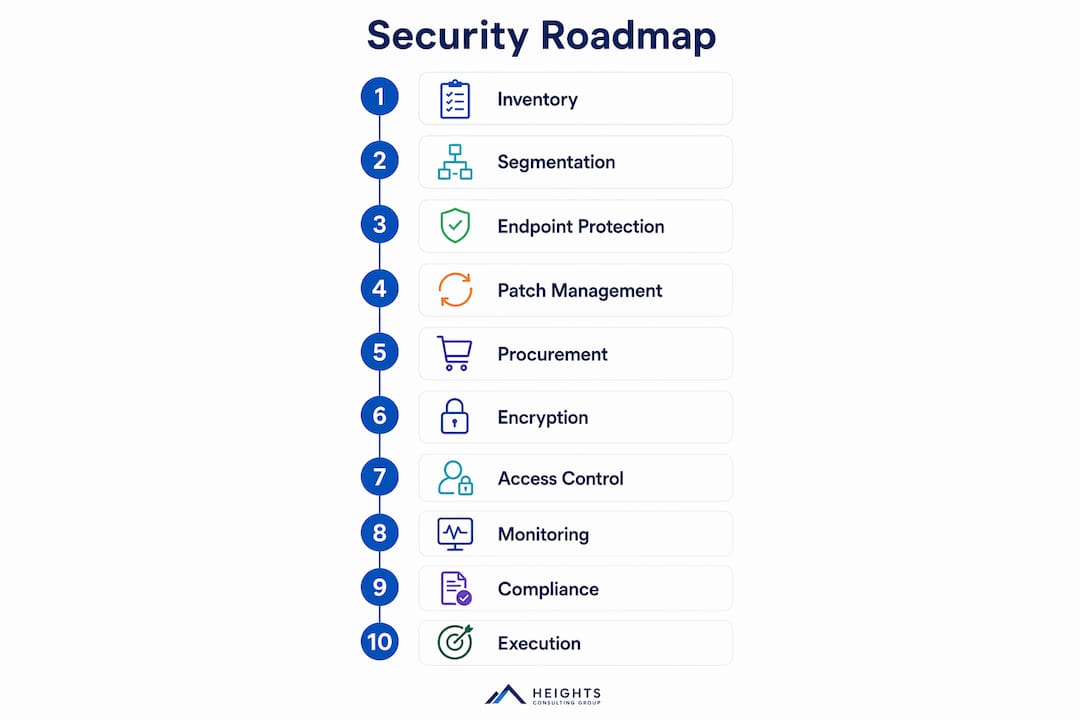
- 1. Build a complete medical-endpoint inventory and prioritize risk
- 2. Segment networks and restrict who and what can talk to medical endpoints
- 3. Choose and tune endpoint protection for healthcare constraints
- 4. Patch, scan, and manage vulnerabilities when patching is not always possible
- 5. Secure medical devices and IoMT through procurement and lifecycle controls
- 6. Encrypt data at rest and in transit and harden device storage
- 7. Control access with IAM, privileged access management, and break-glass procedures
- 8. Monitor continuously, hunt threats, and respond to endpoint incidents
- 9. Align policies and documentation to HIPAA and HHS 405(d)
- 10. Execute a prioritized 90-day roadmap with clear cost buckets
- Key Takeaways
- The controls that matter most are the ones organizations skip first
- Heightscg can accelerate your medical endpoint security program
- Authoritative references and further reading
1. Build a complete medical-endpoint inventory and prioritize risk
You cannot protect what you cannot see. A full asset inventory is the prerequisite for every control in this guide, and it is the first artifact auditors request under HIPAA and HHS 405(d).
Discovery approaches
Passive network discovery tools capture device fingerprints without disrupting clinical operations. Combine that with DHCP/ARP scans, MDM/UEM exports, vendor-supplied device lists, and physical asset-tag validation. No single method catches everything. A healthcare risk assessment methodology that layers these sources typically surfaces devices that IT had no record of, particularly older infusion pumps and monitoring equipment.
Classification fields every inventory record needs:
| Field | Purpose |
|---|---|
| Device class | Life-support, diagnostic, monitoring, administrative |
| Patchability | Vendor-supported, end-of-life, unpatchable |
| Vendor management plane access | Remote update, telemetry, remote support |
| Clinical impact | Which workflows stop if this device fails |
| Serial / firmware / software version | Audit evidence and vulnerability matching |
| Business associate relationship | BAA status and control-plane owner |
| Last patch date | Compliance timeline evidence |
Risk scoring matrix
Score each device on four axes: clinical criticality (patient harm if unavailable), exploitability (patchable vs. unpatchable, known CVEs), vendor control-plane exposure (can a vendor push fleet-wide changes?), and data sensitivity (does it store or transmit PHI?). Multiply criticality by exploitability to get a priority tier. Life-support devices with unpatchable firmware and remote vendor access sit in Tier 1 regardless of their CVE score.
30/60/90-day discovery plan:
- Days 1–30: passive discovery, DHCP/ARP scans, MDM export, and vendor inventory reconciliation
- Days 31–60: classify all discovered devices, assign risk scores, identify Tier 1 assets
- Days 61–90: populate the full inventory table, document BAA relationships, and present evidence package to compliance team
The inventory table is living documentation. Assign an owner for each device class and set a regular review cadence.
2. Segment networks and restrict who and what can talk to medical endpoints
Network segmentation limits how far an attacker can move after compromising a single device. In a flat network, one infected infusion pump can reach the EHR, the pharmacy system, and the vendor management plane. Segmentation makes that lateral path expensive and detectable.

Design principles
Isolate clinical OT/IoMT networks from enterprise IT and guest networks. Apply least-privilege traffic flows: clinical devices should communicate only with the specific servers they need, using explicit allow lists. Every other connection should be denied by default. The NIST NCCoE's guidance on securing wireless infusion pumps demonstrates this architecture using network segmentation, firewall rules, and certificate-based authentication as layered controls.
Technical controls:
- VLANs to separate clinical, administrative, and guest traffic
- Software-defined segmentation for dynamic policy enforcement
- Network Access Control (NAC) to authenticate devices before granting network access
- Host-based firewalls on gateways and jump hosts
- Encrypted tunnels (mTLS or VPN) for all vendor remote access sessions
- Disable unused ports on all clinical devices; block Telnet and FTP at the network layer
Operational controls
Vendor remote access is one of the highest-risk entry points in healthcare networks. Require vendors to connect through a dedicated jump host with session recording enabled. Implement multi-party approval for any destructive vendor action, such as firmware updates or remote wipe commands. Standing vendor VPN access should not exist; use time-limited, just-in-time sessions instead.
AI-enabled network monitoring can detect anomalous device-to-control-plane communication patterns — such as a pump initiating outbound connections to an unexpected IP — far faster than signature-based tools. Deploying ML-based anomaly detection on clinical network segments provides early warning for both compromised devices and unauthorized vendor activity.
Pro Tip: When designing segmentation for a medium-sized hospital, start with a single high-risk device class (infusion pumps or imaging systems) as a pilot. Validate the allow list, confirm clinical workflows are unaffected, then expand to the next class. A phased rollout prevents the operational disruption that kills segmentation projects.
3. Choose and tune endpoint protection for healthcare constraints
Standard enterprise EDR configurations can disrupt clinical workflows. Locking out an account after failed authentication attempts is acceptable on a corporate laptop; on a bedside monitor mid-procedure, it is a patient safety event. Endpoint protection for medical environments requires deliberate tuning.
Essential features to require from any EDR or endpoint protection platform:
- Low-impact telemetry sensors that do not degrade device performance
- Offline forensics capability for devices that lose network connectivity
- Application allow-listing and application control to block unauthorized executables
- Tamper protection to prevent local disabling of the agent
- Integration with SIEM for SOC use cases and threat hunting workflows
Compatibility with legacy and constrained devices
Many medical devices cannot accept third-party endpoint agents. Infusion pumps, for example, are validated devices with fixed configurations, and adding third-party security software can void the manufacturer's validation. For these devices, shift protection to the network layer: use network-based intrusion detection, gateway-level application control, and micro-segmentation as compensating controls. Where agents are deployable, deploy them. Where they are not, document the compensating controls as evidence for HIPAA audits.

Operational tuning
Build baseline whitelists from observed clinical workflows before enabling block mode. False positives in a clinical environment are not just an IT inconvenience; they can interrupt care delivery. Establish a tuning period of 30 days in monitor-only mode, review alerts with clinical operations staff, and only then enforce blocking. Retain telemetry for a minimum of 90 days to support forensic timelines.
AI in endpoint protection
ML-based anomaly detection in modern EDR platforms can surface behavioral deviations that signature-based tools miss entirely. The governance requirement is that the model's outputs must be explainable and auditable. Before deploying an AI-driven detection capability, confirm the vendor can articulate how the model flags an alert, what training data it used, and how false-positive rates are measured. Unexplained AI outputs in a clinical environment create liability, not security.
Pro Tip: Integrate EDR telemetry directly into your SOC's SIEM from day one. Telemetry that sits in a standalone console without correlation to other event sources is detection capability that never gets used. The threat detection platforms that deliver the most value in healthcare are those wired into a 24/7 monitoring workflow.
4. Patch, scan, and manage vulnerabilities when patching is not always possible
Vulnerability management in healthcare is not a standard IT patching cycle. Many medical devices run operating systems the vendor no longer supports, and patching requires vendor coordination, clinical downtime windows, and post-patch validation. The workflow must account for all of that.
Vulnerability lifecycle steps:
- Discovery: run authenticated and unauthenticated scans using tools that handle medical device protocols; supplement with vendor CVE advisories
- Risk scoring: apply CVSS scores adjusted for clinical context (a critical CVE on an unpatchable life-support device scores higher than the same CVE on an administrative workstation)
- Validation and testing: test patches in a staging environment or on a non-production device before clinical rollout
- Staged rollout: patch by device class, starting with administrative endpoints, then diagnostic, then life-support with scheduled downtime windows
- Verification: confirm patch application and document the result for audit evidence
- Exception handling: for unpatchable devices, open a formal exception with documented compensating controls and a review date
Compensating controls for unpatchable devices:
- Microsegmentation to restrict device communication to known-good endpoints only
- Host-based firewall rules at the gateway level to block exploit paths
- Device-specific access proxies that inspect and filter traffic
- Credential rotation for any accounts associated with the device's management interface
Timelines and SLAs
Align patch SLAs to device criticality. Administrative endpoints follow standard critical and high priority timelines, and clinical diagnostic devices may require extended windows to coordinate vendor validation. Life-support devices with unpatchable firmware require documented compensating controls within 30 days of CVE publication and a vendor remediation commitment in writing.
Escalation to procurement
When a vendor cannot or will not patch a critical CVE within an acceptable window, that is a procurement and contract issue, not just a technical one. Contracts should require vendors to disclose CVEs within a defined timeframe and commit to remediation SLAs. If a vendor refuses, that refusal belongs in the risk register and the device replacement roadmap.
5. Secure medical devices and IoMT through procurement and lifecycle controls
The vendor management plane is the highest-leverage attack surface in a medical device fleet. A compromised control plane can push firmware updates, collect telemetry, or execute remote commands across every device in a fleet simultaneously. Standard vendor questionnaires miss this risk entirely because they focus on data-plane security and ignore the update, telemetry, and remote-support channels.
Procurement clauses to require in every device contract:
- Vulnerability disclosure timelines: vendor must notify the organization within a defined period (typically 30 days) of any CVE affecting the device
- Secure update mechanisms: updates must be cryptographically signed and delivered over encrypted channels
- Software Bill of Materials (SBOM): full component transparency so the organization can assess third- and fourth-party dependencies
- Incident notification obligations: vendor must notify the organization within 24 hours of a security incident affecting the device or its management platform
- Control-plane access restrictions: vendor remote access to the management plane must require organization approval and be logged
Per HHS 405(d) medical device guidance, adding security terms to device contracts and treating devices as specialized IoT with explicit lifecycle controls materially reduces risk across the device lifecycle.
Lifecycle management
| Phase | Key controls |
|---|---|
| Procurement | Security clauses, SBOM, control-plane assessment |
| Onboarding | Configuration hardening, default credential removal, network placement |
| Operations | Patch coordination, access reviews, telemetry monitoring |
| Updates | Staged rollout, vendor validation, post-update verification |
| Decommissioning | Data wipe, credential revocation, inventory update |
Vendor governance
Map third- and fourth-party dependencies for every critical device. Identify which vendors, if unavailable for 3–5 days, would stop patient care. Run regular tabletop exercises that include a vendor-total-loss scenario for those dependencies. Require periodic written attestations from vendors confirming their technical safeguards are current.
Pro Tip: Structure purchase orders and Business Associate Agreements to force manufacturer accountability. A BAA that only covers data handling but says nothing about the control plane leaves the organization exposed to fleet-wide destructive actions without any contractual recourse. For healthcare startups navigating device procurement compliance, this contract language is often the most overlooked gap.
6. Encrypt data at rest and in transit and harden device storage
Encryption is a HIPAA technical safeguard and an HHS 405(d) base-level control. For medical endpoints, the practical challenge is implementing encryption without breaking clinical availability or violating device validation requirements.
Minimum encryption expectations:
- Full-disk or file-level encryption on all endpoints where the operating system supports it
- TLS 1.2 or higher for all data in transit between devices, servers, and management platforms
- mTLS or VPN for all vendor remote access sessions
- WPA2 (at minimum) for all wireless clinical device connections, per NIST FIPS 140-2 validated cryptographic modules
- Encrypted backups with restoration tested quarterly
- Encrypted portable media for any removable storage used with clinical devices
Key management
Centralize key management with separation of duties: the team that manages encryption keys should not be the same team that manages the devices those keys protect. Establish rotation policies for keys used by device management platforms, and document the rotation schedule as audit evidence. Keys stored on the device itself, without a centralized management system, are a single point of failure.
Logging and telemetry
Secure logging requires balancing detection needs against PHI privacy. Telemetry collected from clinical devices may contain patient identifiers. Define what telemetry fields are collected, where they are stored, how long they are retained, and who can access them. Retain security logs for a minimum of one year, with 90 days immediately accessible, to meet HIPAA breach investigation timelines.
Audit validation checklist
During audits, confirm: encryption is enabled and verified on all in-scope devices, TLS certificates are current and not self-signed on production systems, backup encryption keys are stored separately from backup data, and portable media controls are documented and enforced.
7. Control access with IAM, privileged access management, and break-glass procedures
Standing administrative accounts on medical device management platforms are a critical vulnerability. A single compromised credential with standing admin access can affect every device that account manages. The fix is just-in-time privilege elevation combined with phishing-resistant authentication.
Controls to enforce:
- JIT privilege elevation: admin access is granted for a defined session, then automatically revoked
- Phishing-resistant MFA (FIDO2 hardware keys or certificate-based authentication) for all admin and vendor accounts — SMS and push based MFA are vulnerable to vishing-based credential theft
- Role-based access mapped to clinical roles: a biomedical engineer does not need the same access as a network administrator
- Session recording for all privileged sessions on device management platforms
- Separation of duties between clinical support accounts and vendor support accounts
Removing standing administrative accounts is one of the highest-impact controls an organization can implement. HHS 405(d) endpoint protection systems guidance explicitly recommends eliminating standing admin accounts and automating endpoint provisioning as core protections. An account that does not exist cannot be compromised.
Break-glass procedures
Emergency access to clinical systems must be controlled, not eliminated. Define a break-glass process that requires two-person approval, generates an immediate alert to the security team, and creates a full audit trail. Post-event review of every break-glass activation should be mandatory. The procedure should be documented, tested in tabletop exercises, and known to clinical operations staff before an emergency occurs.
Migration checklist for standing admin accounts:
- Inventory all accounts with standing admin access to device management platforms
- Map each account to a named individual and a business justification
- Implement JIT elevation for each account using a PAM platform
- Revoke standing access and validate JIT workflow with each account owner
- Enable session recording and alert on any attempt to use a revoked standing credential
Pro Tip: Credential rotation for vendor support accounts is frequently overlooked. Vendors often retain credentials from initial device setup for years. Require vendors to use your organization's JIT access process rather than maintaining their own persistent credentials.
8. Monitor continuously, hunt threats, and respond to endpoint incidents
Detection without response is just logging. The goal is a monitoring program that surfaces anomalous device behavior, feeds a response workflow, and produces evidence that satisfies HIPAA breach investigation requirements.
Detection priorities for medical endpoints:
- Anomalous admin actions: privilege escalation outside approved JIT windows, access from unexpected locations
- Unexpected firmware updates: any firmware change not initiated through the approved change management process
- Unusual vendor control-plane activity: vendor connections outside approved maintenance windows or to unexpected device groups
- Remote-wipe or remote-configuration commands: any command that could alter device state at scale
- Lateral movement indicators: a clinical device initiating connections to systems outside its approved allow list
Pro Tip: Wire device telemetry into your SIEM and build correlation rules specifically for clinical device behavior. A pump that has never initiated an outbound connection suddenly doing so is a high-fidelity alert. Generic IT correlation rules miss these signals entirely because they are tuned for workstation and server behavior.
Runbook: endpoint incident response
- Containment: isolate the affected device from the network at the switch port or VLAN level; do not power off (preserves forensic evidence)
- Clinical fallback: activate manual or paper-based clinical processes for affected workflows; notify clinical operations immediately
- Evidence preservation: capture network logs, device telemetry, and access logs before any remediation; document timestamps for HIPAA breach timeline
- Vendor coordination: notify the device vendor within the timeframe specified in the contract; request their incident response support
- Root cause analysis: determine whether the incident involved the data plane, the control plane, or both
- Recovery: restore from a validated backup or vendor-provided clean image; verify device integrity before returning to clinical use
- Post-incident review: document findings, update runbooks, and report to compliance within HIPAA's 60-day breach notification window if PHI was involved
The Stryker incident analysis makes a point that applies broadly: vendor dependencies that can stop care for 3–5 days must be treated as first-order risks. Testing full vendor outage scenarios in tabletop exercises, rather than relying on vendor SLAs, is the only way to know whether your organization can actually recover.
AI in threat hunting
AI-driven analytics can surface abnormal device behavior patterns that no human analyst would catch by reviewing logs manually. The governance requirement is that AI outputs must be validated before triggering automated responses. Define a human-in-the-loop review step for any AI-generated alert that would result in device isolation or access revocation. Healthcare organizations must also manage shadow AI — unauthorized AI tools used by staff that expand the attack surface without governance controls.
9. Align policies and documentation to HIPAA and HHS 405(d)
Controls without documentation are not controls for audit purposes. HIPAA requires written policies, evidence of implementation, and records of training. HHS 405(d) and the HICP technical volumes provide a ten-practice framework that maps directly to the controls in this guide.
Policy essentials:
- Asset inventory policy: discovery cadence, classification criteria, ownership assignments, and review schedule
- Vulnerability management policy: scanning cadence, SLAs by device class, exception process, and compensating control requirements
- Vendor remote access policy: JIT access requirements, session recording, multi-party approval for destructive actions
- Encryption and retention policy: minimum standards, key management, and log retention windows
- Incident response playbook: tied to HIPAA's 60-day breach notification timeline, with device-specific runbooks
Compliance crosswalk
| Control | HHS 405(d) Practice | NIST SP 800 Reference |
|---|---|---|
| Asset inventory | Practice 9: Network-connected medical devices | NIST SP 800-213 |
| Endpoint protection (EDR, AV) | Practice 2: Endpoint protection | NIST cybersecurity framework SI-3 |
| Patching | Practice 7: Vulnerability management | NIST SP 800 guidance |
| MFA / PAM | Practice 3: Access management | NIST SP 800 guidelines |
| Encryption | Practice 4: Data protection | NIST SP 800 documents |
| Monitoring / IR | Practice 8: Security operations and IR | NIST SP 800-61 |
Evidence auditors expect:
- Inventory exports with all required fields, dated within the last 90 days
- Patch rollout logs showing device, patch applied, date, and approver
- JIT access audit trails showing session start, end, and actions taken
- Vendor attestations confirming annual technical safeguard verification
- Tabletop exercise reports, including vendor-total-loss scenarios
- BAA documentation that covers control-plane access restrictions
For a structured approach to regulatory compliance alignment, the HICP technical volumes are the most practical starting point for healthcare organizations mapping controls to HHS expectations.
10. Execute a prioritized 90-day roadmap with clear cost buckets
Security leaders need a plan they can resource and defend to the board. The following roadmap prioritizes controls by impact and implementation speed, not by technical elegance.
Days 1–30 (quick wins, low cost):
- Launch passive network discovery and begin device inventory
- Enforce phishing-resistant MFA for all vendor and admin accounts
- Isolate vendor management planes from the enterprise network
- Validate that all backups are current, encrypted, and restorable
- Document all standing admin accounts and begin JIT migration planning
Days 31–60 (medium effort, medium cost):
- Deploy or expand EDR telemetry across all patchable endpoints
- Implement VLAN segmentation for the highest-risk device class (start with one)
- Run a vendor-total-loss tabletop exercise for your top three clinical dependencies
- Begin procurement contract review and add security clauses to any active renewals
- Establish vulnerability scanning cadence and assign patch SLAs by device class
Days 61–90 (higher effort, higher investment):
- Complete segmentation rollout to all clinical device classes
- Implement PAM platform for JIT privilege elevation
- Finalize policy documentation suite and submit for compliance review
- Conduct a full HIPAA technical safeguard audit with evidence package
- Identify devices requiring replacement due to unpatchable critical vulnerabilities
Cost buckets
| Bucket | Examples | Approximate scope |
|---|---|---|
| Low (policy and configuration) | MFA enforcement, segmentation rules, policy documentation | Internal labor, minimal tooling cost |
| Medium (tools and sensors) | EDR deployment, PAM platform, vulnerability scanner | Per-seat or per-device licensing |
| High (replacement and managed services) | Legacy device replacement, vendor remediation, managed SOC | Capital and ongoing service cost |
Pro Tip: Present the roadmap to the board as a risk-reduction timeline, not a technology project. Frame each 30-day milestone as a measurable reduction in the probability of a PHI breach or clinical disruption. Executives approve budgets for outcomes, not tools.
Key Takeaways
Securing medical endpoints requires a layered program that starts with inventory and identity controls, then builds toward detection, response, and procurement accountability.
| Point | Details |
|---|---|
| Inventory first | A complete, classified asset inventory is the prerequisite for every other control and the first evidence auditors request. |
| Identity is the highest-leverage control | Phishing-resistant MFA and JIT privilege elevation for admin accounts close the most probable high-impact attack paths. |
| Vendor control planes are first-order risks | Assess and restrict vendor management plane access separately from data-plane security; test 3–5 day vendor outage scenarios. |
| Compensating controls for unpatchable devices | Microsegmentation, gateway firewall rules, and documented exceptions are required for devices that cannot be patched. |
| Heightscg delivers the full program | Heightscg provides inventory assessments, PAM/JIT implementation, SOC/EDR integration, and compliance documentation for healthcare endpoint programs. |
The controls that matter most are the ones organizations skip first
Healthcare security teams tend to invest in perimeter tools and underinvest in identity and inventory. The pattern is consistent: a hospital deploys a next-generation firewall, purchases an EDR platform, and then leaves vendor management plane access wide open with standing credentials that have not rotated in three years. The firewall and the EDR are real controls. But the vendor plane is the path an attacker will take, because it is the path of least resistance.
The Stryker incident reinforced a point that practitioners have known for years: the most dangerous attack surface in a healthcare environment is not the device itself. It is the infrastructure that manages the device. An attacker who compromises a vendor's management platform does not need malware on individual devices. They already have fleet-wide access. That is a fundamentally different threat model than the one most endpoint protection strategies are built for.
The practical implication is that procurement and identity controls deserve the same investment as detection tools. A contract that does not address the control plane, and an admin account that does not require phishing-resistant authentication, are gaps that no amount of EDR telemetry will compensate for. The AI-driven threat hunting capabilities now available to healthcare security teams are genuinely useful, but they surface threats that already got in. The goal is to make getting in harder first.
For security leaders building the case for investment, the 90-day roadmap in this guide is designed to produce measurable, auditable outcomes at each milestone. That structure matters because it converts a security program into evidence, and evidence is what sustains budget approval and satisfies regulators.
Heightscg can accelerate your medical endpoint security program
Healthcare organizations that need to move from a fragmented endpoint posture to a documented, auditable program in 90 days have a concrete alternative to building that capability entirely in-house. Heightscg delivers technical cybersecurity consulting specifically structured for regulated environments, with deliverables that satisfy both operational and compliance requirements.
An engagement with Heightscg typically produces a complete device inventory with risk scores, a prioritized remediation roadmap, policy documentation aligned to HIPAA and HHS 405(d), PAM/JIT implementation support, SOC/EDR integration, and tabletop exercise facilitation including vendor-total-loss scenarios. The 90-day sprint model means security leaders can show measurable progress to the board within a single quarter. For organizations managing 24/7 endpoint monitoring requirements without sufficient internal SOC capacity, Heightscg's managed security services extend detection and response coverage without the overhead of building a full internal team.
To discuss a medical endpoint security assessment or a 90-day remediation program, contact Heightscg directly.
Authoritative references and further reading
The sources below are the primary references for compliance alignment, procurement guidance, and technical controls in this guide. Use them as source-of-truth documents for tabletop exercises, auditor evidence packages, and procurement contract development.
- HHS 405(d) Endpoint Protection Poster: concise operational prescriptions for encryption, MFA, patching, and reporting — the single-page reference auditors recognize immediately
- HHS 405(d) Medical Device Security Poster: procurement clause guidance and lifecycle control recommendations for connected medical devices
- HHS 405(d) Endpoint Protection Systems Poster: specific guidance on removing admin accounts, automated patching, EDR, and MDM
- HICP Technical Volumes (HHS): the ten-practice framework for healthcare cybersecurity; the compliance crosswalk in this guide maps directly to these volumes
- NIST SP 800-213: IoT Device Cybersecurity Guidance: federal framework for identifying device cybersecurity requirements and assessing IoT device securability
- NIST NCCoE SP 1800-8: Securing Wireless Infusion Pumps: reference architecture for defense-in-depth in clinical device environments, including network segmentation, application whitelisting, and certificate-based authentication
- NIST IR 8259: Foundational Cybersecurity Activities for IoT Manufacturers: manufacturer-side guidance on vulnerability management, access control, and data protection for IoT products
- Censinet: The Stryker Cyberattack Analysis: practitioner analysis of vendor control-plane risk, identity controls, and vendor-total-loss tabletop requirements
- Forbes: AI Cybersecurity Risks for Healthcare: governance considerations for shadow AI and AI-driven defensive tools in healthcare environments
- Heightscg: Endpoint Security Best Practices: operational checklists and deployment patterns for healthcare endpoint controls
- Heightscg: AI Integration in Healthcare Security: consultant perspectives on governing AI-driven detection tools in clinical environments