

TL;DR:
- Regulatory compliance requires documented evidence that organizations meet legal and industry standards, not just intentions or verbal commitments.
- Most failures stem from governance gaps, data ownership issues, and lack of accountability structures, especially in AI deployment.
Regulatory compliance is not simply a matter of following rules. For organizations in regulated industries, it represents the systematic, documented proof that your operations consistently meet legal, contractual, and industry-specific requirements. US regulators issued nearly $270 million in fines across five agencies in just the first quarter of 2026. That number reflects a clear enforcement trajectory, and it signals that executives who treat compliance as a back-office function are accepting risk that regulators are no longer willing to overlook.
Table of Contents
- Key takeaways
- What is regulatory compliance, and what does it actually include
- Compliance challenges in the AI and digital transformation era
- How to build an effective compliance governance framework
- Examples of regulatory compliance requirements and enforcement trends
- Integrating compliance into strategic business operations
- My perspective on what most organizations get wrong about compliance
- How Heightscg helps organizations build compliance resilience
- FAQ
Key takeaways
| Point | Details |
|---|---|
| Compliance is evidence, not intent | Organizations must demonstrate adherence through documented policies, controls, and audit trails. |
| Governance gaps drive failures | Most compliance failures trace back to accountability and data lineage issues, not technology shortfalls. |
| AI amplifies regulatory exposure | Deploying AI without governance structures creates compounding regulatory risk across data privacy and operational resilience. |
| Strategic integration pays off | Organizations that embed compliance into operations are significantly more likely to meet transformation goals. |
| Automation reduces burden | Properly governed automated monitoring can cut manual compliance effort substantially, freeing teams for governance work. |
What is regulatory compliance, and what does it actually include
The definition of regulatory compliance goes beyond a checklist. Compliance is consistent evidence an organization meets regulatory expectations, demonstrated through policies, controls, and documentation that hold up under scrutiny. That distinction matters enormously. Intent without documentation is not compliance. Verbal commitment without audit trails is not compliance.
In practice, regulatory compliance in business spans several interconnected components:
- Policies and procedures: Written frameworks that define how the organization behaves in regulated areas, from data handling to access control.
- Technical controls: Implemented safeguards that enforce policy requirements, such as encryption, access logging, and data classification.
- Documentation and recordkeeping: Evidence files, audit logs, and change records that demonstrate controls were applied consistently over time.
- Training programs: Regular, role-specific training that shows employees understand their obligations.
- Monitoring and testing: Ongoing processes that detect deviations before regulators do.
- Reporting mechanisms: Internal and external reporting structures that surface violations and corrective actions in a timely manner.
What are compliance standards? They are the specific frameworks that define what organizations in particular industries must demonstrate. GDPR governs personal data processing for organizations handling EU resident data. HIPAA sets privacy and security requirements for US healthcare entities and their business associates. SOC 2 establishes trust service criteria for technology service providers. ISO 27001 defines requirements for an information security management system. CMMC applies to defense contractors handling controlled unclassified information. Each framework carries distinct requirements, but all of them share one demand: evidence.
The governance versus compliance distinction is worth understanding clearly. Governance defines the decision-making structures, accountabilities, and oversight mechanisms an organization uses to direct itself. Compliance is the outcome those governance structures are designed to produce. Without governance, compliance becomes reactive and fragile. The two functions are not interchangeable, but they must be integrated to work.
Pro Tip: When preparing for an audit, organize your evidence files by control objective, not by document type. Auditors evaluate whether controls achieved their intent, so structuring evidence to map directly to control requirements saves significant time and reduces the risk of incomplete submissions.
Compliance challenges in the AI and digital transformation era
The challenges in regulatory compliance have changed significantly as organizations adopt AI systems and accelerate digital transformation. AI introduces regulatory risk at a different layer than traditional technology. It raises questions about accountability, data lineage, explainability, and bias that most existing compliance frameworks were not designed to answer directly.

Most compliance failures stem from lack of clarity in data lineage, scope, and operational accountability, not from technology gaps or too few tools. This finding reframes the problem. Organizations that respond to compliance pressure by purchasing more software without addressing governance structures are addressing the symptom while ignoring the cause.
Several failure patterns repeat consistently across regulated industries:
- Unclear data ownership: AI systems trained on organizational data frequently lack documented lineage, making it impossible to demonstrate GDPR or CCPA compliance when regulators ask where the data originated.
- Accountability gaps: When an AI system makes a consequential decision, whether denying a loan or flagging a security event, organizations often cannot identify who is responsible for reviewing or overriding that output.
- Scope creep in data use: Systems deployed for one purpose accumulate data inputs over time that were never assessed for compliance implications.
- Insufficient operational resilience controls: Regulators are increasingly examining whether organizations can maintain compliant operations during disruptions, not just during normal conditions.
"The real compliance crisis is a governance crisis. Organizations are deploying capable technology without building the accountability structures that regulators expect to find." Source: Forbes, 2026
The enforcement data makes the stakes concrete. Beyond the aggregate Q1 2026 figures, California secured a $12.75 million CCPA settlement in May 2026 over data minimization violations. That settlement is notable because data minimization is an operational discipline, not a technology problem. It requires governance decisions about what data to collect, how long to retain it, and who has authority to approve exceptions.
Why is compliance necessary in the AI era? Because regulators are not waiting for governance practices to catch up with deployment timelines. Organizations that build AI capabilities without corresponding accountability structures face exposure across data privacy, operational risk, and consumer protection frameworks simultaneously.
How to build an effective compliance governance framework
Compliance costs for financial institutions have nearly doubled to $61 billion, yet many organizations capture only a fraction of the expected benefits from digital transformation because compliance is not built into the delivery process. The cost of compliance is real. The cost of failed transformation due to late-stage compliance intervention is often larger.
An effective compliance governance framework includes these structural elements:
| Governance focus | Compliance focus |
|---|---|
| Accountability structures and roles | Controls that enforce policy requirements |
| Risk appetite and decision authority | Documentation proving controls were applied |
| Board and executive oversight | Audit readiness and evidence management |
| Strategic risk assessments | Regulatory reporting and incident response |
| Policy ownership and review cycles | Training completion and gap remediation |
Building that framework into operational practice requires deliberate capacity allocation. Dedicating approximately 30% of delivery capacity to compliance-related activities embeds compliance into the business cadence rather than treating it as a project that competes with other priorities. This is the difference between compliance as a function and compliance as an operational discipline.
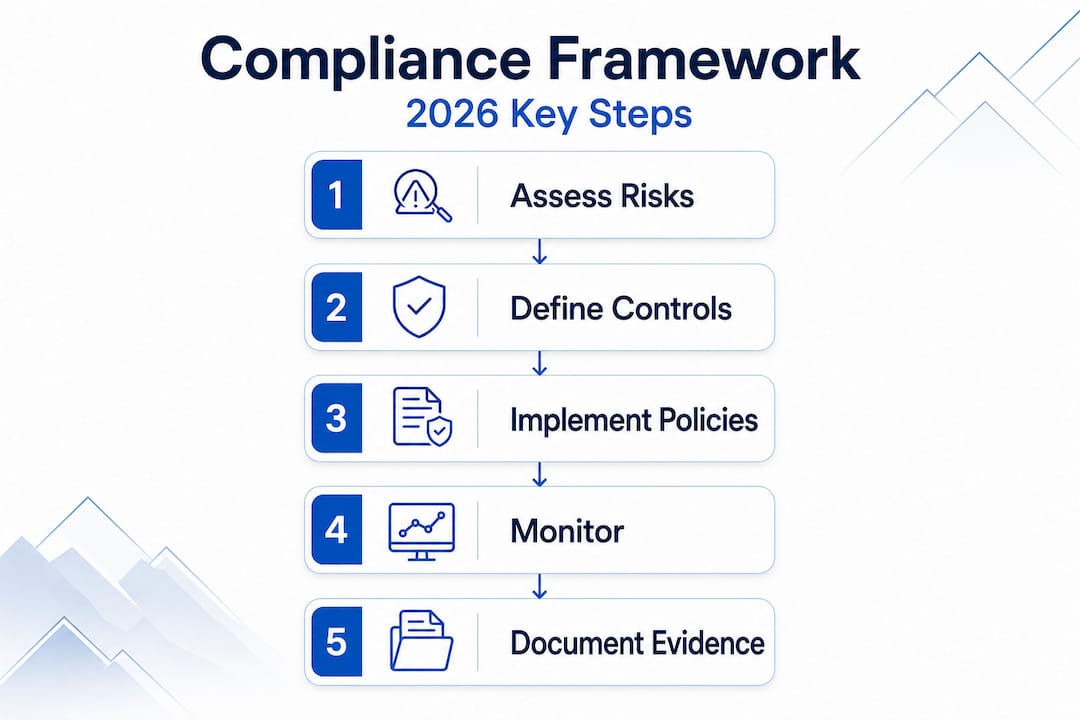
Automated monitoring changes the economics of ongoing compliance. Automated monitoring can reduce manual compliance effort by up to 70%, which means compliance teams can redirect significant capacity toward governance analysis, risk assessments, and exception handling rather than evidence collection. Organizations that have made this shift report faster audit cycles and fewer last-minute remediation efforts.
Evidence management deserves specific attention. Most regulated organizations can demonstrate point-in-time compliance but struggle to show continuous compliance over a defined period. Regulators are increasingly interested in the latter. Continuous monitoring tools that log control performance automatically, combined with periodic control testing and structured exception documentation, create the evidence base that auditors need without requiring manual assembly under time pressure.
Pro Tip: Treat your compliance documentation the same way you treat your financial records. If your evidence cannot reconstruct exactly what controls were in place on a specific date and whether they operated effectively, it will not satisfy a regulatory review.
Examples of regulatory compliance requirements and enforcement trends
Understanding the definition of regulatory compliance becomes more concrete when grounded in specific regulatory compliance requirements and what enforcement actually looks like.
-
HIPAA security rule compliance requires covered entities and business associates to implement administrative, physical, and technical safeguards protecting electronic protected health information. A hospital that deploys an AI-assisted diagnostic tool must assess whether that tool's data handling meets HIPAA requirements before deployment, not after a breach.
-
GDPR data subject rights require organizations to respond to access and deletion requests within defined timeframes. A technology company that uses customer data to train AI models must document a lawful basis for that processing and demonstrate it can honor deletion requests without compromising model performance.
-
SOC 2 Type II reporting requires organizations to demonstrate that controls operated effectively over a minimum period, typically six or twelve months. A SaaS provider seeking enterprise clients increasingly needs a SOC 2 Type II report as a baseline vendor qualification requirement.
-
CCPA enforcement has escalated materially. The $12.75 million data minimization settlement established that California's enforcement posture has moved well beyond warning letters. Organizations collecting consumer data must document their minimization practices with the same rigor they apply to their security controls.
-
CMMC Level 2 certification requires defense contractors to demonstrate 110 security practices aligned with NIST SP 800-171. This is not a self-attestation framework. It requires third-party assessment and ongoing compliance maintenance.
The pattern across these examples is consistent. Regulators are examining whether organizations made deliberate governance decisions about data, risk, and accountability, and whether those decisions are documented. The 2026 compliance enforcement surge reflects a maturing regulatory environment where documentation gaps and governance failures carry financial consequences.
For executives managing compliance priorities in 2026, the essential focus areas are: data inventory and classification, third-party risk assessments, AI governance documentation, access control reviews, incident response testing, and continuous monitoring coverage. Each of these is a governance decision, not a technology purchase.
Integrating compliance into strategic business operations
Organizations that treat compliance as a strategic component rather than a constraint see materially different outcomes. Treating compliance strategically makes organizations seven times more likely to meet their digital transformation goals. That figure reflects something straightforward: projects that encounter compliance requirements at the end of development cycles face rework, delays, and sometimes fundamental redesign. Projects that assess compliance requirements at the design stage do not.
Strategic integration of compliance by design means several things in practice:
- Compliance requirements are assessed during project scoping, not during user acceptance testing.
- Risk and legal teams participate in architecture reviews for systems that handle regulated data or make consequential automated decisions.
- AI and automation tools are evaluated for governance implications before procurement, with documented accountability structures assigned prior to deployment.
- Compliance metrics are reported to executive leadership with the same regularity as financial and operational metrics.
The tradeoffs are real. Moving compliance review earlier in a delivery cycle creates friction at the design stage. But that friction is far less costly than discovering a fundamental compliance gap three weeks before a product launch. Leaders who have made this tradeoff deliberately report that the upfront governance investment reduces total compliance cost over a project lifecycle.
AI and automation can genuinely support compliance when properly governed. Automated control testing, continuous log analysis, and AI-assisted risk scoring reduce the manual burden on compliance teams. The governance requirement is that these tools operate within defined parameters, with human review for exceptions and documented accountability for their outputs.
Pro Tip: When deploying AI tools to support compliance functions, document the tool's decision logic, the human review process for exceptions, and the criteria for escalation. Regulators examining your compliance program will ask these questions, and the answers need to exist before an inquiry begins.
My perspective on what most organizations get wrong about compliance
I've worked with organizations across heavily regulated sectors long enough to recognize the same fundamental misunderstanding recurring at different levels of maturity. Most leadership teams know compliance is necessary. Far fewer treat it as an operational discipline with the same rigor they apply to financial reporting or delivery management.
What I've found is that the organizations under the most compliance pressure are often the ones that responded to that pressure by adding tools. More scanning software. More dashboards. More vendor-provided reports. And yet the exposure persists, because the underlying issue is almost never the technology. It's the absence of clear ownership, documented accountability structures, and honest conversations between compliance and business teams about risk.
The compliance programs I've seen succeed consistently share one characteristic: leadership that treats a compliance conversation as a risk conversation, not a legal formality. When an executive asks the compliance function to flag risks rather than just confirm requirements are met, the entire program shifts from defensive to genuinely protective.
Reactive compliance is expensive in ways that don't show up in the fine totals. It blocks innovation at the worst possible moment, creates adversarial relationships between compliance and delivery teams, and produces documentation that reflects what the organization wishes had happened rather than what actually did. Embedding compliance earlier, with honest documentation practices and genuine governance accountability, is the only approach that produces durable resilience rather than periodic attestations.
— Dan
How Heightscg helps organizations build compliance resilience
Heightscg works with organizations in regulated industries to build compliance programs that hold up under regulatory scrutiny and support business operations rather than constrain them. The firm's approach integrates cybersecurity compliance consulting with AI governance advisory, addressing the governance gaps that drive most compliance failures today. Whether your organization needs a structured risk assessment, continuous monitoring architecture, or a clear path to CMMC, SOC 2, or NIST alignment, Heightscg brings the operational experience to translate framework requirements into documented, auditable controls. Explore the 2026 compliance checklist for executives or contact Heightscg directly to discuss your organization's compliance maturity and where the highest-priority gaps exist.
FAQ
What is the definition of regulatory compliance?
Regulatory compliance is the process by which an organization demonstrates, through documented policies, controls, and evidence, that it consistently meets the legal, regulatory, and industry requirements applicable to its operations. It is distinct from governance, which defines the accountability structures that produce compliance.
Why is compliance necessary for regulated businesses?
Compliance is necessary because regulators impose financial penalties, operational restrictions, and reputational consequences on organizations that fail to meet applicable standards. US regulators issued nearly $270 million in fines in Q1 2026 alone, illustrating the direct financial risk of non-compliance.
What are common examples of regulatory compliance requirements?
Common examples include HIPAA security safeguards for healthcare organizations, GDPR data processing obligations for entities handling EU resident data, SOC 2 Type II reporting for technology service providers, CCPA consumer rights compliance for California businesses, and CMMC certification for defense contractors.
What are the biggest challenges in regulatory compliance today?
The primary challenge is governance, not technology. Most compliance failures trace back to unclear data ownership, insufficient operational accountability, and the absence of documented decision structures, particularly as organizations deploy AI systems without corresponding governance frameworks.
How can organizations improve their regulatory compliance programs?
Organizations improve compliance programs by embedding compliance review into project design cycles, allocating dedicated capacity for ongoing compliance activities, implementing automated monitoring to reduce manual effort, and ensuring executive leadership receives compliance metrics with the same frequency as operational reporting.