

TL;DR:
- Security awareness involves ongoing education to help employees recognize cybersecurity threats and respond effectively. Leadership commitment, role-specific training, and continuous measurement are essential for reducing human error and building a strong security culture.
Security awareness is defined as the ongoing process of educating employees to recognize cybersecurity threats and respond to them correctly. It is not a one-time training event. It is a behavioral discipline that, when embedded into organizational culture, reduces the probability of a successful attack. U.S. cybercrime losses hit $16 billion in 2024, a 33% increase driven largely by human error, misconfiguration, and social engineering. That number reflects what happens when organizations treat awareness as a checkbox rather than a program. NIST SP 800-50 provides the federal standard for structuring these programs, and AI-enabled attacks are now accelerating the urgency for every organization to act.
How to build security awareness: prerequisites and groundwork
Before any training module launches, leaders must complete three foundational steps. Skipping them is the most common reason programs fail within the first year.
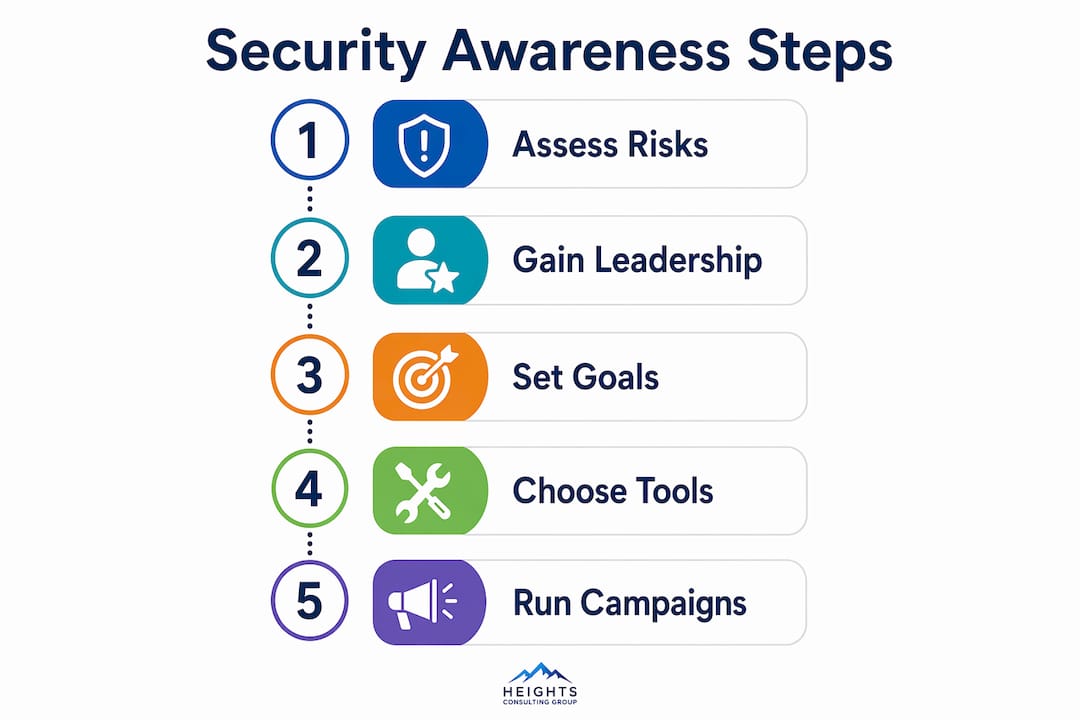
Conduct a baseline risk assessment. Map where human error is most likely to occur. Identify which roles handle sensitive data, which teams click phishing links most often, and where access controls are weakest. This assessment shapes every subsequent decision.

Secure executive sponsorship. Cybersecurity culture cannot be delegated or outsourced. Without a C-suite champion who visibly participates in training and communicates its importance, employees treat it as optional overhead. The sponsorship signal must come from the top.
Set measurable goals. Vague objectives produce vague results. NIST SP 800-50 recommends specific targets such as reducing phishing click rates by 30% within six months. Measurable goals create accountability and give the program a clear definition of success.
Select the right tools. Choose platforms that support continuous learning, behavioral tracking, and phishing simulations. The tool set should align with compliance requirements your organization already faces, including HIPAA, PCI-DSS, GDPR, or the NIST Cybersecurity Framework.
The table below maps common compliance frameworks to their awareness-related requirements:
| Framework | Awareness Requirement |
|---|---|
| NIST CSF | Continuous training and incident reporting culture |
| HIPAA | Annual security awareness training for all staff |
| PCI-DSS | Role-specific training on cardholder data handling |
| GDPR | Data protection awareness for all personnel |
| CMMC | Documented training aligned to maturity level |
Pro Tip: Run a simulated phishing campaign before launching any formal training. The baseline click rate tells you exactly where to focus first and gives you a comparison point six months later.
What are the six phases of an effective security awareness program?
NIST SP 800-50 outlines a six-phase lifecycle for cybersecurity awareness programs. Each phase builds on the last, and skipping any one of them creates gaps that attackers exploit.
-
Assess. Survey employees, review past incident data, and identify knowledge gaps by role. A finance team faces different threats than a DevOps team. The assessment must reflect that difference.
-
Plan. Define the program scope, budget, timeline, and ownership. Assign a program manager with authority to coordinate across departments. Establish the metrics you will track from day one.
-
Design. Build role-specific content. A generic module on password hygiene does not prepare a cloud engineer for credential-stuffing attacks or a customer service rep for vishing calls. AI-driven threats now require content that goes beyond email phishing to cover deepfake audio, AI-generated spear phishing, and multi-channel social engineering. Use spaced repetition to reinforce key concepts over time rather than delivering everything in a single session.
-
Deploy. Roll out training with remote and hybrid employees explicitly included. A distributed workforce creates uneven awareness levels if deployment defaults to in-office formats. Use asynchronous microlearning modules that employees can complete without disrupting their workday.
-
Measure. Track behavioral metrics, not just completion rates. Behavioral metrics outperform completion rates as indicators of real risk reduction. Monitor phishing click rates, time to report suspicious emails, and the volume of incidents reported through official channels. These numbers tell you whether behavior is actually changing.
-
Improve. Treat the program as a living system. Update content quarterly to reflect new threat intelligence. Add targeted interventions for teams that show persistent risk behaviors. Recognize and reward employees who report threats correctly, and use those stories internally to reinforce the desired culture.
Pro Tip: Designate "security champions" within each department. These are employees who receive advanced training and serve as the first point of contact for security questions on their team. They extend your program's reach without requiring additional headcount.
How does leadership engagement shape a security culture?
Nearly 70% of leaders report that employees lack sufficient security awareness despite ongoing investment. The root cause is rarely the training content itself. It is the absence of visible leadership commitment.
C-suite executives and board members must model secure behaviors daily. When a CEO uses a personal email account for business communications or skips multi-factor authentication, the implicit message to the entire organization is that security rules are optional. Executive-level modeling legitimizes the program in ways that no policy document can. Leaders who want to understand how this translates into governance can review C-suite accountability frameworks that connect board behavior to organizational risk posture.
Building a sustainable security culture also requires structural changes, not just behavioral ones. The following practices create the conditions for long-term success:
- Tie security metrics to performance reviews. When managers are accountable for their team's phishing click rates or training completion, awareness becomes a business priority rather than an IT concern.
- Integrate security into business decisions. Every new product launch, vendor contract, or system migration should include a security review. This cross-department integration signals that security is a shared responsibility.
- Reward proactive reporting. Publicly recognize employees who report suspicious emails or flag potential vulnerabilities. Positive reinforcement builds the reporting culture that early threat detection depends on.
- Balance security demands with productivity. Programs that ignore operational realities generate resentment. Training that interrupts critical workflows or adds friction without explanation will be circumvented. Design requirements around how employees actually work.
The role of executive cybersecurity leadership in driving program adoption is well-documented. Organizations where the CISO reports directly to the CEO show measurably stronger awareness outcomes than those where security is buried under IT operations.
What are the most common pitfalls in security awareness programs?
Effective programs move from compliance checkboxes to behavior transformation using positive reinforcement and systematic reporting workflows. Most programs that fail do so because they treat awareness as an educational problem rather than a risk management problem.
"Most programs fail when treated solely as educational challenges rather than comprehensive risk management. Segmentation by threat profile and role enhances effectiveness far more than increasing training volume."
Punitive phishing simulations. Punishment for failed phishing tests drives secrecy and suppresses incident reporting. Employees who fear consequences for clicking a test link will not report real incidents. Replace punishment with coaching. Frame every failed simulation as a learning moment, not a disciplinary event.
Security fatigue. Constant generic reminders cause disengagement. Microlearning integrated into workflows overcomes this by delivering brief, high-relevance content at the moment it matters. A two-minute module on recognizing AI-generated voice fraud, delivered the week after a publicized deepfake incident, lands far better than a 45-minute annual compliance course.
Generic, one-size-fits-all content. A warehouse employee and a financial analyst face entirely different threat profiles. Role-specific training is not a luxury. It is the difference between content that changes behavior and content that gets clicked through to reach the completion certificate.
Outdated content. A program built around 2022 threat scenarios creates a false sense of security in 2026. AI-generated phishing emails now pass basic grammar and tone checks that employees were trained to spot. Content must be updated continuously to reflect the current threat environment.
Key Takeaways
Building security awareness requires a structured, behavior-focused program that combines leadership commitment, role-specific training, and continuous measurement to reduce human-driven risk.
| Point | Details |
|---|---|
| Start with a baseline assessment | Identify role-specific risk areas before designing any training content. |
| Use the NIST SP 800-50 lifecycle | Follow the six-phase assess-to-improve model to build a program with measurable outcomes. |
| Measure behavior, not completion | Track phishing click rates and reporting times rather than training completion percentages. |
| Leadership modeling is non-negotiable | C-suite participation legitimizes the program and drives cultural adoption across all levels. |
| Avoid punitive simulations | Treat failed phishing tests as coaching opportunities to build a reporting culture, not a blame culture. |
Why most security awareness programs are solving the wrong problem
I have worked with organizations that spent significant budget on awareness platforms, ran quarterly phishing simulations, and still experienced breaches caused by employee error. The common thread was not a lack of training. It was a fundamental misunderstanding of what the program was supposed to accomplish.
Most programs are designed to satisfy a compliance requirement. HIPAA mandates annual training, so the organization runs annual training. The box gets checked. The behavior does not change. The real goal of a security awareness program is risk reduction, and that requires treating employees as a variable in the threat model rather than a liability to be managed.
The AI dimension makes this more urgent, not less. Deepfake audio attacks, AI-generated spear phishing, and automated social engineering campaigns now operate at a speed and scale that makes static training obsolete within months. I have seen organizations update their phishing simulation templates once a year while attackers iterate their techniques weekly. That gap is where breaches happen.
The organizations that get this right share one characteristic: their security programs are owned by business leaders, not just security teams. When a CFO asks about phishing click rates in a quarterly review, the entire finance department pays attention. That is the lever most organizations have not pulled yet. Connecting cybersecurity to business outcomes is what separates programs that change behavior from programs that generate reports.
— Dan
How Heightscg supports security awareness and culture-building
Organizations that recognize the gap between compliance training and genuine risk reduction often need external expertise to close it. Heightscg works with business leaders to design and deploy security awareness programs that are grounded in behavioral science, aligned to compliance frameworks like NIST, CMMC, and SOC 2, and built to adapt as AI-driven threats evolve.
Heightscg's cybersecurity consulting services cover the full program lifecycle, from baseline risk assessment through leadership engagement and continuous improvement. The firm's advisors work directly with C-suite executives to embed security into business decision-making rather than treating it as a separate IT function. For organizations ready to move from checkbox compliance to measurable risk reduction, contact Heightscg to discuss a program built for your specific threat environment and organizational structure.
FAQ
What is security awareness in cybersecurity?
Security awareness is the organizational practice of educating employees to recognize, avoid, and report cybersecurity threats. It combines training, simulations, and cultural reinforcement to reduce human-driven risk.
How often should security awareness training be conducted?
Annual training satisfies most compliance requirements, but behavioral research supports continuous microlearning delivered monthly or quarterly. Frequency matters less than relevance and role-specific targeting.
What metrics indicate a security awareness program is working?
Phishing click rates, time to report suspicious emails, and the volume of incidents reported through official channels are stronger indicators than training completion rates alone.
How does AI change security awareness training requirements?
AI-generated phishing emails, deepfake audio, and automated social engineering now bypass traditional detection cues. Programs must update content continuously and expand simulations beyond email to cover multi-channel attack vectors.
What role does leadership play in security awareness success?
C-suite executives must model secure behaviors and treat security metrics as business performance indicators. Programs where leadership visibly participates show measurably stronger employee adoption and reporting culture.
Recommended
- The ROI of Cybersecurity Awareness for Companies - Heights Consulting Group
- From Awareness to Accountability: Building a Cybersecurity Culture in the C-Suite and Boardroom - Heights Consulting Group
- Why Executive Cyber Awareness Matters in 2026
- AI Security: Executive Framework & Best Practices (2025)