

TL;DR:
- Executive cyber awareness is essential for C-level leaders to recognize and respond to targeted threats like whaling and deepfake attacks. Effective training uses short, realistic simulations that reflect current AI-driven attack methods, improving decision-making and organizational security culture. Improving personal hygiene and continuous threat briefings help executives reduce exposure and strengthen overall cyber defense.
Executive cyber awareness is defined as the specialized knowledge and behavioral discipline that C-level leaders need to recognize, resist, and respond to threats specifically targeting their role, access, and public profile. Generic security training does not address this gap. Only 38% of business decision-makers believe their C-suite fully understands cyber risk. That number reflects a structural failure, not a technology gap. The NACD and CISA both frame cyber risk as a board-level business risk, not a technical problem delegated to IT. For leaders in regulated sectors, closing this awareness gap is a compliance and governance obligation, not a discretionary investment.
Why executive cyber awareness is a distinct security problem
Executives are not just high-value targets. They are uniquely exposed in ways that standard employee security programs never address. Their names appear in press releases, earnings calls, conference agendas, and LinkedIn profiles. Attackers use all of that public information.
Whaling is the term security professionals use for phishing attacks crafted specifically for C-level executives. Unlike generic phishing, whaling uses AI-powered executive profiling to build lures that reference real events, real colleagues, and real business contexts. The result is an attack nearly impossible to detect without specialized training.
The attack surface extends well beyond email. Executives now face multi-channel threats across:
- Email: Contextual spear-phishing referencing real deals, board meetings, or regulatory filings
- SMS: Smishing messages impersonating legal counsel, auditors, or board members
- Voice: AI-generated deepfake calls mimicking known colleagues or direct reports
- Video: Synthetic video calls used in wire transfer fraud and credential theft
- Social media: Fake executive profiles used to harvest information or initiate contact
Attackers gather OSINT from conference schedules, earnings call transcripts, and press coverage to make every approach feel legitimate. The sophistication of these attacks is not matched by the training most executives receive.
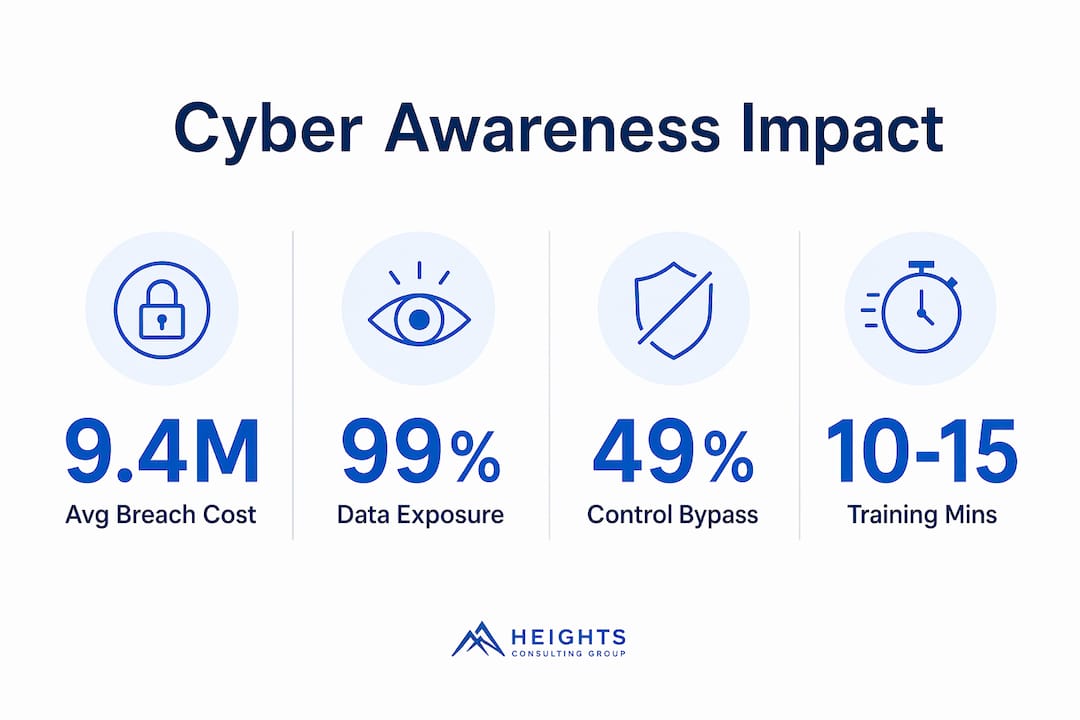
99% of executives have personal data exposed on data broker sites. That exposure gives attackers a ready-made profile before they send a single message.
Pro Tip: When you receive an urgent request by phone or video from a known colleague, verify through a second channel before acting. Deepfake voice technology now replicates tone and cadence well enough to deceive even experienced executives.
How tailored executive training differs from standard security programs
Standard corporate phishing simulations do not prepare executives for sophisticated multi-channel whaling. Generic modules built for the general workforce miss the threat model, the time constraints, and the decision-making context that define executive exposure.
Effective executive cybersecurity training shares four characteristics that separate it from off-the-shelf programs:
- Short, focused sessions: 10–15 minute sessions built around role-specific scenarios outperform hour-long compliance modules. Executives retain more when content is directly relevant to their actual decisions.
- Realistic AI-powered simulations: A deepfake voice call mimicking a known CFO, or a phishing email referencing a real board agenda, creates the kind of cognitive pressure that reveals real behavioral gaps. A single realistic simulation failure) can permanently break executive resistance to security protocols.
- Frequent updates: The threat environment changes faster than annual training cycles. Programs must refresh scenarios quarterly to reflect current attack methods, including AI-generated content.
- Executive-specific threat scenarios: Training should mirror the actual attack vectors executives face, including wire transfer fraud, board impersonation, and regulatory-themed lures.
Executives resist training) primarily because of time constraints and a belief that they are too experienced to be deceived. Realistic simulations address both objections at once. When a leader fails a well-crafted deepfake scenario, the abstract risk becomes concrete.
Pro Tip: Frame executive training as threat intelligence briefings, not compliance exercises. Leaders engage more when sessions are positioned as operational intelligence relevant to their specific role and current threat environment.
What is the business impact of executive cyber awareness on risk and compliance?
The business case for executive awareness is direct. The average cost of a U.S. security breach in 2026 is $9.4 million. A single successful whaling attack can trigger that cost through wire fraud, regulatory fines, litigation, and reputational damage.
The NACD 2026 Director's Handbook frames this clearly. Boards now demand business-centric cyber metrics from executive leadership, not just technical status reports. That shift places accountability for cyber risk squarely on the C-suite, not the CISO alone. Executives who cannot speak to cyber risk in business terms create governance gaps that regulators and auditors notice.
The table below shows how executive engagement affects key security outcomes:
| Outcome area | Without executive engagement | With executive engagement |
|---|---|---|
| Breach detection time | Delayed by unclear escalation paths | Faster due to executive-led incident protocols |
| Security culture | Compliance-driven, checkbox behavior | Risk-aware, leadership-modeled behavior |
| Board reporting | Technical jargon, limited accountability | Business metrics, clear ownership |
| Regulatory posture | Reactive, gap-driven remediation | Proactive alignment with NIST, CMMC, SOC 2 |
| Resource allocation | Security budgets deprioritized | Funding tied to measurable risk reduction |
49% of C-level executives requested to bypass security controls in the last year. That statistic reveals the internal risk dimension of poor executive awareness. When leaders circumvent controls, they signal to the entire organization that security is optional under pressure.
Executives who understand cyber risk at a business level make better decisions about resource allocation, vendor contracts, and incident response. They also set the behavioral standard that the rest of the organization follows. For leaders in board-level cybersecurity reporting, the ability to translate technical risk into financial and operational terms is now a core leadership competency.
Practical steps executives can take to strengthen their own security posture
Improving personal cyber hygiene is not a technical exercise. It is a leadership discipline. The following steps address the most common and consequential gaps in executive security behavior.
-
Activate multi-factor authentication on every account. MFA is the single most effective control against credential theft. Apply it to email, financial systems, cloud platforms, and any account with access to sensitive data. Proactive defense techniques like MFA reduce the impact of credential compromise even when phishing succeeds.
-
Secure personal devices and home networks. Personal digital hygiene is a critical executive blind spot. Attackers target home Wi-Fi networks and personal smartphones because they are less protected than corporate infrastructure. Use a VPN, keep firmware updated, and separate personal and work devices.
-
Establish a verbal verification protocol for financial requests. Any wire transfer, credential change, or sensitive approval requested by email or message should require a live phone confirmation using a known number, not one provided in the request itself.
-
Schedule quarterly threat briefings with your security team. Executives need current intelligence on the specific attack methods targeting their industry and role. A 15-minute briefing each quarter is sufficient to stay ahead of the most common lures.
-
Model the behavior you expect from your organization. Executives who visibly comply with security controls, complete training, and ask informed questions about cyber risk create a culture where security is taken seriously at every level. The executive role in cybersecurity extends beyond personal protection to organizational influence.
-
Participate in realistic simulation exercises. Request that your security team run executive-specific simulations, including deepfake voice scenarios and contextual phishing tied to real business events. Failure in a controlled environment is far less costly than failure in a real attack.
Pro Tip: Add a 5-minute cyber awareness check to your weekly leadership routine. Review one recent threat example relevant to your industry. Consistent exposure to real-world attack patterns builds the pattern recognition that formal training alone cannot develop.
How AI is reshaping executive cyber threats and training
AI has changed the economics of targeted attacks. Crafting a convincing whaling email once required hours of manual research. AI tools now compress that work to minutes, enabling attackers to produce personalized, context-aware lures at scale. The barrier to entry for sophisticated executive targeting has dropped significantly.

The attack methods themselves are evolving. Deepfake voice calls now replicate tone, cadence, and speech patterns with enough fidelity to deceive people who know the person being impersonated. Video deepfakes are increasingly used in business email compromise schemes involving large financial transfers. Multi-channel attacks that combine email, SMS, and voice in sequence are becoming the standard approach for high-value targets.
AI is also reshaping the defense side. Adaptive training platforms now generate simulations that mirror current attack methods, updating scenarios as the threat environment changes. These platforms use executive-specific data, including public profiles and organizational context, to create exercises that reflect real exposure. The 12-month strategic playbook approach, where executives receive structured threat intelligence and simulation exercises throughout the year, is becoming the standard for organizations serious about executive protection.
Governance considerations are also shifting. Executives who deploy AI tools within their organizations must understand that those tools create new attack surfaces. AI systems with access to sensitive data, communications, or financial systems require oversight structures that most organizations have not yet built. The executive who understands AI-driven threats is better positioned to ask the right questions about AI governance inside their own organization.
Key Takeaways
Executive cyber awareness is the most underfunded and highest-impact control in organizational security, because executives combine maximum access with the least targeted training.
| Point | Details |
|---|---|
| Executives are prime targets | Whaling and AI-powered attacks exploit public profiles, requiring specialized training beyond standard programs. |
| Generic training fails executives | Short, role-specific, AI-simulation-based sessions outperform annual compliance modules for this audience. |
| Awareness drives business outcomes | Executive engagement reduces breach costs, improves board reporting, and strengthens regulatory posture. |
| Personal hygiene is a critical gap | Securing home networks, personal devices, and applying MFA addresses exposure that corporate controls cannot reach. |
| AI accelerates both threat and defense | AI-powered attacks demand AI-powered training that updates continuously to match current attack methods. |
The uncomfortable truth about executive security programs
I have worked with enough C-suite leaders to know that the biggest obstacle to executive cyber awareness is not budget or technology. It is the belief that seniority confers immunity. The most dangerous executive is the one who has never been successfully deceived in a simulation and therefore assumes they never will be.
The executives I have seen make the most progress are the ones who treat a simulation failure as useful data, not an embarrassment. One CFO I worked with failed a deepfake voice call exercise that mimicked his own CEO. He was convinced it was real until the debrief. That experience changed how he handled every urgent financial request from that point forward. No amount of slide-based training would have produced the same result.
The other pattern I consistently observe is that executive buy-in is the single most reliable predictor of organizational security culture. When a CEO completes training, asks informed questions in board meetings, and refuses to bypass controls under pressure, the entire organization adjusts its behavior. When the CEO treats security as someone else's problem, that signal travels just as far.
The organizations that get this right do not treat executive awareness as a one-time training event. They treat it as a continuous discipline, with regular threat briefings, realistic simulations, and clear accountability for security behavior at the leadership level. That is the standard worth building toward.
— Dan
How Heightscg supports executive cyber awareness programs
Heightscg works directly with C-level leaders and security teams in regulated industries to build awareness programs that match the actual threat profile executives face in 2026. The firm's approach combines threat intelligence, realistic simulation design, and board-level reporting support to turn executive awareness from a gap into a measurable defense.

For organizations that need continuous protection alongside executive training, Heightscg's managed cybersecurity services provide 24/7 threat detection, proactive risk mitigation, and the operational coverage that executive awareness programs alone cannot deliver. If your organization is ready to close the gap between executive exposure and executive preparedness, Heightscg offers the advisory depth and technical capability to make that transition structured and measurable. Contact Heightscg to discuss where your executive security posture stands today.
FAQ
What is executive cyber awareness?
Executive cyber awareness is the specialized knowledge that C-level leaders need to recognize and resist threats specifically targeting their role, access, and public profile. It differs from general security training by addressing whaling, deepfake attacks, and multi-channel impersonation.
Why are executives more vulnerable than other employees?
Executives combine maximum system access with high public visibility, making them prime targets for AI-powered whaling attacks. 99% of executives have personal data exposed on broker sites, giving attackers a detailed profile before any attack begins.
How long should executive cybersecurity training sessions be?
10–15 minute sessions built around role-specific scenarios are the most effective format for executive training. Shorter, more frequent sessions with realistic simulations outperform longer annual compliance modules.
What role do executives play in organizational cybersecurity culture?
Executives set the behavioral standard for the entire organization. When leaders comply with security controls and engage with training, security culture strengthens across all levels. 49% of C-level executives who bypass controls create measurable internal risk.
How does AI change the executive threat environment?
AI enables attackers to build personalized, context-aware lures at scale, including deepfake voice and video calls that impersonate known colleagues. The same AI capabilities now power adaptive training simulations that update continuously to reflect current attack methods.