

TL;DR:
- Public-sector organizations should require integrated EPP, EDR, XDR, and MDR platforms with verified assessments and clear detection metrics during procurement. Focus on structured PoCs, SIEM integration, and compliance validation rather than solely on certifications like FedRAMP, to ensure effective threat detection and operational readiness. Tailoring deployment and evaluation processes to public-sector needs improves security posture while reducing operational and staffing challenges.
For U.S. public-sector organizations, the right starting point is an integrated EPP + EDR platform with verified SIEM/SOAR integration and documented detection fidelity — contract MDR when your agency lacks 24/7 SOC capacity or needs operational coverage faster than an internal build allows. Before any RFP goes out, lock in these requirements:
- Require MITRE ATT&CK evaluation references or equivalent third-party test results from every shortlisted vendor.
- Mandate FedRAMP authorization or FIPS 140-2/140-3 validated cryptography where federal data handling applies; confirm SOC 2 Type II for cloud-managed consoles.
- Demand a structured proof of concept (PoC) that measures true positive rate, false positive rate, and mean time to triage against seeded, realistic test cases.
- Specify telemetry retention minimums and export formats in the RFP to satisfy NIST SP 800-171 audit requirements and state-level SIEM reporting mandates.
- Reference CISA guidance and applicable state EDR standards (Washington State's WaTech SEC-04-09-S is the most detailed public model) as baseline configuration requirements.
- Score cooperative procurement compatibility (NASPO ValuePoint, NCPA) as a procurement factor, especially for smaller jurisdictions with constrained contracting capacity.
Table of Contents
- What do EPP, EDR, XDR, and MDR actually mean for agency procurement?
- Why government agencies need a different endpoint strategy than commercial buyers
- Which core features must you require in a public-sector endpoint RFP?
- How to evaluate vendors: a scored checklist for public-sector procurement
- Deployment and operations: what actually works in agency environments
- How do you verify vendor claims before signing a contract?
- Heightscg's detection-fidelity rubric and PoC checklist for public-sector evaluation
- Key Takeaways
- What most agencies get wrong about endpoint protection selection
- Heightscg helps agencies move from RFP to operational endpoint protection
- Authoritative sources and further reading for procurement teams
What do EPP, EDR, XDR, and MDR actually mean for agency procurement?
These four categories appear in nearly every government IT security solicitation, yet procurement teams often conflate them. Misaligned definitions produce RFPs that score the wrong capabilities and miss critical gaps.
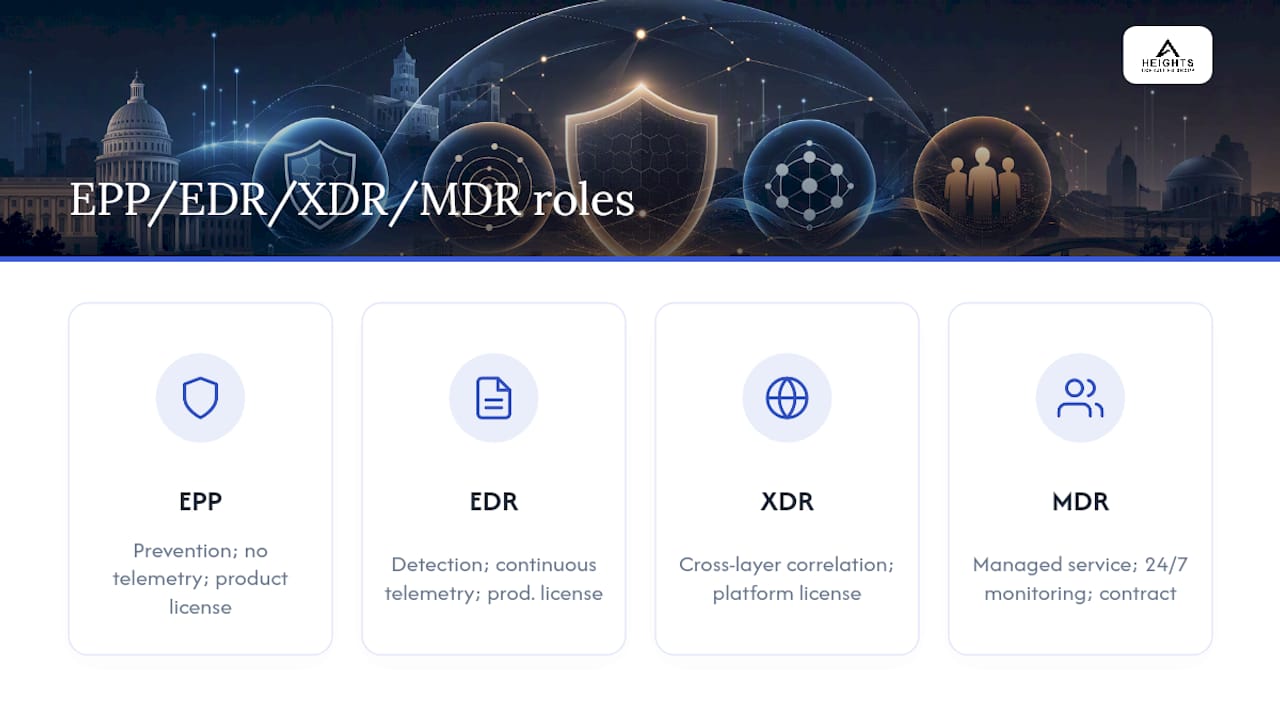
EPP (Endpoint Protection Platform) covers prevention: signature-based and behavioral anti-malware, device control, web filtering, and disk encryption enforcement. It is typically licensed as a software product and deployed via agent. EPP alone is insufficient for today's threat environment because it generates no investigation telemetry.
EDR (Endpoint Detection and Response) records continuous behavioral telemetry from endpoints, surfaces anomalies, and supports investigation and containment. It is the detection and forensics layer. EDR is also product-licensed but requires analyst capacity to act on its output. Without SIEM integration or automation, EDR in isolation will overwhelm a small SOC with unfiltered alerts.
XDR (Extended Detection and Response) correlates telemetry across endpoints, network, identity, and cloud layers into a unified detection pipeline. It is the logical evolution of EDR for agencies with multi-layer visibility needs. XDR is typically licensed as a platform and may require significant integration work to realize its cross-layer value.
MDR (Managed Detection and Response) is a service, not a product. A third-party provider operates the detection and response stack on the agency's behalf, providing 24/7 monitoring, triage, and containment. MDR maps to a managed services contract rather than a product license, and it is the right choice when an agency cannot staff a SOC or needs faster time-to-value than an internal build allows.
Most agencies will procure EPP and EDR as a bundled platform license, then decide separately whether to layer MDR on top or build internal SOC capacity. XDR becomes relevant when the agency has mature cloud and identity telemetry it wants to correlate with endpoint data. Deployment variants matter too: agent-based deployment is standard for managed endpoints; agentless or hybrid approaches apply to OT systems, legacy hardware, or environments where agent installation is restricted by policy.
Why government agencies need a different endpoint strategy than commercial buyers
The threat environment facing public-sector organizations is not simply a scaled-up version of commercial risk. Nation-state actors, ransomware groups targeting municipal services, and supply-chain compromises against defense contractors represent a qualitatively different threat profile. Endpoints are the most common initial access vector across all of these attack patterns.
Compliance and audit obligations compound the operational challenge. Federal agencies and contractors handling Controlled Unclassified Information must satisfy NIST SP 800-171 requirements, and those pursuing DoD contracts face CMMC Level 2 certification assessments that require demonstrable endpoint controls. The White House M-22-01 memorandum directed federal agencies to adopt EDR solutions as part of a shift from reactive to proactive cyber defense. State agencies face parallel mandates: Washington State's WaTech EDR standard, for example, requires agencies to deploy EDR on state-issued endpoints, maintain agents at N-1 version, and configure reporting into the enterprise SIEM.
The operational constraints are equally significant:
- Legacy OS environments. Many agencies run Windows versions or specialized systems that current endpoint agents do not fully support. Vendors must demonstrate coverage for the actual OS mix in the environment, not just current releases.
- Constrained SOC headcount. A SHI study of public-sector cybersecurity found that deployment and tuning complexity, lack of automation, and poor integration are the top barriers to effective endpoint protection. Respondents planned increased investment in EDR, IAM, and incident response as a result.
- Procurement and contracting timelines. Government procurement cycles are long. Cooperative purchasing vehicles like NASPO ValuePoint and NCPA offer pre-negotiated cybersecurity contracts that reduce procurement overhead and give smaller jurisdictions access to enterprise-grade endpoint tools without a full competitive solicitation.
- Vulnerability volume. The National Vulnerability Database recorded 28,831 vulnerabilities in 2023, a volume that makes manual patching workflows untenable. Automation is not a differentiator at this scale; it is a baseline requirement.
AI is reshaping this picture in two directions simultaneously. On the defensive side, AI-assisted triage and anomaly detection reduce the analyst workload that overwhelms understaffed SOCs. On the threat side, AI-enabled attack tooling lowers the skill threshold for adversaries and accelerates the pace of novel malware variants. Agencies that evaluate endpoint tools without explicitly scoring AI-assisted detection and automated triage are measuring yesterday's capability against tomorrow's threat.
Which core features must you require in a public-sector endpoint RFP?
Detection fidelity is the primary metric. GovLoop guidance on endpoint protection for government frames it directly: accurate, actionable alerts that minimize false positives are the single most important operational outcome for public-sector security programs. A vendor that generates high alert volumes with poor signal-to-noise ratio does not reduce risk; it shifts analyst effort from investigation to triage of noise.
Request concrete PoC evidence: true positive rate, false positive rate, and mean time to triage measured against a seeded test dataset. Vendor marketing decks are not substitutes for these numbers.
Beyond detection fidelity, the following technical controls belong in every public-sector endpoint RFP:
- Behavioral telemetry: Continuous process, network, file, and registry event recording with exportable formats (CEF, JSON, or native SIEM connector).
- Real-time isolation and quarantine: Network isolation of a compromised endpoint without requiring physical access or a separate management console action.
- Endpoint rollback and forensics: The ability to revert file system changes made by malware and preserve forensic artifacts for post-incident analysis.
- Application allowlisting (positive security model): For high-compliance and legacy endpoints, a positive security model reduces attack surface more reliably than blocklist-based approaches. The initial policy-creation overhead is real but justified for environments handling CUI or sensitive citizen data.
- File integrity monitoring (FIM): Continuous monitoring of critical system files and configurations, required under several NIST controls.
- Memory protection: Detection of in-memory attacks, process injection, and fileless malware techniques that bypass traditional file-scanning.
- Device control: USB and peripheral management to prevent data exfiltration and unauthorized media introduction.
Nonfunctional requirements are equally critical and frequently omitted from first-draft RFPs. Specify OS and version support explicitly, including any legacy systems in scope. Define telemetry retention minimums (90 days on-agent, 12 months in SIEM is a common baseline). Require SIEM ingestion documentation, SOAR playbook compatibility, and IAM integration points. For any cloud-managed console, require FedRAMP authorization or equivalent and FIPS 140-2/140-3 validated encryption. If the agency handles export-controlled data, specify data residency requirements and confirm the vendor's data processing agreements comply.
Pro Tip: Require vendors to document their agent update cadence and support lifecycle for each OS version in your environment. An agent that drops support for a legacy OS mid-contract creates an unplanned remediation project.
How to evaluate vendors: a scored checklist for public-sector procurement
Structure your vendor evaluation around six weighted categories. The weights below reflect public-sector priorities; adjust them based on your agency's specific compliance obligations and SOC maturity.
-
Detection fidelity (25%): Measured PoC outcomes — true positive rate, false positive rate, mean time to triage. Require vendor to conduct a structured PoC against seeded test cases representing your likely threat patterns. Score vendors on measured results, not claimed capabilities.
-
Telemetry completeness (20%): Coverage of process, network, file, registry, and memory events. Confirm exportability to your SIEM in a supported format. Ask: "Provide documentation of your SIEM ingestion formats and a sample log output from a detection event."
-
Integration capability (15%): Native connectors or documented APIs for your SIEM, SOAR, and IAM platforms. Ask: "Describe your integration architecture with [named SIEM]. Provide a reference customer using this integration in a government environment."
-
Compliance certifications (20%): FedRAMP authorization status (In Process, Authorized, or not listed), FIPS 140-2/140-3 validation for cryptographic modules, SOC 2 Type II report scope and coverage period. Verify FedRAMP status directly on the FedRAMP Marketplace, not from vendor documentation.
-
Support SLAs (10%): Response time commitments for critical incidents, escalation paths, and patch availability timelines. Ask: "What is your SLA for releasing an agent update following a critical CVE disclosure?"
-
Total cost of ownership (10%): Licensing model (per-seat, per-device, bundled SOC hours), professional services for deployment and tuning, training costs, and transition/termination assistance. Request a three-year TCO model, not just Year 1 licensing.
Specific RFP questions that consistently surface differentiation:
- "Describe your PoC methodology for measuring detection fidelity, including how you seed test cases and what success thresholds you commit to."
- "Provide your agent footprint (CPU, memory, disk) on Windows 10, Windows Server 2016, and [any legacy OS in scope]."
- "What is your data retention policy for telemetry stored in your cloud console, and how do customers export data at contract termination?"
- "Provide a reference from a U.S. state or local government agency of comparable size and OS complexity."
On licensing, require vendors to present both a product-only model and a managed service model so you can compare TCO across procurement structures. Cooperative contract pricing through NASPO ValuePoint or NCPA often differs materially from direct negotiation and should be requested as a separate line item.
Deployment and operations: what actually works in agency environments
A phased rollout is not optional for most agencies; it is the only realistic path given legacy OS diversity, constrained change-management windows, and the need to tune detection before expanding scope.

Phase 1: Pilot (a few weeks to a couple of months). Deploy to a representative sample of endpoints covering your primary OS versions, user roles, and network segments. Define pilot success metrics before deployment: target false positive rate, mean time to triage, and SIEM ingestion confirmation. Establish a rollback plan. Do not expand until pilot metrics are met.
Phase 2: Staged expansion (60–120 days). Expand by department or network segment, not by endpoint count alone. Each expansion wave should include a tuning review before the next wave begins. Legacy endpoints and OT-adjacent systems should be staged last, with separate tuning profiles.
Phase 3: Full deployment and steady state. Establish an agent lifecycle management process: enforce the N-1 update policy required by standards like WaTech's EDR mandate, automate update deployment through your endpoint management platform, and schedule quarterly tuning reviews tied to threat intelligence updates.
Operationally, the highest-risk failure mode is alert fatigue. EDR without tuning and automation generates alert volumes that analysts cannot process, which means real incidents get buried. Require vendors to demonstrate, during the PoC, how their platform reduces analyst cognitive load through automated triage, AI-assisted prioritization, and suppression of known-good behaviors. The GovTech analysis of endpoint management challenges is direct on this point: automation is the mechanism that keeps patching and detection workflows viable at scale.
The MDR versus in-house SOC decision comes down to three factors: current analyst headcount, required coverage hours, and time-to-value. Agencies with fewer than four trained analysts and a requirement for 24/7 coverage should contract MDR for monitoring and containment, while retaining in-house staff for policy, escalation, and compliance reporting. A hybrid model, where MDR handles overnight and weekend coverage while internal analysts own daytime investigation, is often the most cost-effective structure for mid-size agencies. Review the managed security services options available before finalizing the staffing model.
Pro Tip: Build SOAR playbooks for your top five incident types before go-live. Playbooks that exist only in documentation do not reduce response time; playbooks integrated into your SIEM/SOAR workflow do.
How do you verify vendor claims before signing a contract?
Vendor self-attestation is not sufficient for public-sector procurement. Independent validation sources provide the evidence base that procurement officers and auditors can cite.
Independent test sources to require:
- MITRE ATT&CK Evaluations: The most operationally relevant independent test for EDR. Results show detection coverage across ATT&CK techniques, not just aggregate scores. Require vendors to provide their most recent evaluation results and explain any detection gaps relevant to your threat profile.
- AV-TEST or AV-Comparatives: Useful for EPP prevention efficacy. Scores on protection, performance, and usability provide a standardized comparison point.
- FedRAMP Marketplace: Verify authorization status directly at fedramp.gov. "FedRAMP Ready" and "FedRAMP Authorized" are materially different statuses; only "Authorized" means the security package has been reviewed and approved.
- SOC 2 Type II reports: Request the full report, not a summary letter. Review the scope section to confirm it covers the specific services and infrastructure the agency will use.
What to require in vendor case studies and references:
- Agency size (endpoint count, user count) and OS mix comparable to your environment.
- Deployment timeframe from contract signature to full production.
- Measured outcomes: false positive rate before and after tuning, dwell time reduction, or incident response time improvement.
- Contact information for a named reference who can speak to the operational experience, not just the sales process.
The following table maps trust signals to what they prove and how to validate them during evaluation:
| Trust Signal | What It Proves | How to Validate |
|---|---|---|
| MITRE ATT&CK Evaluation results | Detection coverage across real-world adversary techniques | Request vendor's evaluation report; review technique-level results at attackevals.mitre.org |
| FedRAMP Authorization | Cloud service meets federal security baseline | Verify status directly on fedramp.gov Marketplace listing |
| FIPS 140-2/140-3 validation | Cryptographic modules meet federal standards | Confirm module certificate number on NIST CMVP database |
| SOC 2 Type II report | Controls over security, availability, and confidentiality are operating effectively | Request full report; confirm scope covers the specific service components in use |
| Government reference customer | Vendor has deployed successfully in a comparable public-sector environment | Conduct a reference call; ask for measured outcomes, not general satisfaction |
Heightscg's detection-fidelity rubric and PoC checklist for public-sector evaluation
The rubric below gives procurement and security teams a scored framework for evaluating vendor PoC results. Apply it during the structured PoC phase before final vendor selection.
Detection-fidelity scoring rubric (0–5 scale)
| Score | True Positive Rate | False Positive Rate | Mean Time to Triage | Notes |
|---|---|---|---|---|
| 5 | — | <2% | <10 minutes | Exceeds public-sector baseline; suitable for high-compliance environments |
| 4 | — | 2–5% | 10–20 minutes | Meets baseline; acceptable with tuning commitment |
| 3 | — | 5–10% | 20 minutes | Marginal; require tuning roadmap and re-test commitment |
| 2 | 60% | 10–20% | — | Below threshold; significant analyst burden |
| 1 | <60% | >20% | >60 minutes | Disqualifying for most agency environments |
PoC checklist
A defensible PoC for public-sector endpoint tooling must include the following elements. Agencies should provide this checklist to vendors at RFP issuance so PoC methodology is standardized across competitors.
- Test dataset: Seeded, anonymized telemetry representing realistic attack patterns for your threat profile (ransomware precursors, lateral movement, credential harvesting). Do not use vendor-supplied test cases exclusively.
- Duration: Minimum 15 business days in a production-representative environment.
- OS coverage: Include at least one legacy OS version present in your production environment.
- SIEM ingestion test: Confirm that detection events appear in your SIEM within a defined latency window (typically under 5 minutes).
- Isolation test: Trigger a simulated containment action and measure time from detection to network isolation.
- Success thresholds: Define minimum acceptable scores on the rubric above before the PoC begins. A score of 4 or higher on detection fidelity is the recommended minimum for contract award.
Sample RFP clauses
Data retention: "Vendor shall retain endpoint telemetry for a minimum of 12 months in a format exportable to [Agency SIEM]. Upon contract termination, vendor shall provide a complete data export within 30 days at no additional cost."
FedRAMP/FIPS: "All cloud-managed console components must hold FedRAMP Authorization (not merely FedRAMP Ready) at the time of contract award. Cryptographic modules must be validated under FIPS 140-2 or FIPS 140-3."
Legacy OS support: "Vendor shall provide full agent functionality, including behavioral telemetry and real-time isolation, for [list specific OS versions]. Vendor shall provide 90-day advance notice before dropping support for any OS version covered under this contract."
Detection and containment SLA: "Vendor shall detect and alert on confirmed malicious activity within [X] minutes of event occurrence and shall support network isolation of a compromised endpoint within [Y] minutes of analyst-initiated containment action."
Termination assistance: "Upon contract expiration or termination for any reason, vendor shall provide transition assistance for a period of 90 days, including data export, agent removal tooling, and knowledge transfer to the successor vendor or agency team."
For a ready-to-use endpoint protection checklist that maps these requirements to specific controls, Heightscg maintains a practitioner resource aligned to public-sector evaluation criteria.
Key Takeaways
Public-sector agencies that prioritize detection fidelity, SIEM integration, and a structured PoC before contract award consistently outperform those that select endpoint tools on feature lists and price alone.
| Point | Details |
|---|---|
| Lead with detection fidelity | Require a structured PoC measuring true positive rate, false positive rate, and mean time to triage before any contract award. |
| SIEM integration is non-negotiable | Confirm telemetry ingestion into your SIEM during the PoC; an endpoint tool that does not feed your SOC adds coverage gaps. |
| Compliance certifications must be verified independently | Confirm FedRAMP status on fedramp.gov and FIPS module validation on the NIST CMVP database, not from vendor documentation. |
| MDR vs. in-house SOC is a staffing decision | Agencies with fewer than four trained analysts and a 24/7 coverage requirement should contract MDR rather than attempt an internal build. |
| Heightscg provides PoC design and RFP support | Heightscg helps agencies structure vendor evaluations, score PoC results, and build procurement language that holds vendors accountable to measurable outcomes. |
What most agencies get wrong about endpoint protection selection
The conventional wisdom in public-sector IT procurement is that compliance certification is the primary selection criterion. If a vendor is FedRAMP Authorized, the reasoning goes, the security baseline is covered. That framing is wrong in a specific and consequential way.
FedRAMP authorization tells you that a cloud service met a defined security baseline at the time of assessment. It says nothing about detection fidelity, alert quality, or how the platform performs against the actual threat patterns targeting your agency. An authorized platform with a 20% false positive rate will consume more analyst hours than it saves. The compliance checkbox and the operational outcome are not the same thing, and conflating them is the single most common mistake in public-sector endpoint procurement.
The second mistake is skipping the PoC or running a vendor-designed PoC with vendor-supplied test cases. A PoC that the vendor controls is a demonstration, not an evaluation. Agencies that seed their own test cases, include legacy OS coverage checks, and measure SIEM ingestion latency get results that predict real-world performance. Those that accept a vendor demo get a best-case scenario.
What actually works: phased PoCs with agency-defined success thresholds, early SIEM ingestion confirmation, and a hybrid staffing model that combines MDR for 24/7 coverage with in-house analysts for policy ownership and escalation. The agencies that stall most often are those that try to build full SOC capability before deploying the endpoint tool, rather than deploying the tool first and building SOC workflows around real telemetry. The endpoint detection strategy that works in practice is iterative, not sequential.
AI-assisted triage is the capability that changes the MDR versus in-house calculus most significantly right now. Platforms that use AI to suppress known-good behaviors and surface high-confidence detections reduce the analyst headcount required to operate EDR effectively. Agencies that evaluate this capability during the PoC, rather than taking vendor claims at face value, make better staffing decisions and more accurate TCO projections.
Heightscg helps agencies move from RFP to operational endpoint protection
Selecting the right endpoint protection platform is only the first decision. Agencies that sign a contract without a structured PoC, defined SIEM integration requirements, and a phased deployment plan routinely find themselves 12 months post-award with an undertuned tool, an overwhelmed SOC, and a compliance gap they cannot close before the next audit.
Heightscg works with federal, state, and local agencies at every stage of this process. The engagement typically begins with a PoC design workshop that produces agency-defined success thresholds and a standardized evaluation methodology vendors must follow. From there, Heightscg supports RFP development, vendor scoring, and contract negotiation, including cooperative procurement pathways through NASPO ValuePoint and NCPA for agencies that need to move faster than a full competitive solicitation allows. For agencies that need ongoing operational coverage, Heightscg's managed security services provide 24/7 monitoring, incident response, and SOC integration without the overhead of building an internal team from scratch. To request a PoC design session or a procurement workshop, contact Heightscg directly.
Authoritative sources and further reading for procurement teams
The references below are the primary sources procurement officers and security leads should cite in RFPs and use to validate vendor compliance claims.
Standards and federal mandates:
- M-22-01: Improving Detection of Cybersecurity Vulnerabilities and Incidents on Federal Government Systems — The White House memorandum directing federal agencies to adopt EDR. Use as the compliance driver for federal endpoint procurement.
- WaTech SEC-04-09-S Endpoint Detection and Response Standard — The most detailed public state-level EDR mandate available. Use as a model for configuration baselines, update cadence requirements, and SIEM reporting language.
- DOJ Endpoint Protection Platform (EPP) Management — Federal agency EPP management reference. Useful for compliance evidence and operational benchmarks.
Operational and procurement guidance:
Heightscg practitioner resources:
- Endpoint protection checklist for IT security teams — Ready-to-use checklist for RFP requirements and PoC acceptance criteria.
- Endpoint detection strategy guide for executives — Executive-level framework for detection investment decisions.
- Contact Heightscg for procurement support or a PoC workshop — Direct engagement for agencies ready to begin vendor evaluation.