

Hire a readiness-focused compliance consultancy — separate from your certifying assessor — before you engage any C3PAO or external auditor. That single decision determines whether your first assessment is a pass or a costly restart.
- Immediate action: Authorize a scoped readiness engagement that maps Controlled Unclassified Information (CUI), defines system boundaries, and produces a System Security Plan (SSP) and Plan of Action and Milestones (POA&M).
- Why it matters first: A unified control library built during readiness lets you reuse SOC 2 evidence for NIST SP 800-171 practices, cutting duplicate work and compressing timelines.
- Independence requirement: Cyber AB R2002 prohibits the same firm from both preparing your environment and conducting your CMMC certification assessment. Violating this sequencing is not a technicality — assessors reject it routinely.
Table of Contents
- Why agencies and government contractors need external compliance management
- What a compliance management solution for agencies actually includes
- How to evaluate and select a compliance management partner
- What does a realistic engagement timeline look like?
- How do you fold AI risk and governance into agency compliance programs?
- How Heightscg approaches compliance management for agencies
- Immediate executive checklist — what to authorize this quarter
- Key Takeaways
- An executive note on what actually drives compliance outcomes
- Heightscg: a compliance partner built for agencies and government contractors
- Useful sources and references (U.S.)
Why agencies and government contractors need external compliance management
Failed assessments carry consequences that extend well beyond the audit itself. Lost contract eligibility, re-engagement fees, and procurement delays can cost far more than the consulting investment required to get ready. External compliance consultants are not mandatory, but for defense contractors without a dedicated internal compliance team, the cost of failing a CMMC assessment almost always outweighs consultant fees.
The buyer landscape reinforces this pressure. Agencies and prime contractors now expect NIST SP 800-171 compliance as a baseline, CMMC certification as a contractual condition, and SOC 2 attestation as a commercial assurance layer. SOC 2 is a CPA attestation under AICPA standards, not a federal mandate — it does not substitute for CMMC or FedRAMP, and treating it as equivalent will exclude you from DoD bids. Most government contractors need both.
Statistic: SOC 2 and CMMC Level 2 share roughly 50–60% control overlap, meaning evidence collected for one framework can often satisfy corresponding practices in the other — a direct argument for hiring specialists who can plan testing across both simultaneously rather than running parallel, disconnected programs.
The strategic case for external advisory is straightforward: internal teams rarely have the framework depth, assessor familiarity, and evidence-packaging experience to pass a first assessment without outside support.
What a compliance management solution for agencies actually includes
Effective compliance management services for agencies span four distinct service layers. Each layer produces specific evidence an assessor will examine.
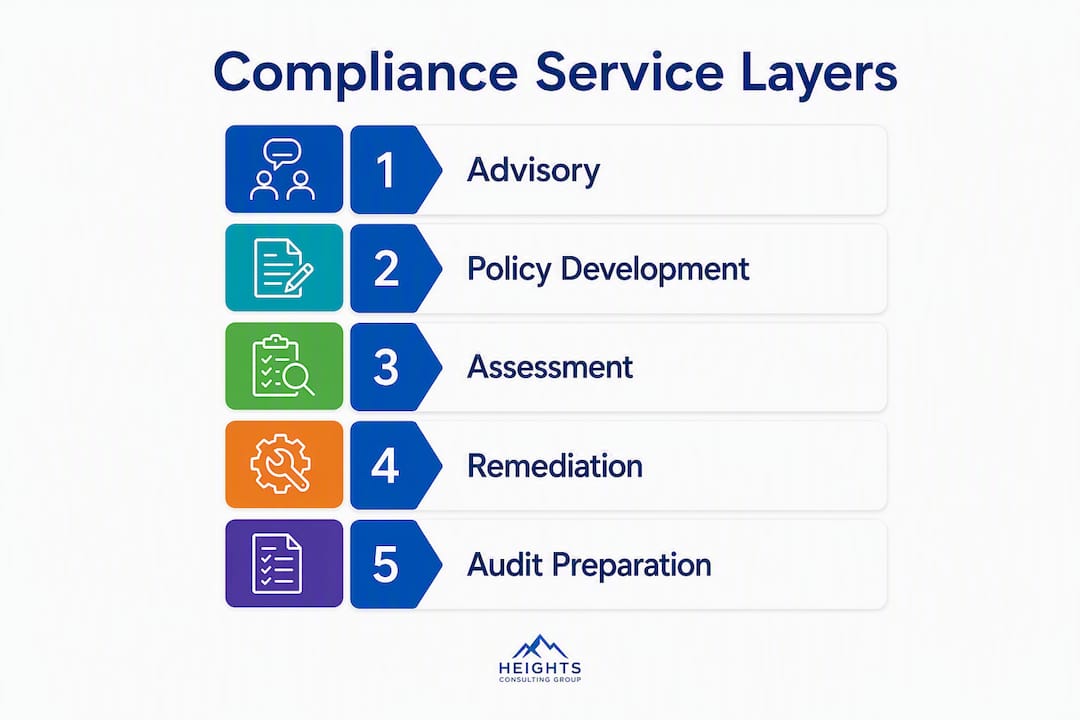
| Service Layer | Core Activities | Primary Assessor Evidence |
|---|---|---|
| Advisory | CUI scoping, SSP authoring, NIST/CMMC/SOC 2/HIPAA/PCI DSS mapping, DFARS gap analysis | SSP, scoping memo, regulatory crosswalk |
| Implementation | Configuration baselines, IAM, encryption, SIEM deployment, change management | Configuration records, change logs, access control matrices |
| Managed Services | monitoring, EDR/SOC operations, incident response, continuous evidence collection | Monitoring logs, IR records, compliance dashboards |
| Audit Support | Mock assessments, evidence packaging, assessor liaison, SPRS scoring, POA&M management | Evidence packages, mock assessment reports, remediation plans |
A unified audit methodology that plans testing to generate evidence for both SOC 2 and CMMC simultaneously prevents duplicate collection and saves measurable time. The managed compliance retainer model extends this by maintaining continuous evidence pipelines rather than scrambling before each audit cycle. For agencies with AI systems touching CUI, the advisory layer must also include AI governance mapping — a gap that most in-house programs have not yet addressed.
How to evaluate and select a compliance management partner
Shortlisting the wrong vendor costs time, money, and potentially your contract eligibility. Use this checklist before issuing an RFP.
- Verify Cyber AB marketplace listing. Confirm the firm holds Registered Practitioner Organization (RPO) or Registered Practitioner (RP) status. This is the baseline credential for CMMC readiness work — not a differentiator, a minimum.
- Confirm independence in writing. Cyber AB R2002 builds C3PAO accreditation on ISO/IEC 17020:2012 Type A independence. Require a written conflict-of-interest stop-line that explicitly prohibits the firm from serving as your assessor.
- Request named practitioner CVs. Vendor-level credentials matter less than the specific practitioners assigned to your engagement. Ask for NIST SP 800-171 fluency evidence and prior DIB client references.
- Require three DIB references. Ask each reference specifically about evidence quality, assessor feedback, and whether the engagement delivered a fixed-scope SSP and POA&M on schedule.
- Demand fixed-fee or capped pricing. Scope reduction — narrowing systems that touch CUI — can reduce remediation and assessment costs by an estimated 20–40%. A vendor unwilling to offer fixed-fee readiness options has no incentive to help you scope efficiently.
- Ask about MSP CMMC experience specifically. Not every managed service provider has been through a C3PAO assessment. Prioritize vendors who can explain what evidence holds up in the Defense Industrial Base.
Red flags: Any vendor that offers to both prepare and certify you for the same CMMC assessment; vague system and resource ownership (SRM) mapping; open-ended hourly billing with no scope cap.
What does a realistic engagement timeline look like?
Phase sequencing and timeline vary by your current control maturity and CUI scope. The table below reflects common ranges for U.S. defense contractors.
| Phase | Activities | Typical Duration |
|---|---|---|
| Scoping & gap analysis | CUI mapping, system boundary definition, initial SSP draft, gap report | 4 weeks |
| Remediation & implementation | Control gaps closed, SIEM/EDR deployed, IAM hardened, policies finalized | 3 months |
| Evidence build & mock assessment | Evidence packaging, mock audit, POA&M updates, SPRS scoring | 6–12 weeks |
| Audit readiness & assessor engagement | C3PAO or CPA engagement, assessor liaison, final evidence delivery | 4 weeks |
| Ongoing managed compliance | Continuous monitoring, evidence refresh, annual reassessment prep | Retainer |
CMMC Level 2 readiness engagements commonly run 6–18 months, with low-maturity organizations holding broad CUI scope hitting the upper end. SOC 2 Type 2 engagements typically run 6–12 months and cost roughly $20,000–$80,000; CMMC readiness and assessment costs commonly range from $50,000–$150,000+ depending on remediation depth.
Primary cost drivers: CUI scope breadth, existing control maturity (ISO 27001 or prior SOC 2 presence accelerates timelines), network and cloud complexity, and whether gaps require technical remediation or documentation work only. Compliance at speed is achievable — but only when scoping decisions are made early and firmly.
How do you fold AI risk and governance into agency compliance programs?
AI systems that touch CUI or influence security-relevant decisions are now a compliance exposure that most SSPs do not yet address. The gap is not theoretical — it is the kind of finding that surfaces during a mock assessment and delays certification.
- Inventory first. Identify every AI system that processes, stores, or routes CUI, or that makes access-control and anomaly-detection decisions. Map each system to existing NIST SP 800-171 control families: access control (3.1.x), configuration management (3.4.x), audit and accountability (3.3.x), and incident response (3.6.x).
- Add AI-specific controls. Model provenance documentation, training-data lineage records, explainability and decision logging, output validation procedures, and bias monitoring processes each need an owner and an evidence artifact.
- Integrate into the SSP and SRM. AI systems belong in the SSP as in-scope components, with named owners in the System Resource Map. Include AI-related scenarios in tabletop incident response exercises — a model producing erroneous access decisions is an IR event, not just an IT ticket.
- Embed AI governance into your compliance by design framework so controls are built in at deployment rather than retrofitted after an audit finding.
Pro Tip: Require model deployment gates that trigger automated evidence capture — log the model version, training dataset hash, and approval chain at every release. This converts a manual evidence burden into a continuous artifact that satisfies audit requests without scrambling.
How Heightscg approaches compliance management for agencies
Heightscg structures engagements around a single evidence repository that serves CMMC, SOC 2, HIPAA, and PCI DSS simultaneously. The process begins with a CUI boundary workshop that produces a defensible scoping memo — the document that determines how much of your environment enters the assessment scope and, therefore, how much remediation you actually need.

From that baseline, Heightscg builds the SSP and SRM with named control owners, then runs a mock assessment cadence that mirrors C3PAO testing procedures. Integrated SOC and SIEM evidence collection feeds the same repository, so monitoring logs generated during managed operations become audit artifacts rather than separate deliverables. Executive reporting is structured for board-level consumption and procurement teams — not just technical staff.
Deliverables include the SSP, POA&M, evidence packages, tabletop IR exercises that cover AI incident scenarios, and a managed compliance retainer option for continuous readiness. Heightscg's framework fluency across NIST SP 800-171, CMMC Levels 1–3, SOC 2, HIPAA, and PCI DSS means crosswalk work is built into the engagement rather than billed separately.
Immediate executive checklist — what to authorize this quarter
- Authorize a scoped readiness gap assessment with a capped fee, defined CUI system boundaries, and an SSP and POA&M as contractual deliverables.
- Require shortlisted vendors to supply: Cyber AB RPO/RP listing, named practitioner CVs with NIST 800-171 fluency evidence, three DIB sector references, and a written conflict-of-interest stop-line.
- Allocate budget in two tranches: readiness consulting fees and a contingency reserve for third-party assessor fees and technical remediation. Assign an internal executive sponsor with single-point program ownership.
- Include RFP language on AI governance: ask vendors explicitly how they inventory AI systems touching CUI, how AI controls are documented in the SSP, and whether AI incidents are included in tabletop exercises.
- Phase your procurement: engage a readiness consultant (RPO) first, then engage an independent C3PAO for certification when the mock assessment confirms readiness. This two-vendor sequence is the safe path under Cyber AB rules.
The executive playbook for multi-regulatory compliance provides additional board reporting and program governance templates for executives managing this process internally.
Key Takeaways
External compliance management services — not software platforms — are the fastest path from CUI inventory to auditable evidence for U.S. agencies and government contractors navigating CMMC, NIST SP 800-171, and SOC 2 simultaneously.
| Point | Details |
|---|---|
| Separate readiness from assessment | Cyber AB rules prohibit one firm from both preparing and certifying you; phase vendors accordingly. |
| Exploit the significant control overlap | SOC 2 and CMMC Level 2 share significant control overlap — a unified evidence library cuts duplicate work. |
| Scope CUI early and narrowly | Narrowing CUI scope can reduce remediation and assessment costs by an estimated 20–40%. |
| Integrate AI controls from day one | AI systems touching CUI need SSP entries, named owners, and IR scenarios before your first mock assessment. |
| Heightscg as a recommended partner | Heightscg delivers scoped readiness, managed compliance retainers, and AI governance integration for agencies and government contractors. |
An executive note on what actually drives compliance outcomes
The compliance programs that fail are rarely the ones with the wrong framework. They fail because no single executive owns the outcome, evidence collection is treated as a pre-audit task rather than an operational function, and AI systems are deployed into the environment without anyone updating the SSP.
The strategic advantage of a unified evidence approach — where SOC 2 testing feeds CMMC artifacts and AI governance controls are mapped to existing NIST families — is not just efficiency. It is the difference between a program that can demonstrate readiness on demand and one that scrambles every audit cycle. Assign one executive sponsor, fund the readiness engagement before the assessor conversation, and treat AI governance as a compliance workstream, not an IT project. Those three decisions determine whether your compliance investment produces a contract-winning outcome or a remediation bill.
Heightscg: a compliance partner built for agencies and government contractors
Agencies and government contractors managing CMMC, NIST SP 800-171, SOC 2, HIPAA, or PCI DSS requirements face a specific challenge: they need a partner with documented DIB experience, not a generalist firm learning the frameworks on their engagement.
Heightscg delivers exactly that combination — framework fluency, managed security operations, and AI governance integration in a single engagement model designed for regulated organizations.
- Scoped readiness engagements with fixed-fee options, CUI boundary workshops, SSP and POA&M as contractual deliverables
- Managed compliance retainer with continuous evidence collection, SOC/SIEM integration, and compliance dashboards for executive reporting
- Audit evidence packaging structured for C3PAO, CPA, and agency assessors
- AI risk and governance integration built into the SSP, SRM, and tabletop IR exercises from day one
Contact Heightscg to request a procurement-ready readiness statement of work or an RFP snippet tailored to your agency's framework requirements.
Useful sources and references (U.S.)
- SOC 2 for Government Contractors (2026 Guide) — control overlap data, cost ranges, and framework role distinctions for defense contractors
- SOC 2 Auditors for Government Contractors — unified audit methodology guidance and assessor selection criteria
- CMMC Consulting Services: Cost, Vetting & Independence — Cyber AB R2002 independence rules, readiness timelines, and consultant vetting criteria
- Cyber AB Marketplace — official directory for verifying RPO and C3PAO accreditation status
- NIST SP 800-171 Rev. 3 — authoritative control requirements for protecting CUI in nonfederal systems
- DFARS 252.204-7012 — contractual cybersecurity requirements for defense contractors