

Healthcare systems face relentless cyber threats that disrupt patient care and expose critical data every day. For CISOs and IT security managers, the challenge isn’t just defending against attackers—it’s managing legacy devices, complex regulations, and workforce gaps that put both compliance and safety on the line. By turning to managed cybersecurity, you gain a specialized partner who addresses these unique risks while aligning security strategies to protect both your organization’s reputation and the health of your patients.
Table of Contents
- Defining Managed Cybersecurity In Healthcare
- What Managed Cybersecurity Actually Covers
- Why Healthcare Needs Specialized Managed Security
- How It Differs From Regular IT Support
- Types Of Managed Cybersecurity Solutions
- Managed Detection And Response (MDR)
- Vulnerability Management Services
- Security Operations Center (SOC) Services
- Compliance And Governance Support
- Incident Response Services
- Driven By Threats: Security Challenges In Healthcare
- Why Healthcare Is A Prime Target
- The Ransomware Reality
- Legacy Systems And Medical Device Vulnerabilities
- Staffing Gaps And Burnout
- Insider Threats And Credential Compromise
- Regulatory Complexity
- Ensuring Compliance With Healthcare Regulations
- The HIPAA Security Rule Foundation
- State-Specific Breach Notification Laws
- Emerging Federal Cybersecurity Standards
- Documentation As Evidence
- Managed Compliance Support
- Operational And Financial Advantages Over In-House Security
- The True Cost Of In-House Security
- Operational Advantages Of Managed Services
- Financial Protection Against Breaches
- Scalability Without Hiring
- Risk Reduction And Accountability
Key Takeaways
| Point | Details |
|---|---|
| Value of Managed Cybersecurity | Outsourcing cybersecurity allows healthcare organizations to focus on patient care while ensuring data protection and compliance. |
| Unique Healthcare Risks | Healthcare facilities face targeted cyber threats that can disrupt patient care, making specialized security solutions essential. |
| Operational Efficiency | Managed services provide 24/7 monitoring and rapid incident response, enhancing security without the challenges of in-house staffing. |
| Regulatory Compliance | Compliance with HIPAA and other regulations is crucial; managed services help navigate and maintain complex requirements effectively. |
Defining Managed Cybersecurity in Healthcare
Managed cybersecurity in healthcare means outsourcing your security operations to a specialized team that monitors, detects, and responds to threats 24/7. Unlike traditional IT support, these professionals focus exclusively on protecting your systems, data, and patient safety.
Healthcare organizations face unprecedented risks. Cyberattacks targeting hospitals exploit interconnected medical devices and legacy systems, jeopardizing patient care. Ransomware can lock down critical infrastructure, delaying surgeries and forcing manual operations. Data breaches expose protected health information (PHI), triggering regulatory fines and eroding patient trust.
Key difference: managed cybersecurity isn't just technology. It's a strategic function that integrates people, processes, and tools to protect your entire organization.
What Managed Cybersecurity Actually Covers
Managed cybersecurity services typically include:
- 24/7 security monitoring through a Security Operations Center (SOC) watching for threats in real time
- Incident response when threats are detected, minimizing damage and recovery time
- Vulnerability management identifying and fixing weaknesses before attackers exploit them
- Threat hunting actively searching for signs of compromise across your network
- Compliance support ensuring you meet HIPAA, state regulations, and other healthcare standards
- User education and awareness teaching staff to recognize phishing and suspicious activity
Many healthcare providers lack internal security expertise. Most physician practices depend on external IT vendors for network security because they simply don't have dedicated security staff. Managed cybersecurity fills this gap.
Why Healthcare Needs Specialized Managed Security
Generic IT security doesn't cut it in healthcare. Your organization operates under unique constraints:
- Mission-critical systems can't go offline. Unlike retail or finance, patient care stops when your network fails.
- Legacy medical devices run outdated software and can't be patched like modern applications.
- Regulatory complexity means you're juggling HIPAA, state breach laws, and emerging federal cybersecurity standards simultaneously.
- Resource scarcity means your IT team is stretched thin managing operations, leaving little time for security.
A managed cybersecurity provider understands these realities. They design solutions around your clinical workflows, not against them.
Managed cybersecurity treats cybersecurity as a patient safety issue, not just an IT problem—because breaches directly impact care delivery.
How It Differs from Regular IT Support
IT support keeps systems running. Managed cybersecurity keeps attackers out. Here's the distinction:
| Aspect | IT Support | Managed Cybersecurity |
|---|---|---|
| Focus | System uptime and function | Threat detection and prevention |
| Staffing | General IT technicians | Security specialists with certifications |
| Proactivity | Reactive to incidents | Actively hunts for threats |
| Compliance | Basic documentation | Expert guidance on regulatory requirements |
Your regular IT team handles helpdesk tickets and infrastructure maintenance. A managed cybersecurity provider hunts for intrusions, investigates suspicious activity, and orchestrates response before breaches happen.
Effective managed cybersecurity integrates seamlessly with your existing IT operations. The two teams work together—IT handles normal operations while security focuses exclusively on protecting those operations from attack.
Pro tip: When evaluating managed cybersecurity services, ask specifically about healthcare experience, HIPAA compliance expertise, and incident response capabilities before signing any contract.
Types of Managed Cybersecurity Solutions
Managed cybersecurity solutions come in different flavors, each designed to address specific healthcare security needs. Understanding your options helps you choose the right fit for your organization's size, complexity, and regulatory environment.
Healthcare organizations typically deploy multiple solution types working together. A comprehensive approach layers detection, prevention, response, and compliance capabilities into an integrated defense strategy.
Managed Detection and Response (MDR)
MDR is the core of most managed cybersecurity programs. A dedicated team monitors your network 24/7 for suspicious activity, investigates alerts, and coordinates response actions when threats are detected.
MDR typically includes:
- Continuous monitoring across endpoints, servers, and network traffic
- Threat investigation by certified analysts who triage and investigate alerts
- Incident response coordination working with your team to contain and remediate threats
- Threat intelligence providing context about attack patterns and emerging risks
MDR works best when integrated with your existing security tools. Rather than replacing your current investment, MDR extends those tools' effectiveness through expert interpretation and rapid response.
Vulnerability Management Services
Vulnerability management identifies security weaknesses before attackers find them. This includes scanning for unpatched systems, misconfigurations, and design flaws that create exploitable gaps.
Healthcare environments create unique vulnerability challenges. Legacy medical devices often cannot be patched. Network segmentation becomes critical. Cybersecurity risk management for medical devices requires specific attention to device functionality and patient safety implications when addressing vulnerabilities.

A managed vulnerability service prioritizes remediation efforts based on your risk tolerance and operational constraints, ensuring critical systems get attention first.
Security Operations Center (SOC) Services
A Security Operations Center is essentially outsourced security staff working exclusively for your organization. SOC analysts monitor alerts, investigate potential incidents, and maintain security infrastructure.
SOC tiers vary:
- Tier 1 handles alert triage, basic investigation, and escalation
- Tier 2 performs deeper analysis, threat hunting, and incident investigation
- Tier 3 manages security tools, architecture decisions, and strategic security planning
Most healthcare organizations use Tier 1 and Tier 2 services. Larger systems may add Tier 3 for strategic guidance.
Compliance and Governance Support
Compliance services help you navigate HIPAA requirements, state breach notification laws, and emerging federal standards. This includes risk assessments, policy development, audit preparation, and documentation management.
Tailored cybersecurity plans address your specific operational needs while meeting regulatory requirements. A managed service provider familiar with healthcare regulations ensures your compliance efforts actually reduce risk rather than creating checkbox exercises.
Incident Response Services
Incident response support activates when a breach occurs. Managed providers help you contain threats, investigate the scope, notify affected parties, and recover systems.
Having a pre-arranged incident response partner means decisions aren't made in crisis mode. You've already vetted the team, agreed on response protocols, and established clear communication channels.
The best managed cybersecurity combines multiple solution types into one coordinated defense—not separate point tools working independently.
Your specific mix depends on your risk profile, budget, and internal capabilities. A small clinic needs different coverage than a large health system with complex IT infrastructure.
Pro tip: Start by identifying your biggest vulnerabilities and resource gaps, then select managed services that address those specific needs rather than buying a standard package.
Driven by Threats: Security Challenges in Healthcare
Healthcare organizations face a relentless barrage of cyber threats unlike any other industry. Attackers target hospitals specifically because patient data is valuable, systems cannot go offline, and organizations often prioritize treatment over security.
The threat landscape has shifted dramatically. Attacks are no longer opportunistic—they're strategic, well-funded, and increasingly sophisticated.
Why Healthcare Is a Prime Target
Attackers focus on healthcare for concrete reasons:
- Patient data sells quickly on the dark web, commanding premium prices compared to credit card numbers
- Ransomware works here because hospitals cannot risk patient deaths by keeping systems offline
- Regulatory fines generate massive ransom demands since organizations face HIPAA violations on top of operational losses
- Interconnected systems create cascading failures when one system is compromised
Healthcare facilities operate as critical infrastructure. Cyberattacks threaten the delivery of essential health services, affecting not just data but actual patient outcomes and emergency response capabilities.
The Ransomware Reality
Ransomware attacks lock your systems and demand payment for decryption keys. In healthcare, this means postponed surgeries, delayed treatments, and patients diverted to other facilities.
Attackers know your negotiating position is weak. Cancel a surgery scheduled for tomorrow? That's not realistic. Pay the ransom? That funds the next attack. Either way, the attacker wins.
Recent attacks have targeted major health systems, disrupting patient care across entire regions. The financial impact combines ransom payments, recovery costs, and lost revenue from cancelled procedures.
Legacy Systems and Medical Device Vulnerabilities
Your organization runs decades-old systems that cannot be easily patched. Medical devices—from imaging machines to infusion pumps—run outdated operating systems with known vulnerabilities.
You cannot simply shut down a CT scanner for a software update. Patching a device that monitors patients in intensive care carries real risk. This creates a security dilemma: protect the network or maintain patient safety.
Managed cybersecurity providers understand this tension. They design protections around operational realities, not against them.
Staffing Gaps and Burnout
Your IT team is stretched impossibly thin. They manage infrastructure, support clinical workflows, and handle routine maintenance—often without dedicated security staff.
Cybersecurity requires specialized knowledge most IT generalists don't possess. Hiring certified security professionals is expensive, and retention is difficult in competitive markets.
Here's a summary of unique cybersecurity challenges faced by healthcare organizations and their real-world implications:
| Challenge | Underlying Issue | Impact on Healthcare Operations |
|---|---|---|
| Legacy medical devices | Cannot be patched, run outdated software | Persistent vulnerabilities, patient risk |
| Ransomware threats | Hospitals can't tolerate downtime | Delayed care, financial loss |
| Regulatory overlap | Conflicting federal and state requirements | Complex, high-cost compliance |
| Internal staffing shortages | Few trained security professionals available | Increased response times, burnout |
| Frequent insider threats | Staff access and credential misuse | Harder detection, greater risk surface |
Healthcare security gaps exist not because organizations don't care, but because the threat landscape has outpaced internal resources and expertise.
Insider Threats and Credential Compromise
Cyber threats don't always come from outside. Disgruntled employees, contractors with excessive access, and compromised credentials create internal attack vectors.
Healthcare employees access sensitive systems frequently. A phishing email reaches a clinical staff member, they click a malicious link, and an attacker gains network access. The attack originated internally, making it harder to detect.
Regulatory Complexity
Breach notification requirements, HIPAA penalties, and state-specific regulations create additional pressure. You're not just managing cyber risk—you're managing legal and financial exposure.
Pro tip: Map your critical systems and data flows, then focus your security investments on the highest-value assets and longest attack paths rather than trying to protect everything equally.
Ensuring Compliance With Healthcare Regulations
Compliance isn't optional in healthcare—it's foundational. Regulatory requirements exist because patient data breaches have consequences that extend far beyond financial losses. Non-compliance means fines, lawsuits, loss of credibility, and potential criminal liability for executives.
Your organization must navigate multiple overlapping regulatory frameworks simultaneously. This complexity is why managed cybersecurity providers with healthcare compliance expertise are invaluable.
The HIPAA Security Rule Foundation
The HIPAA Security Rule forms the baseline for healthcare cybersecurity. It mandates administrative, physical, and technical safeguards for electronic protected health information (ePHI).
HIPAA Security Rule requirements include detailed documentation standards, asset inventories, and comprehensive network mapping. Recent updates strengthen these requirements by demanding more rigorous documentation and clearer accountability structures.
The rule covers three safeguard categories:
- Administrative safeguards include security policies, workforce training, and access controls
- Physical safeguards secure facilities and equipment containing patient data
- Technical safeguards encrypt data, authenticate users, and monitor system activity
Failing any category creates a compliance gap and potential liability.
State-Specific Breach Notification Laws
Beyond HIPAA, each state imposes additional breach notification requirements. California, New York, and others have stricter timelines and broader notification obligations than federal law requires.
A breach discovered on Monday might trigger notification requirements by Friday in certain states. Missing deadlines compounds penalties and damages your organization's reputation.
Managed cybersecurity providers track these varying requirements across all states where you operate, ensuring your incident response procedures meet the strictest applicable standards.
Emerging Federal Cybersecurity Standards
Federal agencies are strengthening healthcare cybersecurity standards beyond HIPAA. Healthcare sector cybersecurity standards focus on protecting patient data and ensuring operational integrity through coordinated federal approaches.
New requirements may include vulnerability management timelines, incident reporting obligations, and supply chain risk assessments. These standards reflect the evolving threat landscape and push healthcare organizations toward more proactive security postures.
Documentation as Evidence
Compliance is documented through asset inventories, vulnerability scans, incident logs, and security assessments. During a breach investigation or audit, these records demonstrate that your organization acted responsibly.
Without proper documentation, regulators assume you did nothing to protect patient data. With documentation, you prove a reasonable security program existed and responded appropriately when threats emerged.
Compliance isn't about passing audits—it's about proving you prioritized patient safety and data protection through documented, consistent security practices.
Managed Compliance Support
Compliance requires continuous effort, not annual checkbox exercises. Regulations change, technology evolves, and your organization's risk profile shifts as you add systems and integrate new services.
Managed cybersecurity providers:
- Monitor regulatory updates and adjust your programs accordingly
- Maintain compliance documentation automatically through monitoring and logging
- Prepare audit responses with evidence of your security controls
- Conduct regular assessments to identify compliance gaps before auditors find them
This reduces compliance burden on your IT team while improving your actual security posture.
Pro tip: Treat compliance documentation as an ongoing operational requirement, not a project completed once yearly. Assign a staff member to maintain your asset inventory and security documentation in real time.
Operational and Financial Advantages Over In-House Security
Building an internal security team sounds straightforward until you calculate the actual cost. Salaries, certifications, retention, burnout, and the time lag between hiring and expertise reaching production—these expenses add up faster than most organizations anticipate.
Managed cybersecurity flips this equation. You pay for specialized expertise on demand without the overhead of full-time employees who may become outdated as threats evolve.
The True Cost of In-House Security
Hiring a CISO (Chief Information Security Officer) costs between $150,000 and $250,000 annually in most markets. Add security analysts, engineers, and compliance specialists, and you're easily looking at $500,000 to $1 million per year for a basic team.
But salaries aren't the only expense:
- Certifications and training keep staff current with evolving threats (CISSP, CEH, cloud certifications cost thousands per person annually)
- Turnover costs force you to restart hiring and training cycles constantly
- Tool licensing multiplies across monitoring, analysis, and response platforms
- Opportunity cost means your IT budget goes to hiring instead of infrastructure improvements
Smaller healthcare organizations often cannot justify these expenses and operate with minimal security coverage.
Below is a cost comparison between building an in-house security team and adopting managed cybersecurity services:
| Factor | In-House Security | Managed Cybersecurity Services |
|---|---|---|
| Annual Staffing Cost | $500,000–$1 million+ | Fixed monthly fee (e.g., $50,000) |
| Talent Retention | High turnover risk | No retention risks for client |
| Incident Response | Restricted by staff bandwidth | 24/7 rapid expert response |
| Tool Maintenance | Full responsibility on IT team | Bundled and maintained by provider |
| Cost Flexibility | Hard to scale, high fixed costs | Scalable with organizational growth |
Operational Advantages of Managed Services
Managed cybersecurity delivers specialized expertise and continuous monitoring that healthcare organizations cannot easily maintain in-house. Your team gets access to certified professionals with deep security experience without the hiring and retention burden.
Operational benefits include:
- 24/7 coverage without the cost of rotating shifts and on-call staffing
- Advanced tools already integrated and optimized by experts
- Faster incident response because analysts focus exclusively on security
- Threat intelligence shared across hundreds of organizations to inform your defenses
- Compliance documentation maintained automatically through continuous monitoring
Your internal IT team stays focused on supporting clinical operations rather than splitting attention between normal infrastructure and security monitoring.
Financial Protection Against Breaches
A single healthcare breach costs millions. The average data breach in the healthcare sector exceeds $10 million when you factor in notification costs, regulatory fines, system recovery, and lost patient trust.
Managed cybersecurity mitigates financial exposure by preventing costly breaches and downtime. Faster detection and response limit breach scope and damage. Prevention stops the breach entirely before it becomes public.
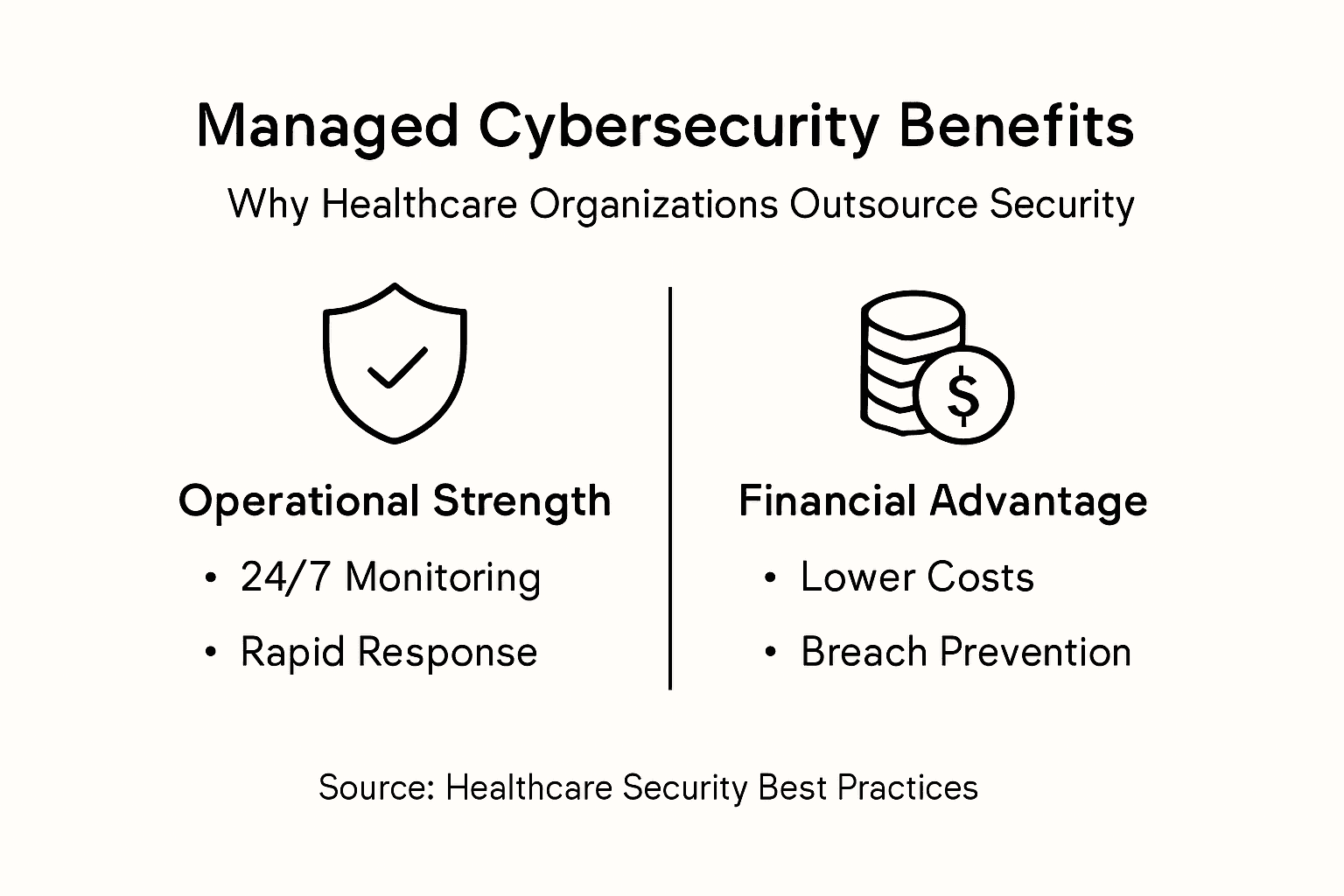
The financial math is simple: paying $50,000 monthly for managed security costs less than one major breach.
Scalability Without Hiring
Your organization grows. You add clinics, integrate new systems, or expand into new markets. In-house security requires hiring additional staff for each expansion.
Managed services scale automatically. You increase coverage without recruiting, training, or managing new employees. This flexibility lets you respond to growth opportunities without security becoming a bottleneck.
The advantage isn't just financial—it's operational freedom. Your team focuses on patient care while managed security handles the threat landscape.
Risk Reduction and Accountability
Managed providers carry professional liability insurance and guarantee service levels through contracts. If their monitoring misses an incident, you have contractual recourse.
Internal teams have no such accountability mechanism. When a breach occurs, liability falls entirely on your organization.
Pro tip: Compare total cost of ownership including hiring, training, tools, turnover, and breach risk rather than just comparing annual salaries to managed service fees.
Secure Healthcare Today with Expert Managed Cybersecurity Solutions
Healthcare organizations face complex challenges like ransomware risks, legacy device vulnerabilities, and strict regulatory demands that put patient safety and business continuity at risk. If protecting critical systems while ensuring compliance feels overwhelming, you are not alone. Managed cybersecurity requires specialized expertise, continuous monitoring, and compliance alignment to truly reduce risk and avoid costly breaches.
At Heights Consulting Group, we understand healthcare's unique cybersecurity landscape and provide tailored support across threat hunting, incident response, and regulatory frameworks like HIPAA and NIST. Our approach transforms cybersecurity into a strategic advantage rather than just an operational hurdle.
Discover how our managed cybersecurity services empower healthcare leaders to safeguard patient data and operational integrity with confidence. Act now to partner with experts who deliver continuous protection and compliance oversight so you can focus on delivering quality care. Visit Heights Consulting Group to learn more and schedule your consultation today.
Frequently Asked Questions
What are the benefits of using managed cybersecurity in healthcare?
Using managed cybersecurity in healthcare ensures 24/7 monitoring for threats, incident response, vulnerability management, and compliance support, which collectively enhance patient safety and organizational resilience against cyberattacks.
How does managed cybersecurity differ from traditional IT support?
Managed cybersecurity focuses exclusively on threat detection and prevention, employing security specialists who actively hunt for threats, whereas traditional IT support primarily deals with system uptime and general IT operations.
Why is healthcare particularly vulnerable to cyberattacks?
Healthcare organizations are prime targets due to the value of patient data, the critical need for uninterrupted services, outdated legacy systems, and regulatory complexities that make them susceptible to ransomware and data breaches.
What types of managed cybersecurity solutions are available for healthcare organizations?
Common managed cybersecurity solutions include Managed Detection and Response (MDR), vulnerability management, Security Operations Center (SOC) services, compliance support, and incident response services, each tailored to protect healthcare systems effectively.