

TL;DR:
- Security gap analysis systematically compares an organization’s cybersecurity controls against frameworks to identify vulnerabilities and compliance gaps. Conducting regular assessments reduces risks, breach costs, and improves audit readiness by proactively addressing control weaknesses. Including AI governance in these analyses is now essential due to emerging AI-specific security and regulatory exposures.
Security gap analysis is the systematic comparison of your current cybersecurity posture against defined frameworks or standards to pinpoint vulnerabilities, missing controls, and compliance gaps. The formal industry term is cybersecurity gap assessment, though security gap analysis is widely used across risk management and compliance functions. Organizations that skip this process operate with blind spots that regulators, auditors, and attackers will eventually find. The global average cost of a data breach reached $4.88 million in 2025, a 10% increase from 2024. That figure alone makes the case for why security gap analysis belongs at the top of every security leader's agenda.
What are the main benefits of a security gap analysis?
The most direct benefit of conducting a security gap analysis is risk reduction before an incident occurs. Organizations that run regular security assessments experience 50% fewer security incidents and 40% lower breach costs. That is not a marginal improvement. It is the difference between a manageable security event and a crisis that consumes executive attention for months.

The financial case extends beyond breach costs. Non-compliance adds an average of $174,538 to breach costs, and approximately 50% of organizations have encountered significant compliance issues within three years. A gap assessment surfaces those compliance exposures before regulators or auditors do.
Additional benefits include:
- Audit readiness. Gap analysis identifies control gaps before certification audits, functioning as a dress rehearsal that prevents reputational damage from failed audits under ISO 27001, SOC 2, or CMMC.
- Budget prioritization. Gap analysis clarifies risk exposure and security maturity, giving executives objective data to justify security investments and build remediation roadmaps.
- Compliance confidence. Mapping controls against NIST, HIPAA, or CMMC frameworks confirms which requirements are met and which are not, reducing the risk of fines and contract penalties.
- Reduced incident response costs. Proactive identification of weaknesses lowers the likelihood of breaches that trigger expensive incident response, legal review, and notification obligations.
Pro Tip: Run a gap assessment against your primary compliance framework at least 90 days before a scheduled audit. That window gives your team enough time to remediate critical findings and document evidence without rushing.
How does a security gap analysis work?
The security gap analysis process follows a structured sequence. Each step builds on the last, producing a prioritized remediation roadmap rather than a static list of findings.
- Define scope and framework. Select the standard or regulation to measure against. Common choices include ISO 27001, NIST CSF, HIPAA, and CMMC. Scope decisions determine which systems, business units, and data types fall under review.
- Assess current controls. Document existing security policies, technical controls, and operational procedures. This includes reviewing access management, endpoint protection, incident response plans, and vendor risk practices.
- Compare against the chosen framework. Map each existing control to the framework's requirements. Cybersecurity gap assessments address weaknesses across people, processes, and technology, not just technical configurations.
- Identify and score gaps. For each missing or insufficient control, assess the likelihood of exploitation and the potential business impact. This scoring drives prioritization.
- Build a remediation roadmap. Assign ownership, timelines, and resource requirements to each finding. High-risk gaps with low remediation cost should move to the top of the queue.
- Measure maturity and track progress. Establish a baseline maturity score and reassess periodically to confirm that remediation efforts are closing gaps over time.
The output of this process is not a compliance checklist. It is an executive-ready view of where the organization stands, what the risks cost if left unaddressed, and what it takes to close them.
| Phase | Primary Output | Key Stakeholders |
|---|---|---|
| Scope and framework selection | Assessment plan | CISO, Legal, Compliance |
| Control assessment | Current state inventory | Security team, IT |
| Gap identification | Gap register with risk scores | CISO, Risk committee |
| Remediation roadmap | Prioritized project plan | CIO, CISO, Business units |
| Progress tracking | Maturity scorecard | Board, Executive team |
Pro Tip: Assign a named owner to every gap finding before the assessment report is finalized. Gaps without owners rarely get closed. Accountability at the finding level is what separates a useful assessment from a document that sits on a shelf.
Gap analysis vs. risk assessments vs. audits: what is the difference?
These three evaluation types are frequently confused, but they serve distinct purposes and produce different outputs. Understanding the distinction helps security leaders deploy each tool at the right moment.
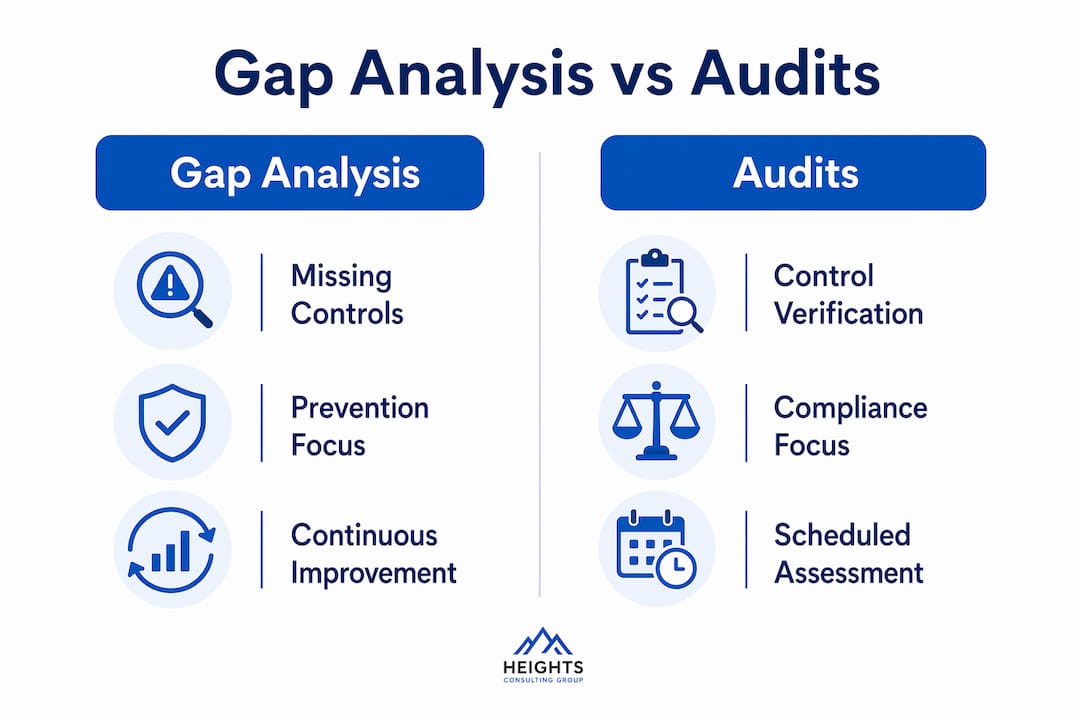
Gap analysis, risk assessments, and audits differ in focus, timing, and output. Gap analysis identifies missing controls relative to a standard. Risk assessments evaluate the likelihood and impact of specific threats. Audits verify whether controls are operating as designed and whether compliance requirements are met.
| Evaluation Type | Primary Focus | Typical Output | Best Used When |
|---|---|---|---|
| Security gap analysis | Missing or insufficient controls | Gap register and remediation roadmap | Preparing for certification or improving posture |
| Risk assessment | Threat likelihood and business impact | Risk register with prioritized risks | Evaluating specific threats or new initiatives |
| Security audit | Control effectiveness and compliance | Audit report with pass/fail findings | Verifying compliance for regulators or clients |
The three approaches complement each other within a mature security program. A gap analysis tells you what controls are missing. A risk assessment tells you which missing controls matter most given your threat environment. An audit confirms that the controls you have implemented are actually working. Running all three in sequence gives security leaders a complete picture that no single evaluation type can provide on its own.
Waiting for an external audit to surface control failures is a high-risk strategy. Internal gap analysis prevents costly audit failures and reputational damage by finding problems first. Organizations that align cybersecurity with business objectives use gap assessments to set the agenda for audits rather than react to them.
Why AI adoption makes security gap analysis more urgent
AI adoption expands governance gaps and risk exposures in ways that traditional security reviews were not designed to detect. When organizations deploy AI systems without defined ownership, access controls, or output validation processes, they create new attack surfaces and compliance exposures that sit outside existing control frameworks.
The specific risks that gap analysis must now address include:
- Shadow AI. Employees using unauthorized AI tools introduce data leakage risks and bypass approved security controls. A gap assessment identifies where AI use policies are absent or unenforced.
- Adversarial AI threats. Attackers use AI to accelerate phishing, automate vulnerability scanning, and generate convincing social engineering content. Organizations without controls mapped to these threat vectors are exposed.
- Model governance gaps. AI systems used in decision-making, fraud detection, or customer interactions often lack audit trails, bias controls, or access restrictions. These gaps create both security and regulatory risk.
- Third-party AI risk. Vendors embedding AI into their products may introduce data processing practices that conflict with HIPAA, GDPR, or CMMC requirements. Gap analysis surfaces these vendor-side exposures.
- Accountability gaps. Unchecked AI systems introduce security and compliance challenges that accumulate quietly until a breach or regulatory inquiry forces them into view.
The practical implication is that a gap assessment conducted in 2026 must include an AI control domain. Organizations that map their AI governance practices against frameworks like NIST AI RMF or ISO 42001 will find gaps that a standard cybersecurity assessment would miss entirely. Addressing those gaps before an incident or audit is the definition of proactive risk management. Ensuring regulatory compliance in cybersecurity now requires accounting for AI-related exposures as a core component of any gap review.
Key takeaways
Security gap analysis is the most direct method for converting unknown cybersecurity exposure into a prioritized, funded remediation plan that executives can act on.
| Point | Details |
|---|---|
| Financial risk is quantifiable | Breach costs average $4.88 million; gap analysis reduces incident frequency and breach severity. |
| Audit readiness requires preparation | Running a gap assessment 90 days before an audit prevents costly failures and reputational damage. |
| Three tools serve different purposes | Gap analysis, risk assessments, and audits each answer a different question and work best in sequence. |
| AI governance is now in scope | AI adoption creates control gaps that standard security reviews miss; include AI frameworks in every assessment. |
| Remediation needs ownership | Every gap finding must have a named owner and timeline or it will not be resolved. |
The case for treating gap analysis as a business function
From my experience working with security leaders across regulated industries, the organizations that get the most value from gap analysis are the ones that treat it as a business function rather than a compliance exercise. The difference shows up in how findings are reported, who owns remediation, and whether the results actually influence budget decisions.
The most common mistake I see is conducting a thorough gap assessment and then filing the report with the security team while the CFO and board remain unaware of the findings. That approach wastes the assessment's most valuable output. Gap analysis is a strategic tool that aligns cybersecurity efforts with specific business needs and compliance frameworks. When findings are translated into business risk language and presented at the executive level, they drive investment decisions that a technical report never would.
The second mistake is treating gap analysis as a one-time event. The threat environment, the regulatory landscape, and the organization's own technology stack all change continuously. A gap assessment conducted 18 months ago does not reflect the AI tools your teams adopted last quarter or the new CMMC requirements your contracts now require. Continuous assessment, even in a lightweight form between full reviews, is what separates organizations that manage risk from those that discover it after a breach.
My recommendation: schedule a full gap assessment annually, conduct a targeted review whenever a significant technology change or regulatory update occurs, and use the findings as the primary input for your security budget request. That sequence turns gap analysis from a compliance obligation into a competitive advantage.
— Dan
How Heightscg supports security gap analysis programs
Heightscg works with security leaders and executives to design and execute gap assessments that go beyond compliance checklists. The firm's approach maps current controls against frameworks including NIST CSF, CMMC, SOC 2, and ISO 27001, then delivers a prioritized remediation roadmap with clear ownership and timelines. Heightscg also incorporates AI governance controls into every assessment, addressing the exposures that standard reviews overlook. For organizations preparing for certification audits or responding to new regulatory requirements, Heightscg provides the structured analysis and remediation planning that converts findings into measurable security improvement. Reach out to the Heightscg consulting team to discuss how a gap assessment can address your organization's specific risk profile and compliance obligations.
FAQ
What is a security gap analysis?
A security gap analysis is a structured comparison of an organization's current cybersecurity controls against a defined standard or framework, such as NIST, ISO 27001, or CMMC, to identify missing or insufficient controls. The output is a gap register and remediation roadmap that prioritizes findings by risk impact.
How often should organizations conduct a gap analysis?
Organizations should conduct a full gap assessment at least once per year and run targeted reviews whenever a significant technology change, acquisition, or regulatory update occurs. Waiting longer than 12 months allows new vulnerabilities and compliance gaps to accumulate undetected.
How does gap analysis differ from a security audit?
Gap analysis identifies missing controls relative to a standard, while a security audit verifies whether existing controls are operating effectively and meeting compliance requirements. Both are necessary, but gap analysis is the better starting point for organizations building or improving their security programs.
What frameworks are used in a security gap analysis?
The most commonly used frameworks include NIST CSF, ISO 27001, HIPAA, CMMC, and SOC 2. The right framework depends on the organization's industry, regulatory obligations, and client contract requirements. AI-focused assessments increasingly incorporate NIST AI RMF or ISO 42001.
Can a gap analysis reduce breach costs?
Organizations that conduct regular security assessments experience 40% lower breach costs compared to those that rely on reactive approaches. Proactive identification and remediation of control gaps directly reduces the likelihood and severity of security incidents.