TL;DR:
- Effective organizational security policies establish clear rules and procedures that ensure compliance and mitigate risks. They assign accountability, define controls, and incorporate AI governance provisions to adapt to evolving threats. Proper development, enforcement, and regular review of these policies build organizational resilience and trust.
Why organizational security policies are the foundation of every resilient business
Organizational security policies are formalized rules and procedures that govern how an organization protects its information assets, controls access, and responds to threats. They are not documentation exercises. They are the operating framework that determines whether your security controls actually hold when a breach attempt, a compliance audit, or an AI governance failure puts them to the test.
The case for having them is direct: organizations without clear policies cannot enforce consistent controls, cannot demonstrate compliance to regulators, and cannot assign accountability when something goes wrong. According to the Cloud Security Alliance, 31% of organizations are unsure whether they experienced an AI-related breach, largely because they lack the inventory and ownership structures that a mature policy would require. That number reflects a governance gap, not a technology gap.
Key functions that security policies serve across every organization:
- Risk boundary definition: Policies establish what is acceptable use, what access is permitted, and what behaviors trigger escalation.
- Regulatory alignment: Frameworks like NIST, CMMC, SOC 2, HIPAA, and PCI DSS require documented policies as a baseline condition for compliance.
- Accountability assignment: Policies name who owns each control, who responds to incidents, and who approves exceptions.
- AI governance integration: As AI systems proliferate, policies must explicitly govern AI agent behavior, data access, and oversight mechanisms.
- Audit readiness: Documented, enforced policies are the primary evidence auditors examine when assessing an organization's security posture.
The NIST AI Risk Management Framework treats governance as a cross-cutting function, not a one-time task. Policies must evolve as the organization's risk profile changes, and that includes the risks introduced by AI adoption. Organizations that treat their security policies as living instruments, reviewed and updated on a defined cycle, consistently demonstrate greater resilience to auditors and customers alike.
Key reasons and benefits of implementing organizational security policies
Security policies deliver measurable operational and legal value. The benefits extend well beyond preventing breaches; they shape how an organization functions under pressure.
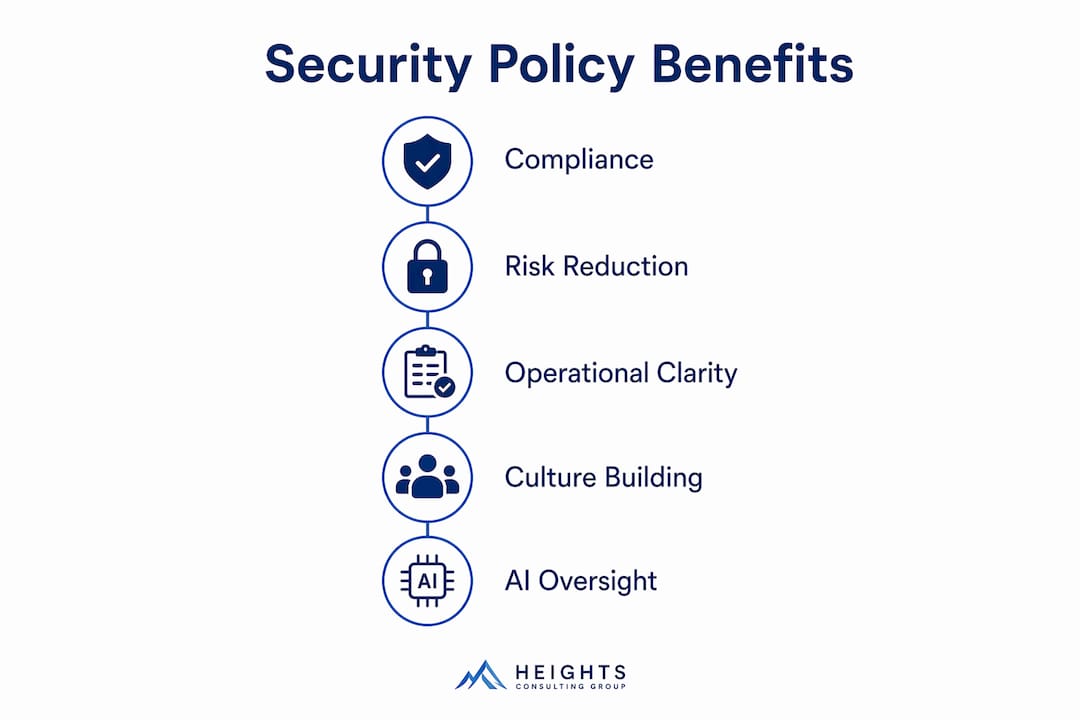
Regulatory compliance and legal protection. Policies translate regulatory requirements from NIST SP 800-12, CMMC, HIPAA, and PCI DSS into enforceable internal rules. Without documented policies, an organization cannot demonstrate compliance, and regulators treat the absence of documentation as evidence of non-compliance. A written policy also limits legal exposure when incidents occur by showing that the organization exercised reasonable care.

Risk reduction through defined controls. Policies specify which controls are required, who implements them, and how exceptions are handled. This removes ambiguity that attackers exploit. When every employee knows the acceptable use policy and every administrator knows the access control standard, the attack surface shrinks because human error decreases.
Operational clarity and efficiency. Security decisions made ad hoc consume time and create inconsistency. Policies move those decisions upstream, so teams spend less time debating what to do and more time executing. This is especially valuable in incident response, where a documented procedure reduces mean time to contain.
A security-conscious culture. Policies communicate organizational values around data protection and privacy. When leadership enforces them consistently, employees internalize security as a professional norm rather than an IT burden. Culture change is slow, but policy enforcement accelerates it.
Audit readiness and third-party trust. Customers, partners, and insurers increasingly require evidence of a documented security program before signing contracts. A policy library that maps to recognized frameworks like SOC 2 or ISO 27001 shortens vendor assessments and builds confidence in your organization's controls.
Additional benefits include:
- Clearer roles and responsibilities across security and IT teams
- Faster onboarding for new employees and contractors
- Reduced insurance premiums when policies demonstrate proactive risk management
- Stronger incident response outcomes when procedures are pre-defined
Pro Tip: When updating your security policies, include a section that explicitly addresses AI tools in use across the organization. Employees are already using AI-assisted applications, often without IT visibility. A policy that names approved tools, prohibited data inputs, and required logging controls closes that gap before it becomes a reportable incident.
What does an effective organizational security policy actually contain?
A policy that cannot be enforced is not a policy. It is a document. The difference lies in specificity: effective policies name owners, define scope, and connect to operational procedures that security teams can actually execute.
Core structural components
Every security policy should address the following elements:
- Scope: Which systems, data types, users, and locations the policy covers
- Purpose and authority: The business or regulatory rationale and the executive sponsor who owns it
- Roles and responsibilities: Named functions (CISO, system owners, data custodians) with defined obligations
- Access controls: Standards for authentication, authorization, least-privilege access, and privileged account management
- Acceptable use: Permitted and prohibited behaviors for corporate systems, networks, and data
- Data classification: Categories (confidential, internal, public) with handling requirements for each
- Incident response procedures: Escalation paths, notification timelines, and containment steps
- Compliance references: Explicit mapping to NIST, CMMC, HIPAA, PCI DSS, or other applicable frameworks
- Enforcement and exceptions: Consequences for violations and a formal process for approved exceptions
- Review cycle: A defined schedule for policy review, typically annual or after material changes
AI governance provisions
Standard policy components are necessary but no longer sufficient. Organizations deploying AI systems need provisions that address the specific risks AI introduces. The NIST AI RMF requires that governance structures assign accountability for AI risks across the full system lifecycle, not just at deployment.
AI-specific policy elements to include:
- AI system inventory: A registry of all AI tools in use, including third-party and employee-adopted applications
- Ownership assignment: Named accountable parties for each AI system's behavior and outputs
- Data input restrictions: Rules governing what data categories may be submitted to AI tools
- Monitoring requirements: Logging and review standards for AI-assisted decisions, particularly high-impact ones
- Kill-switch and override procedures: Documented authority and process to suspend an AI system when behavior deviates from intent
- Vendor and supply chain accountability: Requirements for AI vendors to disclose model behavior, training data provenance, and security controls
AI development requires continuous human-in-the-loop monitoring because AI systems can exhibit decision drift over time, producing outputs that diverge from their original intent without any code change. A policy that does not account for this creates a control gap that grows silently.
How to implement and maintain security policies that actually hold
Policy development fails most often not in the writing phase but in the deployment and enforcement phases. A document that leadership approves but employees never see, or that IT enforces inconsistently, provides almost no protection.
Steps for effective implementation
-
Secure executive sponsorship first. Policies without visible leadership support are ignored. The CISO or CIO must formally own the program, and the CEO must communicate its priority. The NIST AI RMF is explicit that effective risk management requires organizational commitment at senior levels.
-
Assemble a cross-functional working group. Legal, HR, IT, operations, and business unit leaders all have a stake in policy content. Involving them in drafting reduces resistance during rollout and catches gaps that a purely technical team would miss.
-
Map policies to applicable frameworks before writing. Start with the regulatory requirements your organization faces (CMMC for defense contractors, HIPAA for healthcare, PCI DSS for payment processors) and build policy language that satisfies those controls. This prevents the common mistake of writing policies that look complete but fail audits.
-
Communicate policies through training, not just distribution. Sending a PDF to all employees does not constitute training. Role-specific training that explains why a policy exists and what employees are expected to do produces measurably better compliance than passive acknowledgment.
-
Establish enforcement mechanisms before launch. Define the consequences for violations, the process for reporting them, and the authority to grant exceptions. Policies without enforcement are aspirational statements.
-
Conduct regular audits and gap assessments. Schedule quarterly reviews of policy adherence and annual full reviews of policy content. Use audit findings to update policies, not just to document deficiencies.
-
Tailor policies to organizational context. A 50-person professional services firm and a 5,000-person financial institution face different threat profiles and regulatory requirements. Policy depth, formality, and scope should reflect the organization's actual risk exposure, not a generic template.
-
Integrate policy updates into change management. When the organization adopts a new technology, enters a new market, or faces a new regulatory requirement, the policy review cycle should trigger automatically, not wait for the next scheduled review.
Pro Tip: Build AI oversight directly into your policy lifecycle. Assign a named owner to review AI-related policy provisions every six months. AI capabilities and the threats they introduce change faster than annual review cycles can track. A semi-annual AI policy review is now a baseline practice for organizations with material AI exposure.
AI governance in security policies: what every organization must address before 2026 ends
Security and risk management are the biggest barriers to scaling AI for 62% of organizations, outpacing both technical and regulatory limitations. That figure points to a specific failure: organizations are deploying AI without the policy infrastructure to govern it safely.

The core problem is ownership. Governance defines intent and ownership while security enforces controls; without clear policies, security teams deploy controls that create friction without actually reducing risk. When no one owns an AI system's behavior, no one monitors it, no one updates it when it drifts, and no one is accountable when it causes harm.
Shadow AI compounds this. When organizations treat AI governance as an IT infrastructure project rather than a policy and accountability project, employees adopt AI tools outside approved channels. Those tools run with broad access, produce outputs that enter business processes, and leave no audit trail. The policy gap is not theoretical; it is the mechanism by which ungoverned AI creates regulatory exposure.
The organizations that will scale AI safely are not the ones with the most sophisticated models. They are the ones that established ownership, access controls, and monitoring requirements before deployment, not after an incident forced the issue. AI governance is a policy discipline first and a technology discipline second.
A large portion of organizations lack an AI governance policy despite widespread AI use, which creates visibility and accountability gaps that auditors and regulators are beginning to scrutinize directly. The NIST AI RMF requires that accountability structures be in place so that appropriate teams are empowered, responsible, and trained for mapping, measuring, and managing AI risks.
Practical steps for integrating AI governance into existing security policies:
- Conduct an AI inventory audit before writing new policy language. You cannot govern what you have not cataloged.
- Assign explicit ownership for every AI system in use, including third-party tools accessed by employees.
- Treat AI agents as privileged identities with scoped credentials, access limits, and continuous monitoring requirements. Effective policy enforcement requires this framing to prevent AI agents from accumulating access beyond their intended scope.
- Define acceptable AI use with the same specificity applied to acceptable use of corporate networks.
- Require written safety plans for any AI system handling sensitive data or making consequential decisions, as Microsoft's Deputy CISO for AI recommends for safe AI deployment.
- Map AI governance provisions to NIST AI RMF categories (GOVERN, MAP, MEASURE, MANAGE) to align with the framework auditors and enterprise customers increasingly reference.
Organizations aligned with the NIST AI RMF are viewed as more resilient by auditors and customers, which translates directly into competitive advantage in procurement and partnership decisions. For executives building or updating their AI security governance program, the policy layer is where that advantage is built.
Pro Tip: Do not wait for a regulatory mandate to add AI governance provisions to your security policies. The organizations that draft these provisions now, before an incident forces the issue, will face far less disruption when formal requirements arrive. Use the NIST AI RMF GOVERN function as your structural template.
Common pitfalls that undermine security policy programs
Even well-intentioned policy programs fail. The failure modes are predictable, and most of them are organizational rather than technical.
Policies written for auditors, not operators. When policies are drafted to satisfy a compliance checklist rather than to guide actual behavior, they use language that employees cannot apply. A policy that says "users shall employ appropriate security measures" provides no operational guidance. Specificity is what makes a policy enforceable.
No enforcement mechanism. A policy without consequences is a suggestion. Organizations frequently invest in policy writing and then fail to define what happens when violations occur. This signals to employees that the policy is not serious, which accelerates non-compliance.
Infrequent or reactive updates. Threat landscapes change. Regulatory requirements change. AI capabilities change. Policies reviewed only when an incident occurs are perpetually behind the risk environment they are supposed to address. A defined review cycle, with named owners responsible for triggering it, prevents this drift.
Siloed ownership. Security policies that live exclusively within the IT or security team fail to account for the business processes they govern. When HR, legal, and operations are not involved in policy development, the resulting documents create friction with business workflows and get worked around rather than followed.
Underestimating the AI governance gap. Most organizations have acceptable use policies that predate widespread AI adoption. Those policies do not address AI-specific risks: data exfiltration through AI prompts, AI-generated outputs entering regulated workflows, or third-party AI vendors with access to sensitive data. Treating AI as just another software category misses the accountability and monitoring requirements that AI systems specifically require. Consulting resources like Heightscg's AI security framework guide can help security leaders identify where existing policies fall short and what provisions to add.
Treating policy as a one-time project. The organizations that sustain strong security postures treat policy management as an ongoing program with dedicated ownership, budget, and executive visibility. Those that treat it as a project complete it once and move on, leaving a static document that diverges from operational reality within months.
For organizations looking to build or mature their compliance framework, the policy layer is where that work begins. Controls without policy are unanchored; policy without controls is unenforceable. The two must develop together.
Key Takeaways
Organizational security policies are the enforceable foundation that connects regulatory requirements, risk management, and operational accountability into a single coherent program, and AI governance is now a required component of that foundation.
| Point | Details |
|---|---|
| Policies prevent accountability gaps | 31% of organizations are unsure whether they experienced an AI-related breach due to missing ownership and inventory structures. |
| AI governance belongs in policy, not just IT | 62% of organizations cite security and risk management as the top barrier to scaling AI safely. |
| NIST AI RMF provides the governance structure | The framework's GOVERN function assigns accountability for AI risks across the full system lifecycle. |
| Enforcement separates policies from documents | Policies without defined consequences, named owners, and review cycles fail in practice regardless of their written quality. |
| Regular review cycles are operationally required | AI capabilities and threat landscapes change faster than annual cycles track; semi-annual AI policy reviews are now a baseline practice. |
Heightscg works with executives and security leaders to build, audit, and mature organizational security policy programs that address both traditional compliance requirements and emerging AI governance obligations. If your current policies do not explicitly govern AI system ownership, access, and monitoring, connect with our team to close that gap before it becomes a liability.