

Protecting healthcare data is not a compliance checkbox. It is a direct patient safety obligation, a federal legal requirement, and one of the most consequential financial risks your organization carries. The FBI recorded 460 ransomware attacks against U.S. healthcare entities in 2025 alone, making healthcare the most-targeted sector in the country. Peer-reviewed research puts the average cost of a healthcare data breach at approximately $7.1 million per incident. And under HIPAA, enforced by HHS, a covered entity that fails to protect protected health information (PHI) faces mandatory breach notification, OCR investigation, and civil monetary penalties that can reach into the millions.
The immediate ask for any CISO: add a prioritized data-protection risk register item to the next board briefing. It should cover ransomware exposure, third-party vendor dependencies, and AI governance gaps. Those three categories account for the majority of current breach pathways, and boards that have not been briefed on them are operating with an incomplete risk picture.
- Healthcare was the top ransomware target in 2025, with 460 FBI-recorded attacks and more than 3,200 hacking incidents logged between 2020 and 2026.
- The average breach cost in healthcare is roughly $7.1 million, substantially higher than most other sectors.
- HIPAA and HITECH create mandatory notification and compliance obligations enforced by HHS's Office for Civil Rights (OCR), with no opt-out for covered entities.
Key Takeaways
Healthcare data protection is a patient safety obligation, a federal legal requirement, and the single most consequential cybersecurity investment a healthcare organization can make in 2026.
| Point | Details |
|---|---|
| Ransomware is the primary threat | The FBI recorded 460 healthcare ransomware attacks in 2025, making it the most-targeted US sector. |
| Breach costs are substantial | Peer-reviewed research estimates the average healthcare breach at approximately $7.1 million per incident. |
| HIPAA compliance is mandatory | HHS OCR enforces breach notification and civil penalties; a current risk analysis and signed BAAs are non-negotiable. |
| AI governance is now a patient-safety issue | The HSCC's 2026 implementation guide frames AI cyber risks as clinical risks requiring dedicated controls. |
| Heightscg provides structured engagements | Heightscg delivers risk assessments, managed security, and AI governance programs aligned to clinical and regulatory priorities. |
Table of Contents
- Why healthcare data is uniquely sensitive compared to other sectors
- What happens when healthcare data is not protected
- What US leaders must know about HIPAA, OCR, and federal obligations
- The most common causes of healthcare data breaches
- Practical controls leaders should prioritize to protect healthcare data
- How to share data for research and AI without compromising privacy
- How to build an investment case for data protection at the board level
- Executive checklist: questions to ask your board, CISO, and vendors
- Recent research and trends leaders need to know (2024–2026)
- Where leaders typically underinvest: an advisory perspective
- Heightscg helps healthcare leaders turn risk into resilience
- Sources
Why healthcare data is uniquely sensitive compared to other sectors
Most data types carry one category of risk. Healthcare data carries several simultaneously, and that combination is what makes it so valuable to attackers and so consequential when it is exposed.
A single electronic health record (EHR) contains immutable identifiers — Social Security numbers, dates of birth, insurance IDs — alongside clinical history, prescription records, imaging, and billing data. Unlike a compromised credit card, which can be cancelled, a patient's medical history cannot be changed. That permanence gives PHI a long shelf life on criminal markets, where it commands a higher price than financial credentials alone.
"Healthcare data is not just personally sensitive — it is a public good with research and social value, which creates inherent tension between the imperative to share it for learning and the obligation to protect it from harm."
— NIH/NCBI workshop summary on healthcare data as a public good
Clinical workflows amplify the stakes further. EHR-integrated systems govern medication dispensing, lab ordering, surgical scheduling, and care coordination. When those systems are unavailable, even briefly, clinical staff revert to paper-based processes that slow care delivery and introduce error risk. Availability and integrity are not IT concerns in this context. They are patient-safety concerns.
The attack surface has also expanded significantly. Longitudinal records, medical device telemetry, genomic data, and diagnostic imaging all feed into modern clinical environments. Each data type adds re-identification risk: a de-identified genomic dataset combined with publicly available demographic data can, in many cases, be re-linked to an individual.
AI has added a new exposure layer that most organizations have not yet fully mapped. Training datasets drawn from patient records, third-party API integrations feeding clinical decision-support tools, and model outputs that may inadvertently surface PHI all create governance gaps. Leaders who treat AI systems as standard IT assets, subject only to routine access controls, are underestimating the exposure. The HSCC's AI Cyber Governance Framework Implementation Guide identifies data poisoning, model drift, and prompt injection as distinct threat categories that require dedicated controls beyond what a conventional security program provides.
Statistic to know: Between 2020 and 2026, the healthcare sector recorded more than 3,200 hacking incidents, per FBI data cited by the AHA. That volume reflects a sustained, deliberate targeting pattern, not opportunistic attacks.
What happens when healthcare data is not protected
The consequences of a healthcare data breach are not confined to a regulatory fine and a press release. They cascade across clinical operations, finances, and patient trust in ways that take years to fully resolve.
Patient safety is the most direct consequence
Research published on PubMed documents that ransomware incidents correlate with cancelled surgeries, ambulance diversions, and measurable changes in patient outcomes. When an EHR goes offline, clinicians lose access to allergy records, current medication lists, and pending lab results. The margin for error narrows immediately. Facilities that have experienced extended outages report that nursing staff spend significantly more time on manual documentation, reducing direct patient care hours during the exact period when operational stress is highest.
Operational disruption extends well beyond the affected system
A ransomware incident at a billing vendor or lab partner can force downtime at hospitals that have no direct compromise. Third-party breaches have repeatedly demonstrated that the blast radius of a single vendor incident can span dozens of downstream providers simultaneously. In practice, this means a hospital's clinical operations can be disrupted by a security failure in a company it does not directly manage and may not have fully audited.
Financial exposure is multi-layered
Direct remediation costs include forensic investigation, system restoration, legal counsel, and notification. Regulatory exposure under HIPAA can add civil monetary penalties. Class-action litigation has followed major incidents. And patient churn is a real, documented effect: research on patient hospital visit behavior shows that patients reduce care-seeking at providers they associate with a breach, creating long-term revenue impact that does not appear in the immediate incident cost calculation.
Cost reference: Peer-reviewed literature estimates the average healthcare breach at approximately $7.1 million per incident, a figure that excludes downstream patient-retention losses and multi-year reputational effects.
What US leaders must know about HIPAA, OCR, and federal obligations
The U.S. regulatory framework for healthcare data protection is anchored by two statutes and enforced by two federal bodies. Leaders who do not have a working understanding of both are exposed.
HIPAA and HITECH establish the baseline. The Health Insurance Portability and Accountability Act, enacted in 1996 and significantly strengthened by the Health Information Technology for Economic and Clinical Health (HITECH) Act in 2009, requires covered entities and their business associates to implement administrative, physical, and technical safeguards for PHI. HITECH extended direct liability to business associates and increased penalty tiers.
HHS OCR is the enforcement authority. The Office for Civil Rights investigates breach reports, conducts compliance reviews, and issues civil monetary penalties. OCR's breach portal — the so-called "Wall of Shame" — publicly lists every breach affecting 500 or more individuals. A breach of that scale triggers mandatory notification to affected individuals, HHS, and, in some cases, prominent media outlets in the affected state.
CISA plays a complementary role. The Cybersecurity and Infrastructure Security Agency issues sector-specific alerts, vulnerability advisories, and incident response guidance for healthcare. When a zero-day vulnerability affects widely deployed clinical software, CISA's advisories often arrive before vendor patches. Leaders should have a process for monitoring and acting on CISA alerts within defined SLAs.
FDA oversight applies when AI or software functions as a medical device. Clinical decision-support tools that meet the definition of a Software as a Medical Device (SaMD) fall under FDA premarket review requirements, adding a regulatory layer that most IT governance programs are not built to handle.
Practical priorities for leaders:
- Documented risk analysis: HIPAA requires a formal, organization-wide risk analysis. It must be current, documented, and tied to a remediation plan. OCR routinely cites the absence of a current risk analysis as a primary finding in enforcement actions.
- Business Associate Agreements (BAAs): Every vendor, cloud provider, or partner that handles PHI must have a signed BAA. Gaps here are among the most common HIPAA violations OCR identifies.
- Breach response playbook: The 60-day notification clock under HIPAA starts from the date of discovery, not the date of containment. A tested, documented incident response plan is not optional.
- Board-level reporting: OCR expects organizations to demonstrate that leadership is engaged in cybersecurity governance. Board briefings on residual risk, recent incidents, and remediation status are increasingly viewed as evidence of a mature compliance posture.
For a deeper look at how compliance frameworks drive security outcomes, the intersection of NIST CSF and HIPAA requirements is worth examining in detail.
The most common causes of healthcare data breaches
Understanding where breaches originate is the prerequisite for allocating controls budget effectively. The threat landscape in healthcare is not uniform.
Hacking and ransomware account for the largest share of major incidents by volume and severity. Phishing emails remain the dominant initial access vector, enabling credential theft that attackers use to move laterally through clinical networks. Exposed Remote Desktop Protocol (RDP) endpoints and unpatched vulnerabilities in EHR plugins and medical device firmware are consistently exploited. The FBI's 2025 data confirms healthcare as the top ransomware target nationally.
Statistic: The FBI recorded 460 ransomware attacks against healthcare entities in 2025, the highest of any sector. That figure represents reported incidents only; actual attack attempts are substantially higher.
Misconfigured cloud storage is a persistent and underappreciated cause. Public S3 buckets, weak IAM policies, and misconfigured API gateways have exposed millions of patient records in incidents that required no sophisticated attack technique. As healthcare organizations migrate clinical workloads to AWS, Azure, and Google Cloud, configuration drift becomes a standing risk without continuous posture management.
Insider error and unauthorized disclosure account for a meaningful share of breach reports. Lost or stolen laptops and mobile devices, accidental misdirection of PHI in email, and inappropriate access by employees to records outside their care team all generate OCR notifications. Role-based access controls and data loss prevention (DLP) tools directly reduce this exposure.
Third-party and supply-chain breaches carry the widest blast radius. A single compromise at a billing vendor, laboratory partner, or health information exchange can simultaneously affect dozens of downstream providers. The AHA's analysis of third-party cyber risk identifies vendor concentration as one of the sector's most undermanaged resilience risks.
Legacy medical devices and EHR plugins present a category of risk that is difficult to patch quickly. Many networked medical devices run operating systems that vendors no longer support, and EHR plugin ecosystems can introduce vulnerabilities that the primary EHR vendor does not control. Network segmentation is the primary compensating control when patching is not feasible.
Practical controls leaders should prioritize to protect healthcare data
Effective healthcare data protection requires layered controls across technology, governance, and people. The following priorities are sequenced by impact and feasibility for most healthcare organizations.
Foundational controls
- Asset and inventory management: You cannot protect what you cannot see. A current, accurate inventory of all systems, devices, and data flows — including medical devices and cloud workloads — is the prerequisite for every other control.
- Identity and access management (IAM): Multi-factor authentication (MFA) on all remote access and privileged accounts, role-based access control (RBAC) tied to clinical roles, and regular access reviews to remove stale permissions.
- Patch and configuration management: Prioritize EHR systems, network infrastructure, and internet-facing assets. Define and enforce SLAs for critical patch deployment. For unpatched legacy devices, apply network segmentation as a compensating control.
- Encryption: Encrypt PHI at rest and in transit. Full-disk encryption on laptops and mobile devices directly reduces breach notification obligations when devices are lost or stolen.
Detection and response
- EDR/XDR deployment: Endpoint detection and response tools on all managed endpoints, with alerting tuned to clinical environment baselines. Extended detection and response (XDR) correlates signals across endpoints, network, and identity layers.
- Continuous monitoring and SIEM: A security information and event management (SIEM) platform with healthcare-specific use cases — EHR access anomalies, after-hours bulk record queries, and lateral movement indicators.
- Threat hunting: Proactive threat hunting for CISOs reduces dwell time, which is the interval between attacker entry and detection. Shorter dwell time directly limits the scope of a breach.
- Tested incident response: A documented incident response playbook that has been exercised in a tabletop scenario within the past 12 months. The playbook must include clinical downtime procedures, not just IT recovery steps.
Resilience and recovery
- Immutable and offline backups: Ransomware operators specifically target backup systems. Immutable backups, stored offline or in air-gapped environments, are the primary recovery mechanism when encryption attacks succeed.
- RTO/RPO planning for clinical systems: Recovery time objectives (RTO) and recovery point objectives (RPO) must be defined for EHR, pharmacy, and imaging systems specifically. A generic IT RTO of 72 hours is clinically unacceptable for most facilities.
Data governance and AI-specific controls
- DLP and data classification: Data loss prevention tools on email, endpoints, and cloud storage reduce accidental and intentional PHI exfiltration. Classification policies define handling requirements by data sensitivity tier.
- De-identification and tokenization: For analytics, research, and AI training use cases, de-identified or tokenized datasets reduce direct PHI exposure.
- AI governance controls: The HSCC's AI Cyber Governance Framework specifies controls across the model lifecycle: encryption and integrity hashing for training data, DLP on model inputs and outputs, HSM-managed keys for model artifacts, and monitoring for model drift and adversarial inputs. Treating AI systems as standard IT assets leaves these threat categories unaddressed.
- Vendor BAAs and contract terms: Every vendor handling PHI or operating AI systems on clinical data must have a current BAA and contractual security requirements, including incident notification SLAs.
People and process
- Role-based security training: Phishing simulation and awareness training calibrated to clinical roles, not generic IT security content. Nurses, physicians, and administrative staff face different social engineering scenarios.
- Executive KPIs: Mean time to detect (MTTD), mean time to respond (MTTR), phishing click rate, and percentage of critical assets with current patches are the four metrics that give leadership a real-time view of program health.
Pro Tip: When reviewing vendor security attestations, require a SOC 2 Type II report scoped to include the specific services handling your PHI, not a generic enterprise-level attestation. Ask for the bridge letter covering the period since the last audit, and confirm that the scope explicitly covers the clinical data flows in your BAA. A SOC 2 report that excludes the relevant system is not evidence of control.
How to share data for research and AI without compromising privacy
Healthcare data carries genuine public-good value. Clinical research, epidemiological modeling, and AI-driven diagnostics all depend on access to patient data at scale. The governance challenge is enabling that access without creating re-identification risk or regulatory exposure.
De-identification and pseudonymization are the foundational approaches. HIPAA's Safe Harbor and Expert Determination methods provide two compliant pathways for removing or transforming direct identifiers. Pseudonymization replaces identifiers with tokens, allowing data to be re-linked under controlled conditions while reducing exposure in transit and at rest.
Data Use Agreements (DUAs) govern how de-identified or limited datasets are shared with research partners, academic institutions, and AI vendors. A well-drafted DUA specifies permitted uses, prohibits re-identification attempts, requires security controls on the recipient side, and defines breach notification obligations. Many organizations treat DUAs as a legal formality rather than a security control, which is a governance gap.
Privacy-enhancing technologies (PETs) offer stronger protections for high-sensitivity use cases:
- Differential privacy adds calibrated statistical noise to query outputs, preventing individual-level inference while preserving aggregate utility. It is well-suited for population-level analytics and model training on sensitive datasets.
- Federated learning trains AI models across distributed datasets without centralizing the underlying data. Each participating institution trains a local model; only model updates, not patient records, are shared. This approach is particularly relevant for multi-site clinical research where data centralization is legally or operationally impractical.
- Synthetic data generation produces statistically representative datasets with no direct link to real patients. Utility varies by use case; synthetic data works well for model development and testing but may not replicate rare clinical presentations accurately.
Research on privacy-by-design approaches for federated learning and PETs in medical research notes that each technique involves tradeoffs between privacy protection and data utility that require explicit governance decisions, not just technical implementation.
Governance controls for AI projects should mirror the rigor applied to clinical research:
- IRB-equivalent review for AI projects that use patient data, covering data sourcing, model purpose, and output monitoring.
- Data access committees with defined approval criteria and time-limited access grants.
- Continuous monitoring of model outputs for PHI leakage, particularly in generative AI applications where outputs may inadvertently surface training data.
- Vendor contract terms that explicitly prohibit the use of your patient data to train models for other clients.
The NIH/NCBI framework on healthcare data as a public good provides useful grounding for organizations building governance policies that balance research access with privacy obligations.
How to build an investment case for data protection at the board level
Security leaders who frame data protection as a cost center lose budget conversations. Those who frame it as risk quantification win them. The difference is in the metrics and the narrative.
KPIs that matter to the board
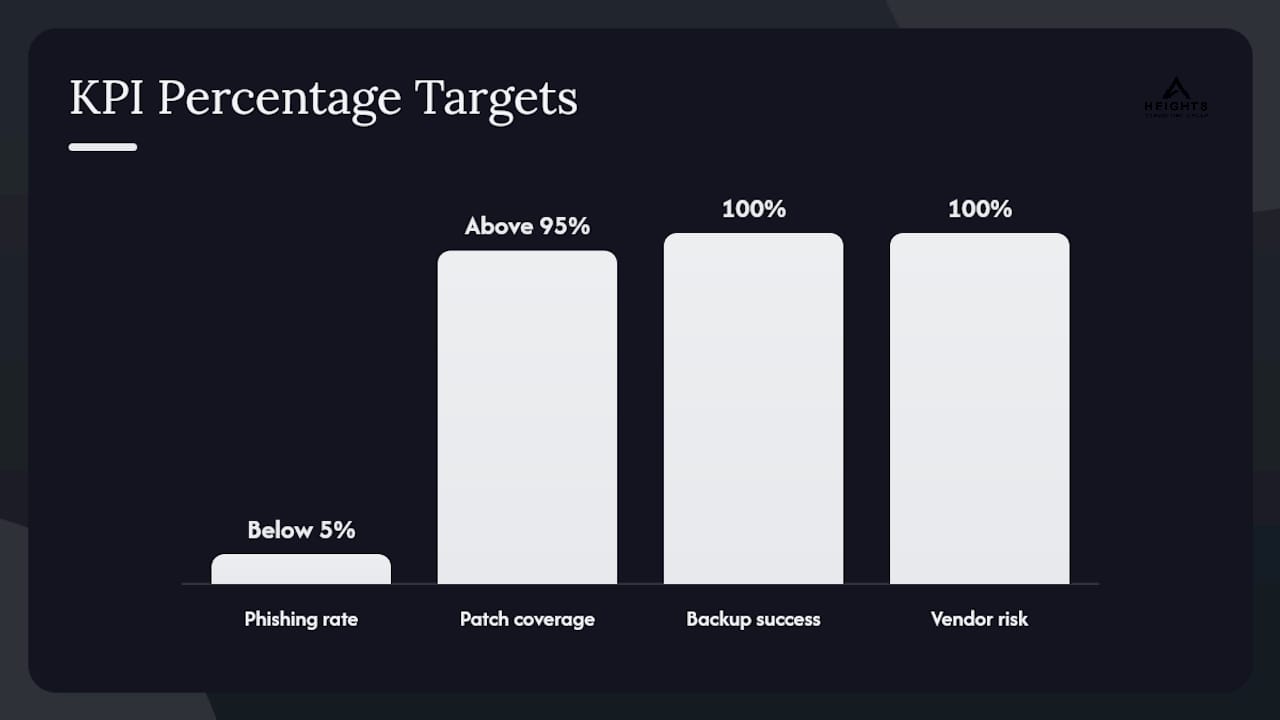
| KPI | Definition | Target Threshold |
|---|---|---|
| Mean Time to Detect (MTTD) | Average time from breach initiation to detection | Under 24 hours for critical systems |
| Mean Time to Respond (MTTR) | Average time from detection to containment | Under 4 hours for ransomware events |
| Phishing click rate | Percentage of staff who click simulated phishing links | Below 5% after training |
| Critical asset patch coverage | Percentage of critical assets with current patches | Above 95% within defined SLA |
| Backup recovery success rate | Percentage of backup restoration tests that succeed | 100% for clinical systems |
| Third-party risk score | Percentage of vendors with current BAAs and security attestations | 100% for PHI-handling vendors |
ROI framing for executives
The avoided-cost model is the most credible framing for boards unfamiliar with security investment logic. With an average breach cost of approximately $7.1 million and a documented ransomware frequency of 460 attacks against U.S. healthcare entities in 2025, the expected annual loss exposure for a mid-size health system is calculable. A security program that reduces breach probability by a meaningful margin — through MFA, EDR, tested incident response, and vendor risk management — generates a quantifiable expected-value return.
Pair that calculation with patient-retention data. Research on patient behavior after breaches shows measurable declines in care-seeking at affected providers, which translates directly to lost revenue that does not appear in breach remediation cost estimates.
For a structured approach to cybersecurity risk management in healthcare, the alignment between NIST CSF maturity levels and investment prioritization provides a practical roadmap for phased spending.
Investment roadmap framing:
- High impact, lower cost: MFA on all remote access, phishing training with simulation, immutable backup implementation, and BAA audit. These controls address the highest-frequency attack vectors at relatively low marginal cost.
- High impact, moderate cost: EDR/XDR deployment, SIEM with healthcare use cases, and network segmentation for legacy medical devices.
- High impact, higher cost: 24/7 SOC coverage, third-party risk management program, and AI governance framework implementation.
Executive checklist: questions to ask your board, CISO, and vendors
Use this checklist in board meetings, quarterly security reviews, and vendor due diligence conversations. Each question is designed to surface gaps that routine status reports often obscure.
Board-level questions
- What is our current residual risk rating, and how has it changed since the last review?
- When did we last conduct a tabletop exercise, and what were the top three findings?
- What are the RTO and RPO for our EHR and pharmacy systems, and have they been validated in a recovery test?
- Which third-party vendors represent our highest concentration risk, and what is our contingency if one of them experiences an extended outage?
CISO and CIO questions
- What are our current MTTD and MTTR figures, and how do they compare to the targets in our security program plan?
- How frequently are backups tested for successful restoration, and when was the last full clinical system recovery test?
- What is our patching posture for EHR plugins and networked medical devices, and which assets are currently outside SLA?
- Has our incident response playbook been updated to reflect our current cloud architecture and AI system dependencies?
Vendor and partner review questions
- Is there a current, signed BAA in place that explicitly covers the data flows in our contract?
- Can you provide a SOC 2 Type II report scoped to the services handling our PHI, along with a bridge letter?
- What is your SLA for notifying us of a security incident that may affect our data, and can you provide documented examples of past notifications?
- Have you experienced a security incident in the past 24 months that affected any healthcare client? If so, what was the scope and resolution?
Pro Tip: When requesting vendor security evidence, ask for the penetration test executive summary from the most recent annual test, the SOC 2 Type II report with scope description, and the incident response contact card with escalation timelines. Frame the request as a BAA compliance requirement rather than a discretionary audit. Vendors who resist providing this evidence under a BAA framework are a risk signal in themselves.
Recent research and trends leaders need to know (2024–2026)
The threat environment in healthcare has shifted materially over the past two years. The following findings represent the evidence base leaders should be citing when making investment and governance decisions.
| Finding | Source | Executive Implication |
|---|---|---|
| Healthcare was the top ransomware target in 2025; FBI recorded 460 attacks | AHA / FBI data | Ransomware is not a tail risk — it is a near-certain operational threat requiring dedicated resilience investment |
| Ransomware incidents correlate with cancelled surgeries, ambulance diversions, and adverse patient outcomes | PubMed study on breach and hospital outcomes | Patient safety is a direct data protection argument; clinical leadership must be part of the security governance conversation |
| Average healthcare breach cost approximately $7.1 million per incident | NCBI/PMC peer-reviewed literature | Breach cost exceeds most annual security program budgets; ROI framing is straightforward |
| Patients reduce care-seeking at providers following a breach | Journal of International Research in Marketing | Revenue impact extends beyond remediation costs; patient trust is a financial asset |
| Third-party breaches represent the sector's highest concentration risk | AHA Cyber Intel | Vendor risk management is not optional; a single vendor failure can disable multiple facilities simultaneously |
| HSCC published AI Cyber Governance Framework Implementation Guide | HSCC / AHA | AI governance is now a documented sector expectation, not an emerging best practice |
The AI governance shift
The publication of the HSCC's AI Cyber Governance Framework Implementation Guide in 2026 marks a turning point. For the first time, the healthcare sector has a detailed, implementation-level playbook for governing AI systems as a distinct risk category. The guide addresses data poisoning, model drift, prompt injection, and adversarial inputs as specific threat vectors requiring dedicated controls.
"AI cyber safety is patient safety. The risks introduced by AI systems — from training data exposure to model manipulation — require the same governance rigor as any other clinical system, not a lighter-touch IT review."
— AHA guidance on AI cyber governance frameworks for healthcare organizations
The AHA's framing is deliberate: AI governance is not an IT project. It is a patient-safety and enterprise risk issue that belongs on the same agenda as ransomware resilience and HIPAA compliance. Organizations that have deployed clinical AI tools without a formal governance framework are carrying undisclosed risk.
Healthcare security services that address both traditional threat vectors and AI-specific controls, such as those described by ABCO Security's healthcare security model, reflect the direction the sector is moving: integrated, multi-layer protection that accounts for both physical and digital clinical environments.
Where leaders typically underinvest: an advisory perspective
The most common gap Heightscg observes across healthcare security programs is not in the foundational controls. Most organizations have firewalls, antivirus, and some form of access management. The gaps are in three areas that receive less budget attention but carry disproportionate risk.
Third-party risk management is the most underinvested category relative to its actual exposure. Organizations spend significant resources securing their own perimeter while maintaining dozens of vendor relationships with minimal security validation beyond an initial BAA. A billing vendor, a lab interface partner, or a cloud-hosted EHR module can become the entry point for an incident that shuts down clinical operations for days. The AHA's analysis of third-party concentration risk makes this point with documented sector-wide evidence.
Backup validation is the second gap. Many organizations have backup systems. Far fewer have tested those systems under conditions that simulate an actual ransomware recovery scenario, where the primary EHR, the backup server, and the network may all be compromised simultaneously. An untested backup is not a recovery asset. It is a hypothesis.
AI governance is the newest and fastest-growing blind spot. Clinical AI tools are being deployed at a pace that outstrips governance program development. When a clinical decision-support model is trained on patient data without a formal data use agreement, without model integrity controls, and without monitoring for output anomalies, the organization is carrying regulatory and patient-safety exposure that does not yet appear in any risk register. The HSCC implementation guide provides the framework. The gap is in execution.
A structured engagement that maps current AI deployments, validates third-party BAA coverage, and tests backup recovery against clinical RTO requirements can reduce an organization's residual risk profile materially, often within a 90-day assessment cycle. That is the kind of work that turns a board briefing from a status report into a demonstrable risk-reduction story.
Heightscg helps healthcare leaders turn risk into resilience
Healthcare organizations managing the intersection of HIPAA compliance, ransomware exposure, and AI governance need more than a checklist. They need a structured program that aligns security controls with clinical risk priorities and gives leadership the evidence to make confident investment decisions.
Heightscg delivers technical cybersecurity consulting across strategy, managed security operations, incident response, and AI governance, specifically for organizations in regulated sectors where the cost of getting it wrong is measured in patient outcomes, not just dollars. The firm's engagements are designed to produce board-ready risk documentation, validated controls, and a prioritized remediation roadmap within a defined timeline. For leaders who need to move from exposure to confidence, the next step is a focused risk assessment scoped to your highest-priority gaps. Contact Heightscg to initiate that conversation.
Sources
Leaders who want to go deeper on any section of this guide should start with these primary sources.
Federal guidance and regulatory obligations:
- FBI: Health care was top target for ransomware, other cyberthreats in 2025 - AHA
- Healthcare Data as a Public Good: Privacy and Security - NCBI/NIH
- Health Information Privacy (HIPAA) - HHS
Peer-reviewed and sector research:
Sector playbooks and AI governance:
Heightscg services: