

TL;DR:
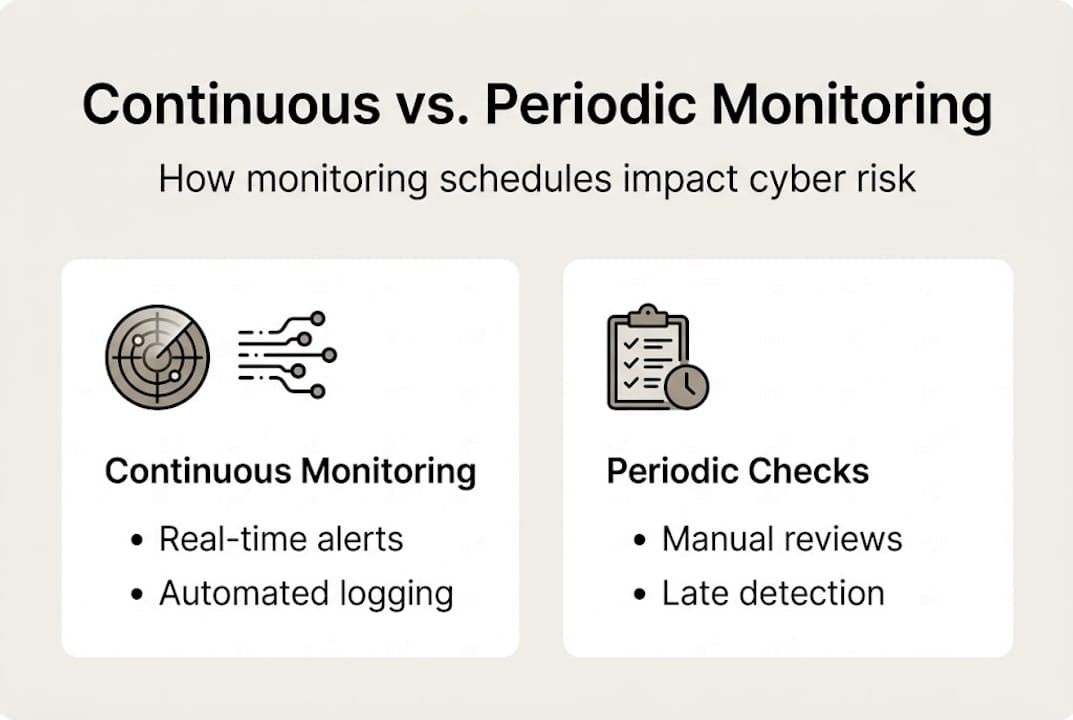
- Continuous monitoring provides real-time security awareness, unlike periodic assessments that create blind spots.
- It enhances risk management, compliance, and operational resilience by enabling proactive threat detection and response.
- Leadership should shift focus from passing audits to maintaining active, ongoing visibility of their organization's risk posture.
Most security leaders believe their organization is protected because they passed last quarter's audit. That belief is one of the most dangerous assumptions in modern cybersecurity. Threats do not pause between scheduled reviews. Attackers probe systems continuously, exploit newly disclosed vulnerabilities within hours, and move laterally through networks long before a periodic scan catches them. The organizations that suffer the most damaging breaches are often technically compliant on paper. This guide explains what continuous monitoring actually means at the executive level, how it connects to regulatory frameworks, and how you can use it to make faster, more confident risk decisions.
Table of Contents
- Understanding continuous monitoring: More than just an IT tool
- Bridging compliance and real-time risk management
- From visibility to action: Turning monitoring data into executive decisions
- Building a resilient, proactive security culture
- Perspective: Why most leaders underestimate continuous monitoring—until it's too late
- Take the next step toward continuous security leadership
- Frequently asked questions
Key Takeaways
| Point | Details |
|---|---|
| Real-time risk insight | Continuous monitoring enables organizations to see and respond to threats as they emerge, not months later. |
| Compliance isn't enough | Periodic compliance checks alone miss dynamic risks—continuous approaches close this gap. |
| Executive-ready decisions | Well-designed monitoring transforms technical data into actionable insights for leadership. |
| Build resilience | Embedding continuous monitoring helps shift your whole organization from reactive to proactive security. |
Understanding continuous monitoring: More than just an IT tool
Continuous monitoring is frequently mischaracterized as a purely technical function, something the security operations team handles in the background. That framing undersells its strategic importance. At its core, continuous monitoring is an executive-level risk management discipline. It provides leadership with a real-time, persistent view of the organization's security posture rather than a snapshot taken once or twice a year.
NIST SP 800-137 defines the practice clearly: continuous monitoring provides ongoing awareness of security posture, vulnerabilities, and threats to support real-time risk management decisions. That definition is worth reading twice. The emphasis is on awareness and decisions, not just detection.
"Continuous monitoring is not a technology purchase. It is an organizational commitment to maintaining situational awareness across every layer of the enterprise, from endpoints to cloud workloads to third-party connections."
Periodic approaches, whether annual audits, quarterly vulnerability scans, or point-in-time assessments, create blind spots by design. Between review cycles, configurations drift, new assets appear, and access privileges accumulate. An attacker who enters during that gap may operate undetected for weeks. The FedRAMP continuous monitoring guide reinforces this concern, noting that cloud and dynamic environments make point-in-time assessments structurally insufficient.
The business drivers for continuous monitoring extend well beyond avoiding breaches. They include:
- Risk management: Real-time visibility allows leaders to prioritize remediation based on actual exposure, not theoretical risk scores.
- Regulatory compliance: Frameworks including NIST, CMMC, HIPAA, and FedRAMP increasingly expect ongoing evidence of control effectiveness, not just periodic attestations.
- Stakeholder trust: Boards, investors, and regulators are asking harder questions. Organizations with mature monitoring programs can answer those questions with data.
- Operational resilience: Continuous monitoring shortens the time between threat detection and containment, limiting the blast radius of any incident.
Thinking of continuous monitoring as always-on cyber defense reframes it correctly. It is the difference between knowing your organization's risk posture today versus hoping nothing changed since the last review.
Bridging compliance and real-time risk management
Compliance frameworks are valuable, but they were never designed to be the whole answer. A SOC 2 report, a CMMC assessment, or a HIPAA audit captures a moment in time. The controls that passed review last spring may have drifted, been misconfigured, or become irrelevant to new attack vectors by the time the ink dries.

This is where continuous monitoring transforms compliance from a checklist exercise into a living risk management practice. The NIST RMF Monitor step is explicit: ongoing authorization depends on continuous monitoring data, not periodic reauthorization alone. FedRAMP's framework goes further, stating that continuous monitoring aligns with the Monitor step in the Risk Management Framework and supports ongoing authorization, crucial for dynamic and cloud environments.
| Dimension | Periodic monitoring | Continuous monitoring |
|---|---|---|
| Visibility | Snapshot at review time | Real-time, persistent |
| Compliance evidence | Point-in-time attestation | Ongoing, auditable data |
| Threat detection | Delayed until next cycle | Near-immediate |
| Risk response | Reactive, post-audit | Proactive, event-driven |
| Regulatory alignment | Minimum requirement | Exceeds framework intent |
For C-level leaders looking to integrate continuous monitoring into existing compliance frameworks for cybersecurity, a practical sequence looks like this:
- Map your control inventory. Identify which controls are subject to drift, misconfiguration, or external dependency. These are your highest-priority monitoring targets.
- Establish automated baselines. Define what "normal" looks like for each critical control and configure alerts when deviations occur.
- Assign ownership. Every monitored control should have a named owner accountable for remediation, not just detection.
- Integrate monitoring outputs into governance reporting. Security data should flow into board-level risk dashboards, not stay buried in technical logs.
- Review and adapt. Threat landscapes shift. Monitoring strategies should be reviewed quarterly and updated as new risks emerge.
Pro Tip: When preparing for an audit, use your continuous monitoring data as a narrative. Auditors respond well to organizations that can show how controls performed over time, not just that they were in place on audit day. That evidence trail turns a stressful compliance review into a confident demonstration of operational maturity.
From visibility to action: Turning monitoring data into executive decisions
Data without context is noise. One of the most common failures in security programs is generating enormous volumes of monitoring output that never reaches the people who need to act on it. The goal is not more dashboards. It is better decisions.
Continuous monitoring provides the ongoing awareness that enables real-time risk management decisions, but that value is only realized when the data is translated into executive-relevant language. The following metrics tend to resonate most with C-suite and board audiences:
- Mean time to detect (MTTD): How long does it take to identify a threat after it enters the environment? Industry benchmarks vary, but shorter is always better.
- Mean time to respond (MTTR): How quickly does the organization contain and remediate after detection? This metric directly correlates with breach cost.
- Risk heat maps: Visual representations of where the highest-severity exposures exist across business units or systems.
- Control effectiveness scores: Aggregated data showing whether specific controls are performing as designed or degrading over time.
- Third-party risk indicators: Alerts tied to vendor or partner environments that could introduce exposure into your own network.
| Risk indicator | What it signals | Executive action |
|---|---|---|
| Spike in failed authentications | Potential credential stuffing | Escalate to CISO, review MFA coverage |
| Unpatched critical CVE | Known exploitable vulnerability | Prioritize emergency patching cycle |
| Unusual data egress | Possible exfiltration attempt | Initiate incident response protocol |
| Control drift detected | Configuration deviation from baseline | Assign remediation owner, set deadline |
The business case for continuous threat detection becomes clear when you map these indicators to financial exposure. A single undetected credential compromise can cost millions in forensic investigation, regulatory fines, and reputational damage.
Pro Tip: Establish a formal escalation path before an incident occurs. Define which alert types require immediate CISO notification, which require board disclosure, and which can be handled operationally. Organizations that define this in advance respond faster and with far less internal confusion during a real event.
Building a resilient, proactive security culture
Continuous monitoring is not sustainable as a purely technical program. It requires cultural alignment from the boardroom to the operations floor. Organizations that treat it as an IT project rather than a leadership priority consistently underperform in security maturity assessments.
The shift from reactive to proactive security begins with how leadership frames risk conversations. When executives ask "Are we compliant?" instead of "What is our current exposure?", they inadvertently signal that periodic checkpoints are sufficient. That framing filters down through the organization.
"In dynamic cloud environments, point-in-time security fails to meet the demands of the RMF Monitor step and leaves organizations without the ongoing authorization evidence that regulators increasingly expect."
Leadership steps for embedding continuous monitoring into organizational processes:
- Tie monitoring metrics to executive performance goals. When MTTD and MTTR appear in leadership scorecards, they get attention and resources.
- Include security posture updates in board reporting cycles. Quarterly board briefings should include a one-page monitoring summary, not just a compliance status.
- Fund monitoring as infrastructure, not as a project. Treating it as a one-time initiative guarantees it degrades over time.
- Invest in staff training. Analysts who understand the business context of what they are monitoring make better triage decisions.
- Evaluate managed security partners rigorously. Essential managed cybersecurity services can extend internal capabilities significantly, particularly for organizations without 24/7 SOC coverage.
For many organizations, achieving continuous protection without the overhead of building and staffing a full internal monitoring program is the most practical path forward. Managed security partners bring pre-built tooling, trained analysts, and threat intelligence that would take years to develop internally.
Perspective: Why most leaders underestimate continuous monitoring—until it's too late
Here is an uncomfortable pattern we see repeatedly. An organization invests in compliance, passes its assessments, and leadership concludes the security program is solid. Then a breach occurs, not because controls were absent, but because no one was watching them continuously. The attacker was inside for 47 days before anyone noticed.
The continuous security advantage is not about having better tools. It is about maintaining vigilance as an organizational habit. Compliance proves you built the controls. Continuous monitoring proves they are working right now.
Most leaders delay the investment because the cost feels abstract until a breach makes it concrete. That is the wrong calculation. The real question is not what continuous monitoring costs. It is what a 47-day undetected intrusion costs in regulatory fines, litigation, and lost customer trust.
Pro Tip: The single most powerful leadership lever is shifting your security program's success metric from "Did we pass the audit?" to "What is our current risk posture?" That one change in framing drives better investments, better accountability, and faster response across the entire organization.
Take the next step toward continuous security leadership
Understanding continuous monitoring is the first step. Operationalizing it across a regulated enterprise requires the right strategy, the right tools, and experienced guidance tailored to your industry's specific risk profile.
Heights Consulting Group works with C-level leaders and security teams to design and implement monitoring programs that are both technically rigorous and executive-relevant. Whether you are building from the ground up or strengthening an existing program, our technical cybersecurity consulting practice provides a faster way to continuous protection without the overhead of building everything internally. Ready to move from periodic checkpoints to always-on resilience? Contact Heights CG to start the conversation.
Frequently asked questions
What is continuous monitoring in cybersecurity?
Continuous monitoring is the ongoing, automated assessment of an organization's security posture, threats, and vulnerabilities in real time. Per NIST SP 800-137, it supports real-time risk management decisions rather than periodic reviews.
How does continuous monitoring help with regulatory compliance?
Continuous monitoring generates up-to-date, auditable evidence of control effectiveness, transforming compliance from a point-in-time attestation into an active practice. It aligns with frameworks like NIST RMF and supports ongoing authorization requirements.
Why are periodic security checks not enough?
Periodic checks create gaps where threats can enter and persist undetected until the next review cycle. In cloud and dynamic environments, point-in-time assessments fail to satisfy the ongoing authorization demands of modern compliance frameworks.
What are the main benefits of continuous monitoring for executives?
Continuous monitoring delivers real-time risk visibility, supports regulatory compliance with ongoing evidence, and enables faster, data-driven executive decisions that reduce both breach likelihood and response time.
Does continuous monitoring require large technology investments?
Not necessarily. Continuous monitoring scales to organizational size and maturity, and managed security services allow organizations to access enterprise-grade monitoring capabilities without building and staffing a full internal program.
Recommended
- Continuous Monitoring: Your Always‑On Cyber Defense - Heights Consulting Group
- Continuous Security: Heights CG's Strategic Advantage
- How to Evaluate Managed Cybersecurity Services for Long‑Term Resilience: A No‑Fluff Checklist - Heights Consulting Group
- Why Managed Cybersecurity Services Are Essential Today - Heights Consulting Group
- INUSUAL | Importancia de la escucha activa en líderes tecnológicos