

TL;DR:
- Penetration testing verifies whether vulnerabilities can be exploited to cause real business harm, unlike vulnerability scans. It provides immediate insights into breach risks, compliance, sales, and AI governance, with AI and LLM findings rated high risk 32% of the time. Regular testing, including AI-specific assessments, helps organizations manage evolving threats and meet regulatory and board expectations effectively.
Penetration testing — the practice formally defined in NIST SP 800-115 as security testing in which assessors mimic real-world attacks — answers one question that no vulnerability scanner can: Can an attacker actually turn this weakness into a business-impacting incident? That question belongs on the board agenda, not just the security team's backlog.
Conducting penetration testing delivers four outcomes executives can act on immediately:
- Breach risk reduction: Validated exploits show which weaknesses are genuinely reachable and dangerous, so remediation dollars go to the right places.
- Compliance evidence: Frameworks including PCI DSS, CMMC, HIPAA, and SOC 2 either mandate or strongly expect test evidence that controls work under adversarial conditions.
- Sales and procurement enablement: Enterprise buyers and cyber insurers increasingly require proof of testing before signing contracts or setting premiums.
- AI governance validation: As organizations deploy AI systems, penetration testing provides the runtime evidence that policies and controls actually hold under attack, closing the evidence gap that design-time reviews cannot fill.
Stat to know: AI and LLM findings are rated high risk 32% of the time, compared with 13% for traditional enterprise applications — a gap that makes specialized testing a business necessity, not an optional add-on.
Table of Contents
- What is penetration testing, exactly?
- Why conduct penetration testing: core business benefits
- What types of penetration tests should your organization run?
- How a penetration test is carried out
- How often should you run penetration tests?
- What does penetration testing cost, and how do you measure ROI?
- Penetration testing and U.S. compliance frameworks
- Penetration testing vs. vulnerability scanning: knowing the difference
- Who should run your penetration tests, and how do you choose a provider?
- Reframing penetration testing as a board-level risk control
- Key Takeaways
- The test that actually changes decisions
- Heightscg's penetration testing and AI security services
- Useful sources and further reading
What is penetration testing, exactly?
Penetration testing is an authorized adversary simulation in which skilled testers attempt to exploit real weaknesses in your systems to prove whether those weaknesses are actually exploitable and what business damage they could cause. A vulnerability scan tells you a door might be unlocked; a penetration test opens the door, walks through it, and documents what an attacker could reach on the other side.
A concrete example: a web application test might chain a misconfigured API endpoint with a privilege-escalation flaw to demonstrate that an unauthenticated external user can access customer records. That proof-of-concept is what converts a theoretical risk into a board-level decision.
Scope typically covers:
- Web applications and APIs (authentication, authorization, injection flaws, business logic)
- Internal and external networks (firewalls, segmentation, lateral movement paths)
- Cloud environments (IAM misconfigurations, storage exposure, serverless functions)
- Endpoints and Active Directory (credential theft, privilege escalation, persistence)
- AI and LLM interfaces (prompt injection, model extraction, agentic tool invocation, data poisoning)
- Physical and social engineering (badge access, phishing, pretexting)
Why conduct penetration testing: core business benefits
Penetration testing validates exploitability and provides evidence linking findings to business impact, remediation priorities, and customer and insurer expectations. That framing matters because it shifts the conversation from "we ran a security test" to "we know which risks can hurt us and we have proof we addressed them."
The primary business benefits, each with a direct operational consequence:
- Breach prevention through validated risk: Knowing a flaw is theoretically present is not the same as knowing it is exploitable. A pen test closes that gap and prevents organizations from over-investing in low-risk findings while ignoring high-impact chains.
- Prioritized remediation: Testers rank findings by exploitability and business impact, not just CVSS score. A critical CVSS finding that requires physical access is lower priority than a medium-severity flaw that allows remote code execution.
- Compliance evidence that auditors accept: Documented, scoped, and retested findings satisfy auditor requests for evidence that controls were validated under adversarial conditions, not just configured.
- Sales and procurement acceleration: Regulated buyers in healthcare, defense, and financial services routinely require pentest reports before awarding contracts. Having a current report removes a procurement blocker.
- Cyber insurance positioning: Insurers use pentest results to assess risk posture. Organizations with documented testing and remediation histories often qualify for better terms.
- AI governance assurance: An AI security review assesses design-time controls; a penetration test verifies whether those controls hold at runtime. Both are necessary, and neither substitutes for the other.
Testing costs are a fraction of average breach costs. The ROI case is straightforward: a test that surfaces a critical exploit path before an attacker does prevents the incident, the regulatory notification, the legal exposure, and the reputational damage that follow.

What types of penetration tests should your organization run?
Different risks require different test types. Matching the test to the business context is what makes the investment defensible to auditors and executives alike.
| Test Type | Primary Objective | When to Use |
|---|---|---|
| Web application / API | Validate authentication, authorization, injection, and business logic flaws | New product launch, major release, API changes |
| Network (external/internal) | Map attack paths from the perimeter or from an assumed-breach position | Annual baseline, post-firewall change, segmentation review |
| Cloud configuration | Identify IAM misconfigurations, storage exposure, and lateral movement in cloud environments | Cloud migration, new SaaS integration, IaaS expansion |
| Red team | Simulate a full adversary campaign across people, process, and technology | Mature programs, board-level assurance, pre-M&A |
| Social engineering | Test human controls: phishing, vishing, pretexting, physical access | Annual awareness validation, post-incident, new workforce |
| AI / LLM | Test prompt injection, model extraction, data poisoning, and agentic tool abuse | Before deploying AI features, post-model update, compliance prep |
| Physical | Assess badge access, tailgating, and physical data exposure | New facilities, compliance audits, red team exercises |
The AI/LLM test type deserves specific attention. Tests must address prompt injection, data poisoning, model evasion, API abuse, and agentic tool invocation across perception, reasoning, memory, action, and human supervision layers. These are behavioral failures, not infrastructure failures. A tester who only knows traditional application security will miss them entirely.
Pro Tip: When scoping an AI test, ask the provider to explicitly map each test case to a layer of the AI operating cycle — perception, reasoning, memory, action — and require proof-of-concept evidence for any finding rated high or critical. A report that lists "prompt injection possible" without a working exploit is not sufficient evidence for a board or auditor.
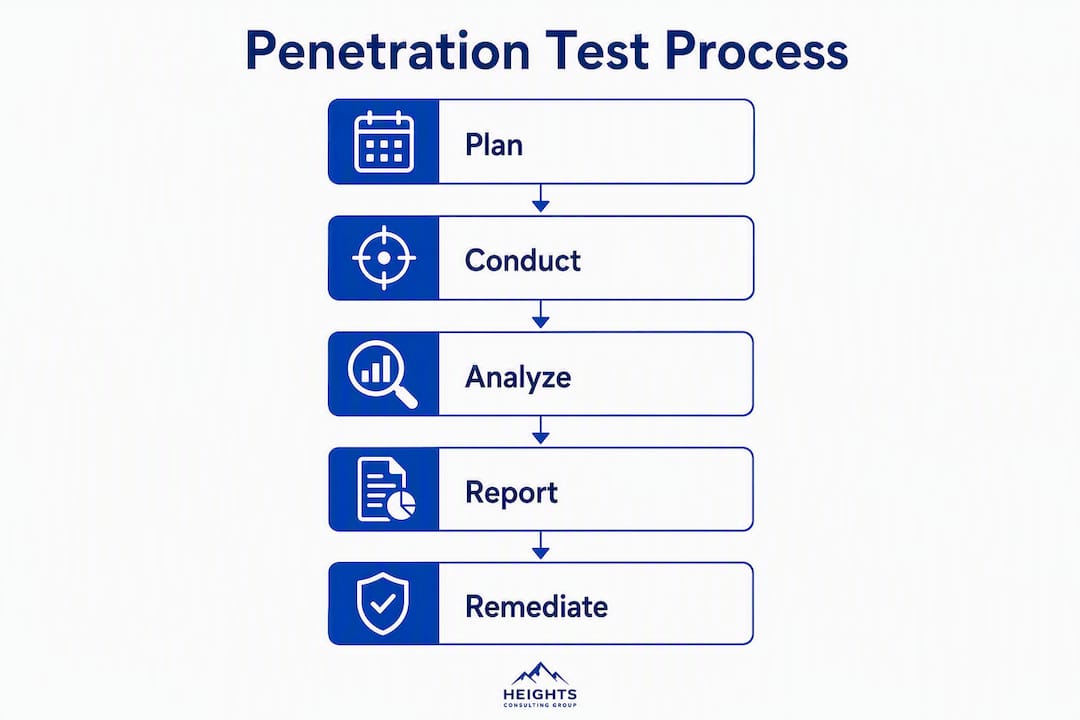
How a penetration test is carried out
Understanding the stages helps you set realistic timelines, allocate budget, and know what deliverables to require before signing an engagement.
-
Scoping and rules of engagement. Define the target environment, authorized methods, out-of-scope systems, emergency contacts, and acceptable testing windows. This document protects both parties and ensures the test reflects actual business risk. Include AI model interfaces and third-party API dependencies in scope wherever they exist.
-
Reconnaissance. Testers gather information about the target using passive (open-source intelligence, DNS, certificate transparency) and active (port scanning, service enumeration) methods. This stage mirrors what an attacker does before launching an attack.
-
Exploitation and proof-of-concept. Testers attempt to exploit identified weaknesses and document each successful exploit with reproducible evidence: screenshots, HTTP request/response pairs, command output, or session tokens. The goal is to prove exploitability, not just identify potential.
-
Privilege escalation and attack-path chaining. A skilled tester does not stop at the first foothold. They chain findings to demonstrate how far an attacker could move: from a compromised web server to an internal database, or from a phished credential to domain administrator.
-
Clean-up. All test artifacts, backdoors, and modified configurations are removed. The environment should be in the same state it was in before testing began.
-
Reporting. The deliverable has two components: an executive summary that translates findings into business risk language (what an attacker could do, what it would cost, what to fix first), and a technical report with validated findings, exploit evidence, attack-path context, and remediation guidance.
-
Remediation and retest. A pentest without retesting is like an audit with no verification of corrective actions. Retesting confirms fixes are complete, catches partial remediations, and produces the evidence auditors need to close findings.
How often should you run penetration tests?
Annual testing is a reasonable baseline for most organizations, but it is not sufficient on its own. Risk-based testing triggered by product launches, cloud changes, vendor onboarding, or major remediation work provides more relevant assurance than a fixed annual schedule.
Triggers that should prompt an on-demand test, regardless of schedule:
- Major application release or significant feature change
- Cloud migration or new infrastructure deployment
- Onboarding a high-risk third-party vendor or integration
- Deploying an AI model, agent, or LLM-powered feature
- Merger, acquisition, or significant organizational change
- Regulatory audit preparation (especially SOC 2 Type 2 or CMMC)
- Post-incident review where the attack vector is unclear
- Significant remediation of previously identified critical findings
Timing relative to audit windows matters. For SOC 2 Type 2, pen tests should occur within the observation window and preferably early to allow remediation before the audit ends. Scheduling a test in the final weeks of an observation period leaves no time to remediate and retest, which means findings remain open on the audit record.
Organizations with mature programs often adopt a continuous or rolling model: automated vulnerability scanning runs continuously, targeted penetration tests run on a risk-triggered basis, and a full-scope assessment runs annually. This approach keeps assurance current without requiring a full engagement every quarter.
What does penetration testing cost, and how do you measure ROI?
Cost varies significantly based on scope, environment complexity, and the depth of reporting required. The factors that drive price:
- Scope size: Number of applications, IP ranges, cloud accounts, or AI interfaces in scope
- Environment type: Cloud-native environments with ephemeral infrastructure require different tooling than on-premises networks
- Test methodology: Black-box, gray-box, and white-box engagements carry different time requirements
- AI/LLM testing: Behavioral testing of AI systems requires specialized expertise and adds time
- Red team depth: Multi-phase adversary simulations cost significantly more than targeted application tests
- Retest scope: Whether the engagement includes a full retest or a targeted retest of critical findings
- Reporting granularity: Executive-grade reporting with attack-path narratives takes more time than a raw findings list
A simple ROI framework for executive conversations:
The expected value of a penetration test equals the reduction in expected loss it produces. If a critical exploit path, once discovered and remediated, reduces the probability of a breach by a meaningful margin, and the average cost of a breach in your sector runs into the millions, the math favors testing even at the higher end of typical engagement costs. Non-financial returns compound that case: a current pentest report accelerates enterprise sales cycles, supports cyber insurance applications, and satisfies auditor requests without requiring emergency remediation under time pressure.
For building the business case, frame the investment against three reference points: the cost of a breach, the cost of a failed audit, and the cost of a lost contract. Testing costs are a fraction of any of those outcomes.
Penetration testing and U.S. compliance frameworks
Compliance is one of the clearest drivers for security testing, but the requirements differ by framework. Understanding what each standard actually demands prevents both under-investment and wasted effort.
| Framework | Penetration Testing Requirement | Key Evidence Auditors Expect |
|---|---|---|
| PCI DSS | Mandatory — annual internal and external tests plus segmentation testing | Scoped report, validated exploitability, remediation history, retest evidence |
| CMMC Level 2/3 | Required under CA.L3-3.12.1e — periodic testing of organizational systems | Scope documentation, findings with severity, remediation plan, retest confirmation |
| HIPAA | Required as part of the Security Rule's technical safeguard evaluation | Risk analysis documentation, test scope, findings, and remediation evidence |
| SOC 2 | Not explicitly named, but auditors treat it as strong evidence for CC4.1 and CC7.1 | Scoped report within observation window, remediation evidence, retest confirmation |
| NIST CSF / SP 800-115 | Recommended as part of continuous monitoring and assessment | Methodology documentation, findings, and remediation tracking |
SOC 2 auditors widely treat penetration testing as credible evidence for CC4.1 (Monitoring Activities) and CC7.1 (Vulnerability Detection) even though the standard does not name it explicitly. In practice, auditors ask for it. Organizations that cannot produce a current, scoped test report with remediation evidence face harder conversations during fieldwork.
For CMMC Level 3, the assessment guide explicitly lists penetration testing under CA.L3-3.12.1e as a required practice for organizations handling Controlled Unclassified Information. This is a mandatory control, not a recommendation.
What auditors want to see in every report:
- Defined scope and rules of engagement
- Validated exploitability with proof-of-concept evidence (not just theoretical findings)
- Severity ratings with business-impact context
- Remediation guidance with ownership assigned
- Retest results confirming fixes were effective
Penetration testing vs. vulnerability scanning: knowing the difference
Treating a vulnerability scan as a substitute for a penetration test is one of the most common and costly mistakes security programs make. They serve different purposes and produce different evidence.
Automated vulnerability scanning:
- Runs continuously or on a scheduled basis
- Identifies known vulnerabilities by matching configurations and software versions against CVE databases
- Produces high-volume output that requires triage
- Cannot determine whether a vulnerability is actually exploitable in your specific environment
- Cannot chain multiple weaknesses into an attack path
- Cannot test business logic, authentication flows, or AI behavioral failures
Manual penetration testing:
- Conducted by skilled testers over a defined engagement window
- Validates exploitability through actual exploitation attempts
- Chains multiple weaknesses to demonstrate real attack paths
- Tests business logic, authorization controls, and behavioral failures that scanners cannot detect
- Produces evidence suitable for auditors, executives, and insurers
The right model combines both. Vulnerability assessment services provide the continuous coverage needed to catch known weaknesses at scale; penetration testing provides the exploitability validation that converts scan findings into business risk decisions. Scan for coverage, test for exploitability.
For reporting: use scan data to track vulnerability count, severity distribution, and mean time to remediate. Use pentest data to track validated exploitability, attack-path complexity, and residual risk after remediation.
Who should run your penetration tests, and how do you choose a provider?
The quality of a penetration test is determined almost entirely by the skill and methodology of the testers. Credentials, scope expertise, and contractual protections all matter.
Provider selection checklist:
- Credentials: Look for testers holding OSCP, GPEN, GWAPT, or equivalent certifications. For AI testing, ask specifically about experience with LLM attack methodologies and agentic system testing.
- Scope expertise: Confirm the provider has demonstrated experience in your specific environment type — cloud-native, on-premises, AI/ML systems, or OT/ICS if relevant.
- Rules of engagement: Require a signed rules-of-engagement document before any testing begins. It should define authorized methods, out-of-scope systems, and emergency escalation contacts.
- Proof-of-exploit standard: Require that every finding rated high or critical include a reproducible proof-of-concept. Theoretical findings without exploit evidence are not sufficient for compliance or executive reporting.
- Remediation support: Confirm whether the provider offers remediation guidance calls or technical support after the report is delivered.
- Retest policy: Require a retest of critical and high findings as part of the engagement scope, not as a separate billable add-on.
- Reporting SLAs: Define the expected delivery timeline for the draft and final report. Delayed reports create audit scheduling problems.
- Disclosure and confidentiality: Require that all findings, exploit code, and test artifacts remain confidential and are destroyed or returned after the engagement.
Internal vs. external teams: Internal security teams bring valuable context about the environment but lack the independence that auditors and insurers expect. External testers bring fresh perspective, specialized tooling, and the independence that makes findings credible to third parties. The strongest programs combine both: internal teams provide environment context and facilitate access; external testers conduct the independent assessment.
Pro Tip: When issuing an RFP for penetration testing, include a requirement that the provider deliver a separate executive summary of no more than two pages, written in business language with no technical jargon. If a provider cannot produce that, their findings will not survive a board presentation.

Reframing penetration testing as a board-level risk control
Executives and boards do not need a technical briefing on penetration testing. They need to understand what it controls, what it costs when skipped, and how AI adoption has changed the risk calculus.
The executive claim: Penetration testing reduces uncertainty about business-impacting risk. It belongs in the governance control set alongside financial audits and business continuity testing, not in the IT team's operational backlog.
Why AI changes the conversation. Organizations deploying AI systems face an attack surface that traditional security controls were not designed to address. An AI security review is a design-time assessment; a penetration test verifies runtime exploitability. Both are necessary, and conflating them creates governance gaps. When an AI agent is deployed without runtime testing, the organization has a control plan but no evidence the controls work under adversarial conditions. That is an accountability gap that boards should not accept.
Common AI failure modes that penetration testing must cover:
- Prompt injection: An attacker manipulates the model's input to override instructions or extract sensitive data
- Data poisoning: Training or retrieval data is corrupted to alter model behavior
- Model extraction: Repeated queries reconstruct proprietary model behavior or training data
- Agentic tool abuse: An AI agent with tool-calling capabilities is manipulated into executing unauthorized actions
AI risk in numbers: AI and LLM findings are rated high risk 32% of the time, compared with 13% for traditional enterprise applications. For organizations deploying AI systems, that gap represents a material, unpriced risk if testing does not cover AI interfaces explicitly.
Board presentation talking points:
- Penetration testing produces three measurable outputs: validated exploitability, time-to-remediate, and residual risk after remediation. These are the metrics that belong in a board risk report.
- A current pentest report is a procurement asset. Enterprise buyers and insurers ask for it.
- AI deployment without penetration testing is a governance gap. The AI security and governance playbook provides a practical framework for closing it.
- Common board questions: "When was our last test?" "What did it find?" "What did we fix?" "When is the next one?" If your team cannot answer all four, the program needs attention.
For guidance on translating these findings into board-level cybersecurity reporting, the structure matters as much as the content.
Key Takeaways
Penetration testing is a board-level risk control that validates exploitability, satisfies compliance requirements, and produces the evidence organizations need to make defensible security decisions.
| Point | Details |
|---|---|
| Test for exploitability, not just presence | Scanners find weaknesses; pen tests prove which ones an attacker can actually use to cause business harm. |
| AI systems require specialized testing | AI and LLM findings are rated high risk 32% of the time, nearly three times the rate of traditional applications. |
| Timing drives compliance value | For SOC 2 Type 2, schedule tests early in the observation window to allow remediation and retest before the audit closes. |
| Retest is not optional | A finding without a retest confirmation is an open risk; require retest coverage in every engagement contract. |
| Heightscg delivers board-ready evidence | Heightscg's technical consulting and AI security testing services produce executive summaries, validated findings, and retest evidence suited for auditors and board reporting. |
The test that actually changes decisions
Most organizations that underinvest in penetration testing are not ignoring security. They are treating the test as a compliance checkbox rather than a decision-making tool. That distinction drives every mistake that follows: scoping too narrowly, skipping the retest, filing the report without acting on it, and then repeating the same test next year without measuring whether anything improved.
The programs that get real value from testing share a few habits. They scope tests around business risk, not just technical perimeter. They require proof-of-concept evidence for every critical finding, because a finding without a working exploit is a hypothesis, not a fact. They schedule retests as part of the original engagement, not as an afterthought. And they present findings to leadership in business language, with remediation ownership assigned before the report is closed.
The AI dimension adds urgency to all of this. Organizations deploying AI agents, LLM-powered features, or automated decision systems are adding attack surface that most security programs have not yet tested. A design-time review tells you the controls were planned correctly. A penetration test tells you whether they actually hold when someone is actively trying to break them. Those are different questions, and the second one is the one that matters to a board.
The organizations that treat penetration testing as a governance control, not a technical exercise, are the ones that can answer the board's four questions without hesitation.
Heightscg's penetration testing and AI security services
Heightscg works with security leaders and executive teams in regulated industries to design, scope, and validate penetration testing programs that produce evidence boards and auditors can act on. The firm's technical consulting practice covers web application and API testing, network and cloud assessments, AI and LLM security testing, and retest validation — with reporting structured for both technical teams and executive leadership.
For organizations preparing for a SOC 2 Type 2 audit, CMMC assessment, or AI system deployment, Heightscg delivers the scoped assessments, executive summaries, and remediation support that turn test results into closed findings. The technical cybersecurity consulting practice is built for organizations that need findings to hold up under auditor scrutiny, not just internal review.
To scope an assessment or discuss your organization's testing program, contact Heightscg for a direct conversation with the consulting team.
Useful sources and further reading
- NIST SP 800-115: Technical Guide to Information Security Testing and Assessment — The foundational U.S. government methodology for security testing, including penetration testing scope and process.
- CMMC Assessment Guide Level 3 — CA.L3-3.12.1e — Official DoD guidance on penetration testing requirements for organizations handling Controlled Unclassified Information.
- NCSC Penetration Testing Guidance — Authoritative guidance on scoping, methodology, and provider selection from the UK's National Cyber Security Centre; widely referenced by U.S. practitioners.
- Rethinking Penetration Testing for AI-Enabled Systems — Academic paper on how AI systems require behavioral testing beyond traditional infrastructure compromise models.
- State of Pentesting: AI High-Risk Findings — Industry data on the elevated risk profile of AI and LLM findings relative to traditional applications.
- Penetration Testing ROI: Executive Guide — Practical framing for building an executive-facing business case for penetration testing investment.
- Business Case for Penetration Testing — Covers SOC 2 auditor expectations and financial framing for security testing programs.
- Penetration Testing for SOC 2 Audit — Guidance on timing tests within the SOC 2 Type 2 observation window.
- Penetration Testing as a Business Risk Control — Argues for risk-triggered testing cadences and the accountability value of retesting.
- AI Security Review vs. Penetration Testing — Clarifies the governance gap created when organizations conflate design-time reviews with runtime testing.
- Pen Testing AI Agents: What a CISO Should Ask For — Detailed methodology for scoping AI agent tests across the full operating cycle.