

A single data breach costs regulated businesses an average of $9.44 million, yet many executives still view cybersecurity as an IT expense rather than strategic protection. This financial exposure threatens competitiveness, contract viability, and operational continuity. Strategic cybersecurity aligned with compliance frameworks transforms risk management from reactive spending into competitive advantage, particularly for organizations navigating HIPAA, CMMC, or SOC 2 requirements.
Table of Contents
- Understanding The Financial And Operational Risks Of Cyber Threats
- Linking Cybersecurity To Regulatory Compliance Obligations
- Common Misconceptions About Cybersecurity In Business Context
- Frameworks And Strategic Models For Integrating Cybersecurity
- Case Studies And Real-World Examples From Regulated Industries
- Practical Guidance For Decision-Making And Investment Prioritization
- Explore Strategic Cybersecurity Solutions With Heights CG
Key Takeaways
| Point | Details |
|---|---|
| Financial Risk Scale | Average breach costs $9.44M in regulated industries, with operational downtime adding hidden losses. |
| Compliance Reduces Penalties | NIST, CMMC, SOC 2 frameworks cut regulatory fines by up to 30% while securing contract eligibility. |
| Human Error Dominates | 70% of breaches involve human mistakes, requiring training and culture alongside technology. |
| Strategic Framework Value | Proper frameworks balance investment, reduce risk, and align cybersecurity with business objectives. |
| Real ROI Evidence | Case studies show compliance adherence prevents penalties and improves threat mitigation rates. |
Understanding the Financial and Operational Risks of Cyber Threats
Regulated businesses face staggering financial exposure from cyber incidents. The $9.44 million average breach cost represents direct expenses like forensics, legal fees, and notification requirements. Indirect costs accumulate through operational downtime, lost productivity, and business disruption that can persist months after incident containment.
The human element creates vulnerability that technology alone cannot address. Research shows 70% of breaches involve human error, from clicking phishing links to misconfiguring cloud storage. This reality demands comprehensive strategies addressing both technical controls and workforce behavior through ongoing training and awareness programs.
Three critical business consequences define the cyber risk landscape:
- Financial losses extending beyond immediate breach costs to include regulatory fines, legal settlements, and customer compensation
- Operational interruptions disrupting revenue generation, supply chains, and service delivery commitments
- Reputational damage eroding customer trust, partner confidence, and competitive market position
Executives must recognize these interconnected risks when evaluating cybersecurity risk management frameworks. The financial impact extends across quarters and fiscal years, affecting stock valuations, insurance premiums, and contract negotiations. Understanding the full cost spectrum enables informed investment decisions that protect enterprise value.
Linking Cybersecurity to Regulatory Compliance Obligations
Compliance requirements and cybersecurity practices form two sides of the same strategic coin. Federal and industry regulations mandate specific security controls that directly reduce both breach likelihood and regulatory penalties. Organizations adhering to frameworks like NIST, CMMC, and SOC 2 lower regulatory penalties by up to 30% while demonstrating due diligence to auditors and business partners.
Three major U.S. frameworks address different organizational needs:
- NIST provides flexible, scalable risk management guidance applicable across sectors and organizational sizes
- CMMC establishes defense contractor maturity levels required for Department of Defense contracts and sensitive information handling
- SOC 2 demonstrates trust principles around security, availability, and confidentiality for service organizations and cloud providers
Cybersecurity investments fulfill dual purposes by satisfying compliance mandates while reducing operational risk. Regular security assessments, access controls, and incident response capabilities required by regulations also prevent breaches and minimize damage when incidents occur. This alignment creates measurable ROI through both penalty avoidance and risk reduction.
Contract eligibility increasingly depends on demonstrable compliance framework adherence. Partners and customers demand third party attestations, security certifications, and audit reports before signing agreements or sharing sensitive data. Organizations lacking proper frameworks lose competitive opportunities and face higher insurance costs reflecting elevated risk profiles.
The regulatory landscape continues evolving, with new state privacy laws and federal mandates raising baseline requirements annually. Proactive cybersecurity compliance strategies position organizations ahead of regulatory changes rather than scrambling to catch up after enforcement actions.
Common Misconceptions About Cybersecurity in Business Context
Executive misconceptions about cybersecurity create dangerous gaps between perceived and actual protection levels. The most damaging fallacy treats cybersecurity as purely an IT department responsibility. Effective security requires C-suite leadership, board oversight, and cross-functional collaboration spanning legal, HR, operations, and finance teams.
Another widespread misunderstanding assumes purchasing security products guarantees protection. Technology provides necessary tools, but adaptive risk management determines actual security posture. Products require proper configuration, continuous monitoring, regular updates, and integration into broader risk management processes. Static deployments quickly become obsolete against evolving threats.
Many executives underestimate reputational damage severity compared to direct financial losses. Customer trust erosion, negative media coverage, and competitive disadvantage often exceed breach response costs. Public incidents trigger customer defection, partnership terminations, and regulatory scrutiny that compound initial damage over years.
The checklist mentality represents another dangerous misconception:
- Believing compliance equals security rather than establishing minimum baselines
- Assuming annual audits provide continuous protection between assessments
- Neglecting emerging threats not explicitly covered by current frameworks
- Underinvesting in workforce training and security culture development
Pro Tip: Security maturity requires continuous adaptation, not one time implementations. Establish quarterly reviews of threat intelligence, control effectiveness, and framework alignment to maintain protection against evolving risks.
Effective cybersecurity demands strategic perspective treating security as business enabler rather than cost center. Resilient frameworks support innovation, customer trust, and operational reliability while managing risk within acceptable tolerances aligned to business objectives.
Frameworks and Strategic Models for Integrating Cybersecurity
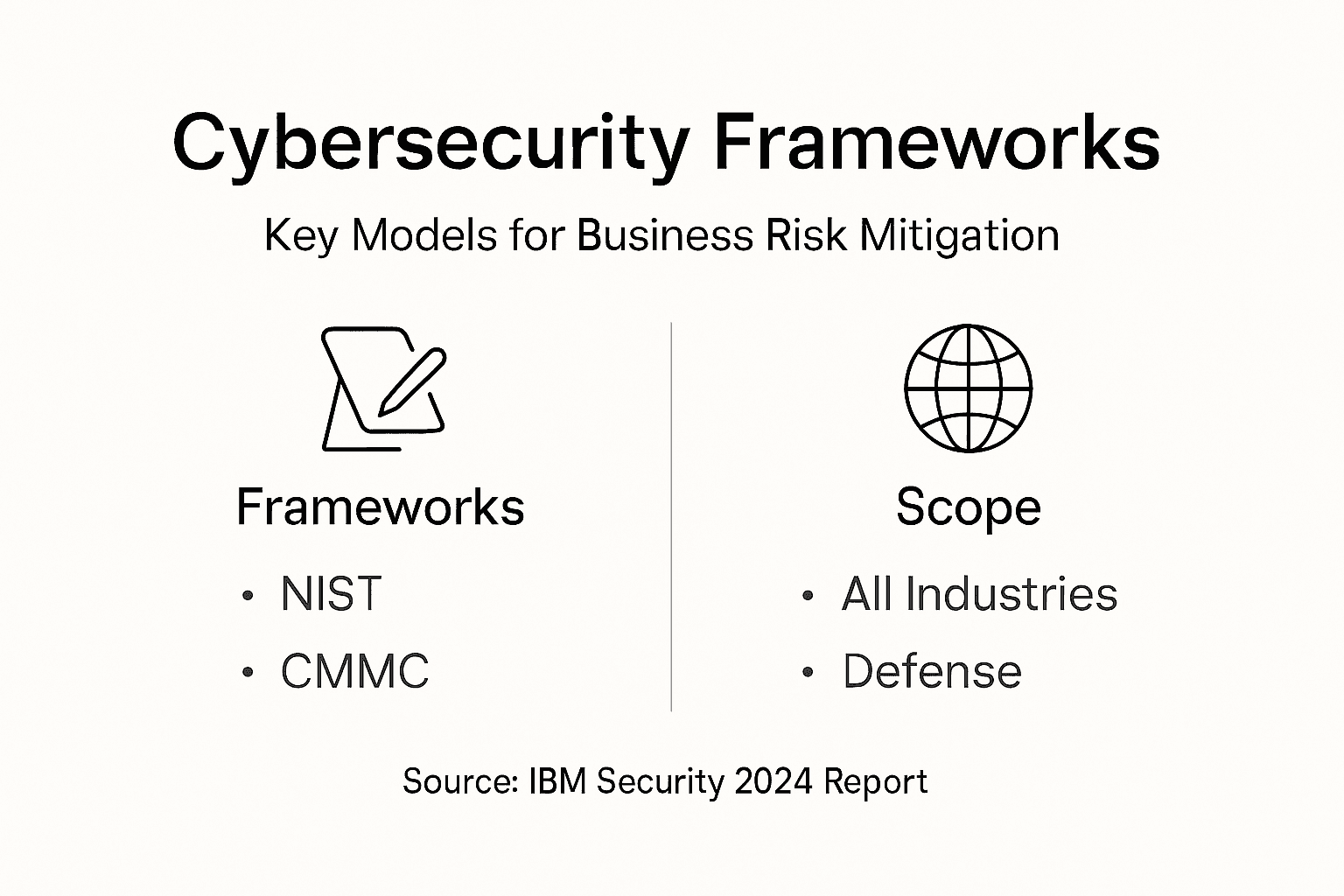
Selecting appropriate cybersecurity frameworks requires understanding organizational context, regulatory obligations, and business objectives. The three dominant U.S. frameworks serve different purposes while offering complementary benefits:
| Framework | Primary Scope | Best For | Core Focus |
|---|---|---|---|
| NIST | All organizations | Flexible risk management across sectors | Identify, Protect, Detect, Respond, Recover functions |
| CMMC | Defense contractors | DoD contract eligibility and classified data | Maturity levels from basic to advanced practices |
| SOC 2 | Service providers | Customer trust and vendor assessments | Security, availability, confidentiality, privacy, processing integrity |
Strategic framework selection balances multiple considerations. Organizations must weigh compliance requirements against implementation costs, existing security maturity, industry expectations, and customer demands. The framework comparison reveals overlap in core security principles while highlighting specialization for specific use cases.
A phased integration approach maximizes framework value:
- Assess current security posture through gap analysis against framework requirements
- Prioritize controls addressing highest risks and compliance obligations first
- Develop implementation roadmap with realistic timelines and resource allocation
- Integrate security controls into existing business processes and technology infrastructure
- Establish continuous monitoring and improvement cycles for ongoing effectiveness
Scalability and adaptability determine long term framework success. Small organizations can implement core controls and expand as resources grow. Large enterprises require customization addressing diverse business units, geographies, and regulatory jurisdictions. Both must maintain flexibility as threats evolve and regulations change.
Pro Tip: Map framework controls to specific business risks and compliance requirements. This linkage demonstrates security ROI to stakeholders and focuses investment on highest value protections.
Framework implementation should align with enterprise risk management processes rather than existing in isolation. Strategic cybersecurity frameworks integrate security metrics into executive dashboards, risk registers, and board reporting alongside financial, operational, and strategic risks.
Selecting between established security frameworks requires evaluating organizational maturity, resource availability, and specific compliance drivers. Many organizations adopt hybrid approaches combining NIST flexibility with SOC 2 attestation requirements or CMMC compliance mandates.
Case Studies and Real-World Examples from Regulated Industries
Real world examples illustrate how strategic cybersecurity investments produce measurable business outcomes. A regional healthcare provider serving 200,000 patients implemented comprehensive HIPAA aligned security controls after near miss incidents exposed vulnerabilities. The investment included encryption, access controls, employee training, and incident response capabilities totaling $850,000.

Within 18 months, the organization successfully defended against three significant phishing campaigns and one ransomware attempt. More importantly, clean audit results secured a major health system partnership worth $12 million annually that required demonstrated security maturity. The cybersecurity investment paid for itself within the first contract year while avoiding potential HIPAA penalties ranging from $100,000 to $1.5 million per violation.
Contrast this with a financial services firm that delayed security upgrades to maximize short term profitability. A breach exposing 45,000 customer records resulted in $3.2 million in direct costs, $890,000 in regulatory fines, and loss of institutional trust that reduced new account openings by 34% over the following year. The total economic impact exceeded $8 million, far surpassing the $1.2 million quote for comprehensive security improvements management had rejected.
Key lessons from regulated industry cases:
- Proactive security investments prevent larger losses and create competitive advantages through demonstrated trustworthiness
- Framework alignment accelerates audit processes, reduces compliance costs, and enables faster contract negotiations
- Board level security oversight correlates with better incident outcomes and faster recovery times
- Organizations treating cybersecurity as strategic enabler outperform peers viewing it as cost center
A defense contractor achieved CMMC Level 2 certification through systematic control implementation over 14 months. The certification unlocked $28 million in DoD contracts previously unavailable, delivering 200% ROI on security investments while strengthening overall risk posture. Enhanced threat detection capabilities identified and stopped two attempted intrusions that would have disqualified the organization from future government work.
Practical Guidance for Decision-Making and Investment Prioritization
Executives face competing demands for limited budgets, making cybersecurity investment prioritization critical for maximizing protection within resource constraints. Current spending trends show organizations allocating 12 to 15% of IT budgets to security, with regulated industries at the higher end reflecting compliance obligations and elevated risk profiles.
Three criteria guide effective cybersecurity investment decisions:
- Risk reduction potential measured through decreased likelihood and impact of specific threat scenarios
- Compliance requirement satisfaction addressing regulatory mandates and contractual obligations
- Business alignment supporting strategic objectives like cloud migration, digital transformation, or market expansion
Balancing these factors requires cross-functional input from security, legal, operations, and business unit leaders. Investments reducing critical risks while satisfying compliance needs deserve highest priority. Solutions enabling business initiatives while managing security concerns create additional value beyond pure risk reduction.
Ongoing operational requirements demand sustained investment beyond initial technology deployments:
- Continuous threat intelligence monitoring to identify emerging risks and adjust defenses accordingly
- Regular workforce training addressing evolving attack techniques and reinforcing security culture
- Control effectiveness testing through penetration testing, tabletop exercises, and audit readiness assessments
- Technology updates maintaining current patches, replacing obsolete systems, and adopting security improvements
Pro Tip: Establish security investment committees with representation from business units, finance, legal, and IT. This structure ensures decisions balance risk tolerance, compliance needs, and business objectives while building organizational security awareness.
Common investment pitfalls undermine security effectiveness despite adequate budgets. Technology overemphasis neglects human factors contributing to 70% of breaches. Compliance focused spending may satisfy auditors while leaving operational vulnerabilities unaddressed. Short term thinking delays necessary investments until after incidents force reactive spending at higher costs.
Executives should demand metrics demonstrating security program effectiveness:
- Reduction in high severity vulnerabilities over time
- Mean time to detect and respond to security incidents
- Employee security awareness scores and phishing simulation results
- Audit findings trends showing control maturity improvements
- Business impact assessments quantifying protected revenue and avoided losses
These measurements enable data driven decisions about resource allocation, program adjustments, and risk acceptance. Linking security metrics to business outcomes helps communicate value to boards, investors, and stakeholders who lack technical expertise but understand financial and operational impacts.
Explore Strategic Cybersecurity Solutions with Heights CG
Transforming cybersecurity from compliance burden into competitive advantage requires expert guidance aligned with your business objectives. Heights CG specializes in helping regulated organizations implement strategic resilient cybersecurity frameworks that reduce risk, satisfy compliance obligations, and support operational excellence.
Our tailored approach addresses your specific industry requirements, regulatory environment, and business goals through comprehensive assessments, framework implementation, and ongoing optimization. We help executives make informed decisions balancing security investments with competing priorities while demonstrating measurable value to stakeholders. Contact Heights CG to discuss how strategic cybersecurity transforms risk management into business enabler, or explore our compliance framework consulting services designed for regulated industries.
Frequently Asked Questions
How can executives balance cybersecurity investments against competing business priorities?
Adopt risk based prioritization linking security spending to business impact and compliance requirements. Focus resources on controls protecting critical assets, satisfying regulatory mandates, and enabling strategic initiatives. Regular investment framework reviews ensure alignment as business conditions and threat landscapes evolve.
What role does human error play in cybersecurity breaches, and how can businesses address it?
Human mistakes contribute to 70% of breaches, making workforce training essential alongside technical controls. Effective programs combine regular awareness training, simulated phishing exercises, clear security policies, and culture emphasizing shared responsibility. Leadership engagement signals organizational priority and encourages employee participation in security practices.
How do cybersecurity frameworks like NIST, CMMC, and SOC 2 support regulatory compliance?
These frameworks provide structured security controls satisfying legal and contractual obligations across industries. Implementation demonstrates due diligence to auditors, reduces regulatory penalties, and accelerates compliance assessments. Organizations with mature compliance frameworks spend less time preparing for audits and face lower risk of enforcement actions.
What metrics should executives track to measure cybersecurity program success?
Track incident reduction rates, compliance audit scores, system downtime, and budget alignment with risk priorities. Include qualitative measures like leadership engagement, cross-functional collaboration, and security culture maturity. Effective cybersecurity metrics link technical performance to business outcomes, demonstrating protected revenue, avoided losses, and competitive advantages gained through security maturity.