

Regulatory audit readiness is the organizational ability to demonstrate compliance at any time through owned controls, retrievable evidence, and verified processes. Three actions you can assign today: nominate a named control owner for every high-risk control, run a 48-hour evidence retrieval test on your five most-cited control areas, and build a high-risk control inventory ranked by regulatory impact. Organizations that treat readiness as a continuous discipline typically reduce evidence retrieval time from days to hours.
Key Takeaways
Regulatory audit readiness is a continuous operational discipline, not a pre-audit sprint — organizations that maintain owned controls, retrievable evidence, and tested processes respond to any regulator faster and with fewer findings.
| Point | Details |
|---|---|
| Readiness is continuous | Evidence captured at execution, not reconstructed before an audit, is what auditors trust and what reduces retrieval time from days to hours. |
| Ownership is the foundation | Every control must have a named individual owner; diffuse ownership is the single most common audit red flag across regulated industries. |
| AI requires governance first | Deploying AI for evidence collection or anomaly detection without data governance, model audit logs, and human oversight creates new compliance exposure. |
| Measure to manage | Track evidence retrieval time, percentage of controls with named owners, and remediation mean time to closure to demonstrate progress to executive sponsors. |
| Heightscg accelerates readiness | Heightscg delivers structured assessments, remediation roadmaps, and AI governance advisory for organizations in regulated U.S. industries. |
Table of Contents
- What regulatory audit readiness actually means — and how it differs from an audit
- Why audit readiness is a business risk, not just a compliance task
- The four core components every audit-ready organization must have
- A practical audit readiness checklist you can run this quarter
- How to run an audit readiness assessment
- What timelines and costs actually look like
- Common mistakes that undermine audit readiness
- How to measure readiness and demonstrate progress over time
- How AI is changing audit readiness — and what governance gaps to close first
- What to do next if your team is short on time or expertise
- What organizations consistently get wrong about audit readiness
- Heightscg's audit readiness services: from assessment to continuous compliance
- Sources
What regulatory audit readiness actually means — and how it differs from an audit
A regulatory audit is an external evaluation conducted by a government agency or its delegated body to determine whether an organization complies with applicable laws, rules, or standards. The auditor arrives with a defined scope, requests specific evidence, and issues findings. Audit readiness, by contrast, is the internal state that determines how well your organization responds when that request arrives.
The distinction matters because most organizations conflate the two. They treat readiness as a sprint that begins when a notice lands. Continuous, real-time evidence capture and visible ownership are what separate organizations that pass audits cleanly from those that spend the first 72 hours in triage.
Common U.S. regulatory triggers include:
- FDA inspections of pharmaceutical, medical device, and food manufacturers under 21 CFR
- SEC examinations of registered investment advisers and broker-dealers
- OSHA site inspections triggered by complaints, referrals, or programmed scheduling
- HIPAA compliance reviews by the HHS Office for Civil Rights
- State tax audits and IRS examinations covering income, payroll, and sales tax
- CMMC assessments for defense contractors under the DoD supply chain
- SOC 2 Type II audits requested by enterprise customers in regulated sectors
What readiness covers versus what an auditor evaluates:
| Readiness covers | Auditor evaluates |
|---|---|
| Written policies and procedures | Whether policies match actual execution |
| Named control owners | Whether owners can demonstrate the control works |
| Evidence retention schedules | Whether evidence exists, is retrievable, and is unaltered |
| Training completion records | Whether staff can describe and perform their responsibilities |
| Remediation logs | Whether prior findings were closed and root causes addressed |
Scope is the first control point when a notice arrives: identify the years, entities, systems, and transaction types covered before mobilizing your team. That single step prevents wasted effort on out-of-scope controls.
Why audit readiness is a business risk, not just a compliance task
Organizations that treat readiness as a periodic project rather than an operational discipline pay for it in three ways: regulatory penalties, operational disruption, and reputational damage. FDA warning letters can trigger production holds that cost manufacturers millions per week. SEC deficiency letters can restrict a firm's ability to take on new clients. OSHA willful violations carry civil penalties that compound with each cited instance.
The operational disruption is often underestimated. An unready organization diverts senior staff from revenue-generating work for weeks to reconstruct evidence that should have been captured at execution. That diversion has a real cost, even when the audit ultimately produces no findings.
The executive-level business case for continuous audit preparedness is straightforward: lower remediation costs, reduced insurance and penalty exposure, faster M&A due diligence (buyers discount heavily for unresolved compliance gaps), and a smaller audit overhead burden per cycle. Organizations that have invested in readiness infrastructure also tend to respond faster to new regulatory requirements because their control mapping and evidence systems are already in place.
AI adoption adds a new dimension to this risk calculus. Organizations deploying AI tools without governance documentation, model audit logs, or clear ownership create compliance exposure that existing frameworks are only beginning to address. That gap is not hypothetical — regulators including the SEC and FTC have already issued guidance on algorithmic accountability, and enforcement actions are accelerating.
The four core components every audit-ready organization must have
Readiness is not a single artifact. It is a system of four interdependent components. A gap in any one of them creates exposure across all the others.
People and roles
Every control must have a named owner — a specific individual, not a team or a title. The audit liaison coordinates all auditor communications and manages the evidence package. Control owners execute and document their controls. IT custodians maintain system access logs, configuration records, and tamper-evident audit trails. Records owners govern retention schedules and retrieval procedures.
When an auditor asks "who is responsible for this control?" and the answer is "the compliance team," that is a red flag. Auditors interpret diffuse ownership as a signal that the control is not actually being executed.
Processes and controls
Control mapping connects each regulatory requirement to a specific operational control, an owner, an execution frequency, and an evidence artifact. Without that mapping, you cannot know which controls are untested or which requirements are uncovered. Remediation loops close the gap: when a control fails a test, the loop captures the root cause, assigns a fix, and retests before the next audit cycle.
Technology and data
Centralized evidence stores with version control, tamper-evident logs, and role-based access are the infrastructure layer of readiness. Spreadsheets and shared drives fail this test because they lack immutability and audit trails. Purpose-built compliance management systems or GRC platforms provide the access controls, versioning, and retrieval speed that auditors expect.

Evidence types and examples
| Evidence type | Example artifact | Retention trigger |
|---|---|---|
| Training records | LMS completion certificate with timestamp | Annual or role-change |
| Change logs | Ticketed system change with approver signature | Per change event |
| Calibration records | Instrument calibration report with technician ID | Per calibration cycle |
| Access approvals | Provisioning ticket with manager authorization | Per access grant |
| Incident records | Incident report with timeline and resolution | Per incident |
Pro Tip: Capture evidence at the point of execution with immutable metadata — timestamp, actor ID, and system identifier. Evidence reconstructed after the fact is the single most common trigger for deep auditor sampling, because back-dated records are detectable through metadata comparison.
A practical audit readiness checklist you can run this quarter
Regulatory inspection readiness is a 365-day discipline, but you can make material progress in 90 days with a structured triage approach. The checklist below is organized by priority band.
Triage: immediate actions (week 1)
- Confirm audit scope. Identify the regulation, the covered period, the systems in scope, and the auditing body.
- Nominate your audit liaison. One person owns all auditor communications from this point forward.
- Run a 48-hour evidence retrieval test. Request the five most commonly cited evidence types and measure how long retrieval takes.
- Identify unowned controls. Pull your control inventory and flag any control without a named individual owner.
- Freeze relevant records. Place a litigation-style hold on records in scope to prevent deletion or modification.
Short-term: 30–90 day actions
- Map regulations to controls. For each applicable requirement, document the control, the owner, the execution frequency, and the evidence artifact.
- Conduct a gap analysis. Compare current control execution against documented requirements; score each gap by regulatory impact and detectability.
- Remediate high-priority gaps. Assign owners, set deadlines, and track closure in a remediation log with root-cause documentation.
- Standardize documentation. Retire outdated SOPs, version-control all policies, and confirm that staff are working from current procedures.
- Train control owners. Deliver role-specific training on what their control requires, what evidence to capture, and how to respond to auditor questions.
- Run a mock inspection. Simulate the auditor's first-hour requests (see below) and measure your team's response time and accuracy.
Long-term: continuous actions
- Schedule quarterly control testing. Test a sample of controls each quarter and document results in your GRC system.
- Maintain a living remediation log. Every finding, internal or external, enters the log with a root cause, owner, and target closure date.
- Review and update the control inventory after any regulatory change, system change, or organizational restructuring.
- Report readiness KPIs to executive leadership on a quarterly cadence (see the measurement section below).
Sample first-hour evidence package
When an auditor arrives, the first-hour requests typically include:
- Organizational chart with named compliance and control roles
- Most recent policy and procedure index with version dates
- Training completion report for the covered period
- Access control list for systems in scope
- Most recent internal audit or self-assessment report
- Remediation log showing closure of any prior findings
Have this package pre-assembled and retrievable in under 30 minutes. The speed and organization of your first-hour response sets the auditor's confidence level for the entire engagement.
How to run an audit readiness assessment
An assessment is a structured gap analysis that produces a prioritized remediation plan. It can be run internally or with an external advisor, but the methodology is consistent either way. Mapping requirements to controls and running risk-based self-assessments are the proven foundation.
Assessment methodology:
- Scope. Define the regulation(s), covered period, business units, systems, and processes in scope.
- Inventory. Catalog all controls, policies, procedures, and evidence artifacts currently in place.
- Gap analysis. For each requirement, determine whether a control exists, whether it is being executed, and whether evidence is retrievable.
- Remediation plan. Rank gaps by risk criteria and assign owners, timelines, and verification actions.
- Retest. After remediation, retest each closed gap to confirm the control is operating effectively.
- Governance hand-off. Transfer the control inventory, remediation log, and testing schedule to the ongoing compliance function.
Assessment roles
| Role | Responsibilities |
|---|---|
| Assessment lead | Owns methodology, timeline, and final report |
| Subject matter expert (SME) | Validates control design against regulatory requirements |
| Control owner | Provides evidence and demonstrates control execution |
| Remediation owner | Executes gap closure and documents root cause |
| Executive sponsor | Approves scope, resources, and remediation budget |
Prioritization matrix
Rank each gap across four criteria: regulatory impact (severity of a finding), frequency (how often the control executes), detectability (how easily an auditor would find the gap), and business impact (operational or financial consequence). High scores on two or more criteria place a gap in the immediate remediation band.
Auditors commonly use statistical sampling to select evidence. For a population of 100 or more transactions, expect a sample of 25–40 items. For smaller populations, expect 100% review. Design your evidence capture accordingly: every transaction in a high-frequency control should produce a retrievable artifact, not just a representative sample.
What timelines and costs actually look like
Audit readiness is not a fixed-cost project. The effort scales with organizational complexity, the number of regulations in scope, and the maturity of existing controls. The figures below reflect typical ranges for U.S. organizations, not guarantees.
By organization size:
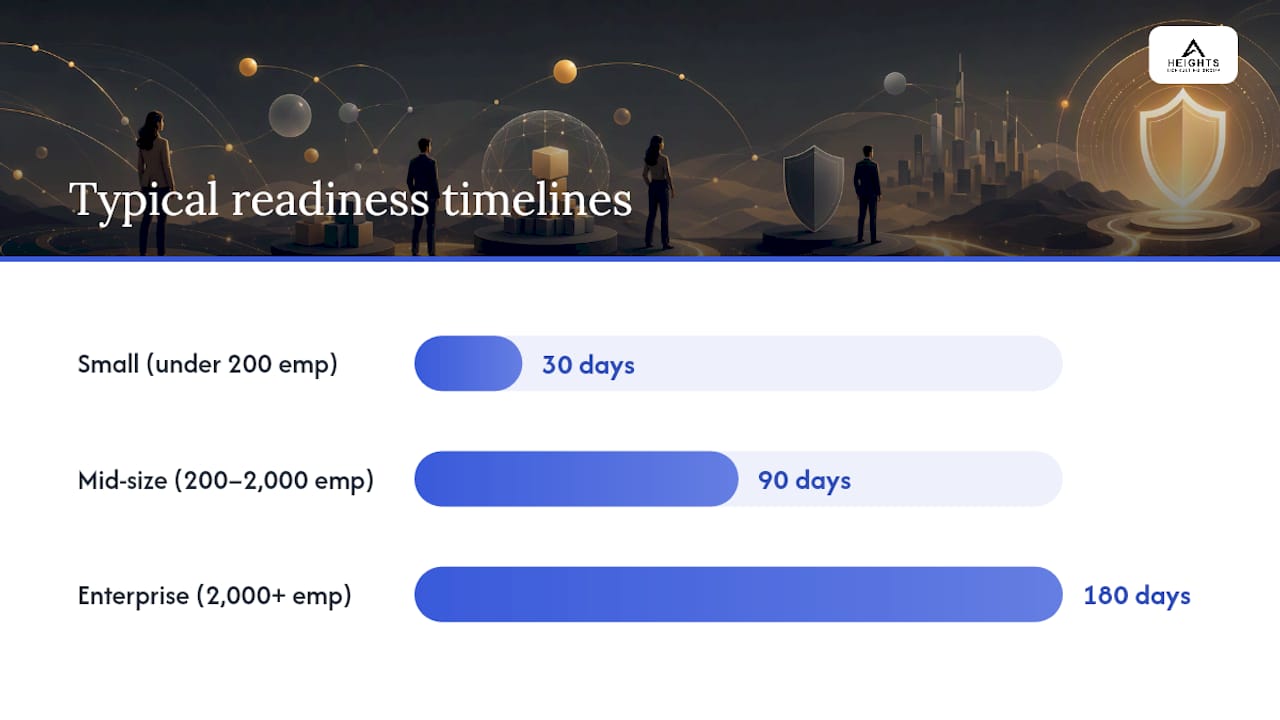
- Small organization (under 200 employees, one primary regulation): A focused 30-day effort can address the highest-risk gaps if controls are partially documented and ownership is assignable. Expect 2–4 weeks of staff time from a compliance lead and 1–2 SMEs, plus tooling costs if a GRC platform is not already in place.
- Mid-size organization (200–2,000 employees, 2–4 regulations): A 90-day program is realistic for gap analysis, remediation of critical findings, and a mock audit. Staff time expands to include IT, HR, and operations leads alongside the compliance function.
- Enterprise (2,000+ employees, multiple regulations, complex IT environment): A 180-day program is the minimum for a credible readiness baseline. Fragmented systems, multiple business units, and legacy applications each add weeks to the data consolidation phase alone.
Primary cost drivers:
- People time: The largest cost in most programs. Control owners, IT custodians, and compliance staff divert time from operational work.
- Remediation work: Closing gaps in controls, updating SOPs, and retraining staff requires sustained effort beyond the assessment itself.
- Tooling and licensing: GRC platforms, document management systems, and evidence repositories carry licensing costs that vary by vendor and seat count.
- Data consolidation: Fragmented records across multiple systems or locations multiply retrieval time and remediation cost.
- External advisory fees: Consultants accelerate the assessment and remediation phases but add direct cost.
Two factors reliably double the timeline: unowned controls (no one can demonstrate execution without an owner) and fragmented systems (evidence spread across disconnected platforms requires manual consolidation before any gap analysis can begin).
Common mistakes that undermine audit readiness
Most audit failures are predictable. The red flags below appear repeatedly across regulated industries, and auditors know exactly what to look for.
Red flags and how to address them:
- Missing ownership. Controls assigned to teams or job titles rather than named individuals. Fix: require a named owner for every control in your inventory before the assessment begins.
- Late evidence capture. Evidence reconstructed after the fact rather than captured at execution. Fix: build evidence capture into the workflow itself — a training completion triggers an automatic LMS record, a system change closes a ticket with approver metadata attached.
- Obsolete SOPs. Procedures that describe how work was done two years ago, not how it is done today. Fix: tie SOP review to an annual calendar event and version-control every document.
- Version sprawl. Multiple versions of the same policy circulating across departments. Fix: designate a single authoritative document repository and retire all other copies.
- Inconsistent training records. Training logs that show completion for some staff but not others, or that cannot be filtered by role and date. Fix: use an LMS that generates exportable completion reports by role, date range, and regulation.
- Ad-hoc remediation without root cause. Findings closed by fixing the symptom without documenting why the control failed. Fix: require a root-cause field in every remediation log entry.
Pro Tip: Back-dated records are detectable. Auditors compare document metadata against system timestamps and access logs. A record created on the day of the audit but dated six months earlier triggers deep sampling across the entire control population — not just the one record. Immutable, point-of-execution capture is the only reliable defense.
Auditors interpret these red flags as signals about organizational culture, not just individual control failures. A pattern of missing ownership or late evidence suggests that compliance is not embedded in operations — and that inference shapes the depth and tone of the entire examination.
How to measure readiness and demonstrate progress over time
Readiness without measurement is an assertion, not a posture. The KPIs below give compliance leaders concrete data to report to executive sponsors and to track improvement between audit cycles.
Suggested KPIs:
- Evidence retrieval time: How long it takes to produce a requested artifact from the moment of request. Target: under two hours for any in-scope control.
- Percentage of controls with named owners: The share of your control inventory with a specific individual assigned. Target: 100% before any audit engagement.
- Control completion rate: The percentage of scheduled control executions completed on time in the reporting period.
- Percentage of controls tested: The share of controls that have been tested (internally or by an external assessor) within the last 12 months.
- Remediation mean time to closure: The average number of days from finding identification to verified closure. Track separately for critical, high, and medium findings.
Three-level maturity model:
- Level 1 — Basic: Controls exist on paper; ownership is partial; evidence is retrievable but requires manual effort; no formal testing cadence.
- Level 2 — Managed: All controls have named owners; evidence is captured at execution; a quarterly testing cadence is in place; a remediation log tracks all findings.
- Level 3 — Optimized: Evidence capture is automated; control testing is continuous; KPIs are reported to executive leadership quarterly; AI-assisted anomaly detection flags control failures before auditors do.
A quarterly readiness scorecard should show the executive sponsor three things: current KPI values versus targets, open remediation items with owners and due dates, and any regulatory changes that require control updates. That cadence keeps leadership engaged and prevents the readiness program from losing momentum between audit cycles.
How AI is changing audit readiness — and what governance gaps to close first
AI is entering audit workflows faster than governance frameworks are being built to contain it. An OECD study of 15 audit institutions across 14 countries and the EU found that 87% had at least one AI tool in production, but many deployments remain at pilot stage. The primary barrier to scaling is data governance — fragmented, inconsistent data prevents AI from producing reliable outputs at the control level.
Practical AI use cases in audit readiness:
- Automated evidence collection: AI tools can pull structured data from GRC systems, HR platforms, and ticketing systems to assemble evidence packages without manual retrieval.
- Document classification: Natural language processing classifies policies, procedures, and training records against regulatory requirements, flagging gaps or outdated versions.
- Anomaly detection: Machine learning models identify unusual patterns in access logs, transaction records, or control execution data that human reviewers would miss in large datasets.
- Predictive risk sampling: AI can prioritize which controls to test based on historical finding patterns, control complexity, and change frequency — focusing human effort where risk is highest.
Research on AI auditability requirements, drawing on interviews with 23 AI audit experts, makes clear that effective AI audits require multidisciplinary teams combining data scientists, product managers, and compliance auditors. Organizations must design AI systems to be auditable across their full lifecycle, not just at deployment.
Prerequisites before deploying AI for readiness:
- Data governance: AI outputs are only as reliable as the underlying data. Establish data ownership, quality standards, and lineage documentation before connecting AI tools to compliance data.
- Model explainability: Auditors and regulators will ask how a finding was generated. Black-box models that cannot explain their outputs create more compliance risk than they resolve.
- Audit logs for AI actions: Every AI-generated classification, flag, or recommendation must be logged with the model version, input data, and timestamp. This is the AI equivalent of point-of-execution evidence capture.
- Human oversight checkpoints: AI tools should surface findings for human review, not close controls autonomously. The control owner remains accountable; the AI is a detection layer.
- Cross-functional competency: Teams adopting AI for readiness need staff who understand both the regulatory requirements and the model's behavior. Neither skill alone is sufficient.
For organizations building AI governance frameworks alongside their readiness programs, the sequencing matters: establish data governance and human oversight protocols before deploying AI tools, not after a finding forces the issue. The AI security considerations that apply to production AI systems — access controls, model versioning, output logging — are the same controls auditors will eventually evaluate.
What to do next if your team is short on time or expertise
Most compliance teams face the same constraint: the work is clear, but the bandwidth is not. The three-action playbook below is designed for teams that need to make progress without adding headcount.
30/90/180-day priorities:
- 30 days: Nominate control owners for every high-risk control, run the 48-hour evidence retrieval test, and produce a gap inventory ranked by regulatory impact. This alone moves most organizations from Level 1 to the threshold of Level 2 maturity.
- 90 days: Complete the gap analysis, close critical findings, run a mock inspection, and stand up a quarterly testing cadence. At 90 days, you should be able to produce the first-hour evidence package in under 30 minutes.
- 180 days: Automate evidence capture for high-frequency controls, implement a GRC platform or centralized evidence repository, and deliver the first quarterly readiness scorecard to executive leadership.
Engagement triggers — when to bring in external help:
- Your control inventory has more than 20% unowned controls and internal staff cannot absorb the remediation workload.
- A prior audit produced repeat findings, indicating that root causes were not addressed.
- A regulatory change (new rule, expanded scope, new framework) requires control mapping that your team lacks the regulatory expertise to complete.
- You are preparing for a first-time audit under a framework your organization has not previously been examined against (CMMC, SOC 2 Type II, HIPAA).
- Fragmented systems are preventing evidence consolidation within a reasonable timeframe.
What success looks like:
At 90 days, every high-risk control has a named owner, the first-hour evidence package is retrievable in under 30 minutes, and the gap inventory is in active remediation. At 180 days, a quarterly testing cadence is running, KPIs are reported to the executive sponsor, and the organization can respond to an unannounced inspection without diverting senior staff from operational work.
What organizations consistently get wrong about audit readiness
The most persistent misconception in this space is that audit readiness is a documentation problem. Organizations invest heavily in writing policies and assembling binders, then discover during an inspection that auditors are not primarily interested in what the policy says. They are interested in whether the control is actually being executed, by whom, and whether the evidence proves it.
The second recurring gap is ownership at the executive level. Compliance programs that live entirely within the compliance function tend to atrophy between audit cycles. The controls that matter most — access management, change control, training completion — are owned by IT, HR, and operations. When those functions do not have explicit accountability for their controls, the compliance team spends every pre-audit period reconstructing evidence that should have been captured continuously.
AI adds a third gap that is still emerging. Organizations deploying AI tools for document processing, anomaly detection, or risk scoring often do so without establishing who owns the model's outputs, how those outputs are logged, or what happens when the model produces an incorrect classification. That gap will surface in audits. Regulators across sectors are developing expectations for AI governance documentation, and organizations that cannot produce model audit logs, training data lineage, or explainability documentation will face the same scrutiny as organizations with missing control evidence.
The leadership advice that holds across all of these gaps: fund readiness as an operational line item, not a project budget. A project ends. Regulatory scrutiny does not.
Heightscg's audit readiness services: from assessment to continuous compliance
Heightscg works with organizations in regulated industries to build and maintain audit readiness programs that hold up under real regulatory scrutiny. The engagement typically begins with a structured readiness assessment: scope confirmation, control inventory, gap analysis, and a prioritized remediation roadmap delivered within 30–60 days depending on organizational complexity.
From there, Heightscg supports remediation execution, evidence system design, and the governance hand-off that keeps the program running after the initial engagement closes. For organizations adopting AI tools in their compliance workflows, Heightscg provides AI governance advisory that addresses data lineage, model audit logging, and human oversight protocols — the prerequisites regulators are beginning to examine directly.
The engagement model is advisory-led and outcome-focused. Deliverables include a control inventory with named owners, a gap analysis report with risk rankings, a remediation roadmap with milestones, and a quarterly readiness scorecard template your team can run independently. If your organization is facing an upcoming audit, a recurring finding, or a new regulatory requirement, contact Heightscg to schedule an initial consultation and confirm whether a readiness assessment is the right starting point.
Sources
The sources below support the guidance in this article. Each is linked to its primary location.
- The state of artificial intelligence in public audit
- What “Audit-Ready” Really Means
- Regulatory Inspection Readiness
- Your Compliance Audit Is in 30 Days. Here's What to Actually Do.
- How to prepare for a regulatory audit: proven steps
- Preparing for Business Audits and Inspections in the U.S
Recommended
- Regulatory Compliance Tips for Business Leaders in 2026
- Mastering regulatory compliance: Essential guide for IT leaders
- Efficient Compliance, Strategic Advantage: An Executive Playbook - Heights Consulting Group
- Regulatory Compliance Checklist 2026: Essential Steps for Executives | Heights Consulting Group