

TL;DR:
- IT governance focuses on oversight and accountability to support business objectives and manage risks.
- Effective frameworks like COBIT and ISO/IEC 38500 should be tailored to industry, maturity, and regulatory needs.
- Outcome-driven governance, emphasizing measurable results over policies, enhances cybersecurity and regulatory compliance.
Many C-level executives treat IT governance as a synonym for IT management or, worse, a compliance checklist handed off to the IT department. That framing is costly. According to ISO 38500, IT governance is the system by which an organization directs and controls IT to ensure it supports business objectives, manages risks, and delivers value while maintaining compliance. That definition carries real weight. True IT governance is an integrated strategy linking IT accountability, cybersecurity posture, and measurable business outcomes. This guide clarifies the frameworks, practical applications, and failure patterns that every executive in a regulated industry needs to understand.
Table of Contents
- What is IT governance?
- Key IT governance frameworks and methodologies
- Common challenges and proven solutions in highly regulated industries
- Best practices for aligning IT governance with cybersecurity and business strategy
- Why outcome-driven IT governance beats policy compliance every time
- Transform your IT governance and cybersecurity outcomes with Heights CG
- Frequently asked questions
Key Takeaways
| Point | Details |
|---|---|
| Strategic alignment | IT governance ensures that technology decisions directly support business goals and long-term value. |
| Framework selection | Use the right mix of frameworks—like COBIT and ISO/IEC 38500—tailored to your organization’s needs. |
| Regulatory performance | Regulators care about actual outcomes, so governance must deliver real-world risk reduction. |
| Proactive risk control | Effective IT governance links cyber controls with enterprise risk management and compliance. |
What is IT governance?
At its core, IT governance is about oversight and accountability, not operational execution. It answers the question: Is our IT delivering the right value, at the right risk, within the right boundaries? Day-to-day IT management handles the how. Governance handles the why and the what.
ISO 38500 frames this clearly: IT governance ensures IT supports business objectives and manages risk. That means governance sits above the IT function, guiding it from a board and executive level rather than from inside the server room.
"IT governance is the system by which an organization directs and controls IT to ensure it supports business objectives, manages risk, and delivers value while maintaining compliance." — ISO 38500
The practical distinction matters enormously. When governance and management blur, accountability gaps emerge. IT leaders make strategic calls without board visibility. Executives approve budgets without understanding risk exposure. The result is a misaligned organization where cybersecurity investment fails to map to actual business priorities.
Effective IT governance addresses four primary objectives:
- Value delivery: Ensuring IT investments generate measurable returns aligned with strategic goals
- Performance supervision: Monitoring IT performance against defined metrics and outcomes
- Risk mitigation: Identifying and managing technology risks, including cybersecurity threats, before they escalate
- Regulatory compliance: Maintaining adherence to applicable laws, standards, and frameworks
This is where virtual CISO services become especially valuable. A vCISO provides executive-level governance oversight without requiring a full-time internal hire, bridging the gap between board intent and technical execution. Organizations that want a broader view of how governance integrates with security programs can explore strategic cybersecurity services as a starting point.
Pro Tip: Most organizations confuse IT governance with IT management. Clarify these roles explicitly in your governance charter to eliminate accountability gaps before they become audit findings.
Key IT governance frameworks and methodologies
No single framework governs IT governance universally. The right choice depends on your industry, regulatory exposure, and organizational maturity. Key methodologies include COBIT, ISO/IEC 38500, ITIL, NIST CSF, and TOGAF, each serving distinct but often complementary purposes.
| Framework | Primary purpose | Guidance level | Primary audience |
|---|---|---|---|
| COBIT | IT management and governance controls | Detailed, prescriptive | IT leaders, auditors |
| ISO/IEC 38500 | Board-level IT oversight principles | High-level, principles-based | Executives, boards |
| ITIL | IT service management | Operational, process-focused | IT operations teams |
| NIST CSF | Cybersecurity risk management | Flexible, scalable | Security and risk teams |
| TOGAF | Enterprise architecture alignment | Strategic and technical | Enterprise architects |
Each framework brings distinct strengths:
- COBIT provides actionable controls and metrics that translate governance intent into operational practice
- ISO/IEC 38500 gives boards a principled lens for evaluating IT decisions using the Evaluate-Direct-Monitor (EDM) cycle
- ITIL strengthens service reliability and continuity, supporting governance by managing IT delivery quality
- NIST CSF is the go-to for cybersecurity risk structuring, especially in U.S. federal and defense sectors
- TOGAF aligns technology architecture with enterprise strategy, ensuring IT investments support long-term goals
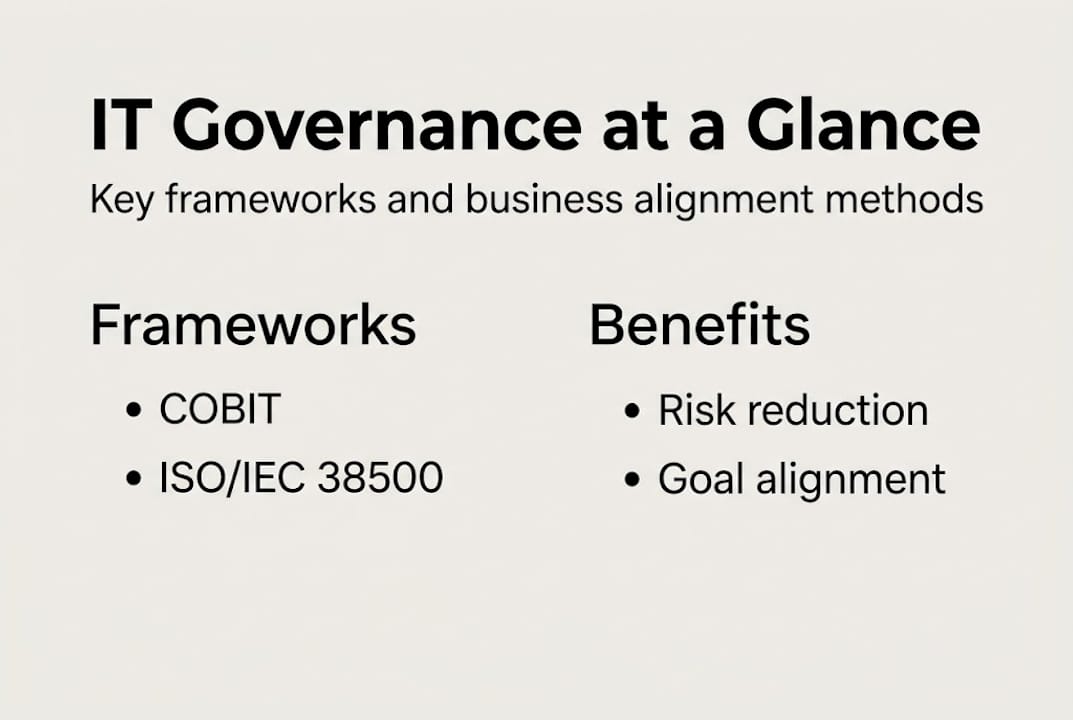
In practice, high-performing organizations rarely rely on a single framework. COBIT and ISO/IEC 38500 are frequently paired: ISO provides the board-level oversight principles, while COBIT delivers the controls and metrics to operationalize them. For a rigorous in-depth framework analysis, examining how these frameworks interact reveals where gaps most commonly appear.
Leaders seeking to establish security governance within their organizations will find that framework selection is not a one-time decision. Revisiting it as your regulatory environment evolves is essential. For those navigating complex regulatory landscapes, a broader guide on regulatory compliance for IT leaders offers structured context.
Pro Tip: Choose frameworks based on your regulatory context, maturity level, and strategic goals, not because a vendor recommended them or because a peer organization uses them.
Common challenges and proven solutions in highly regulated industries
Regulated industries face a sharper version of the same IT governance problems every enterprise encounters. The difference is that in financial services, healthcare, or defense, governance failures carry both reputational and significant financial consequences.
The ESMA record fine for control failings established a clear signal: good intentions and written policies are not enough. Regulators assess process outcomes. The following table maps the most common governance failures to their real-world impact:
| Governance failure | Frequency/impact | Regulatory consequence |
|---|---|---|
| SDLC control gaps | 78% of incidents linked to development failures | Fines, operational restrictions |
| Third-party breaches | 35% of breaches via vendors | Supply chain sanctions |
| Regulatory pace mismatch | 74% of firms fined for lag | Enforcement actions |
| Skills and training gaps | Persistent across all sectors | Audit findings, liability |
These aren't abstract risks. They are recurring patterns that surface in every regulatory enforcement cycle.
To counter them, organizations should follow these steps:
- Deploy multi-layer controls across the software development lifecycle (SDLC), not just at deployment gates
- Invest in continual skills training tied to current regulatory requirements, not last year's curriculum
- Conduct regular third-party risk assessments with contractual accountability and monitoring cadences
- Align governance programs with emerging frameworks such as DORA and NIS2 before enforcement deadlines arrive
Addressing cyber risk best practices at the control level is necessary, but executives also need to bring these challenges into the boardroom cybersecurity strategy conversation. Boards that treat IT governance as a delegated IT function consistently underperform on audit outcomes compared to those with active executive ownership. For organizations operating under multiple regulatory regimes, guidance on multi-regulatory compliance is increasingly relevant.
Pro Tip: Periodically map actual control performance against new regulations, not just your written policy. The gap between what a policy says and what controls actually do is where regulatory exposure lives.
Best practices for aligning IT governance with cybersecurity and business strategy
Governance only produces resilience when it connects directly to both cybersecurity operations and business objectives. The following steps create that connection in a structured, measurable way:
- Set formal oversight structures at the board and C-suite level, including defined accountability for IT governance outcomes
- Integrate complementary frameworks: COBIT and ISO/IEC 38500 are often integrated to combine principled oversight with actionable controls
- Define accountability explicitly so that every governance control has a named owner with measurable responsibilities
- Automate compliance reporting to reduce manual overhead and enable real-time visibility into governance posture
- Test controls regularly through red team exercises, tabletop simulations, and third-party audits rather than treating policy documentation as proof of compliance
Equally important is knowing what to avoid:
- Siloed governance processes that keep cybersecurity, legal, and finance teams operating in separate lanes without shared risk language
- Neglecting board engagement by treating IT governance as purely a technical function that executives review only at audit time
- Relying on policy documents alone as evidence of a functioning governance program without verifiable control performance data
The business case for strong governance is measurable. Organizations with mature governance programs report reduced incident response costs, faster audit cycles, and demonstrably lower risk exposure. A structured cyber risk assessment guide provides a concrete starting point for organizations ready to quantify their current posture. Leaders in heavily regulated sectors will also find that risk management for CISOs in healthcare offers transferable frameworks applicable across industries.

Linking risk posture directly to enterprise objectives and stakeholder risk appetite is what separates governance programs that drive value from those that merely satisfy auditors.
Why outcome-driven IT governance beats policy compliance every time
From our perspective at Heights Consulting Group, the most persistent misconception in IT governance is that a robust policy library will satisfy regulators and keep the organization safe. Recent enforcement actions, including landmark regulatory fines, prove otherwise. Regulators do not grade on intent. They evaluate outcomes.
The organizations we see performing best do not have the thickest policy manuals. They have governance models that map every IT decision to a measurable business impact. They run hybrid frameworks combining COBIT's control specificity with ISO's board-level oversight and NIST CSF's risk orientation, and they revisit that architecture as the threat and regulatory landscape shifts.
There is an uncomfortable truth worth stating directly: boards that delegate governance entirely to the IT function are not governing. They are abdicating. Executive accountability and continuous measurement are what produce lasting resilience. The shift from compliance-oriented to outcome-driven governance is not a minor refinement. It is the defining difference between organizations that lead their sectors and those that react to crises.
Transform your IT governance and cybersecurity outcomes with Heights CG
Moving from policy-focused governance to outcome-driven governance requires more than a new framework document. It requires strategic expertise, technical integration, and a partner who understands the regulatory and business pressures unique to your sector.
Heights Consulting Group works with executives in highly regulated industries to close governance gaps, integrate cybersecurity with business strategy, and build programs that perform under audit scrutiny. Whether your organization needs a technical cybersecurity consulting engagement to assess current controls or a broader initiative focused on cybersecurity business transformation, we provide the structured, executive-led guidance that drives measurable results. Contact Heights CG to start the conversation.
Frequently asked questions
What is the difference between IT governance and IT management?
IT governance is oversight, not management. Governance sets the strategic direction and ensures IT activities support business goals, while IT management handles the day-to-day operational execution of those directives.
Why is IT governance especially important in regulated industries?
In regulated sectors, poor IT governance directly exposes organizations to major financial penalties and breach liability. Regulated firms face fines for SDLC and control failures, and regulators assess actual outcomes rather than stated intent or policy documents.
Which IT governance framework should my organization use?
Key frameworks include COBIT, ISO/IEC 38500, NIST CSF, and others. The right choice depends on your industry, regulatory requirements, and organizational maturity, and many organizations benefit from integrating multiple frameworks.
How do IT governance failures result in regulatory fines?
Regulators and auditors evaluate process outcomes and control performance, not just policy documentation. Regulators assess outcomes, not intentions, and gaps between written policy and actual controls create the liability that leads to enforcement actions.
How can IT governance directly reduce cybersecurity risks?
IT governance manages risk and supports business value by linking IT controls directly to an organization's risk posture, enabling proactive and measurable defense against both cyber threats and compliance failures.
Recommended
- Align cybersecurity with business objectives: 2026 guide
- Cybersecurity Governance: Enhance Resilience. Heights Consulting Group.
- How to Establish Security Governance for Compliance Success
- Align Cybersecurity: Executive Best Practices for 2026
- Understanding Quality Assurance: The Backbone of IT Solutions - Toptest Global | QA-Driven IT & Workflow Automation Solutions