

Data privacy is an individual's right and ability to control their personal information — deciding when, how, and to what extent it is collected, used, disclosed, retained, or deleted. For organizations, it means establishing lawful, ethical rules governing every touchpoint where personal data is handled.
Three practical implications follow immediately from that definition:
- Consent and control: Personal data should only be collected and used when the individual has been informed and, where required, has agreed.
- Purpose limits: Data collected for one reason cannot be repurposed freely — the original use case governs what is permissible.
- Individual rights: People have the right to access, correct, and in many cases delete their own data.
For individuals, the first action is straightforward: review the privacy settings on your most-used apps and accounts. For organizations, the starting point is mapping where personal data flows across your systems, vendors, and processes.
Table of Contents
- What types of personal data does data privacy actually cover?
- How does data privacy differ from data security and data protection?
- Why does data privacy matter, and what are the real risks?
- Core data privacy principles every organization should know
- How is data privacy regulated in the United States?
- How do organizations operationalize privacy programs?
- What technical controls protect personal data?
- Practical steps individuals can take to protect their own data
- Real-world privacy failures and what they reveal
- Authoritative frameworks and resources for deeper guidance
- Executive guidance: managing privacy risk in AI adoption
- How did data privacy law evolve to where it is today?
- How do data privacy laws differ internationally?
- Key Takeaways
- The privacy gap most organizations are not closing
- How Heightscg supports privacy governance and AI-safe data practices
- Primary sources and further reading
What types of personal data does data privacy actually cover?
Personal data is any information that identifies or can reasonably identify a specific individual. That definition is broader than most people expect.
Standard personal data includes names, email addresses, phone numbers, government ID numbers, IP addresses, and account credentials. Sensitive personal data carries higher risk and stricter handling requirements:
- Health and medical records (diagnoses, prescriptions, mental health history)
- Biometric identifiers (fingerprints, facial geometry, voiceprints)
- Financial account data (bank account numbers, credit card details, credit scores)
- Racial or ethnic origin, religious beliefs, sexual orientation
Contextual and behavioral data is often underestimated. A mobile app that tracks your location continuously, an IoT thermostat logging your daily schedule, or an advertising platform building a behavioral profile from your browsing history — each generates data that, in isolation, may seem innocuous but becomes sensitive when combined.
Three technical concepts shape how privacy obligations attach to data:
- Identifiable data: Directly links to a named individual. Full legal protections apply.
- Pseudonymized data: Real identifiers are replaced with tokens or codes. The original data can be re-linked with a separate key. Privacy rules still apply because re-identification is possible.
- Anonymized data: Identifiers are removed or transformed so that re-identification is not reasonably possible. Genuinely anonymized data generally falls outside most privacy regulations — but achieving true anonymization is harder than it looks, and many datasets described as "anonymous" remain re-identifiable when combined with other sources.
How does data privacy differ from data security and data protection?

The short answer: privacy governs lawful use, security provides technical safeguards, and data protection covers lifecycle management — including availability and recoverability. These three concepts are complementary, not interchangeable.

| Concept | Core question | Primary owner | Typical controls |
|---|---|---|---|
| Data privacy | Is this use of data lawful and ethical? | Legal, compliance, policy | Consent mechanisms, privacy notices, rights workflows |
| Data security | Are the systems protecting data from unauthorized access? | IT, security operations | Encryption, access controls, monitoring, incident response |
| Data protection | Is data available, intact, and recoverable across its lifecycle? | IT, business operations | Backup, disaster recovery, retention schedules, disposal |
The organizational implication is real: a company can have excellent security controls and still violate privacy — for example, by sharing customer data with a third party without a lawful basis. Conversely, a strong privacy policy does nothing to prevent a breach if the underlying systems are poorly secured.
Responsibility for each domain tends to sit in different parts of the organization. Privacy is usually owned by legal or compliance. Security sits with the CISO and IT. Data protection in the lifecycle sense is often a shared responsibility between IT and business process owners. Effective programs require all three functions to coordinate, not operate in silos.
Why does data privacy matter, and what are the real risks?
The stakes are concrete on both sides of the relationship between individuals and organizations. Privacy failures cause dignitary harm, financial loss, discrimination, and reputational damage — and those harms flow in both directions.
For individuals, the documented consequences include:
- Identity theft and financial fraud from exposed account credentials or Social Security numbers
- Stalking and physical safety risks when location data is disclosed without consent
- Employment or insurance discrimination based on health, financial, or behavioral profiles
- Reputational damage from unauthorized disclosure of sensitive personal information
For organizations, the exposure is regulatory, financial, and operational:
- Regulatory fines under laws like the CCPA/CPRA, HIPAA, and the GLBA
- Civil litigation from affected individuals or class-action suits
- Loss of customer trust, which is difficult to quantify but consistently cited as a long-term revenue risk
- Operational disruption when a privacy incident escalates into a security incident requiring incident response
Since 2018, many U.S. states have enacted comprehensive privacy laws, creating an expanding compliance perimeter that organizations can no longer treat as a future concern. The enforcement environment has shifted from theoretical to active.
Core data privacy principles every organization should know
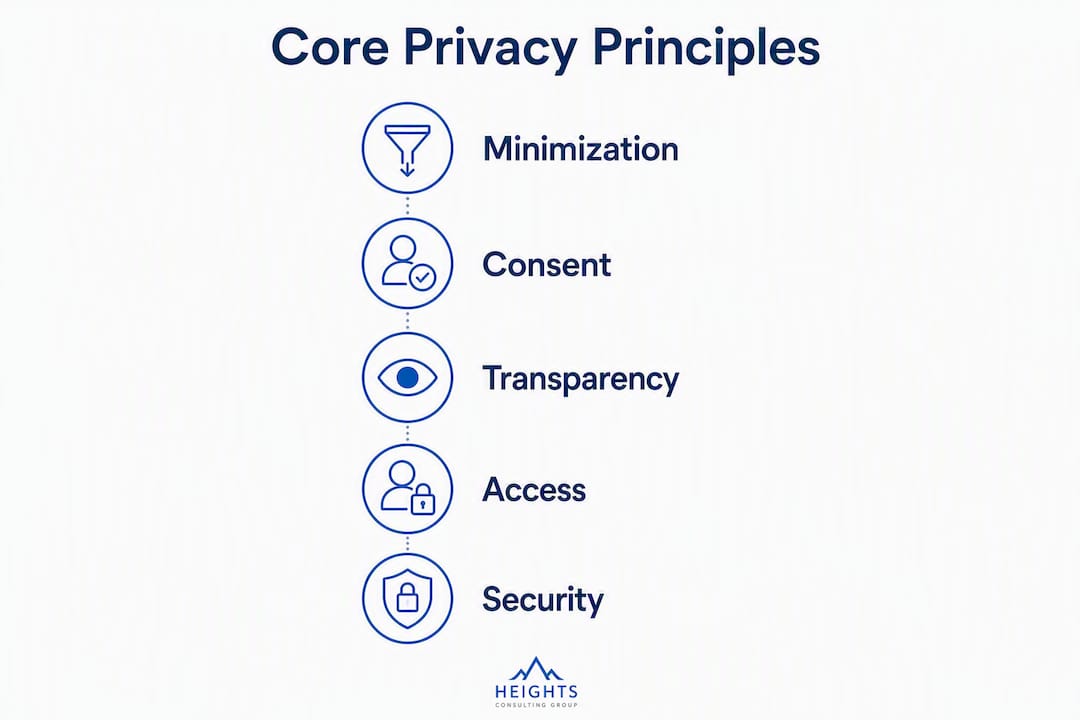
Six foundational principles govern responsible data handling across virtually every major privacy framework, from the GDPR to the CCPA/CPRA. Understanding them is the prerequisite for building any compliant program.
- Consent: Personal data should be collected only with the individual's informed agreement, except where another lawful basis applies (such as a legal obligation or legitimate interest). Consent must be freely given, specific, and revocable.
- Purpose limitation: Data collected for a stated purpose cannot be used for a materially different one without additional notice and, where required, fresh consent.
- Data minimization: Collect only what is necessary for the stated purpose. Every additional data field is additional risk — legal, operational, and reputational.
- Retention limitation: Personal data should not be kept longer than necessary. Defined retention schedules and automated deletion processes are the operational controls that enforce this principle.
- Transparency and notice: Individuals must be informed about what data is collected, why, how long it is kept, and with whom it is shared. Privacy notices are the primary mechanism, but they must be readable, not just legally complete.
- Accuracy: Organizations are responsible for keeping personal data accurate and up to date, particularly where inaccurate data could harm the individual.
- Individual rights: Access, correction, deletion ("right to be forgotten"), portability, and the right to object are recognized in most modern frameworks. Operationalizing these rights requires defined workflows, not just policy statements.
- Accountability: Organizations must be able to demonstrate compliance, not just assert it. Documentation, audit trails, and governance structures are the evidence.
Pro Tip: Data minimization by design is the single principle that enforces the most others simultaneously. If a system is architected to collect only what it needs, purpose limitation, retention, and consent scope all become easier to manage — and the attack surface for a breach shrinks proportionally.
How is data privacy regulated in the United States?
The U.S. approach to data privacy is fragmented: there is no single comprehensive federal privacy law. Instead, organizations navigate a patchwork of sector-specific federal rules and an expanding set of state-level comprehensive privacy statutes.
| Law / Framework | Scope | Who it applies to | Key individual rights |
|---|---|---|---|
| CCPA / CPRA (California) | Broad consumer data | For-profit businesses meeting size/revenue thresholds doing business in California | Access, deletion, correction, opt-out of sale/sharing |
| HIPAA | Protected health information | Covered entities (healthcare providers, insurers) and business associates | Access, amendment, accounting of disclosures |
| GLBA | Financial consumer data | Financial institutions | Notice, opt-out of certain sharing |
| FTC Act (Section 5) | Unfair or deceptive practices | Most commercial entities | Enforcement-based; no direct individual rights |
| State comprehensive laws | Broad consumer data | Varies by state threshold | Access, deletion, correction, portability (varies) |
Practical compliance implications for businesses operating across multiple states:
- Track which state laws apply based on resident count thresholds, not just where the business is incorporated.
- Build consumer rights workflows (access, deletion, correction) that can be triggered and fulfilled within statutory timeframes.
- Maintain breach notification procedures that satisfy the fastest applicable state deadline.
- Distinguish between consent-based and legitimate-interest-based processing, since U.S. state laws vary on which bases are recognized.
Pro Tip: Rather than building a separate compliance program for each state, adopt a privacy-by-design baseline that meets the most stringent applicable requirements, then layer jurisdiction-specific addenda for areas where state laws diverge. A single enterprise privacy policy with regional supplements is more sustainable than 20 separate policies.
The absence of a federal omnibus privacy law means the compliance perimeter expands every legislative cycle. Organizations that treat regulatory compliance as a one-time project rather than a continuous program consistently find themselves behind.
How do organizations operationalize privacy programs?
Privacy is an enterprise program requiring cross-functional governance and repeatable operational controls — not a legal checkbox or a single policy document. The NIST Privacy Framework frames privacy risk as a set of harms individuals may experience and explicitly links privacy risk management to enterprise risk management, which is the right framing for executive decision-making.
The core operational components:
- Governance structure: Designate a privacy officer or privacy function with clear authority. Establish a cross-functional privacy committee that includes legal, IT, security, and business operations.
- Data inventory and mapping: Identify every category of personal data the organization collects, where it is stored, who has access, how it flows to third parties, and what the lawful basis is for each processing activity.
- Data Protection Impact Assessments (DPIAs): Conduct structured risk assessments before launching new products, systems, or processing activities that involve personal data at scale or in novel ways.
- Policy and training: Maintain written privacy policies, data handling procedures, and vendor contracts with appropriate data processing terms. Train staff who handle personal data.
- Logging and audit trails: Maintain records of processing activities, consent records, rights requests, and breach notifications. These are the evidence base for accountability.
A practical implementation checklist for organizations starting a privacy program:
- Inventory all personal data categories and processing activities
- Classify data by sensitivity and apply proportionate controls
- Minimize data collection to what is operationally necessary
- Document the lawful basis for each processing activity
- Set and enforce retention schedules with automated deletion where possible
What technical controls protect personal data?
The core privacy-enhancing technologies (PETs) and technical controls relevant to any organization's data protection program include encryption, tokenization, pseudonymization, anonymization, differential privacy, and access controls. Each serves a different purpose and carries distinct tradeoffs.
- Encryption at rest and in transit: Protects data from unauthorized access during storage and transmission. The critical operational detail is key management — encryption is only as strong as the controls governing who holds the keys and how those keys are rotated and revoked.
- Tokenization: Replaces sensitive values (such as payment card numbers) with non-sensitive tokens. The original data is stored in a separate, secured vault. Widely used in payment processing under PCI DSS.
- Pseudonymization: Replaces direct identifiers with codes. Re-identification is possible with the linking key, so pseudonymized data still carries privacy obligations. It reduces risk but does not eliminate it.
- Anonymization and k-anonymity: Removes or generalizes identifiers so that individuals cannot be singled out. Techniques like k-anonymity and differential privacy are widely used but carry reidentification and utility tradeoffs — combining an "anonymized" dataset with a second dataset can often re-identify individuals.
- Differential privacy: Adds calibrated statistical noise to datasets or query results so that individual records cannot be inferred. Used by organizations like Apple and the U.S. Census Bureau. The tradeoff is reduced data utility at higher privacy budgets.
- Access controls and least privilege: Limit who can read, modify, or export personal data to those with a documented need. Role-based access control (RBAC) and privileged access management (PAM) are the standard implementations.
- Audit logging: Records who accessed what data, when, and what action was taken. Essential for breach investigation, rights request fulfillment, and regulatory accountability.
Pro Tip: Encryption protects data from external attackers, but key management determines whether it also protects against insider threats and vendor exposure. Treat encryption key lifecycle — generation, rotation, escrow, and revocation — as a business control, not just a technical configuration.
Practical steps individuals can take to protect their own data
The most effective personal data protection measures are not technical — they are behavioral. Reducing your exposure starts with a few deliberate decisions about what you share, with whom, and under what conditions.
Start with these immediate actions:
- Review privacy settings on social media accounts, mobile apps, and browser extensions. Most default settings favor data collection over privacy.
- Use strong, unique passwords for every account and enable two-factor authentication (2FA) wherever it is offered. A password manager such as Bitwarden or 1Password makes this practical.
- Limit app permissions to what the app genuinely needs. A flashlight app does not need access to your contacts or location. On iOS and Android, you can review and revoke permissions in system settings.
- Minimize what you share in online forms, loyalty programs, and app registrations. Every field you leave blank is data that cannot be breached or misused.
- Read privacy notices before signing up for new services — at minimum, look for what data is shared with third parties and whether it is sold.
- Audit data brokers. Services like Spokeo, Whitepages, and similar aggregators hold detailed profiles on most U.S. adults. You can submit opt-out requests directly to each broker, or use a service like DeleteMe to automate the process.
For a more structured approach, follow these steps to check and limit app permissions:
- On your phone, open Settings and navigate to Privacy or App Permissions.
- Review each permission category (location, microphone, camera, contacts).
- For any app you do not actively use or trust, revoke all non-essential permissions.
- For location specifically, set apps to "While Using" rather than "Always" unless there is a clear functional reason.
- Periodically repeat this audit — app updates can silently request new permissions.
Real-world privacy failures and what they reveal
Privacy failures tend to follow recognizable patterns. Three illustrative scenarios show what goes wrong and why.
-
Excess data collection without a clear purpose: A retail company collects detailed behavioral profiles on customers — purchase history, browsing patterns, inferred demographics — and retains them indefinitely. When a breach occurs, the exposed dataset is far larger and more sensitive than necessary. The principle breached is data minimization. The lesson: collect only what you need, and delete it when the purpose is served.
-
Insecure storage of sensitive records: A healthcare organization stores patient records in a cloud environment with misconfigured access controls, making files accessible without authentication. The principle breached is security-as-a-privacy-control. The lesson: privacy policies mean nothing if the underlying systems are not secured. HIPAA's Security Rule exists precisely because privacy and security are inseparable in practice.
-
AI model memorization of training data: A company deploys a generative AI model trained on customer support transcripts. The model memorizes and can reproduce sensitive information present in those transcripts — including names, account details, and complaint histories — when prompted in certain ways. The principle breached is purpose limitation and data minimization. The lesson: personal data used to train AI models does not stay neatly contained; it can persist in model weights and surface unpredictably. Organizations must assess what data goes into training pipelines before deployment, not after.
Authoritative frameworks and resources for deeper guidance
The most reliable starting points for privacy program development and individual rights information are primary regulatory and standards sources, not secondary summaries.
For organizations:
- NIST Privacy Framework: The most practical enterprise-oriented tool for U.S. organizations. It provides a risk-based structure for identifying, governing, controlling, communicating, and protecting privacy. Designed to complement the NIST Cybersecurity Framework.
- FTC guidance: The Federal Trade Commission publishes enforcement actions, business guidance, and consumer education on privacy. Its Section 5 authority covers unfair or deceptive data practices across most commercial sectors. FTC.gov is the authoritative source.
- State attorney general pages: California's OAG, Colorado's AG, and Virginia's AG publish official CCPA/CPRA, CPA, and VCDPA guidance respectively. These are the enforcement authorities — their published guidance carries more weight than third-party summaries.
- OECD AI and Privacy Guidelines: Useful for organizations operating internationally or building AI governance programs. The OECD has worked to integrate its Privacy Guidelines with its AI Principles to reduce governance gaps.
For individuals:
- FTC Consumer Information (consumer.ftc.gov): Plain-language guidance on identity theft, data broker opt-outs, and privacy rights.
- State attorney general consumer protection pages: Most states publish guidance on exercising your rights under applicable state privacy laws.
- GDPR as a rights model: Even for U.S. residents, the GDPR's rights framework (access, deletion, portability, objection) is a useful reference for understanding what privacy rights can look like when comprehensively codified.
Executive guidance: managing privacy risk in AI adoption
The single most important executive action on privacy today is treating it as enterprise risk and building privacy-by-design into AI programs before deployment, not after a regulatory inquiry. Foundation models create privacy risks that existing frameworks were not designed to address — including memorization of training data, prompt injection, and data poisoning.
An executive checklist for AI privacy governance:
- Assign an AI privacy owner. Someone must be accountable for the privacy implications of every AI system the organization operates or procures.
- Conduct DPIAs for AI systems. Any AI system that processes personal data at scale, makes automated decisions, or uses sensitive data categories requires a structured impact assessment before go-live.
- Inventory training data and model provenance. Know what personal data was used to train or fine-tune any model your organization deploys, including third-party models accessed via API.
- Establish contractual controls with model providers. Data processing agreements, data retention limits, and audit rights should be standard terms in any AI vendor contract.
- Build adversarial testing into your threat model. Prompt injection, data poisoning, and model inversion are realistic attack vectors that can force models to reveal sensitive training data. These belong in your security testing program.
- Address the right-to-deletion problem proactively. When personal data is embedded in model weights, satisfying a deletion request may require retraining the model. Organizations that have not planned for this will face an operationally difficult situation when the first request arrives.
- Prepare for algorithmic opacity. Modern ML complexity can prevent even internal teams from fully explaining model behavior, which creates accountability gaps in DPIAs and regulatory responses. Document what you can explain and build explainability requirements into procurement.
For the first 90 days, prioritize: completing an AI system inventory, assigning privacy ownership for each system, and conducting at least one DPIA on your highest-risk AI deployment. The AI security and governance playbook from Heightscg provides a structured starting point for organizations building these programs.
Pro Tip: The OECD has found that AI and privacy policy teams frequently operate in silos, producing governance gaps that neither team owns. Structurally integrating your AI governance committee with your privacy function — shared meetings, shared risk register — closes that gap before regulators find it.
How did data privacy law evolve to where it is today?
The concept of a legal right to privacy in the United States predates the digital era. In 1890, Samuel Warren and Louis Brandeis published "The Right to Privacy" in the Harvard Law Review, arguing that individuals had a common law right to be "let alone." That framing shaped U.S. privacy thinking for decades.
The first wave of sector-specific federal legislation arrived in the 1970s. The Fair Credit Reporting Act (1970) regulated how consumer credit data could be used. The Privacy Act of 1974 governed federal agency handling of personal records. The Family Educational Rights and Privacy Act (FERPA, 1974) protected student records. Each law addressed a specific harm in a specific context, establishing the sectoral pattern that defines U.S. privacy law today.
The 1990s and 2000s brought HIPAA (1996) for health data and the GLBA (1999) for financial data, followed by the Children's Online Privacy Protection Act (COPPA, 1998). The FTC's authority under Section 5 of the FTC Act became the primary enforcement mechanism for general commercial privacy practices in the absence of a broader statute.
The GDPR, which took effect in May 2018, represented a fundamentally different approach: a single comprehensive law applying across all sectors and all EU member states, with extraterritorial reach and significant penalties. It accelerated the global conversation about privacy rights and directly influenced the California Consumer Privacy Act, which passed in 2018 and was strengthened by the CPRA in 2020. Since then, states including Virginia, Colorado, Connecticut, Texas, and others have enacted their own comprehensive privacy statutes, creating the multi-state patchwork that organizations navigate today.
How do data privacy laws differ internationally?
The contrast between the U.S. and European approaches is the most consequential divide in global privacy governance. The EU's GDPR establishes a rights-based, comprehensive framework with a single supervisory authority structure across member states, mandatory data protection officers for many organizations, and fines up to 4% of global annual turnover for serious violations. GDPR and modern state privacy laws enshrine rights that operationalize transparency and control for individuals — access, deletion, correction, portability, and the right to object to automated decision-making.
The U.S. model is sectoral and fragmented, as described above. The practical interaction between the two systems matters for any U.S. organization that handles data from EU residents: GDPR applies to them regardless of where the organization is headquartered. The EU-U.S. Data Privacy Framework provides a mechanism for U.S. organizations to receive personal data from the EU in compliance with GDPR transfer requirements, but participation requires a public commitment to the DPF Principles, which are enforceable under U.S. law.
Other major frameworks include Canada's PIPEDA (and its provincial equivalents), Brazil's LGPD, and India's Digital Personal Data Protection Act. Each reflects a different balance between individual rights, business flexibility, and government access. For multinational organizations, the practical implication is that a privacy program built to GDPR standards provides a strong baseline for most other jurisdictions, while U.S.-only programs often require significant supplementation to meet international obligations.
Key Takeaways
Data privacy is a right and an operational discipline: individuals must exercise control over their personal data, and organizations must build governance programs that make that control real and legally defensible.
| Point | Details |
|---|---|
| Core definition | Data privacy is the right to control how personal information is collected, used, disclosed, retained, and deleted. |
| U.S. legal reality | No single federal privacy law exists; organizations must track sector rules (HIPAA, GLBA) and an expanding set of state comprehensive laws. |
| AI is a primary risk driver | AI systems can memorize training data, resist deletion requests, and create accountability gaps that existing frameworks were not designed to address. |
| Organizational starting point | Inventory all personal data flows, assign privacy ownership, conduct DPIAs for high-risk systems, and enforce retention schedules. |
| Individual actions | Review app permissions, enable 2FA, minimize data sharing, and submit opt-out requests to data brokers. |
| Heightscg's role | Heightscg provides privacy governance advisory, AI security assessments, and compliance program support for organizations navigating this environment. |
The privacy gap most organizations are not closing
Privacy programs that live only in legal and compliance functions are structurally incomplete. The most consequential privacy decisions in most organizations are made by product managers, data engineers, and AI teams — people who are often not in the room when privacy policy is written and not trained to recognize when a design choice creates a privacy liability.
The quick wins are well understood: conduct a data inventory, implement a rights request workflow, update vendor contracts. These are table stakes, and most mature organizations have done them. The harder work is integrating privacy into the decision-making processes where data is actually collected and used — product design reviews, AI model procurement, third-party data sharing agreements, and cloud architecture choices.
The AI dimension makes this more urgent, not less. When a foundation model is trained on personal data, the privacy implications are not fully visible at deployment time. They surface later, when a user submits a deletion request the organization cannot fulfill, or when an adversarial prompt extracts sensitive information the model was never supposed to retain. The organizations that are ahead of this problem have one thing in common: they assigned ownership of AI privacy risk before deploying AI systems, not after.
The tradeoff executives face is real. Building a privacy program that is genuinely integrated into AI and product development requires cross-functional coordination, dedicated resources, and sustained leadership attention. The alternative — treating privacy as a compliance formality — is cheaper in the short term and consistently more expensive when something goes wrong.
How Heightscg supports privacy governance and AI-safe data practices
Organizations that have completed a data inventory and written a privacy policy have taken the first steps. The harder work — operationalizing rights workflows, conducting DPIAs for AI systems, managing multi-state compliance obligations, and building contractual controls with AI vendors — is where most programs stall.
Heightscg works with organizations to build privacy programs that are operationally grounded, not just policy-complete. Engagements cover privacy program design and gap assessment, DPIA facilitation for AI and high-risk processing activities, multi-state compliance strategy, AI governance frameworks, and vendor contract review for data processing terms. For organizations in regulated sectors — healthcare, financial services, defense — the team brings direct experience with HIPAA, GLBA, and NIST framework alignment.
Relevant services include:
- Privacy program advisory and gap assessment
- AI governance and privacy risk assessment
- Regulatory compliance consulting (HIPAA, GLBA, CCPA/CPRA, NIST)
- Technical implementation of privacy controls (access management, encryption, audit logging)
- Incident response planning for privacy breaches
To discuss a privacy assessment or governance engagement, contact Heightscg directly. For organizations building or reviewing their compliance posture, the regulatory compliance checklist is a practical starting point.
Primary sources and further reading
For practitioners and executives:
- NIST Privacy Framework v1.0 — Enterprise risk-based privacy program structure; the authoritative U.S. standard for organizational privacy governance.
- FTC Privacy and Security Guidance — Enforcement precedent, business guidance, and consumer education from the primary federal privacy enforcement authority.
- RAND: Artificial Intelligence Impacts on Privacy Law — Authoritative analysis of how AI complicates deletion rights, accountability, and regulatory compliance.
- Stanford HAI: Data Privacy and Foundation Models — Technical and policy analysis of privacy risks specific to large generative models.
- OECD: AI, Data Governance and Privacy — International framework integrating AI principles with privacy governance.
- EU-U.S. Data Privacy Framework — Official DPF Principles for U.S. organizations receiving personal data from the EU.
For individuals:
- HHS HIPAA Privacy Rule — Authoritative source on health data rights and covered entity obligations.
- California OAG CCPA resources — Official guidance on California consumer privacy rights and enforcement.
- FTC Consumer Information — Plain-language guidance on identity theft, data broker opt-outs, and exercising privacy rights.