

TL;DR:
- Maintaining consistent cyber hygiene reduces organizational cyber risk by up to 40 percent within a year.
- Effective practices include patch management, strong password control, multi-factor authentication, and AI threat awareness.
Cyber hygiene is defined as the recurring set of behaviors and practices that individuals and organizations perform to keep their digital systems secure, functional, and resilient against cyber threats. The formal industry term is "cybersecurity hygiene," and it sits at the foundation of every mature security program, from NIST Cybersecurity Framework implementations to CISA advisories on critical infrastructure protection. Cyber hygiene is not a one-time project. It is an ongoing discipline, comparable to personal health habits, that determines whether an organization presents an easy target or a costly one. Consistent hygiene practices can reduce an organization's cyber risk and exposure by up to 40% within the first 12 months. That figure alone justifies treating digital hygiene as a board-level priority, not an IT afterthought.
What is cyber hygiene, and what are the essential best practices in 2026?
Good cybersecurity hygiene is built from a short list of repeatable actions performed consistently. Routine hygiene actions include patching software, managing access permissions, removing unnecessary software, and monitoring devices for anomalies. None of these tasks require advanced tools. They require discipline and a clear schedule.
The following practices form the core of any effective cyber hygiene checklist in 2026:
- Patch management on a defined schedule. Most successful attacks exploit known vulnerabilities with available patches, not advanced zero-day flaws. Patching within 24–72 hours of a critical release closes the window attackers rely on most.
- Password management with a dedicated password manager. Storing credentials in plaintext or reusing passwords across accounts is a primary attack vector. Tools like dedicated password managers generate and store unique credentials for every account, eliminating the reuse problem entirely.
- Multi-factor authentication using authenticator apps or push notifications. Outdated MFA methods like SMS codes remain a significant vulnerability in 2026. Authenticator apps and hardware tokens provide substantially stronger protection.
- Automated software and firmware updates. Automation removes human error from the update cycle. Scheduling updates during off-peak hours reduces operational disruption while maintaining coverage.
- Vulnerability scanning and removal of unnecessary software. Every application installed on a system is a potential attack surface. Regular scans identify exposures, and removing unused software shrinks that surface immediately.
- AI threat awareness as part of hygiene practice. AI-generated phishing, deepfake social engineering, and automated credential stuffing are now standard attacker tools. Recognizing these threats and training teams to identify them belongs on every hygiene checklist alongside technical controls.
Pro Tip: Prioritize patching using CISA's Known Exploited Vulnerabilities (KEV) catalog. The KEV catalog identifies vulnerabilities actively exploited in the wild, giving security teams a data-driven starting point rather than relying on generic severity scores alone.
Why is cyber hygiene important for individuals and organizations?
Cyber hygiene matters because it directly determines how difficult and expensive an organization is to attack. Cyber hygiene is a cultural discipline that raises the cost of attack by eliminating the simple vulnerabilities attackers exploit first. When those easy entry points disappear, attackers move to softer targets.
The benefits extend well beyond breach prevention:
- Risk reduction at scale. Organizations that apply consistent hygiene best practices reduce their cyber risk and exposure by up to 40% within 12 months. That reduction translates directly into lower cyber insurance premiums and fewer incident response engagements.
- Faster, cleaner incident response. Well-maintained systems reduce operational noise, enabling security analysts to identify and validate threats faster during active events. A cluttered environment full of unpatched systems and stale permissions generates false positives that slow every investigation.
- Defense of critical infrastructure. CISA and the U.S. Coast Guard issued a joint advisory in july 2025 warning that failing to implement basic hygiene measures, including avoiding plaintext password storage and managing admin credentials securely, exposes critical infrastructure to significant risk. The advisory names specific hygiene failures as the root cause of exposure, not sophisticated attacks.
- Governance and compliance alignment. Frameworks including NIST CSF, CMMC, SOC 2, and HIPAA all embed hygiene requirements into their control sets. Organizations with mature hygiene practices satisfy compliance requirements more efficiently and with fewer gaps.
- Reduced operational debt. Unpatched systems and legacy permissions accumulate over time. Operational debt from legacy configurations makes future hygiene work harder and more expensive. Starting early prevents the compounding effect.
For clinics and healthcare organizations specifically, cyber hygiene for clinics carries additional weight. HIPAA requires documented controls over access, patching, and device management. A single unpatched endpoint in a clinical network can expose protected health information and trigger regulatory penalties that dwarf the cost of prevention.
What are common cyber hygiene mistakes to avoid?
Poor cybersecurity hygiene is rarely the result of ignorance. It is almost always the result of inconsistency, competing priorities, and the mistaken belief that hygiene is a project with an end date.
The most damaging mistakes organizations make include:
- Weak or reused passwords stored in plaintext. This remains the most exploited credential vulnerability. A CISA advisory specifically calls out plaintext credential storage as a critical infrastructure risk.
- Delayed or skipped patching cycles. Patch fatigue is real, but deferring updates is the single most reliable way to hand attackers a working entry point.
- Overreliance on SMS-based MFA. SMS codes are interceptable through SIM swapping and SS7 protocol attacks. Relying on SMS MFA in 2026 reflects an outdated threat model.
- Ignoring IoT and smart device hygiene. Printers, HVAC controllers, smart cameras, and other connected devices often run unpatched firmware for years. They sit on the same network as critical systems and receive almost no hygiene attention.
- Treating hygiene as a one-time project. Security teams that complete a hygiene initiative and move on find themselves back at square one within 12–18 months as new vulnerabilities emerge and configurations drift.
- Manual processes that depend on human memory. Any hygiene task that relies on someone remembering to do it will eventually fail. Automation is not optional at scale.
Pro Tip: Build hygiene into existing workflows rather than creating separate security tasks. Attach patch reviews to sprint cycles, include permission audits in quarterly business reviews, and tie device inventory checks to asset management processes already in place. Hygiene habits that fit existing routines survive organizational change far better than standalone programs.
How can organizations practically implement and sustain effective cyber hygiene?
Sustaining cybersecurity hygiene requires structure, ownership, and the right tools. Cyber hygiene success depends less on tools and more on consistent execution and embedding routines into daily workflow. The tools support the discipline; they do not replace it.

A practical implementation approach combines automation, governance, and threat intelligence:
| Implementation Layer | What It Covers | Why It Matters |
|---|---|---|
| Asset inventory | All devices, software, and accounts | You cannot protect what you cannot see |
| Automated patching | OS, applications, and firmware | Removes human error from the update cycle |
| Access management | Permissions, admin accounts, and offboarding | Limits blast radius of any single compromise |
| Vulnerability scanning | Regular scans tied to threat intelligence | Prioritizes remediation by actual risk, not severity score alone |
| Governance and training | Ownership, accountability, and awareness | Embeds hygiene into culture rather than treating it as a technical task |
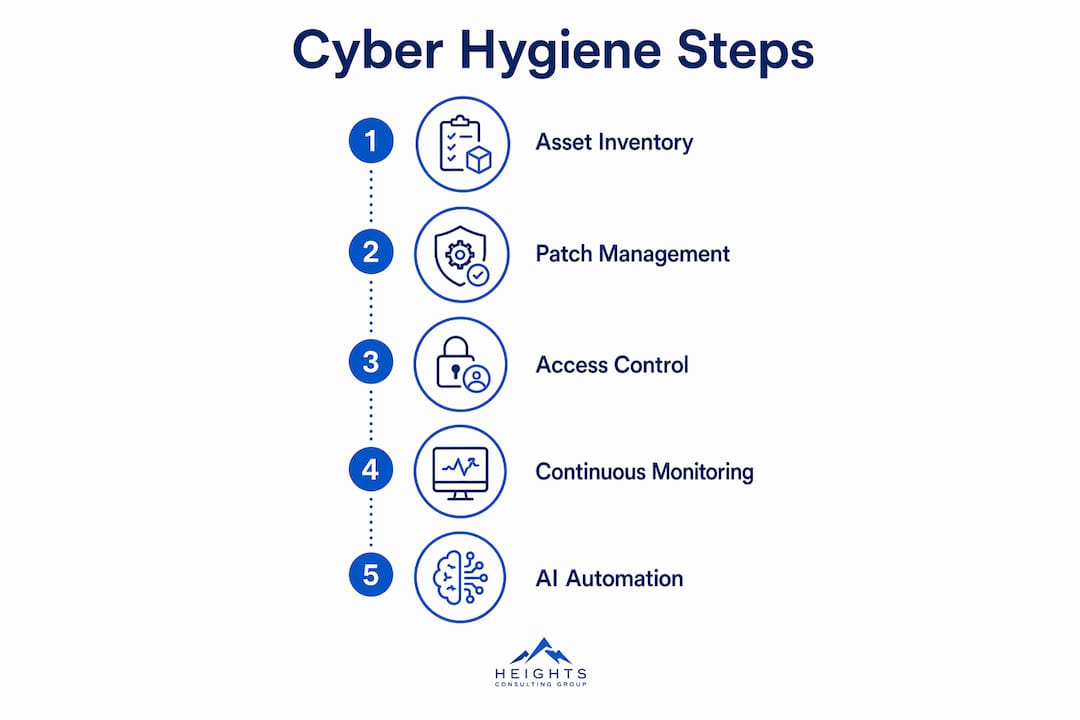
Shifting from reactive to proactive security requires combining vulnerability scans with threat intelligence feeds. This combination allows security teams to validate threats faster and allocate remediation effort where it produces the most risk reduction.
AI plays a growing role in this layer. AI-powered tools now automate anomaly detection, flag configuration drift, and correlate vulnerability data with active threat intelligence at a speed no manual process can match. For executives managing proactive cybersecurity risk, AI augmentation of hygiene monitoring is no longer a future consideration. It is a present requirement.
Operational debt from unpatched systems and legacy credentials grows over time, making hygiene progressively harder. Structured fallback plans and clear asset ownership are the two most effective controls for patching at scale. Organizations that assign named owners to every asset class and define escalation paths for deferred patches maintain hygiene discipline even under resource constraints. For organizations navigating compliance requirements, cyber risk management steps that embed hygiene into governance frameworks produce the most durable results. Financial firms and other regulated entities benefit from aligning hygiene controls directly to NIST CSF, CMMC, or SOC 2 control families, making compliance evidence a byproduct of routine operations rather than a separate audit exercise. For teams looking to validate their security posture against real-world threats, a forex trading security checklist illustrates how MFA adoption and credential hygiene apply across high-stakes digital environments beyond traditional enterprise IT.
Key Takeaways
Consistent cyber hygiene is the single most cost-effective way to reduce organizational cyber risk, and it requires ongoing execution, not a one-time fix.
| Point | Details |
|---|---|
| Hygiene reduces risk measurably | Consistent practices cut cyber risk and exposure by up to 40% within 12 months. |
| Patching is the highest-leverage action | Most attacks exploit known, patchable vulnerabilities, not zero-days. |
| Automation prevents human error | Scheduled, automated patching and scanning remove the gaps that manual processes create. |
| Culture determines sustainability | Hygiene embedded in daily workflows survives organizational change; standalone programs do not. |
| AI threats require updated hygiene | SMS MFA and manual updates are inadequate against AI-assisted attacks in 2026. |
Why I think most organizations are solving cyber hygiene backwards
After working with organizations across regulated industries, I have seen the same pattern repeat: teams invest in detection and response tools before they have solved the basics. They buy threat intelligence platforms while running unpatched servers. They deploy endpoint detection and response solutions on systems still using default admin credentials. The tools are good. The foundation is not there.
The uncomfortable truth is that most breaches I have seen investigated were not sophisticated. They were preventable. An attacker found a known vulnerability, used a credential that had not been rotated, and moved laterally through a network that had no segmentation. No advanced persistent threat. No zero-day. Just poor hygiene compounded over time.
The shift that actually produces results is treating hygiene as a governance function, not a technical task. When a CISO reports hygiene metrics to the board alongside incident counts, patching velocity improves. When asset owners are accountable for their systems' patch status, deferred updates get escalated instead of forgotten. AI-driven threats are accelerating the timeline on all of this. Attackers now use AI to identify unpatched systems and generate targeted phishing at scale. The organizations that survive this environment are the ones that build proactive security postures from the ground up, starting with hygiene, not ending with it.
— Dan
Heightscg's approach to building lasting cyber hygiene programs
Organizations that treat cyber hygiene as a technical checkbox rarely sustain it. Heightscg works with security leaders and executives to embed hygiene into governance frameworks, compliance programs, and daily operations, so that maintenance becomes a measurable, accountable function rather than a periodic effort.
Heightscg's technical cybersecurity consulting services cover the full hygiene lifecycle, from asset inventory and patch management to access governance and vulnerability prioritization. For organizations in regulated industries, Heightscg aligns hygiene controls directly to NIST, CMMC, and SOC 2 requirements, reducing compliance overhead while strengthening the security posture. If your organization is ready to move from reactive security to a disciplined, proactive program, contact Heightscg to discuss where your hygiene program stands and what it takes to sustain it.
FAQ
What is cyber hygiene in simple terms?
Cyber hygiene is the set of routine practices, such as patching software, managing passwords, and controlling access, that keep digital systems secure over time. It is the cybersecurity equivalent of regular maintenance, not a one-time fix.
What is cyber hygiene for clinics and healthcare organizations?
Cyber hygiene for clinics refers to the specific application of standard security practices, including patch management, access control, and device monitoring, within healthcare environments subject to HIPAA requirements. A single unpatched endpoint in a clinical network can expose protected health information and trigger regulatory penalties.
How often should organizations review their cyber hygiene checklist?
Critical patches should be applied within 24–72 hours of release, with full hygiene reviews conducted at least quarterly. CISA's Known Exploited Vulnerabilities catalog provides a continuously updated reference for prioritizing the most urgent remediation actions.
Why is SMS-based MFA no longer considered good cyber hygiene?
SMS codes are vulnerable to SIM swapping and SS7 protocol attacks, making them an unreliable second factor. Authenticator apps and hardware tokens provide significantly stronger protection and are the recommended standard in 2026.
How does AI change cyber hygiene requirements?
AI enables attackers to identify unpatched systems and generate targeted phishing campaigns at a speed and scale that manual processes cannot match. Effective cyber hygiene now requires AI-augmented monitoring tools and updated threat awareness training to address AI-assisted attack methods.
Recommended
- Cyber Risk Management: 10 Best Practices for 2025
- Navigating 2026’s Cyber Regulatory Landscape with Confidence: A C‑Suite Playbook - Heights Consulting Group
- Cybersecurity checklist for executives: 2025 strategies
- Why Cybersecurity Is a Business Priority in 2026: Strategies & Compliance | Heights Consulting Group