

TL;DR:
- Vulnerability prioritization ranks security risks based on actual operational threat levels, not just severity scores. Incorporating exploitability, asset criticality, and threat intelligence, especially with tools like EPSS, improves remediation focus and compliance. Rapid AI-driven exploits require continuous validation to keep pace with emerging threats and closing governance gaps.
Vulnerability prioritization is the process of ranking security vulnerabilities by the actual risk they pose to an organization's specific environment, not by theoretical severity alone. Security teams face over 28,900 new CVEs annually, a volume that makes patching everything impossible. The industry term for this discipline is risk-based vulnerability management, and it sits at the intersection of threat intelligence, asset criticality, and business context. For executives and security professionals in regulated sectors, understanding why vulnerability prioritization determines remediation outcomes is the difference between focused defense and wasted effort.
Why severity scores alone fail at vulnerability prioritization
CVSS scores measure theoretical severity, not the actual risk a vulnerability poses in your environment. CVSS scores are theoretical, meaning a CVSS 9.8 vulnerability sitting behind a hardened firewall with no external exposure can be far less dangerous than a CVSS 6.5 flaw on an internet-facing production database. Treating every high score as an equal emergency creates alert fatigue and misallocates remediation resources.
The numbers reinforce this point sharply. Less than 1% of CVEs are ever weaponized by threat actors. That statistic means the vast majority of high-severity findings on a typical scan report will never be exploited in the wild. Security teams that chase CVSS scores without filtering for real-world exploitability spend cycles on vulnerabilities that pose negligible operational risk.
The gap between theoretical severity and actual exploit risk is where prioritization earns its value. Two additional data points sharpen the case:
- Exploit velocity: 28% of exploits occur within 24 hours of vulnerability disclosure. Speed of exploitation, not severity score, determines urgency.
- Existing exposure: 68% of organizations carry at least one CVE already exploited by known threat actors. The threat is not hypothetical; it is present in most environments right now.
- Weaponization rate: Because fewer than 1% of CVEs become active exploits, prioritization filters separate signal from noise.
- Environmental context: Asset exposure, network segmentation, and compensating controls all change the effective risk of any given vulnerability.
The Exploit Prediction Scoring System (EPSS) addresses this gap directly. EPSS assigns a probability score to each CVE based on observed exploit activity and threat actor behavior. Combining CVSS with EPSS and environmental context narrows the remediation focus to vulnerabilities that are both severe and likely to be exploited in your specific environment.
Pro Tip: Run EPSS scores alongside CVSS for every new scan cycle. Vulnerabilities with high EPSS scores but moderate CVSS ratings often represent the most immediate operational risk and should move to the top of the remediation queue.
What does effective vulnerability prioritization require?
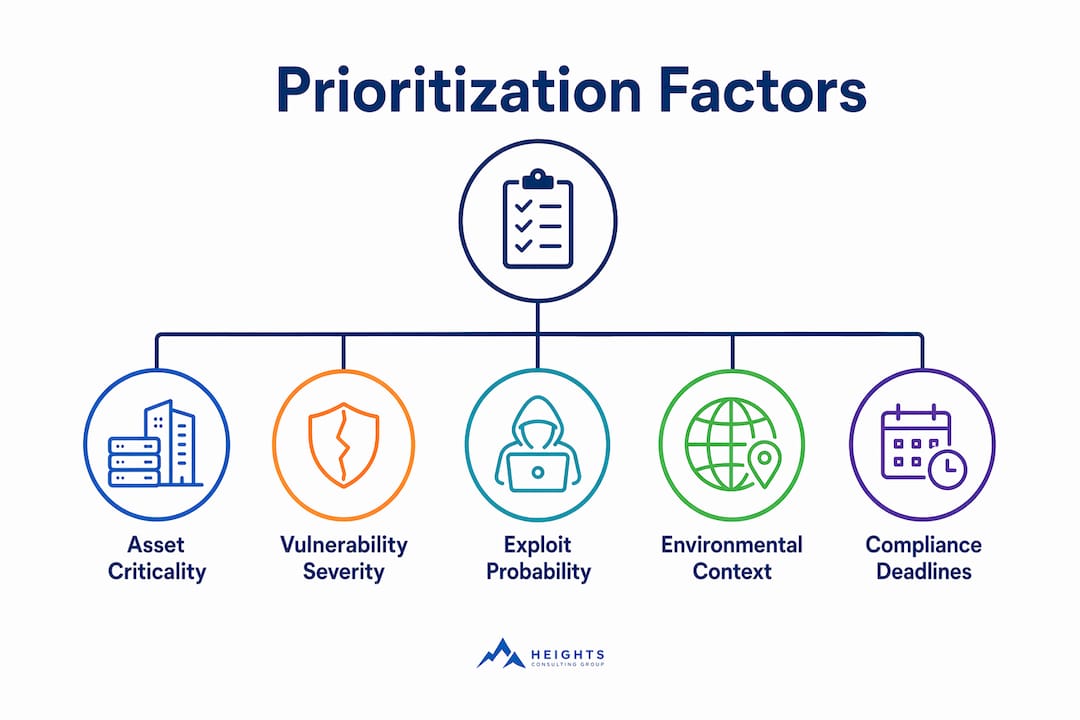
Effective prioritization integrates four data dimensions: asset criticality, exploitability, threat intelligence, and business impact. Each dimension changes the risk calculation in ways that a severity score cannot capture alone.
The following factors form the operational foundation of any mature prioritization program:
- Asset criticality mapping. Assign business criticality ratings to all assets before scoring vulnerabilities against them. A vulnerability on a payment processing server carries more weight than the same flaw on a test workstation.
- Exploit intelligence integration. Use threat feeds and EPSS data to identify which vulnerabilities are actively targeted by threat actors relevant to your industry. Healthcare organizations face different adversary profiles than financial institutions.
- Reachability and exposure analysis. Assess whether a vulnerable system is internet-facing, accessible from a compromised network segment, or isolated behind strong controls. Reachability determines whether an attacker can actually reach the flaw.
- Continuous assessment cadence. Quarterly assessments create 45 to 90-day blind spots. Regulated sectors should adopt monthly or continuous monitoring to match the pace of new CVE disclosures.
- Cross-functional governance. Remediation ownership must extend beyond the security team. Business owners, application teams, and infrastructure leads all carry accountability for assets in their domain.
The table below maps each prioritization factor to its primary data source and the risk question it answers.
| Prioritization factor | Primary data source | Risk question answered |
|---|---|---|
| Asset criticality | CMDB, business impact analysis | How damaging is compromise of this asset? |
| Exploitability | EPSS, threat intelligence feeds | How likely is this CVE to be exploited? |
| Reachability | Network topology, firewall rules | Can an attacker actually reach this system? |
| Threat actor relevance | MITRE ATT&CK, sector-specific feeds | Are adversaries targeting this vulnerability now? |
| Remediation SLA compliance | NIST, HIPAA, PCI DSS requirements | Does this flaw breach a regulatory timeline? |
Integrating vulnerability discovery into CI/CD pipelines for early detection adds another layer of maturity. Catching flaws before production deployment reduces the remediation cost and eliminates the exposure window entirely for new code releases.
How does vulnerability prioritization support compliance in regulated sectors?
Regulated sectors operate under explicit remediation timelines that make structured prioritization a compliance requirement, not just a best practice. Critical vulnerabilities require remediation within 72 hours, high-severity findings within 7 days, and medium-severity issues within 30 days. Organizations that lack a prioritization framework cannot consistently meet these timelines because they have no systematic way to identify which vulnerabilities are critical in their specific environment.

Compliance frameworks including HIPAA, PCI DSS, and SOC 2 all emphasize structured prioritization and documented remediation timelines. Auditors do not accept informal processes. They require evidence that risk-based decisions were made, documented, and acted upon within prescribed windows. For executives navigating regulatory compliance in 2026, this means vulnerability management must produce audit-ready records, not just patched systems.
Several governance practices define compliance-aligned prioritization programs:
- Formal risk acceptance. When remediation is deferred, business and system owners must formally own that risk acceptance decision. Security teams cannot carry this accountability alone.
- Documented exception processes. Every deferred remediation needs a written rationale, an owner, a review date, and compensating controls.
- Executive visibility. CISOs and CIOs need dashboards that show remediation velocity, SLA compliance rates, and open risk acceptances. This data supports board-level risk reporting.
- NIST and CISA alignment. Both NIST and CISA classify vulnerability management as a continuous discipline. Point-in-time assessments do not satisfy their guidance for organizations in critical infrastructure sectors.
The vulnerability management and business resilience connection is direct: organizations that meet remediation SLAs consistently demonstrate lower breach rates and faster recovery times when incidents do occur.
How does AI change vulnerability prioritization strategies?
AI compresses the time between vulnerability disclosure and active exploitation. AI-driven exploitation shortens the window from disclosure to attack, rendering static scan reports obsolete within hours of generation. A vulnerability report produced on Monday morning may already be outdated by Monday afternoon if an AI-assisted exploit kit has been deployed against the disclosed CVE.
This acceleration changes the calculus for security teams fundamentally. Automation in exploit detection and validation becomes a necessity, not an enhancement. Security programs that rely on weekly or monthly scan cycles cannot respond to threats that materialize within 24 hours of disclosure. Continuous, risk-based validation replaces the patch-everything mandate as the operative standard.
"AI-driven attacks rapidly reduce time to exploit, making continuous, risk-based validation critical to effective prioritization. Organizations that treat vulnerability management as a periodic exercise will find their programs structurally misaligned with the speed of modern threats."
AI also introduces new governance risks. Organizations deploying AI-assisted security tools without clear ownership, defined data handling policies, and accountability structures create new exposure. The tool may surface accurate findings, but without governance, those findings do not translate into prioritized, documented remediation actions. The exploit intelligence landscape has shifted in ways that demand both technical adaptation and executive accountability.
Pro Tip: Integrate AI-generated threat intelligence into your prioritization workflow, but assign a human reviewer to validate high-priority findings before escalating to remediation. AI surfaces patterns quickly; human judgment confirms business context.
Ethical hacking and continuous validation methodologies now incorporate AI-assisted attack simulation to test whether prioritized vulnerabilities are actually exploitable in a given environment. This closes the loop between theoretical risk scoring and confirmed exposure.
Key Takeaways
Risk-based vulnerability prioritization, not CVSS severity alone, determines which vulnerabilities actually threaten your organization and must be remediated first.
| Point | Details |
|---|---|
| CVSS scores are insufficient | Combine CVSS with EPSS and environmental context to identify real exploit risk. |
| Exploit speed demands urgency | 28% of exploits occur within 24 hours of disclosure, requiring continuous assessment cycles. |
| Compliance requires documentation | HIPAA, PCI DSS, and SOC 2 mandate documented, risk-based remediation decisions with clear timelines. |
| Governance extends beyond security teams | Business owners must formally own risk acceptance decisions for deferred remediation. |
| AI accelerates the threat window | Static reports become obsolete quickly; continuous, automated validation is now the baseline standard. |
The governance gap no one talks about
Most organizations treat vulnerability prioritization as a tooling problem. They buy a scanner, configure severity thresholds, and assign tickets to the security team. The program stalls within months. The real issue is structural: vulnerability management is a governance discipline, not a technical one.
What I have seen consistently across regulated sectors is that the organizations with the lowest remediation backlogs are not the ones with the most sophisticated tools. They are the ones where business owners accept accountability for assets in their domain. When a CFO understands that a deferred patch on a financial reporting system represents a formal risk acceptance with their name on it, remediation timelines compress dramatically.
The other misconception I encounter regularly is that prioritization means patching everything faster. It does not. It means patching the right things first, and formally documenting why other things wait. That distinction matters enormously during a regulatory audit or a post-incident review. Executives who have not built that documentation discipline into their programs will face uncomfortable questions when a breach occurs.
My recommendation to security leaders: stop measuring your program by the number of vulnerabilities closed. Measure it by SLA compliance rates on critical and high findings, by the percentage of risk acceptances that carry formal business owner signatures, and by your mean time to remediate across asset criticality tiers. Those metrics tell the real story of program maturity.
— Dan
Heightscg supports your vulnerability prioritization program
Vulnerability prioritization requires more than a scanner and a spreadsheet. It demands governance structure, compliance alignment, and continuous threat intelligence, all working together under executive oversight.
Heightscg works with executives and security leaders in regulated industries to build prioritization programs that satisfy NIST, HIPAA, PCI DSS, and SOC 2 requirements while keeping remediation focused on actual risk. From technical cybersecurity consulting that maps asset criticality to exploit intelligence, to managed cybersecurity services that provide continuous monitoring, Heightscg delivers the structure organizations need to move from reactive patching to risk-informed defense. Contact the team at Heightscg to discuss how a structured prioritization program fits your compliance obligations and risk tolerance.
FAQ
What is vulnerability prioritization in cybersecurity?
Vulnerability prioritization is the process of ranking security vulnerabilities by the actual risk they pose to a specific environment, combining factors like exploitability, asset criticality, and business impact rather than severity scores alone.
Why is CVSS scoring insufficient for prioritization?
CVSS measures theoretical severity, not environmental risk. A high CVSS score on an isolated system may pose less real danger than a moderate score on an exposed, business-critical asset.
How often should organizations assess vulnerabilities?
Quarterly assessments create 45 to 90-day blind spots. NIST and CISA recommend continuous or monthly monitoring, particularly for organizations in regulated sectors managing over 28,900 new CVEs disclosed annually.
Who owns risk acceptance for deferred vulnerabilities?
Business and system owners must formally own risk acceptance decisions for deferred remediation. Assigning this accountability only to security teams creates a governance gap that regulators and auditors will flag.
How does AI affect vulnerability prioritization?
AI-driven exploitation compresses the time from disclosure to active attack, making static reports obsolete quickly. Organizations must adopt continuous, risk-based validation workflows to keep pace with AI-accelerated threat timelines.