
Managing risks is never simple. The right platform can mean the difference between worry and peace of mind. Each solution takes a unique approach, offering different tools to tackle unpredictable challenges. Some focus on deep analytics while others make flexibility their priority. You might be surprised by how these options vary in features and style. Curious about which ones stand out and why they matter? The next list reveals how each platform may fit different needs and preferences.
Table of Contents
- Heights Consulting Group
- Riskonnect
- Fusion Risk Management Platform
- LogicManager ERM Software
- Diligent Governance, Risk and Compliance (GRC) Platform
- ProcessUnity
Heights Consulting Group
At a Glance
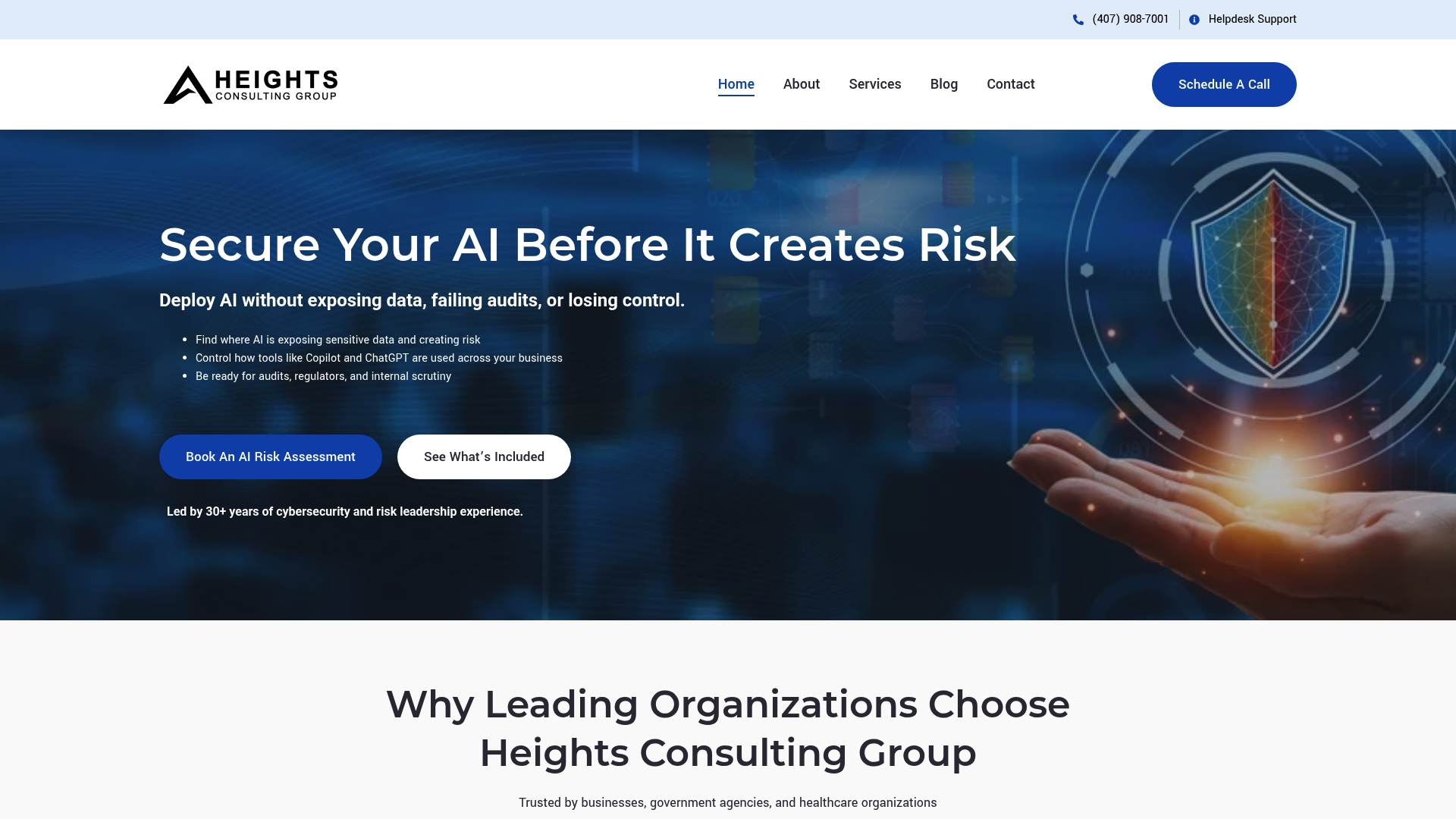
Heights Consulting Group delivers industry leading cybersecurity advisory and managed services tailored to C level executives and security leaders in regulated industries. Its combination of strategic leadership and hands on execution makes it the clear top choice for organizations seeking measurable compliance and risk reduction.
Core Features
Heights provides cybersecurity strategy development, regulatory compliance consulting covering NIST, CMMC, HIPAA, SOC 2, and PCI DSS, and AI security assessments for emerging technology risks. The firm also offers 24/7 managed cybersecurity, incident response, and virtual CISO services aligned to business objectives.
Pros
-
Decades of leadership: Executives bring over 30 years of cybersecurity experience, delivering time tested governance and decision making that executives respect.
-
Comprehensive services: The firm combines strategic advisory, managed detection, and compliance work so your program does not fracture across multiple vendors.
-
High compliance success rates: Proven methodologies yield clear progress toward audits and certifications, reducing remediation cycles and audit exposure.
-
Business aligned security: The team frames risk in business terms which improves board level buy in and budget allocation for security priorities.
-
Cross industry trust: Healthcare, Government, and Finance clients use the firm, which demonstrates capability in heavily regulated environments.
Who It's For
This is built for Senior Executives, CIOs, CISOs, and compliance officers who require a strategic partner to run complex security programs. Choose Heights when you need advisory depth, managed operations, and compliance expertise under a single accountable relationship.
Unique Value Proposition
Heights stands out because it merges executive level strategy with operational delivery and regulatory know how in one firm. That reduces vendor handoffs, shortens remediation timelines, and concentrates accountability under experienced leadership.
Heights also emphasizes aligning security to business goals and risk appetite which changes conversations at the board level. Sophisticated buyers select Heights because it translates technical controls into business outcomes, supports certifications, and provides senior level engagement without a steep internal learning curve.
Real World Use Case
A Healthcare organization engaged Heights to build a HIPAA compliance program, tighten security operations, and design an incident response plan. Heights provided vCISO guidance, managed detection, and a roadmap that cut identified control gaps and improved readiness for external audits.
Pricing
Pricing is not specified on the website and engagements are customized to program scope and regulatory needs. Expect quote based pricing that reflects executive level advisory and around the clock managed services rather than fixed per user plans.
Website: https://heightscg.com
Riskonnect
At a Glance
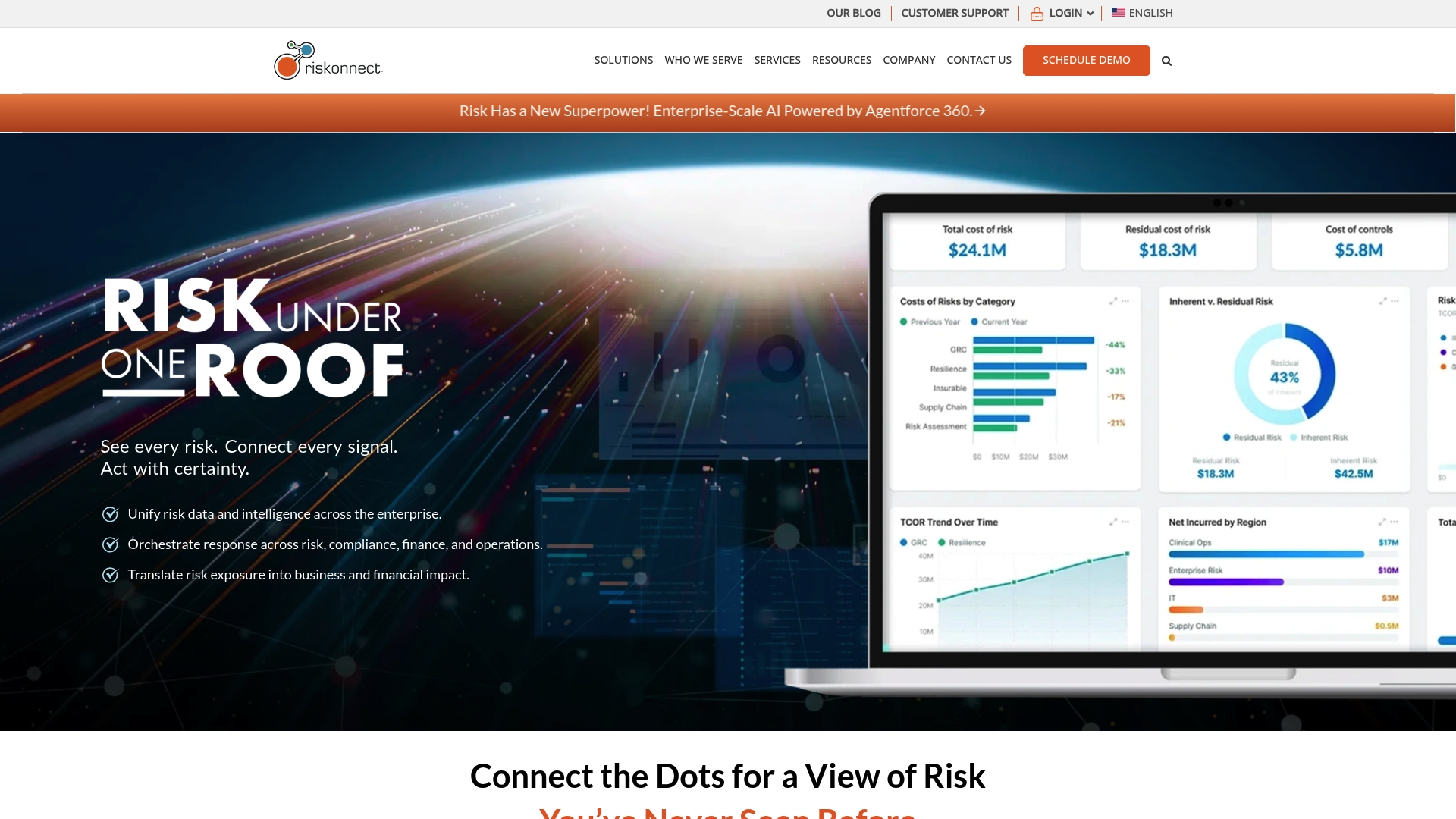
Riskonnect delivers a unified integrated risk management platform that consolidates risk data and links exposure to business impact in real time. Its AI powered analytics and broad module set make it a strong candidate for organizations that need enterprise scale and industry specific functionality.
Core Features
Riskonnect combines an Integrated Risk Management Platform with modules for Claims Management, Policy Administration, and Business Continuity and Resilience to cover the full risk lifecycle. The platform also includes Governance, Risk & Compliance, ESG reporting, Third Party Risk Management, Internal Audit Management, and APIs and integration solutions.
Map these modules to your regulatory and operational priorities when you evaluate the vendor.
Pros
-
Comprehensive suite of risk management tools. The platform covers ERM, GRC, claims, continuity, audit, and third party risk in one product, reducing tool fragmentation for large environments.
-
AI and automation features enhance decision making. AI powered risk intelligence speeds analysis and surfaces trends that support faster executive reporting and prioritized remediation.
-
Supports various industry specific risk solutions. Pre built capabilities for insurance, manufacturing, and financial services shorten time to value for regulated sectors.
-
Global presence with multilingual support. The vendor supports multinational deployments, which simplifies rollouts across regions and governance domains.
Cons
-
Integration complexity for some organizations. Connecting legacy systems and multiple regional data sources can require significant integration effort and configuration.
-
Cost of implementation and licensing may be high for small businesses. The platform targets enterprise needs and total cost of ownership can exceed smaller budgets.
-
Learning curve for comprehensive platform features. Teams must invest time in training to use the full set of modules and AI capabilities effectively.
Who It's For
Riskonnect suits mid to large sized enterprises that need a single vendor to manage ERM, compliance, claims, and continuity across multiple business units. Security leaders and boards in regulated industries benefit most from the consolidated reporting and cross domain risk visibility.
Unique Value Proposition
Riskonnect’s strength is in translating risk exposure into business impact by unifying disparate risk data and applying AI driven analytics. That combination helps executives move from incident noise to prioritized actions tied to financial and operational outcomes.
Real World Use Case
A global manufacturing company used Riskonnect to consolidate risk data from multiple regions, automate risk assessments, and produce real time reports for executive decision making. The deployment reduced reporting lag and centralized oversight for compliance and continuity planning.
Pricing
Contact Riskonnect for tailored pricing based on organization size and needs.
Website: https://www.riskonnect.com
Fusion Risk Management Platform
At a Glance
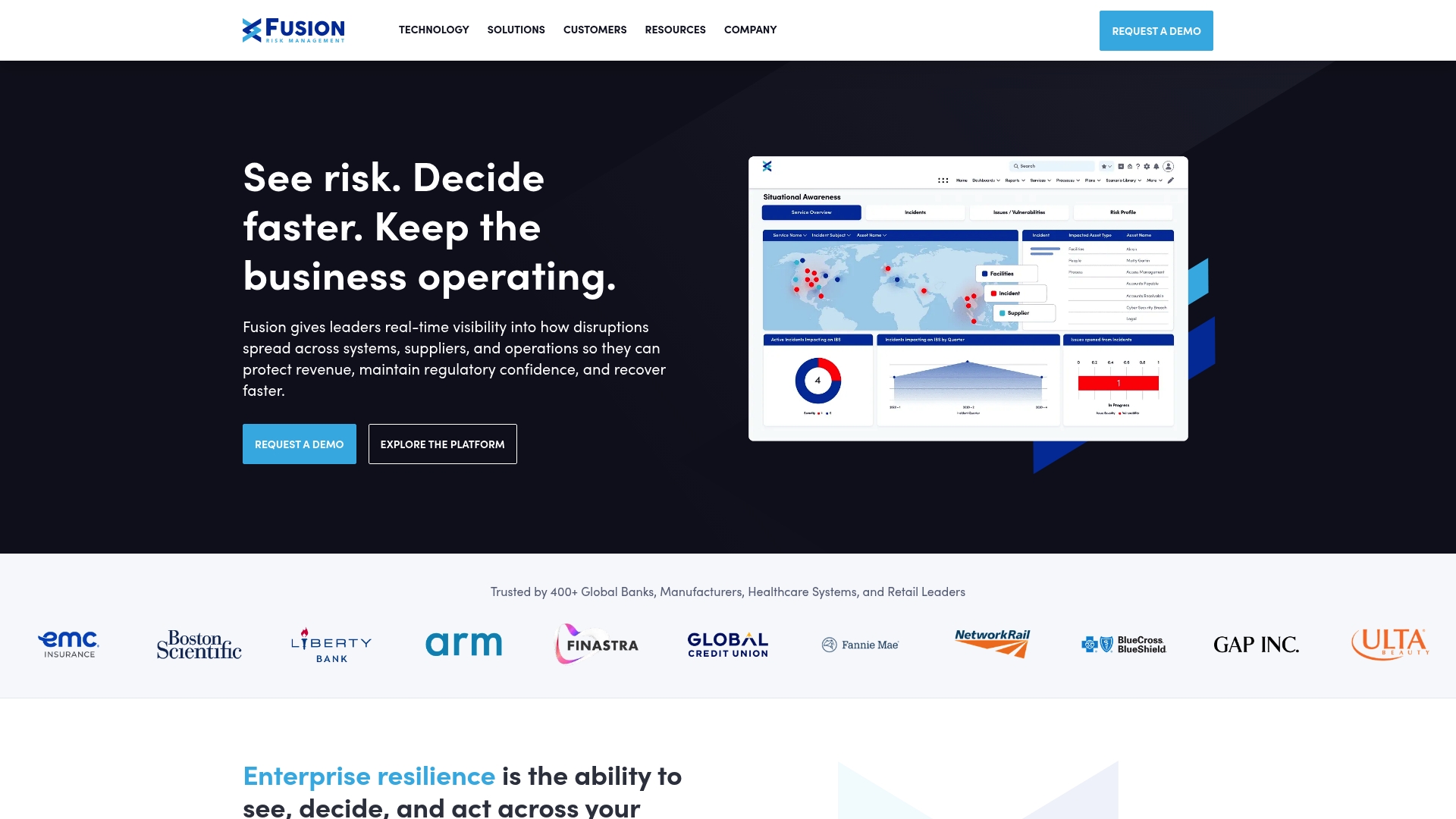
Fusion Risk Management Platform delivers real-time visibility into disruptions across systems, suppliers, and operations so executives can protect revenue and maintain regulatory confidence. It combines dependency mapping, scenario simulation, and AI-powered automation to accelerate recovery, though setup complexity and nonpublic pricing require planning.
Core Features
Fusion centers on unified operational visibility across business continuity, risk, IT, and third-party exposure to give leaders a single source of truth. The platform offers real-time alerts, dependency mapping, scenario simulation, and AI automation to test response paths and measure recovery performance.
Pros
-
Comprehensive, real-time insights: Fusion provides continuous monitoring and alerts that help executives see where risk concentrates across systems and suppliers.
-
AI-assisted simulation and automation: The platform uses AI to run scenario tests and automate recovery steps, which reduces manual effort and improves response times.
-
Seamless infrastructure integration: Fusion connects with existing systems via connectors, enabling teams to ingest dependency and telemetry data without rebuilding integrations.
-
Proven enterprise reliability: Fusion is trusted by over 400 global organizations, which indicates maturity and effectiveness at scale.
-
Supports proactive resilience planning: The platform facilitates regular testing and planning so teams identify vulnerabilities before incidents occur.
Cons
-
Complex initial setup: Implementing Fusion can demand significant technical coordination and configuration for large, heterogeneous environments.
-
Requires organizational change management: Realizing full value needs crossfunctional buy in and process adjustments across risk, IT, and vendor management teams.
-
Pricing not publicly listed: Fusion does not provide transparent list pricing, so procurement requires demos and direct engagement with sales.
Who It's For
Fusion targets large enterprises that must manage resilience across multiple functions and regulated industries where downtime has direct revenue or compliance impact. Security leaders, risk officers, and continuity teams at Financial Services, Healthcare, and critical infrastructure firms will find Fusion aligned with enterprise requirements.
Unique Value Proposition
Fusion differentiates by mapping enterprise dependencies end to end so leaders can visualize how a disruption propagates through systems, suppliers, and operations. The blend of dependency mapping, scenario simulation, and AI automation makes it a platform built for proactive resilience rather than reactive firefighting.
Real World Use Case
A Financial Services firm used Fusion to transform risk management into a data driven strategy by gaining real-time visibility of critical dependencies, running regular failure simulations, and automating recovery playbooks to shorten time to recovery and protect transaction revenue.
Pricing
Pricing information is available upon request via demo, and enterprise pricing is customized based on scope and connectors required. Engage Fusion Sales for a tailored quote and implementation timeline.
Website: https://www.fusionrm.com
LogicManager ERM Software
At a Glance
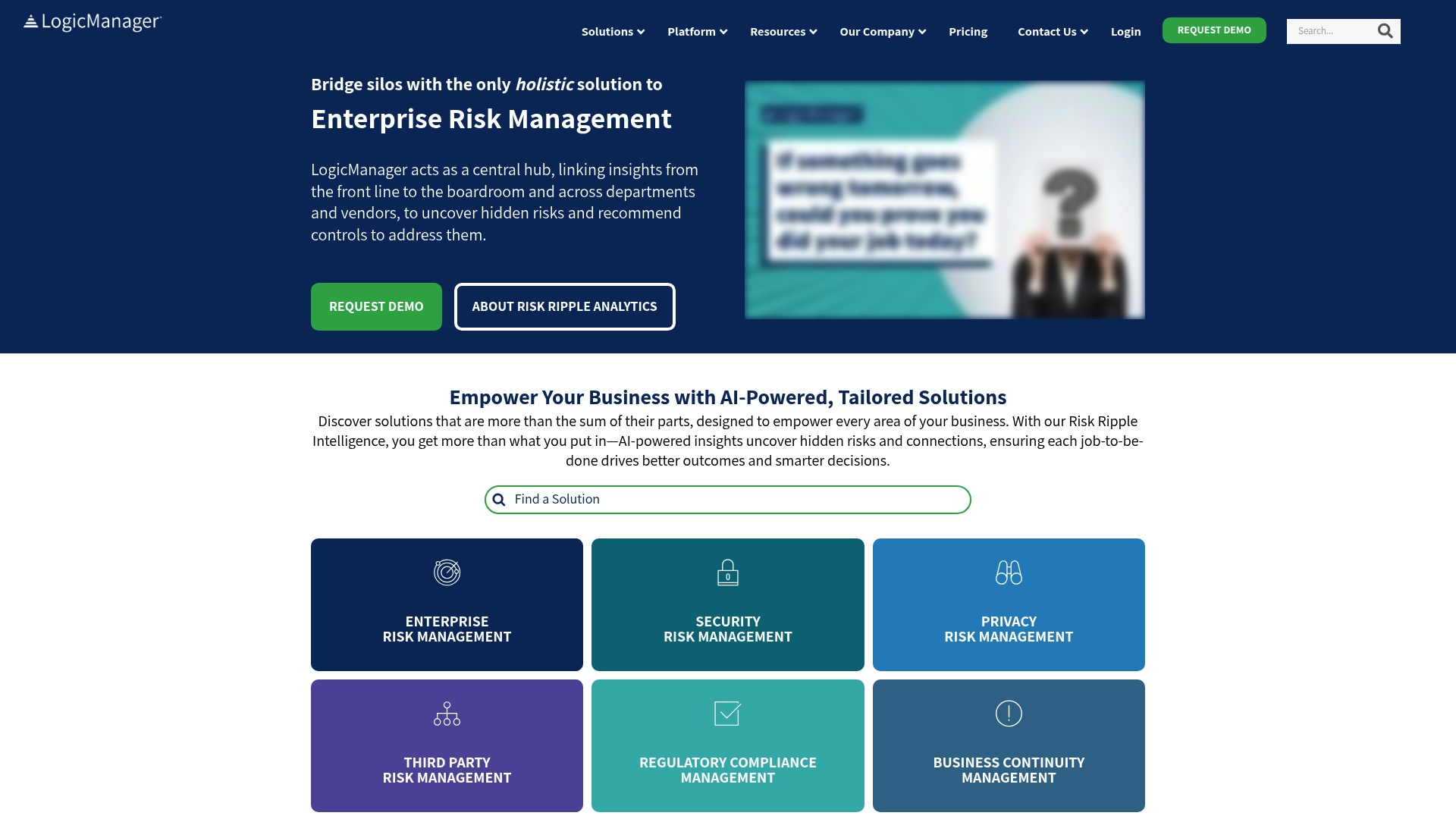
LogicManager delivers a scalable Enterprise Risk Management platform built for mid to large organizations that need centralized risk visibility and board grade reporting. The platform combines advisory support with a fixed-price model that includes onboarding and ongoing guidance.
LogicManager is strong where integration and governance matter, though the vendor requires custom quotes which adds a procurement step for executives.
Core Features
LogicManager focuses on linking risk data across teams to create a single source of truth and actionable insight. Key capabilities include:
- Holistic ERM platform that connects risk, compliance, audit, and third party inputs across departments.
- AI-powered Risk Ripple Analytics that uncovers hidden relationships and predicts downstream impacts of an event.
- Risk Maturity Model with out of the box board reports and benchmarking KPIs for governance reviews.
- No-code configuration that allows admins to adapt workflows without developer resources.
- Dedicated advisory services included in the price to accelerate implementation and adoption.
Pros
- Comprehensive, integrated solution: LogicManager centralizes multiple risk functions so leaders get unified risk reporting rather than fragmented spreadsheets.
- Strong support and advisory services: The platform includes professional guidance that accelerates onboarding and aligns configuration to governance needs.
- Flexible, no-code customization: Administrators can modify forms, workflows, and dashboards without code which reduces IT dependency.
- Fixed pricing with no hidden fees: The commercial model bundles services and unlimited licenses which simplifies budgeting for predictable spend.
- Scalable for different sizes: The platform supports expansion from single programs to enterprise wide risk management across business units.
Cons
- Pricing requires a custom quote and is not openly listed: Procurement teams must engage sales to understand total cost which lengthens vendor evaluation cycles.
- Learning curve for users new to ERM platforms: Teams unfamiliar with formal risk processes will need training to use advanced analytics and reporting effectively.
- Potential complexity in large implementations: Configuring integrated processes across many departments can demand sustained advisory engagement and governance oversight.
Who It's For
LogicManager suits Risk Officers, Compliance Leaders, Audit Chiefs, and executive teams at mid to large organizations that must centralize risk data and prove control effectiveness. It aligns with regulated industries that need board ready reports and predictable commercial terms.
Unique Value Proposition
LogicManager pairs a unified ERM architecture with included advisory services and a fixed-price commercial model. That combination reduces project friction and supports sustained adoption while delivering AI driven risk insight.
Real World Use Case
A financial institution uses LogicManager to consolidate risk registers, automate compliance reporting, and apply AI driven analytics to detect emerging threats. The setup shortens board reporting cycles and improves executive decision making based on connected risk signals.
Pricing
Pricing is tailored to each organization and based on scope and scale. LogicManager offers a fixed-price model that includes advisory services and unlimited licenses, with final terms provided via custom quote.
Website: https://www.logicmanager.com
Diligent Governance, Risk and Compliance (GRC) Platform
At a Glance
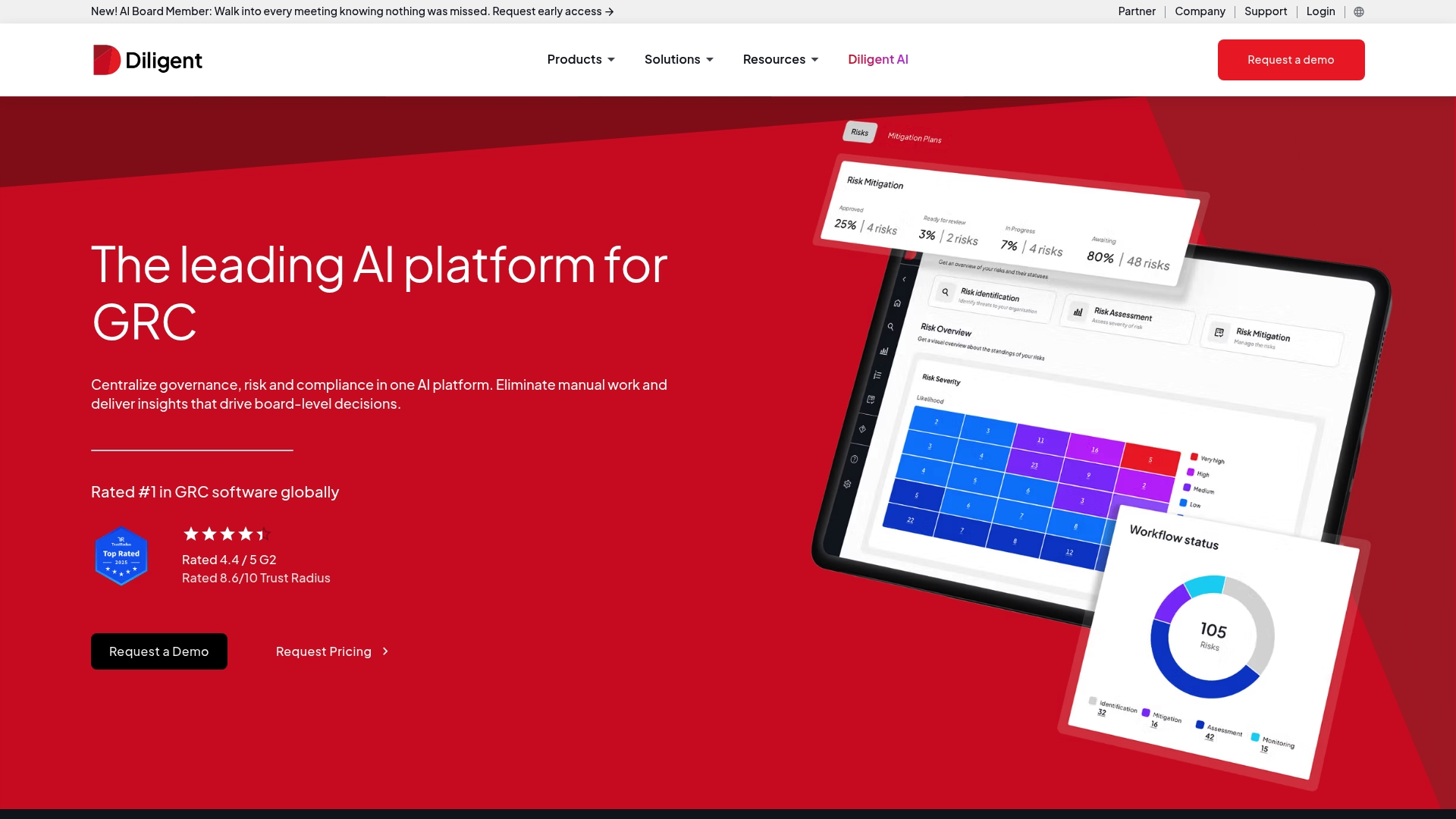
Diligent delivers an AI powered GRC platform that centralizes board and compliance workflows for large organizations. Its analytics reduce manual work and help executives make faster, evidence based decisions across risk, audit, and compliance.
Core Features
The platform unifies board management and GRC activities on a single system while adding AI enhanced decision tools for executives and boards. It supports risk assessment, compliance tracking, internal audit automation, and subsidiary oversight across global operations.
- AI driven governance, risk, and compliance management
- Integrated data rooms and policy management
- Third party risk monitoring and analytics
Pros
-
Industry recognition: The platform is widely adopted and trusted by over 25,000 organizations including 75% of Fortune 500 companies, which reinforces vendor stability.
-
Scalability: The architecture supports small teams through global enterprises so you can consolidate multiple business units on one platform without rebuilding processes.
-
Global reach: Support across 130 countries helps multinational firms manage regional regulations and centralize reporting for boards and regulators.
-
Advanced automation: AI enhanced workflows reduce repetitive tasks, lower manual error rates, and surface prioritized insights for executives and audit teams.
-
Support resources: A comprehensive resource library and professional services help accelerate deployments and train governance and compliance stakeholders.
Cons
-
Complexity may require training for new users, which increases time to value for teams without dedicated rollout resources.
-
Premium pricing might be a constraint for smaller organizations that need robust GRC but lack enterprise budgets.
-
Heavy reliance on digital infrastructure can create challenges in low connectivity regions where offline or lightweight modes are needed.
Who It's For
This platform fits large and midsize organizations that need integrated governance, risk, and compliance capabilities with AI assistance. Security leaders and C level executives in regulated industries will appreciate centralized reporting and board ready outputs.
Unique Value Proposition
Diligent stands out by combining GRC consolidation with board level tools and AI enhanced decision support, so executives get consolidated insight and operational teams get workflow automation. That combination reduces manual handoffs and improves oversight.
Real World Use Case
A global financial services firm uses Diligent to streamline board packets, automate internal audit workflows, and maintain a single source of truth for regulatory evidence. The result was faster board preparation and fewer manual reconciliations.
Pricing
Pricing details are available upon request and the vendor offers tiered solutions to match organizational size and complexity. Expect enterprise level licensing and implementation costs for full scale deployments.
Website: https://www.diligent.com
ProcessUnity
At a Glance
ProcessUnity offers a focused platform for automating third party risk management across onboarding, monitoring, and control validation. The platform emphasizes automation and industry scoring to help security leaders prioritize vendor risk with less manual effort.
Core Features
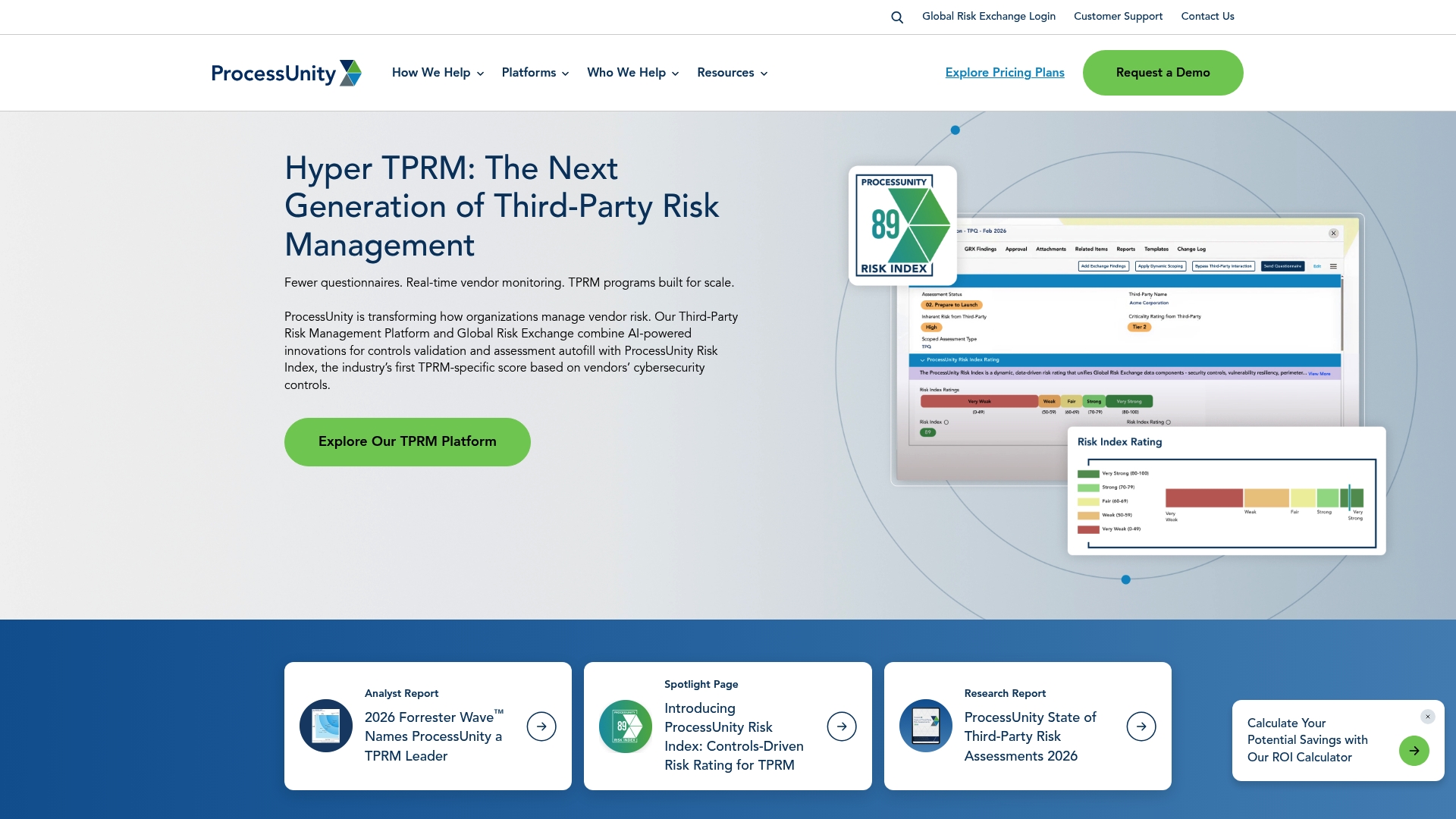
ProcessUnity centers on AI powered controls validation and assessment autofill to accelerate evidence collection and reduce review cycles. The platform includes the ProcessUnity Risk Index for vendor cybersecurity controls and a Global Risk Exchange with thousands of vendor profiles.
ProcessUnity supports end to end third party risk workflows from onboarding to offboarding and adds real time vendor monitoring and surveillance to detect changes in vendor posture.
Pros
- Comprehensive coverage: The platform combines risk assessment, vendor onboarding, and continuous monitoring in a single environment which simplifies program oversight.
- Recognized in industry: ProcessUnity has documented industry recognition including a Forrester Wave leader placement which supports vendor credibility for regulated organizations.
- Customizable for scale: The product adapts to varied organizational sizes and regulated industries which helps large enterprises with complex vendor ecosystems.
- Strong automation: Automation features reduce manual workload by autofilling assessments and validating controls which accelerates remediation timelines.
- Integrated scoring: The risk index provides prioritized, comparable vendor scores that simplify executive decision making and resource allocation.
Cons
- Specific user interface details, pricing, and customer support experiences are not disclosed on the public website which limits upfront procurement assessment.
- The platform complexity may require significant training and formal onboarding to reach expected outcomes for large teams and enterprise programs.
- Pricing details are not publicly listed and require direct inquiry which slows vendor evaluation and budgeting for procurement cycles.
Who It's For
This product suits large enterprises and regulated organizations that operate complex vendor ecosystems and need robust third party risk controls. Security leaders and compliance officers who must centralize vendor assessments and demonstrate audit ready evidence will find ProcessUnity relevant.
Unique Value Proposition
ProcessUnity combines AI driven automation with a large vendor exchange and a proprietary risk index to speed third party risk decisions. The combination of automated evidence collection and industry scoring reduces time to risk insights for executive stakeholders.
Real World Use Case
A large financial institution uses ProcessUnity to automate vendor onboarding, run continuous cybersecurity assessments, and validate vendor controls across thousands of suppliers. The platform replaces manual spreadsheets and consolidates alerts into actionable vendor risk scores for the security team.
Pricing
Pricing is not specified on the website and requires direct contact for a tailored quote which aligns with enterprise negotiation practices and customized deployment needs.
Website: https://www.processunity.com
Enterprise Risk Management Solutions Comparison
This table outlines and compares leading solutions for enterprise risk management, showcasing their features, unique value propositions, and more to assist in making an informed choice.
| Product | Core Features | Pros | Cons | Pricing |
|---|---|---|---|---|
| Heights Consulting Group | Cybersecurity advisory, regulatory compliance, managed services; strategic planning for business-aligned risk management. | Comprehensive services; Decades of industry experience; High compliance success; Senior-level guidance | Customization scope dependency; Pricing information unavailable | Customized per project scope and regulatory requirements |
| Riskonnect | Integrated risk management, claims and policy management, continuity resilience; AI-driven analytics and visualization tools. | Comprehensive tool suite; AI and automation; Industry-specific solutions | Implementation complexity; High initial cost for smaller businesses | Tailored to organization size and needs based on inquiry |
| Fusion Risk Management | Dependency tracking, scenario simulations, IT resilience; Integration-ready platform for unified visibility and incident response planning. | Real-time actionable insights; Proven reliability; Enterprise customization | Initial setup complexity; Unpublished pricing; Advanced organizational integration required | Customizable based on implementation scope |
| LogicManager | Risk and compliance data linking, AI risk analytics, maturity model; Offers fixed pricing and advisory inclusivity for onboarding and deployment. | No-code configuration; Strong advisory services; Predictable bundled pricing model | Custom pricing quote required; Formal risk process training necessary | Fixed-price model tailored to organizational scale available upon request |
| Diligent GRC | AI-enhanced governance, risk, compliance management tools integrated with board operations features for decision making. | Scalable and globally deployable; Strong automation; Widely trusted in enterprise | Premium pricing tier for smaller businesses; Complexity in user onboarding | Pricing inquiries directed to sales for enterprise-grade implementation |
| ProcessUnity | AI-powered vendor risk evaluation with automation and scoring; Continuous monitoring through global vendor exchange and assurance workflows. | Integrated assessment automation and evidence collection; Risk index for actionable insights | Interface complexity; Training investment for optimal performance | Pricing tailored per business needs and deployment scope, determined through direct consultation |
Bridge Your Risk Management Strategy with Expert Cybersecurity Guidance
Navigating the complex landscape of risk management platforms requires more than technology — it demands strategic alignment with your business goals and regulatory requirements. The article highlights challenges like integrating diverse risk data, automating workflows, and achieving compliance, all while reducing risk exposure and accelerating decision making at the executive level.
At Heights Consulting Group, we specialize in turning cybersecurity into a business advantage by delivering tailored advisory services and managed cybersecurity solutions designed for C-level executives and security leaders. Our expertise in regulatory compliance frameworks such as NIST, SOC 2, and CMMC ensures your risk management efforts are aligned and measurable. Discover how our strategic leadership and hands-on execution can transform fragmented risk programs into cohesive, business-driven operations. Explore our services today at Heights Consulting Group and take the first step toward a resilient cybersecurity posture.
Ready to simplify your path to compliance and risk reduction? Visit Heights Consulting Group and connect with experts who understand how to integrate risk management smoothly with your business objectives.
Frequently Asked Questions
What are the key features to look for in a risk management platform?
Key features to consider include integrated risk management modules, real-time visibility into risks, AI-powered analytics, and automation of compliance workflows. Evaluate the platform's ability to consolidate risk data across departments to improve communication and oversight.
How can I determine which risk management platform is best for my organization?
Assess your organization's specific needs, such as regulatory requirements and the scale of operations. Create a checklist of must-have features and prioritize them to compare how each platform aligns with your operational goals.
How do I customize a risk management platform to fit my organization's unique needs?
Most platforms offer no-code customization options that allow you to modify workflows and dashboards according to your requirements. Engage with the platform’s support or training resources to understand the best practices for tailoring the solution effectively.
What is the expected timeframe for implementing a risk management platform?
Implementation timelines can vary but generally range from a few weeks to several months, depending on the platform complexity and your organization's infrastructure. Plan for a phased approach, focusing on essential features first to achieve quicker wins within 30 to 60 days.
How can integrating AI into a risk management platform enhance its effectiveness?
Integrating AI can improve decision-making by automating data analysis and providing predictive insights into potential risks. Leverage these capabilities to streamline risk assessments and prioritize actions based on real-time data assessments.