

TL;DR:
- Predictive threat intelligence uses AI to forecast cyber attacks before indicators of compromise appear. It provides a lead time that allows organizations to act proactively and reduce damage. Success depends on integrating forecasts into automated response workflows supported by reliable data architecture.
Predictive threat intelligence is defined as a forward-looking cybersecurity capability that uses AI, machine learning, and behavioral analytics to forecast attack vectors before indicators of compromise appear. Industry frameworks categorize it as the third stage in security maturity, positioned after reactive and proactive defense, and directly preceding autonomous, preemptive response. The role of predictive threat intelligence is not simply to detect threats faster. It is to give security teams and executives the lead time to act before damage occurs. For organizations operating in regulated industries or complex IT environments, this distinction separates programs that absorb breaches from those that prevent them. Understanding how this capability works, what it delivers, and where it fails is the foundation of any mature cybersecurity program in 2026.
How predictive threat intelligence works
Predictive intelligence models draw from multiple data sources simultaneously: historical threat patterns, underground forums, domain registrations, and vulnerability disclosures. Each source contributes a different signal type. Historical patterns reveal attacker behavior cycles. Forum monitoring surfaces early planning activity. Domain registration data flags infrastructure being staged for phishing or command-and-control operations. Vulnerability disclosures expose the attack surface before exploitation begins.
AI and machine learning translate these raw signals into forecasts through several analytical techniques:
- Time series modeling identifies cyclical attack patterns tied to geopolitical events, patch cycles, or fiscal calendars.
- Natural language processing (NLP) extracts threat actor intent from unstructured text in forums, paste sites, and dark web channels.
- Reinforcement learning refines detection models based on feedback from confirmed threat events.
- Meta-learning allows models to generalize across threat actor groups, improving accuracy when data on a specific adversary is sparse.
- Behavioral analytics establishes baseline activity profiles and flags deviations that precede known attack sequences.
The Open Cybersecurity Schema Framework (OCSF) provides a data normalization standard that allows telemetry from disparate sources to be compared and analyzed consistently. Without normalization, models produce conflicting outputs and excessive false positives.
Pro Tip: Treat data hygiene as a prerequisite, not an afterthought. Predictive models trained on inconsistent or incomplete telemetry generate alert volumes that overwhelm SOC teams and erode analyst trust in the system.

What are the benefits of predictive threat intelligence?
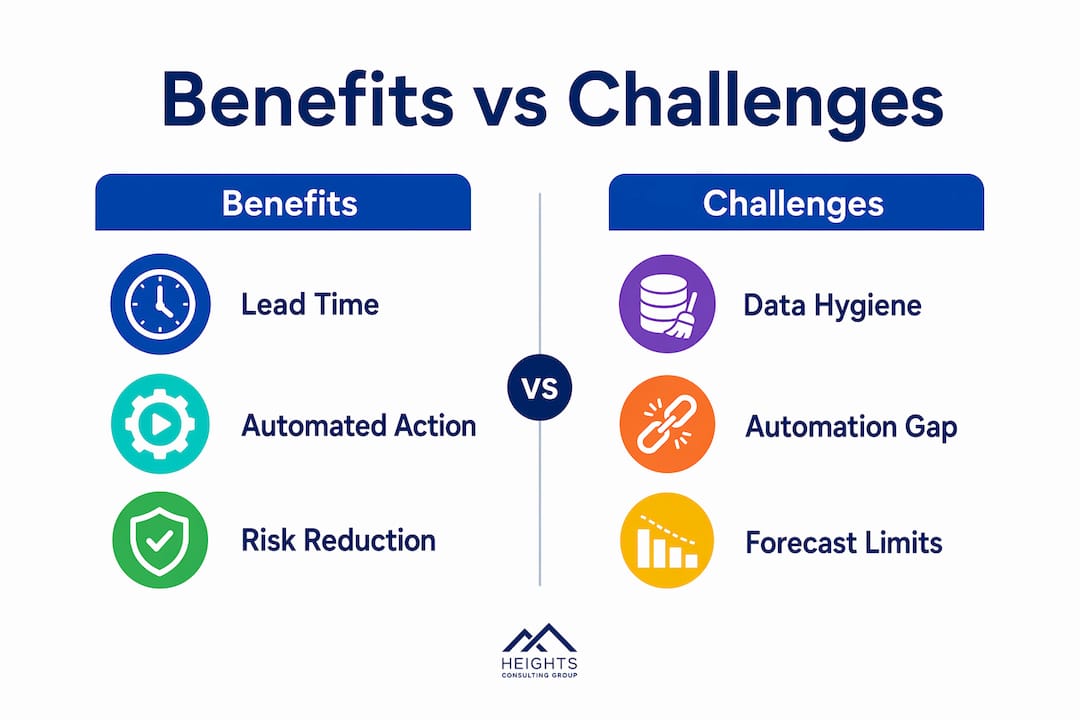
The most direct benefit is lead time. Anticipatory defense models shift security teams from chasing alerts to positioning resources ahead of likely attack sequences. That shift has measurable consequences for dwell time, the period between initial compromise and detection. Shorter dwell time means less data exfiltrated, fewer systems affected, and lower recovery costs.
The operational benefits extend well beyond the SOC:
- Improved decision velocity. Security leaders receive prioritized risk signals rather than undifferentiated alert streams. This allows faster, more confident decisions about where to deploy resources.
- High-probability risk prioritization. AI-powered models rank threats by likelihood and potential impact, directing analyst attention to the risks that matter most rather than the most recent ones.
- Reduced analyst fatigue. Filtering signal from noise before it reaches analysts preserves capacity for the investigations that require human judgment.
- Enterprise-wide risk alignment. The predictive intelligence stage informs budget shaping, scenario-based planning, and cross-department collaboration, extending its value beyond technical security functions.
- Strategic planning support. Executives gain visibility into emerging threat categories months before they become active incidents, enabling proactive investment decisions.
"Predictive threat intelligence is strategic, influencing enterprise risk management and executive decision-making beyond SOC operations. When security intelligence informs the boardroom, organizations stop treating cybersecurity as a cost center and start treating it as a risk management function."
Measuring the value of predictive intelligence requires a different metric than classical detection accuracy. Lead-time metrics measure how far in advance a threat is flagged relative to when it materializes. That timing gap defines the operational window for preemptive action. An intelligence program that flags a threat 72 hours before exploitation begins delivers fundamentally different value than one that flags it 30 minutes after the first alert fires.
For security leaders building the case for investment, the AI-driven risk management conversation at the board level is where predictive intelligence programs gain or lose executive sponsorship.
What are the challenges in adopting predictive threat intelligence?
The most consequential misconception about predictive threat intelligence is that forecasting an attack prevents it. It does not. Predictive intelligence alone does not block attacks. The forecast must connect to an automated defense workflow that acts on the signal. Without that connection, the intelligence sits in a report while the attack proceeds.
This gap between prediction and prevention is known as the predictive gap. Organizations that invest in forecasting capabilities without building the automation pipelines to act on them end up with sophisticated analysis and reactive outcomes. The intelligence is non-operational until it triggers a preemptive response.
Common challenges organizations encounter include:
- Over-reliance on third-party data. Many programs aggregate external threat feeds and treat that as sufficient. First-party data, including internal vulnerability research and observed attacker behavior in your own environment, significantly improves prediction accuracy. External feeds describe the threat landscape broadly. Internal data describes your specific exposure.
- Poor signal-to-noise ratio. Predictive models that ingest unfiltered telemetry generate false positive volumes that degrade analyst confidence and slow response times.
- Data architecture gaps. Organizations without a mature data normalization layer cannot reliably compare signals across sources, which limits model accuracy and increases alert fatigue.
- Automation deficits. Security teams that lack orchestration capabilities cannot act on predictive signals at the speed required to close the predictive gap.
- Misaligned success metrics. Programs evaluated on detection accuracy rather than lead time optimize for the wrong outcome and undervalue their most important capability.
Pro Tip: Build your data architecture before you build your models. A mature normalization layer, aligned to standards like OCSF, is the foundation that determines whether your predictive program generates signal or noise.
How can organizations operationalize predictive threat intelligence?
Operationalizing predictive intelligence means connecting forecasts to actions. The integration of AI outputs into automated workflows is what separates programs that forecast threats from programs that prevent them. The following steps describe a practical path from intelligence to preemptive defense.
- Map predictive signals to detection workflows. Identify which threat categories your models forecast with the highest confidence. Align those categories to existing detection rules and adjust sensitivity thresholds based on current risk levels.
- Automate preemptive actions. Configure security orchestration tools to execute defined responses when predictive thresholds are crossed. Examples include firewall rule updates, network segmentation triggers, and hunting queries targeting early-stage indicators.
- Build scenario-based playbooks. Use predictive analysis to develop playbooks for the threat scenarios most likely to affect your environment. Playbooks informed by predictive scenario planning reduce response time and decision fatigue during active incidents.
- Integrate external attack surface management. Combine predictive intelligence with continuous monitoring of your external attack surface. This pairing identifies exposed assets that align with forecasted attack vectors before adversaries do.
- Establish cross-department collaboration. Legal, procurement, and communications teams need advance notice of credible threats that affect their functions. Predictive intelligence programs that operate in isolation miss the organizational impact of the threats they forecast.
The following table maps predictive intelligence outputs to the automated actions they should trigger:
| Intelligence signal | Automated action |
|---|---|
| Threat actor infrastructure staging | Firewall rule pre-block for flagged IP ranges |
| Vulnerability disclosure matching your stack | Detection sensitivity increase for related attack patterns |
| Dark web chatter targeting your sector | Elevated monitoring on privileged accounts |
| Domain registration mimicking your brand | DNS block and phishing alert to communications team |
| Behavioral anomaly in privileged accounts | Automated session review and SOC escalation |
Security teams that combine this workflow with threat hunting capabilities gain an additional layer of validation. Hunters can pursue early indicators surfaced by predictive models before those indicators mature into confirmed incidents. That combination closes the predictive gap more reliably than automation alone.
Key Takeaways
Predictive threat intelligence delivers its full value only when forecasts connect directly to automated preemptive actions, supported by clean data architecture and cross-functional organizational alignment.
| Point | Details |
|---|---|
| Forecasting requires automation | Predictive intelligence without automated response workflows does not prevent attacks. |
| Lead time is the right metric | Measure how far in advance threats are flagged, not just detection accuracy. |
| First-party data improves accuracy | Internal vulnerability data and observed attacker behavior outperform third-party feeds alone. |
| Data architecture is foundational | Normalizing telemetry with standards like OCSF reduces false positives and improves model reliability. |
| Intelligence extends beyond the SOC | Predictive programs inform executive decisions, budget planning, and cross-department risk management. |
Why the mindset shift matters more than the technology
From my experience working with security programs at various maturity levels, the technology is rarely the limiting factor. The organizations that struggle most with predictive intelligence are not the ones with inadequate tools. They are the ones where security still operates as a technical function disconnected from business risk decisions.
The shift from reactive to predictive requires executive sponsorship that goes beyond budget approval. It requires leadership that understands why a threat forecast from three months ago should influence procurement decisions today. Without that understanding, predictive programs get funded as technology projects and measured as detection tools. They underperform on both counts.
I have also seen organizations invest heavily in predictive models before their data architecture was ready. The result is a sophisticated forecasting system generating alerts that analysts do not trust, because the underlying telemetry is inconsistent. The lesson is straightforward: data readiness precedes model deployment, not the other way around.
The trajectory toward autonomous, intelligence-led security operations is real. But the organizations that will get there are the ones building the data foundations, automation pipelines, and executive alignment today. The technology will continue to advance. The organizational readiness is the variable that determines who benefits from it.
— Dan
Heightscg helps organizations move from forecast to defense
Predictive threat intelligence programs require more than technology deployment. They require a clear maturity assessment, a data architecture that supports reliable forecasting, and automation workflows that translate intelligence into preemptive action.
Heightscg works with security leaders and executives to assess program maturity, design AI-driven detection and response architectures, and build the operational workflows that close the predictive gap. The firm's managed cybersecurity services provide 24/7 continuous threat detection and response, giving organizations the operational coverage to act on predictive signals at any hour. For organizations ready to move from reactive posture to anticipatory defense, contact Heightscg to discuss a tailored program assessment.
FAQ
What is predictive threat intelligence?
Predictive threat intelligence is a cybersecurity capability that uses AI and behavioral analytics to forecast attack vectors before indicators of compromise appear. It represents the third stage in security maturity, positioned between proactive defense and autonomous preemptive response.
How does predictive threat intelligence differ from traditional threat intelligence?
Traditional threat intelligence describes threats that have already been observed. Predictive intelligence forecasts threats before they materialize, giving security teams lead time to act rather than respond.
What data sources does predictive threat intelligence use?
Predictive models draw from historical threat patterns, underground forums, domain registrations, vulnerability disclosures, and internal telemetry. First-party data from your own environment significantly improves forecast accuracy over external feeds alone.
Why is lead time a more useful metric than detection accuracy?
Lead time measures how far in advance a threat is flagged before it materializes. That timing gap defines the operational window for preemptive action, which is the primary value predictive intelligence delivers over reactive detection.
What is the predictive gap and how do organizations close it?
The predictive gap is the failure to connect forecasts to automated defense actions. Organizations close it by integrating predictive intelligence outputs into security orchestration workflows that trigger preemptive responses without requiring manual review for every signal.