

TL;DR:
- Effective governance in digital risk management establishes accountability, policies, and oversight to align security efforts with business goals. It includes defining roles, managing supply chain risk, and integrating risk assessments to support timely decision-making. Strong governance enhances organizational resilience and builds trust with investors, regulators, and customers.
Governance in digital risk management is defined as the structured system of accountability, policies, and oversight that enables organizations to identify, assess, and respond to digital threats in alignment with business objectives. The NIST CSF 2.0 GOVERN function establishes this as the strategic cornerstone of any cybersecurity program, integrating roles, responsibilities, and risk strategy into enterprise operations. Without governance, digital risk efforts fragment into disconnected technical controls with no clear ownership or business context. As AI adoption accelerates and regulatory expectations tighten, the role of governance in digital risk has shifted from a compliance requirement to a core business discipline that determines organizational resilience.
What are the essential components of a governance framework for digital risk?
A governance framework for digital risk defines who owns risk decisions, what policies guide behavior, and how oversight is exercised across the organization. The NIST CSF 2.0 GOVERN categories provide the clearest structure available, covering organizational context, risk management strategy, roles and responsibilities, policies, oversight, and supply chain risk. Each component is interdependent. A policy without an assigned owner is unenforceable. An oversight committee without authority is theater.
The structural elements that define an effective governance framework include:
- Organizational context: A documented understanding of the business environment, regulatory obligations, and risk appetite that shapes every downstream decision.
- Defined roles and authorities: Clear assignment of who owns digital risk at the board, executive, and operational levels, including a designated risk owner for each critical asset or process.
- Policies and standards: Written expectations that govern cybersecurity activities, access controls, incident response, and acceptable use, reviewed at least annually.
- Oversight mechanisms: Board and executive committees with the authority to approve risk treatment decisions, not just receive reports.
- Supply chain risk governance: Formal processes for assessing third-party digital risk, including vendor due diligence and contractual security requirements.
Pro Tip: Map each governance component to a named executive owner before your next board meeting. Gaps in ownership become visible immediately, and that visibility is the first step toward closing them.
The supply chain dimension deserves particular attention. Most organizations govern their internal digital environment with reasonable discipline but treat third-party risk as a procurement issue. That gap is where breaches originate. Governance frameworks that extend oversight to vendors, cloud providers, and software dependencies close the most common attack surface that internal controls miss.

How do risk assessment strategies integrate with governance to manage digital risks?
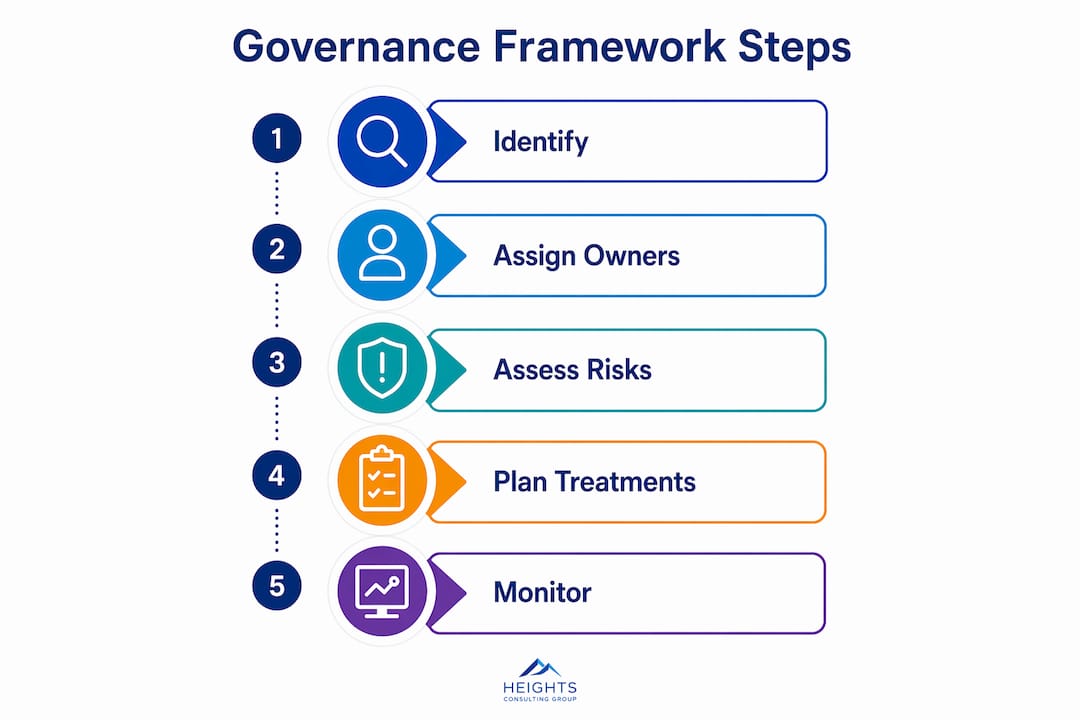
Risk assessment is the mechanism that feeds governance with the information it needs to make decisions. Without a structured assessment process, governance bodies operate on assumptions rather than evidence. Industry-standard risk assessments in 2026 follow a five-step lifecycle with comprehensive annual reviews and quarterly updates. That cadence reflects the pace at which digital threats evolve, particularly as AI-generated attacks compress the window between vulnerability disclosure and exploitation.
The five-step risk assessment lifecycle that governance programs depend on:
- Identification: Catalog all digital assets, data flows, and dependencies, including AI systems and cloud services that may not appear in legacy asset inventories.
- Analysis: Evaluate the likelihood and potential impact of threats against each identified asset, using threat intelligence to ground assumptions in current attack patterns.
- Evaluation: Prioritize risks against the organization's documented risk appetite, separating risks that require immediate treatment from those that can be monitored.
- Treatment: Assign a risk owner and a treatment decision, whether mitigation, transfer, acceptance, or avoidance, with a defined timeline and success metric.
- Monitoring: Track residual risk continuously and trigger reassessment when material changes occur, such as a new AI deployment, a regulatory update, or a significant incident.
Pro Tip: Assign a named risk owner at step four, not after. Ownership assigned during treatment planning produces faster decisions and clearer accountability than ownership assigned after the fact.
Scenario-based semi-quantitative assessments produce better capital allocation decisions than simple five-by-five risk matrices. That matters because boards approve budgets based on risk reports. A heat map with red, amber, and green cells does not give a CFO the information needed to justify a $2 million security investment. A scenario that models the financial impact of a ransomware event on a specific business unit does. Governance programs that connect cyber risk assessment outputs to board-level financial reporting earn executive engagement that compliance-only programs never achieve.
What best practices should organizations adopt in governance to address emerging digital risks like AI and quantum computing?
The governance practices that worked in 2020 are insufficient for 2026. AI systems introduce risks that traditional governance frameworks were not designed to handle, including model drift, adversarial manipulation, and regulatory exposure from automated decision-making. Quantum computing threatens current encryption standards on a timeline that is no longer theoretical. Boards must increase digital risk oversight including AI governance frameworks that balance innovation with regulatory compliance as AI regulations expand globally. That is a structural challenge, not a training problem.
The best practices that address these emerging risks are:
- Align digital investments with business KPIs. IT governance best practices require that every major digital initiative, including AI deployments, maps to a measurable business outcome. Governance bodies that approve investments without defined success metrics cannot evaluate whether risk is being managed or simply transferred.
- Build board-level technical acumen. Directors who cannot distinguish between a large language model and a rules-based algorithm cannot govern AI risk. Organizations should recruit directors with technology backgrounds or invest in structured board education programs covering AI, quantum, and cloud risk.
- Grant executive sponsors binding authority. Governance programs succeed when executive sponsorship carries real decision-making power. Advisory-only governance councils produce recommendations that sit in inboxes. Councils with binding authority produce decisions that change behavior.
- Adopt a federated governance model. Federated governance assigns domain experts to manage risk locally within a centrally coordinated framework. A business unit deploying an AI tool owns the risk of that deployment. The central governance function sets the standards and monitors compliance. This model scales without creating bottlenecks.
- Embed governance checkpoints in IT delivery. Digital assurance within IT delivery workflows creates enforcement nodes at the points where risk is actually introduced. A security review gate in the software development lifecycle catches AI model vulnerabilities before deployment, not after an incident.
The AI governance gap is the most pressing issue for organizations in regulated industries. Financial services firms deploying AI for credit decisions, healthcare organizations using AI for diagnostics, and defense contractors using AI for logistics all face regulatory frameworks that are evolving faster than their internal governance structures. Organizations that build IT governance alignment now will be positioned to meet those requirements. Those that wait will face retroactive compliance costs that dwarf the investment in proactive governance.
How does governance enhance organizational resilience and business value in managing digital risk?
Governance converts digital risk management from a cost center into a source of competitive advantage. The mechanism is transparency. Good corporate governance builds transparency and accountability that protects investor capital and supports corporate sustainability. That OECD principle applies directly to digital risk. Organizations that can demonstrate to investors, regulators, and customers that they govern digital risk with discipline command greater trust than those that cannot.
"Good governance integrates environmental, social, and digital factors into core strategy, reinforcing transparency and accountability for economic resilience. Organizations that treat digital risk governance as a strategic function, not an IT obligation, build the institutional credibility that sustains long-term business value." — OECD Corporate Governance Guidance
Regulatory compliance is a direct output of mature governance. Organizations with defined roles, documented policies, and active oversight committees can demonstrate compliance with frameworks like NIST CSF 2.0, SOC 2, CMMC, and HIPAA more efficiently than those without. That efficiency reduces audit costs and accelerates the path to certification. More importantly, it reduces the probability of a regulatory finding that triggers reputational damage. A single public enforcement action can erase years of brand equity.
Governance also improves the quality of risk-informed investment decisions. When a CISO presents a risk treatment recommendation to a board that understands the governance framework, the conversation shifts from "how much does this cost?" to "what risk does this address and what is the residual exposure?" That shift produces better capital allocation. Organizations that embed governance in cybersecurity report faster incident response, clearer accountability during crises, and stronger post-incident recovery. Those outcomes are measurable and directly tied to business continuity.
Key Takeaways
Effective governance is the structural foundation that converts digital risk management from reactive technical work into a board-level business discipline with measurable outcomes.
| Point | Details |
|---|---|
| Governance defines accountability | Assign named owners for every digital risk domain before your next board cycle. |
| NIST CSF 2.0 GOVERN provides structure | Use the GOVERN function categories to audit gaps in roles, policies, and oversight. |
| Risk assessments must feed governance | Annual reviews and quarterly updates give governance bodies the evidence needed for sound decisions. |
| AI and quantum require new practices | Boards need technical acumen and binding authority to govern emerging digital risks effectively. |
| Transparency drives business value | Organizations that demonstrate governance discipline earn investor trust and reduce regulatory exposure. |
Why governance is the decision most executives delay and cannot afford to
The pattern I see most often is this: an organization invests heavily in technical security controls, deploys endpoint detection, runs penetration tests, and builds a SOC, then discovers during an incident that no one has clear authority to make the call that stops the bleeding. The technical capability exists. The governance structure does not.
Governance is not the part of digital risk management that feels urgent until it fails. That is precisely why it gets delayed. Executives prioritize the visible threats, the ransomware headlines, the phishing campaigns, and the vendor audits, while the structural question of who owns what decision goes unanswered. When a crisis arrives, that unanswered question becomes the most expensive problem in the room.
The shift I have seen work is treating governance as an operating model decision, not a compliance project. Organizations that assign real authority to their governance councils, federate risk ownership to domain experts, and embed assurance checkpoints in their delivery workflows do not just manage risk better. They make faster decisions under pressure. That speed is the practical value of governance that rarely appears in framework documentation but shows up clearly in incident timelines.
AI has made this more urgent, not less. Every AI system an organization deploys without a defined owner, a documented risk assessment, and a governance checkpoint is a liability that grows with every model update. The organizations that will navigate AI regulation successfully are the ones building governance structures now, before the regulatory requirements crystallize into enforcement actions.
— Dan
How Heightscg helps organizations build governance that holds
Heightscg works with C-suite leaders and governance professionals to build cybersecurity governance frameworks that connect directly to business objectives and regulatory requirements. The work goes beyond policy documentation. Heightscg embeds governance structures into existing enterprise risk management programs, assigns clear ownership models, and aligns oversight mechanisms with board reporting cycles.
For organizations facing AI risk exposure, supply chain vulnerabilities, or compliance gaps under NIST CSF 2.0, CMMC, or SOC 2, Heightscg provides technical cybersecurity consulting that translates governance frameworks into operational controls. The firm's strategic cybersecurity services cover governance design, risk assessment program development, and incident response advisory, giving executives a single partner for the full governance lifecycle. Organizations ready to close governance gaps can connect with Heightscg to begin a structured assessment.
FAQ
What is the role of governance in digital risk?
Governance in digital risk assigns accountability, sets policies, and provides oversight so organizations can manage digital threats in alignment with business objectives. The NIST CSF 2.0 GOVERN function defines this as the strategic foundation of any cybersecurity program.
How does a governance framework reduce cyber risk?
A governance framework reduces cyber risk by defining who owns each risk decision, establishing policies that guide behavior, and creating oversight mechanisms that catch gaps before they become incidents. Organizations with mature governance frameworks demonstrate compliance more efficiently and respond to incidents faster.
What are the best practices for governance in 2026?
The most effective governance practices in 2026 include granting executive sponsors binding decision-making authority, adopting a federated model where domain experts own local risk, embedding assurance checkpoints in IT delivery workflows, and building board-level competency in AI and quantum risk.
How should organizations govern AI risk?
Organizations should treat every AI deployment as a governed asset with a named owner, a documented risk assessment, and a defined oversight process. Boards need technical acumen to evaluate AI risk, and governance councils need binding authority to enforce AI policies before regulatory requirements force the issue.
How does governance connect to organizational resilience?
Governance builds resilience by creating the accountability structures and decision-making clarity that organizations need during a crisis. OECD guidance confirms that transparency and accountability, the direct outputs of good governance, protect investor capital and support long-term business sustainability.