

TL;DR:
- Cybersecurity metrics transform technical data into business-relevant insights to support risk management and decision-making. They should be owned, thresholded, aligned with frameworks like NIST CSF 2.0, and integrated into continuous monitoring processes. Most programs fail due to a governance gap, not data scarcity, emphasizing the need for accountability, clear escalation, and AI-related indicator development.
Cybersecurity metrics are defined as quantifiable measures that assess an organization's security posture, threat exposure, and operational effectiveness across technical and business dimensions. The role of cybersecurity metrics extends well beyond IT dashboards. For C-level executives and security leaders, these indicators translate raw security data into the business language boards use to make investment, risk, and governance decisions. Key performance indicators such as Mean Time to Detect (MTTD), Mean Time to Respond (MTTR), patch compliance rates, and Recovery Time Objectives (RTO) form the foundation of any mature measurement program. Frameworks like NIST CSF 2.0 and continuous monitoring programs defined under NIST SP 800-137 provide the governance structure that gives these numbers meaning. AI-powered security platforms are now accelerating data collection and anomaly detection, but they also introduce new complexity into what organizations choose to measure and how they interpret results.
What are the key categories of cybersecurity metrics for executives?
Cybersecurity performance indicators fall into three distinct categories: strategic, operational, and business resilience. Each serves a different audience and decision-making purpose, and conflating them is one of the most common mistakes security programs make.
Strategic metrics give boards and executive committees a view of overall risk posture relative to industry benchmarks and enterprise risk appetite. These include cybersecurity maturity scores mapped against NIST CSF 2.0 tiers, percentage of critical assets covered by active monitoring, and third-party risk exposure ratings. The NACD's 2026 board-level toolkit confirms that boards use these metrics primarily for fiduciary evaluation, requiring management to align security data with enterprise risk categories rather than technical outputs. This means a CISO presenting to the board must reframe patch compliance not as a technical percentage, but as a measure of exposure reduction across revenue-generating systems.
Operational metrics track the efficiency and effectiveness of the security team's day-to-day functions. MTTD measures how quickly a threat is identified after it enters the environment. MTTR measures how quickly it is contained and remediated. Patch latency tracks the gap between a vulnerability's disclosure and its remediation. Cyber-resilience metrics should link these technical KPIs directly to impacted business processes and recovery effectiveness, not treat them as standalone scorekeeping.
Business resilience metrics connect security performance to continuity outcomes. RTO defines how quickly a system must be restored after an incident. RPO defines how much data loss is acceptable. When a ransomware event hits a manufacturing firm's operational technology environment, the board does not want to know how many alerts were generated. They want to know whether the organization recovered within its defined RTO and what the disruption cost in revenue and regulatory exposure.
- MTTD and MTTR: core detection and response efficiency indicators
- Patch compliance rate: measures vulnerability remediation velocity across asset classes
- RTO and RPO: define acceptable recovery thresholds for business continuity planning
- Asset coverage rate: percentage of critical systems under active monitoring
- Third-party risk score: quantified exposure from vendor and supply chain relationships
- AI-assisted detection rate: proportion of threats identified through automated behavioral analysis
Pro Tip: When selecting metrics for board reporting, map each indicator to a named business process or revenue stream. A metric without a business owner and a business consequence will not drive decisions.
What are common pitfalls in cybersecurity metrics programs?
Most metrics programs fail not because organizations lack data, but because they measure the wrong things or measure the right things without accountability. Understanding these failure modes is as important as knowing which metrics to track.
-
Vanity metrics create false confidence. A 98% patch compliance rate looks strong until you discover the 2% gap covers your externally facing web servers. Dashboards showing MTTR or patch compliance without accountability for specific asset classes or risk tiers mask the exact vulnerabilities attackers exploit.
-
Activity metrics replace outcome metrics. Counting the number of phishing simulations run or vulnerability scans completed measures activity, not security improvement. Outcome metrics ask whether the phishing click rate declined over two quarters or whether critical vulnerabilities were remediated within the defined SLA window.
-
No metric ownership means no improvement. When a metric has no assigned owner, stagnation is guaranteed. MTTR that has not improved in six months is not a data problem. It is an accountability problem. Metrics without clear ownership fail to improve security posture regardless of how well they are visualized.
-
Dashboards without escalation paths are decoration. A security operations center that monitors 40 KPIs but has no defined threshold for escalating a degraded metric to the CISO or board is running a reporting theater, not a risk management program.
-
AI-generated metrics introduce data overload. AI-powered platforms like Microsoft Sentinel and CrowdStrike Falcon generate enormous volumes of behavioral signals and risk scores. Without a defined process for translating those outputs into prioritized, decision-ready metrics, security teams drown in data while executives remain uninformed.
The most dangerous metric is the one that looks healthy while the underlying risk grows. Boards and CISOs must demand trend data, named owners, and defined escalation thresholds for every metric on their dashboard.
How to implement an effective cybersecurity metrics program
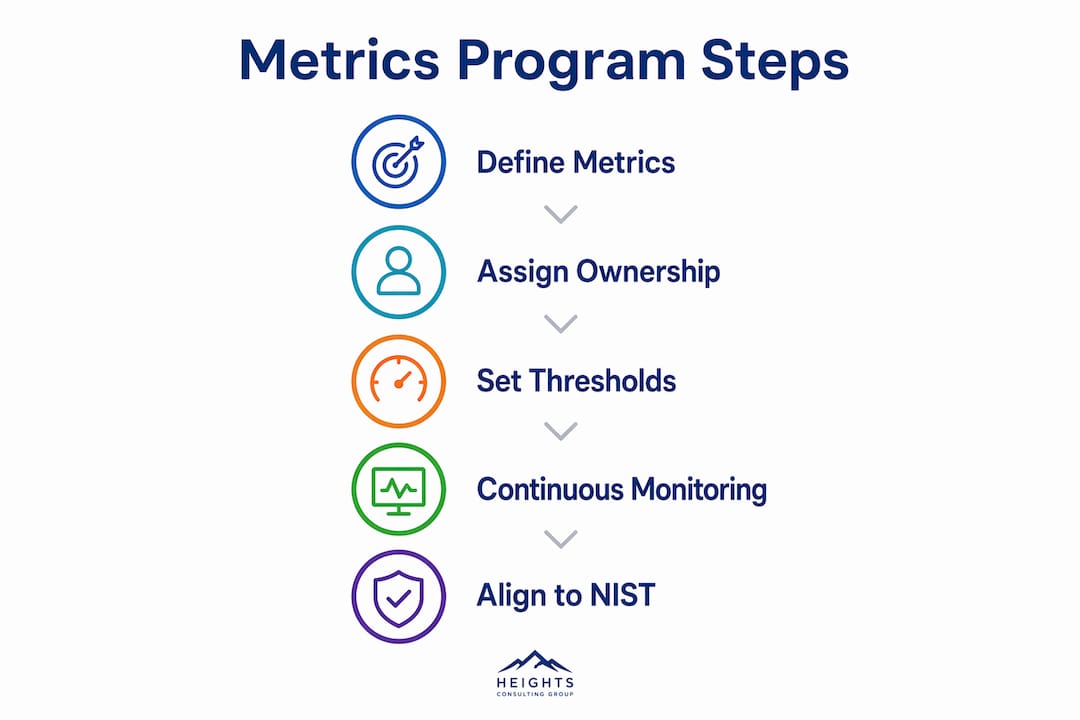
A mature metrics program is a measurement-to-decision pipeline, not a reporting exercise. Effective program design requires defined monitoring cadence, escalation governance, and alignment to enterprise risk frameworks to prevent static dashboards and drive continuous improvement.

Align metrics to NIST CSF 2.0 governance functions
NIST CSF 2.0 links cybersecurity measurements to enterprise risk management and workforce planning, providing a structured basis for selecting and communicating metrics at senior leadership levels. Each of the six functions, Govern, Identify, Protect, Detect, Respond, and Recover, maps to specific measurable outcomes. Organizations that anchor their KPI selection to CSF 2.0 tiers can benchmark their maturity against defined profiles and communicate progress in terms boards recognize.
Build a continuous monitoring cadence
Information Security Continuous Monitoring programs, as defined under NIST SP 800-137, treat metrics as ongoing inputs for risk-based decisions rather than periodic snapshots. This means defining which metrics are reviewed daily by the SOC, which are reviewed weekly by the CISO, and which are presented monthly or quarterly to the board. Federal frameworks treat these metrics as inputs enabling authorizing officials to make risk-based decisions, not as standalone scorekeeping tools.
Assign ownership and set thresholds
Every metric must have a named owner, a target value, and a defined threshold that triggers escalation. MTTR for critical incidents might have a 4-hour target with a 24-hour escalation threshold. Patch latency for internet-facing systems might have a 72-hour SLA with automatic board notification if the backlog exceeds 15 unpatched critical vulnerabilities. Without these parameters, metrics generate reports but not decisions.
| Metric | Owner | Target | Escalation Threshold |
|---|---|---|---|
| MTTD (critical threats) | SOC Manager | Under 1 hour | Over 4 hours triggers CISO review |
| MTTR (critical incidents) | Incident Response Lead | Under 4 hours | Over 24 hours triggers board notification |
| Patch latency (critical CVEs) | Vulnerability Management Lead | 72 hours | Over 10 unpatched critical CVEs triggers executive review |
| Asset monitoring coverage | Security Architecture Lead | 98% of critical assets | Below 95% triggers remediation sprint |
| Third-party risk score | Vendor Risk Manager | No high-risk vendors unmitigated | Any critical vendor gap triggers contract review |
Pro Tip: Integrate your metrics program with your cyber risk management process so that threshold breaches automatically feed into risk register updates. This closes the loop between measurement and governance.
How do metrics empower executives to drive organizational resilience?
The strategic value of measuring cybersecurity effectiveness is realized when metrics inform resource allocation, justify investment, and connect security performance to business continuity outcomes. This is where the role of security metrics shifts from operational reporting to executive decision support.
Board-level reporting requires translating technical indicators into business language. A CISO who presents raw MTTD data to the board is providing information. A CISO who presents MTTD alongside the average cost of a breach at each detection stage is providing the basis for an investment decision. Boards require concise summaries with absolute trend data, named metric owners, and actionable gaps to enable informed cybersecurity investment and oversight.
- Justifying security investment: Metrics that show a 40% reduction in MTTR following an endpoint detection and response deployment give CFOs a concrete return on security spending.
- Workforce and resource planning: Coverage metrics that reveal monitoring gaps in cloud workloads or OT environments identify where additional staffing or tooling is needed before an incident occurs.
- Incident lifecycle tracking: Tracking the full lifecycle from detection through containment, eradication, and recovery against defined RTO and RPO targets builds the evidence base for cyber resilience claims.
- Adapting to AI-driven risk: As organizations deploy AI systems across business functions, new metrics are needed to track AI model access controls, data exposure through generative AI tools, and the accuracy of AI-assisted threat detection. Organizations without these indicators are operating blind to an expanding attack surface.
Consider a financial services firm that deployed a vCISO-led metrics program aligned to NIST CSF 2.0. Within two quarters, the firm reduced its average MTTD from 18 hours to under 3 hours by tracking detection coverage gaps across hybrid cloud environments. That single metric improvement, tied directly to a named business process and a board-approved risk threshold, justified a $2 million investment in extended detection and response capabilities. The connection between executive strategy and resilience is not theoretical. It is measurable.
Key takeaways
Cybersecurity metrics deliver their full value only when they are owned, thresholded, aligned to business risk, and integrated into a governance process that drives decisions rather than generates reports.
| Point | Details |
|---|---|
| Define metrics by category | Separate strategic, operational, and resilience metrics to serve the right audience with the right data. |
| Assign ownership and thresholds | Every metric needs a named owner, a target, and an escalation threshold to drive accountability. |
| Align to NIST CSF 2.0 | Use the framework's six functions to anchor metric selection to enterprise risk management and governance. |
| Translate for the board | Convert technical KPIs into business impact language, linking detection and recovery times to cost and continuity. |
| Account for AI-driven risk | Add metrics tracking AI system access, data exposure, and automated detection accuracy as AI adoption grows. |
Why most metrics programs still miss the mark
After working with organizations across regulated industries, the pattern I see most consistently is not a lack of data. It is a lack of consequence. Security teams produce dashboards that no one acts on, and boards receive reports that contain numbers without context or ownership. The metrics exist, but the governance infrastructure around them does not.
The shift I have watched accelerate in 2026 is the pressure AI adoption is placing on existing measurement frameworks. Organizations are deploying generative AI tools across finance, legal, and operations without adding a single new metric to track the security implications. That is not a technology gap. It is a governance gap, and it is exactly the kind of gap that surfaces in a breach investigation.
The executives who get this right treat their metrics program the way a CFO treats financial controls: with defined owners, regular audits, and clear escalation when numbers fall outside acceptable ranges. They also recognize that implementing the NIST framework is not a one-time compliance exercise. It is the operating system for continuous measurement and improvement. The organizations that build this discipline now will be the ones that can demonstrate resilience to regulators, insurers, and boards when it matters most.
— Dan
How Heightscg helps organizations build metrics-driven security programs

Heightscg works with C-level executives and security leaders to design and operationalize cybersecurity metrics programs that connect technical performance to business risk. The firm's advisory team brings direct experience with NIST CSF 2.0 implementation, continuous monitoring program design, and board-level risk communication across highly regulated industries. Whether your organization needs to establish baseline KPIs, mature an existing measurement program, or translate security data into executive reporting that drives investment decisions, Heightscg provides the structured guidance to get there. Explore Heightscg's technical cybersecurity consulting services, or contact the team to discuss your organization's specific risk measurement and governance needs.
FAQ
What is the role of cybersecurity metrics in risk management?
Cybersecurity metrics provide quantifiable evidence of an organization's security posture, enabling executives and boards to make informed decisions about risk tolerance, investment priorities, and governance accountability. They connect technical security operations to enterprise risk management frameworks like NIST CSF 2.0.
Which cybersecurity KPIs matter most to C-level executives?
MTTD, MTTR, RTO, RPO, and asset monitoring coverage are the KPIs most relevant to executive decision-making because they directly measure detection speed, recovery capability, and business continuity exposure. Boards require these metrics presented with trend data, named owners, and defined escalation thresholds.
How do you avoid vanity metrics in a security program?
Vanity metrics are avoided by tying every indicator to a specific business process, assigning a named owner, and setting a threshold that triggers a defined response. A high patch compliance rate is a vanity metric unless it specifies which asset classes are covered and what happens when coverage drops below the target.
How does AI affect cybersecurity metrics programs?
AI-powered platforms like Microsoft Sentinel and CrowdStrike Falcon generate high-volume behavioral signals that can overwhelm teams without a defined process for translating outputs into prioritized metrics. Organizations also need new indicators tracking AI system access controls and data exposure as generative AI tools expand the attack surface.
How often should cybersecurity metrics be reviewed?
Review cadence should match the metric's operational urgency. SOC-level metrics like MTTD are reviewed daily, CISO-level operational metrics weekly, and board-level strategic metrics monthly or quarterly. NIST SP 800-137 defines continuous monitoring as an ongoing process, not a periodic audit.