

TL;DR:
- Boardroom cybersecurity is now a core governance responsibility focused on setting risk appetite and oversight, not technical management. Effective oversight requires continuous engagement, structured frameworks, and clear accountability, especially with AI's growing risks. Boards that move beyond compliance to prioritize resilience improve organizational security and response capabilities.
Boardroom cybersecurity is defined as the board's fiduciary duty to oversee, govern, and manage cyber risk as a core enterprise risk that directly affects organizational resilience and value creation. The role of boardroom cybersecurity has shifted from a delegated IT concern to a formal governance responsibility, accelerated by SEC disclosure rules that now require boards to demonstrate material oversight of cyber incidents. According to NACD 2026 data, 72% of directors prioritize technology investments for growth, and 76% view AI as a defining factor requiring board-level cyber-risk oversight. Those numbers confirm that cybersecurity governance is no longer optional at the board level. It is the standard expectation in every regulated industry.
What are the primary responsibilities of the board in cybersecurity oversight?
The board's role in cybersecurity is oversight, not technical management. Board focus belongs on setting expectations and confirming that risk mitigation controls are in place, not on reviewing firewall configurations or patch schedules. That distinction matters because boards that cross into technical management create confusion about accountability and slow down the security team's ability to act.
The board's core duties in cyber-risk governance include:
- Set the risk appetite. Define how much cyber risk the organization will accept, and document that threshold in a governance charter.
- Establish accountability. Require management to report against defined metrics, not just status updates.
- Engage the CISO regularly. Cybersecurity belongs on every board agenda as a standing item, not a quarterly exception.
- Oversee incident response readiness. Confirm that a tested incident response plan exists and that escalation paths are documented.
- Monitor regulatory compliance. Verify that the organization meets obligations under frameworks such as NIST, CMMC, HIPAA, and SOC 2.
Pro Tip: Ask your CISO to present cyber risk in business terms, specifically material exposure, financial impact, and control gaps. If the report leads with technical metrics, send it back.
Boards that treat cybersecurity as a standing governance priority, rather than a periodic briefing, build organizations that respond faster and recover better. Active board engagement and continuous education directly improve organizational resilience. That outcome is measurable in reduced incident dwell time and faster regulatory response.

How do boards integrate cybersecurity strategy with business risk and growth?
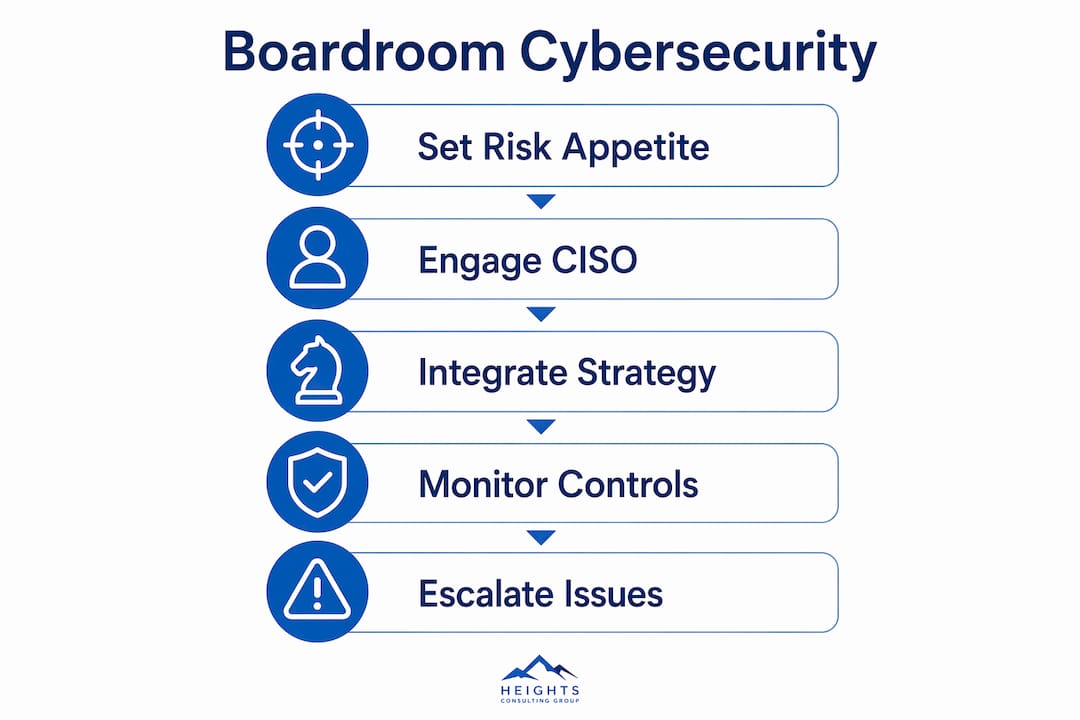
Cybersecurity is a business enabler when governed correctly. A board that treats security investment as a cost center misses its role as a differentiator, particularly in regulated industries where clients and partners evaluate security posture before signing contracts. The World Economic Forum's 2026 guidance positions the CISO as a business strategist and trusted advisor, not a technical operator. Boards must structure the organization so the CISO can fulfill that role.
AI adoption has fundamentally changed the risk equation. Every AI system deployed without formal governance creates a new attack surface and a new accountability gap. Boards in financial services, healthcare, and defense contracting face compounding risk when AI tools are introduced without documented ownership, access controls, or oversight structures. The board's responsibility is to ask whether AI deployments have been assessed for security risk before they reach production.
Embedding a cybersecurity culture from the C-suite to frontline staff requires more than policy. It requires visible leadership commitment. When the board asks about security culture in management reviews, the entire organization receives a clear signal about priorities. That signal is more effective than any awareness training program.
Key areas where boards align security with business objectives:
- Approving security investment tied to specific risk reduction outcomes
- Requiring AI governance policies before new AI tools are deployed at scale
- Linking CISO performance metrics to business resilience, not just compliance checkboxes
- Reviewing third-party and supply chain risk as part of enterprise risk management
- Confirming that security architecture supports, rather than restricts, growth initiatives
What governance structures improve boardroom cybersecurity oversight?
Structured oversight is the difference between a board that governs cyber risk and one that merely receives reports about it. The NACD-ISA 2026 Director's Handbook defines six principles and fifteen tools for moving beyond compliance to active risk governance. That framework gives boards a concrete foundation rather than a set of aspirational guidelines.
Committee roles and reporting lines
Audit, risk, and technology committees each carry distinct responsibilities in cyber-risk governance. The audit committee owns compliance and disclosure obligations. The risk committee owns enterprise risk appetite and scenario planning. The technology committee owns investment oversight and architecture decisions. Boards that assign cyber risk to a single committee without cross-committee coordination create blind spots.
The CISO's reporting line is a governance decision, not an HR decision. CISO direct access to the CEO and board, combined with fluency in translating technical exposure into business risk language, is a critical enabler of board-level impact. A CISO buried three levels below the C-suite cannot provide the board with the visibility it needs.
Governance tools that strengthen oversight
- Risk appetite statements. Document the organization's accepted level of cyber risk in writing, reviewed annually.
- Metrics dashboards. Require management to report on key risk indicators, not raw technical data. Board reporting should cover material risks, control gaps, incidents, and investment needs.
- Tabletop exercises. Run board-level incident response simulations at least once per year to test escalation paths and decision-making under pressure.
- External advisors. Engage independent cybersecurity advisors to validate management's assessments and provide the board with an unfiltered view of risk posture.
- Governance charters. Document roles, responsibilities, escalation paths, and risk appetite in a formal charter reviewed by legal counsel.
Pro Tip: A board-level cybersecurity reporting guide helps committees define what good reporting looks like before the first briefing. Set the standard in advance, not after a gap becomes visible.
The following table compares governance maturity levels boards commonly occupy and what distinguishes each:
| Maturity level | Characteristics |
|---|---|
| Reactive | Cybersecurity reviewed only after incidents; no standing agenda item |
| Compliance-focused | Meets regulatory minimums; limited connection to business risk |
| Risk-informed | Regular CISO briefings; risk appetite documented; metrics reviewed quarterly |
| Governance-mature | Cross-committee coordination; tabletop exercises; AI risk formally assessed |
What are common pitfalls boards face in cybersecurity oversight?
The most common board failure in cybersecurity governance is confusing oversight with management. Boards that request technical briefings, approve specific security tools, or direct remediation activities undermine the CISO's authority and blur accountability lines. The result is a security team that waits for board approval instead of acting on risk.
Governance gaps cause costly failures when security teams act without documented risk appetite or escalation paths. When those structures are absent, practitioners make high-stakes business decisions without formal authority. That is not a security failure. It is a governance failure.
Common pitfalls boards must actively avoid:
- Siloed security teams. When the security function operates without integration into enterprise risk management, boards receive incomplete risk pictures.
- Poor CISO positioning. A CISO without direct board access cannot communicate material risk in time to prevent damage.
- Check-the-box compliance culture. Meeting NIST or CMMC requirements does not equal risk governance. Compliance confirms a baseline. It does not confirm resilience.
- Reactive reporting cycles. Quarterly briefings miss fast-moving threats. Boards need a defined escalation trigger for material incidents between scheduled meetings.
- AI blind spots. Boards that have not formally addressed AI governance leave a significant and growing risk unmanaged.
Without structured formal governance defining decision rights and escalation paths, security teams end up making unintended high-risk decisions. That dynamic exposes the organization to regulatory liability and reputational damage that the board will ultimately own.
Key takeaways
Effective boardroom cybersecurity governance requires documented risk appetite, direct CISO access to the board, cross-committee coordination, and formal AI risk oversight to move beyond compliance into genuine resilience.
| Point | Details |
|---|---|
| Oversight, not management | Boards set expectations and verify controls; they do not direct technical remediation. |
| CISO reporting line matters | Direct CISO access to the CEO and board is a governance requirement, not an organizational preference. |
| AI risk needs formal ownership | Every AI deployment without documented oversight creates an unmanaged attack surface. |
| Governance structures drive outcomes | Risk appetite statements, metrics dashboards, and tabletop exercises distinguish mature boards from reactive ones. |
| Compliance is not resilience | Meeting NIST or CMMC requirements confirms a baseline; it does not confirm the organization can withstand a real attack. |
What I've learned about boards and cybersecurity that most articles won't tell you
Most board cybersecurity conversations I observe focus on the wrong question. Directors ask "Are we compliant?" when they should ask "Are we resilient?" Those are different questions with different answers, and the gap between them is where organizations get hurt.
The boards that govern cyber risk effectively share one trait: they have a CISO who can speak in business language and a board that has done enough education to understand what they are hearing. Neither side can carry that relationship alone. When a CISO presents a slide deck full of vulnerability counts and patch rates, the board nods and moves on. Nothing changes. The proactive governance playbook starts with fixing that communication gap before anything else.
AI has made this harder. Boards now face a risk category that moves faster than their governance cycles. An AI tool deployed by a business unit last quarter may already be processing sensitive data without security review. The board cannot govern what it does not know exists. That requires a standing AI governance agenda item, not a one-time briefing.
The boards I respect most treat cybersecurity the same way they treat financial controls: with defined accountability, regular verification, and zero tolerance for governance gaps. That posture does not require technical expertise. It requires discipline and the willingness to ask hard questions until the answers are clear.
— Dan
Heightscg's approach to board-level cybersecurity governance
Heightscg works directly with boards and executive leadership teams in regulated industries to build governance structures that hold up under real pressure.

Heightscg's strategic governance consulting covers risk appetite development, CISO engagement frameworks, and board reporting standards tailored to your industry's regulatory environment. For organizations facing AI-driven risk complexity, Heightscg provides structured AI governance assessments that give boards the visibility they need to make informed decisions. If your board is ready to move from compliance-focused oversight to genuine cyber resilience, contact Heightscg to discuss a governance engagement built around your specific risk profile.
FAQ
What is the board's primary role in cybersecurity?
The board's primary role is oversight: setting the organization's cyber risk appetite, verifying that controls are in place, and holding management accountable for risk mitigation. Boards do not manage technical security operations.
How often should the board engage with the CISO?
Cybersecurity should be a standing agenda item at every board meeting, with a defined escalation process for material incidents between scheduled sessions. Quarterly-only briefings create dangerous visibility gaps.
What governance frameworks should boards reference for cybersecurity oversight?
The NACD-ISA 2026 Director's Handbook provides six principles and fifteen tools for board-level cyber-risk governance. NIST and CMMC frameworks define compliance baselines, but governance maturity requires going beyond those minimums.
How does AI change the board's cybersecurity responsibilities?
AI adoption expands the attack surface and creates new governance gaps when tools are deployed without formal security review or documented ownership. Boards must add AI risk to their standing oversight agenda and require management to assess AI deployments before production release.
What is the difference between cybersecurity compliance and cybersecurity resilience?
Compliance confirms that an organization meets a defined regulatory baseline. Resilience confirms that the organization can detect, respond to, and recover from a real attack. Boards that govern only for compliance leave significant risk unmanaged.