

Many organizations believe security monitoring is simply about purchasing the right tools and letting them run. This misconception creates dangerous gaps in compliance and cyber defense. Effective security monitoring requires strategic leadership, skilled analysts, and structured frameworks to transform raw data into actionable intelligence. This article reveals how C-level executives and security leaders can leverage monitoring as a strategic advantage in regulated environments.
Table of Contents
- The Evolving Context of Security Monitoring In Compliance And Cyber Risk Management
- Governance And Leadership: The Cornerstone Of Effective Security Monitoring
- Implementing Security Monitoring Within NIST CSF 2.0 And Other Frameworks
- From Tools To Intelligence: The Real Role Of Security Monitoring
- Comparing Core Security Monitoring Frameworks And Practical Considerations For 2026
- Actionable Strategies For C-Suite And Security Leaders To Enhance Security Monitoring In 2026
- Partner With Heights Consulting Group For Strategic Cybersecurity Monitoring
- FAQ
Key takeaways
| Point | Details |
|---|---|
| Security monitoring is a strategic imperative | Effective monitoring requires governance, skilled personnel, and alignment with business objectives beyond just technology. |
| Frameworks provide structured guidance | CISA's CPGs and NIST CSF 2.0 offer practical, outcome-driven approaches to managing cyber risk. |
| Tools represent only 10% of success | Pattern recognition, behavioral baselining, and expert analysis constitute 90% of effective threat detection. |
| Leadership drives program effectiveness | Executive engagement in governance ensures accountability, resources, and strategic alignment with compliance requirements. |
| Continuous improvement is essential | Regular benchmarking, threat intelligence integration, and operational refinement strengthen monitoring capabilities. |
The evolving context of security monitoring in compliance and cyber risk management
Regulatory pressures continue to intensify across sectors in 2026. Organizations in healthcare, finance, and critical infrastructure face mounting compliance obligations that demand continuous security visibility. You need real-time detection capabilities to satisfy auditors and demonstrate due diligence.
Security monitoring directly supports risk-based decision making. Rather than reactive incident response, modern monitoring programs enable proactive threat hunting and pattern analysis. CISA's Cross-Sector Cybersecurity Performance Goals provide clear foundational practices and a baseline to guide investment, benchmarking, and measurable risk reduction.
Senior leadership must oversee cybersecurity governance as part of their fiduciary duty. Boards increasingly demand evidence that monitoring programs align with regulatory requirements and business objectives. Implementing the NIST cybersecurity framework provides a structured path to integrate monitoring within broader risk management strategies.
Without strategic oversight, monitoring becomes fragmented. Disparate tools generate alerts that overwhelm security teams without providing actionable insights. This chaos undermines both compliance posture and operational efficiency. Understanding this context clarifies why leadership and structured approaches are essential next.
Governance and leadership: the cornerstone of effective security monitoring
CISA's updated CPGs elevate governance to a core cybersecurity function. The governance component highlights the critical role of organizational leadership in accountability, risk management, and operational integration of cybersecurity. This isn't just about delegation; executives must actively participate in oversight.
Accountability starts at the top. Your board and C-suite need clear reporting structures that translate technical security metrics into business risk indicators. When leadership understands how monitoring protects revenue, customer trust, and regulatory standing, they allocate appropriate resources.
Effective continuous security monitoring programs require governance frameworks that define roles, responsibilities, and escalation procedures. Who owns security monitoring decisions? How do findings reach decision makers? These questions demand leadership attention.
Governance also ensures alignment between cybersecurity investments and strategic business goals. Your monitoring program should protect what matters most to your organization. A financial services firm prioritizes transaction monitoring differently than a healthcare provider focuses on patient data access patterns.
Pro Tip: Engage boards and executives early by presenting security monitoring as a competitive advantage rather than a cost center. Frame discussions around business enablement and risk mitigation, not just technical controls.
Strong governance increases organizational resilience. When everyone understands their role in security monitoring, response times improve and compliance gaps shrink. With governance established, organizations can adopt structured frameworks to organize and improve their monitoring efforts.
Implementing security monitoring within NIST CSF 2.0 and other frameworks
NIST CSF 2.0 provides a structured approach to manage cybersecurity risk, with resources like Quick Start Guides and Profiles to facilitate implementation. This framework offers common language that bridges technical teams and business leadership. You can map your monitoring capabilities against five core functions.
The framework emphasizes outcomes over prescriptive controls. Rather than mandating specific technologies, it defines what your organization should accomplish:
- Identify your assets, risks, and vulnerabilities requiring monitoring
- Protect critical systems through access controls and safeguards
- Detect anomalous activities and security events in real time
- Respond to incidents with coordinated procedures
- Recover operations and learn from security events
Security monitoring primarily supports the Detect and Respond functions. Your team needs visibility into network traffic, endpoint behaviors, and user activities. Detection capabilities must distinguish normal operations from potential threats. Response procedures depend on timely, accurate monitoring data to trigger appropriate actions.
Implementation resources simplify adoption. NIST provides sector-specific profiles that help you implement the NIST framework according to your industry's unique requirements. Healthcare organizations face different monitoring priorities than manufacturing facilities.
| CSF Function | Security Monitoring Role | Key Activities |
|---|---|---|
| Identify | Asset and risk discovery | Inventory systems, classify data, assess vulnerabilities |
| Protect | Access control validation | Monitor authentication, verify permissions |
| Detect | Anomaly identification | Analyze logs, hunt threats, identify patterns |
| Respond | Incident coordination | Alert triage, containment actions, evidence collection |
| Recover | Restoration verification | Validate system integrity, document lessons learned |
Stepwise implementation fosters maturity over time. You don't need perfect monitoring on day one. Start with critical assets and high-risk processes, then expand coverage as capabilities mature. This approach aligns security investments with compliance priorities and business value. Beyond frameworks, it's crucial to recognize that tools alone don't make monitoring effective.
From tools to intelligence: the real role of security monitoring
Many executives believe purchasing a SIEM platform or EDR solution solves their monitoring challenges. This misconception leads to tool sprawl and analyst burnout. The tool is only 10% of effective threat monitoring; 90% involves knowing what to look for, interpreting data, and acting appropriately.
Behavioral baselining forms the foundation of meaningful detection. Your security team must understand normal patterns for users, applications, and network flows. Only then can they spot deviations that indicate insider threats, compromised credentials, or advanced persistent threats. This knowledge comes from experience and continuous learning, not software licenses.
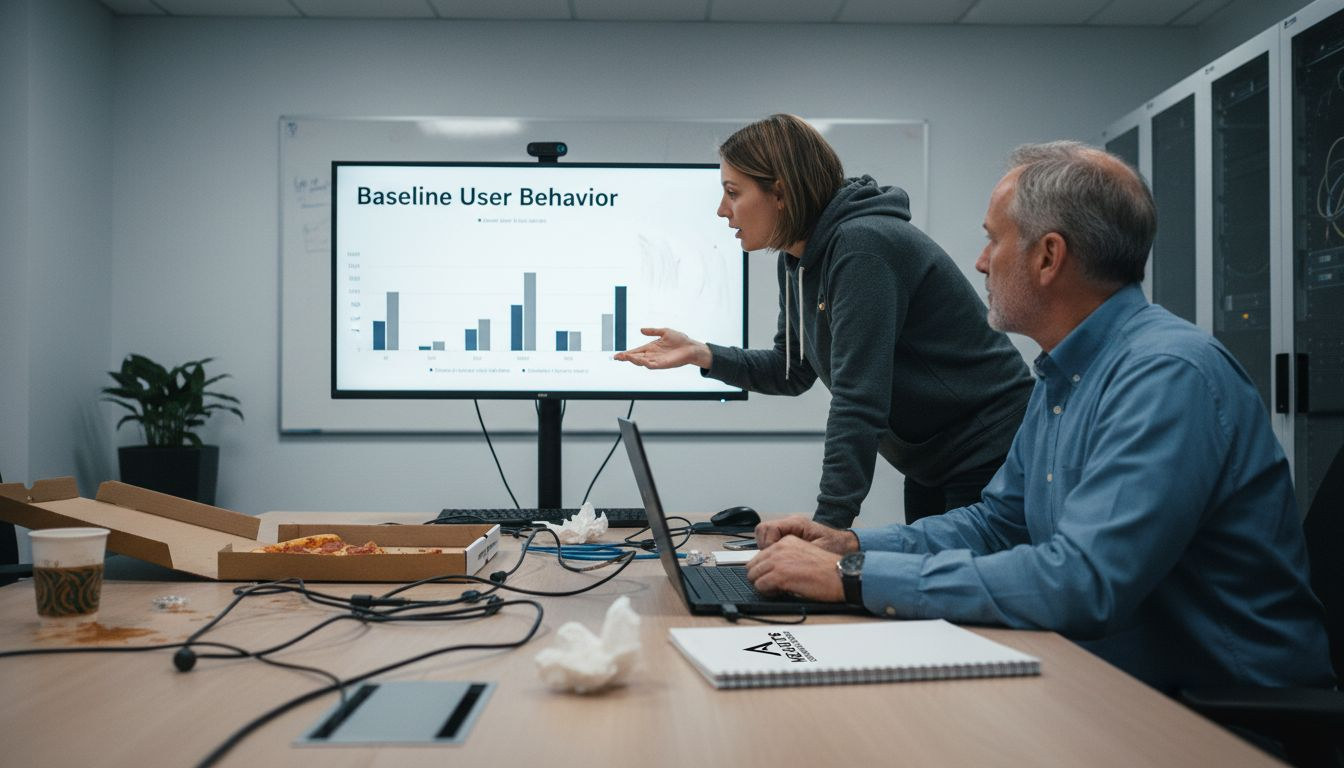
Data noise presents a massive challenge. Average enterprises generate 25TB of security telemetry monthly, with only 3 to 5 signals indicating real threats. Filtering this volume requires sophisticated analytics and skilled analysts who understand attack methodologies. Without expertise, you drown in false positives while missing genuine incidents.
Real-time log aggregation centralizes diverse telemetry data from endpoints, network devices, cloud services, and applications. This creates a unified view of security events across your environment. However, aggregation alone doesn't provide intelligence. You need correlation rules, threat intelligence feeds, and human judgment to extract meaning.
"Security monitoring is 10% technology and 90% knowing what matters. Skilled analysts transform raw data into actionable intelligence that protects your organization."
Pro Tip: Invest in skilled analysts and adaptive tools for context-driven detection. The best monitoring programs combine machine learning for initial filtering with human expertise for final analysis and decision making.
Proactive cybersecurity monitoring tactics emphasize threat hunting over passive alert response. Your team should actively search for indicators of compromise rather than waiting for automated alerts. This requires deep understanding of attacker techniques and your environment's unique characteristics. Having grasped these operational realities, let's compare core frameworks and factors to consider for practical implementation.
Comparing core security monitoring frameworks and practical considerations for 2026
CISA's CPGs and NIST CSF 2.0 serve complementary purposes in your security monitoring strategy. Understanding their differences helps you leverage both effectively. CPGs offer governance-focused, outcome-driven controls that are accessible to non-technical executives. The framework emphasizes measurable goals that boards can track.
NIST CSF 2.0 provides comprehensive risk management structure with implementation guidance. Its flexibility allows customization across industries and organizational sizes. You can map existing controls to framework categories, identify gaps, and prioritize investments based on risk profiles.
| Framework | Primary Focus | Monitoring Emphasis | Best Use Case |
|---|---|---|---|
| CISA CPGs | Governance and baselines | Leadership accountability, outcome metrics | Board reporting, executive engagement |
| NIST CSF 2.0 | Risk management lifecycle | Detection and response maturity | Operational implementation, compliance alignment |
| ISO 27001 | Information security management | Controls-based monitoring | Certification requirements, international operations |
| CIS Controls | Tactical security actions | Prioritized implementation | Technical teams, quick wins |
Both frameworks emphasize leadership governance and strategic monitoring. Your executives need to understand how monitoring programs support business objectives. Security becomes a boardroom conversation about risk appetite and resource allocation, not just a technical function.
Practical factors determine program success beyond framework selection. You need skilled personnel who understand both technology and your business context. Security frameworks for CISOs provide structure, but people execute the mission. Tool integration matters; disparate systems create blind spots and inefficiencies.
Behavioral analytics capabilities separate basic monitoring from advanced threat detection. Your program should identify unusual access patterns, data exfiltration attempts, and privilege escalation activities. These sophisticated detections require ongoing tuning and threat intelligence integration.
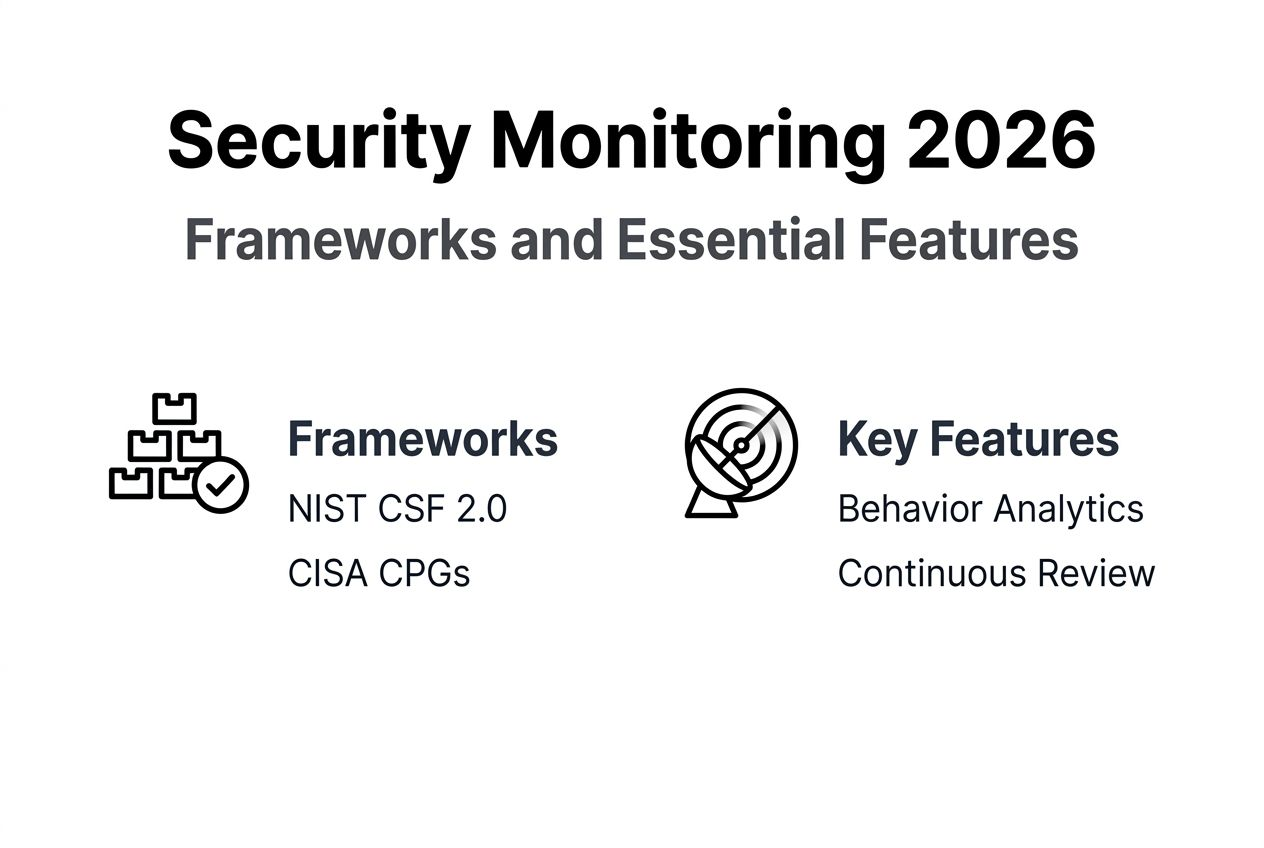
Regular benchmarking and continuous improvement are critical for long-term effectiveness. Measure your monitoring program against industry standards and peer organizations. What detection capabilities do similar companies maintain? Where are your gaps? This analysis drives strategic planning and budget justification. Finally, let's translate these insights into actionable measures for C-levels and security leaders.
Actionable strategies for C-suite and security leaders to enhance security monitoring in 2026
You can strengthen your organization's security monitoring program by following these prioritized steps. Each builds on governance principles and framework guidance discussed throughout this article.
-
Establish clear executive accountability for cybersecurity monitoring outcomes. Assign a senior leader as the responsible party who reports directly to the board on monitoring effectiveness, incident trends, and compliance status.
-
Align monitoring goals with compliance and business risk objectives. Map your detection capabilities to regulatory requirements and critical business processes. Prioritize monitoring for systems that generate revenue, contain sensitive data, or enable operations.
-
Leverage frameworks like CPGs and NIST CSF for structured approaches. Use CISA's CPGs, which are designed to be practical and understandable for senior executives and board members, facilitating leadership engagement.
-
Invest in staff expertise and advanced behavioral analytics. Budget for training, certifications, and retention of skilled security analysts. Technical tools require expert operators to generate value.
-
Implement dashboard reporting that translates data into executive-level insights. Your board doesn't need raw alert counts; they need trend analysis, risk scores, and business impact assessments.
-
Continuously refine monitoring based on threat intelligence and operational data. Regular reviews of detection rules, response procedures, and coverage gaps ensure your program adapts to evolving threats.
Pro Tip: Use dashboards that translate technical metrics into business risk indicators. Show executives how monitoring protects revenue, customer trust, and regulatory compliance rather than focusing on technical details.
Develop a unified compliance strategy that integrates security monitoring with broader governance, risk, and compliance initiatives. This holistic approach reduces redundant efforts and strengthens your overall security posture. Create feedback loops between monitoring findings and strategic planning. What do incidents reveal about your environment? How should these insights influence technology investments and policy updates?
Schedule quarterly reviews with your security leadership team to assess monitoring program maturity. Use framework benchmarks to measure progress and identify improvement opportunities. This regular cadence ensures monitoring remains aligned with business evolution and threat landscape changes. Having outlined these steps, the article will now briefly demonstrate how Heights CG can support your strategic cybersecurity needs.
Partner with Heights Consulting Group for strategic cybersecurity monitoring
You face complex challenges implementing effective security monitoring in regulated environments. Heights Consulting Group offers tailored strategic consulting that transforms monitoring from a technical function into a business advantage. Our experts understand the unique requirements of healthcare, finance, and critical infrastructure sectors.
We deliver comprehensive solutions for proactive cybersecurity monitoring tactics that reduce risk and ensure compliance. Our managed cybersecurity services provide 24/7 threat detection and response capabilities backed by experienced analysts. You gain immediate access to advanced monitoring infrastructure without the overhead of building internal capabilities.
Heights CG helps you implement frameworks like NIST CSF 2.0 and CISA's CPGs with practical guidance tailored to your organization's maturity and resources. We focus on measurable outcomes that satisfy both auditors and business stakeholders. Contact Heights CG to discuss how we can strengthen your security monitoring program and transform compliance from a burden into a competitive advantage. To close, we answer some frequently asked questions about security monitoring to clarify common concerns.
FAQ
What is the primary role of security monitoring in regulated industries?
Security monitoring continuously detects and responds to cyber threats while ensuring compliance with industry regulations. It provides evidence of due diligence for auditors and enables proactive risk management. Effective monitoring protects sensitive data, maintains operational continuity, and demonstrates regulatory accountability.
How do governance and leadership impact security monitoring effectiveness?
Strong governance ensures accountability, resources, and alignment with business objectives, making monitoring programs more effective. Executive engagement drives strategic investment decisions and cross-functional coordination. Leadership oversight transforms security monitoring from a technical function into a business enabler that supports organizational resilience and competitive advantage.
Which frameworks best guide security monitoring strategy and implementation?
CISA's CPGs provide outcome-driven controls accessible to executives and boards for governance oversight. NIST CSF 2.0 offers comprehensive risk management structure with implementation resources for operational teams. Both frameworks emphasize leadership accountability and strategic alignment, making them complementary tools for building mature monitoring programs.
Why is understanding behavioral baselining important in security monitoring?
Behavioral baselining allows detection of unusual activities that may indicate insider threats or advanced attacks. Normal patterns establish context for identifying deviations that automated rules might miss. This approach catches sophisticated threats like credential abuse, data exfiltration, and lateral movement that don't trigger signature-based detections.
What steps can C-level executives take to support effective security monitoring?
Engage actively in governance by assigning clear accountability and reviewing monitoring outcomes regularly. Align monitoring investments with business risks and compliance requirements rather than treating security as a separate function. Invest in skilled teams and appropriate technologies that enable proactive threat hunting, not just reactive alert response.
Recommended
- Continuous Security: Heights CG's Strategic Advantage
- Proactive Cybersecurity Monitoring: Stay Ahead Now - Heights Consulting Group
- Proactive Cybersecurity Monitoring Tactics for Threat Prevention in 2026: Heights Consulting Group.
- Emerging Threats and Proactive Executive Responses Explained - Heights Consulting Group