

Facing relentless cyber threats, American healthcare and financial organizations know that basic technical controls alone are not enough. The pressure to achieve both regulatory compliance and robust security posture pushes CISOs and IT managers to rethink their entire defensive strategy. By focusing on continuous risk assessment and comprehensive policy frameworks, leaders strengthen their organization’s ability to detect, prevent, and respond to evolving risks while maintaining trust and business continuity. The following principles and architectures provide actionable steps toward building a resilient, compliant security posture.
Table of Contents
- Security Posture—Definition And Key Principles
- Types Of Security Posture In Modern IT
- Core Components Of A Strong Security Posture
- Compliance Frameworks And Legal Obligations
- Risks, Business Impact, And Common Pitfalls
Key Takeaways
| Point | Details |
|---|---|
| Understanding Security Posture | A strong security posture combines technical controls, risk management, compliance, and proactive threat strategies to protect against cyber risks. |
| Adapting to Compliance Requirements | Organizations in regulated industries must develop nuanced security frameworks that meet stringent legal standards while ensuring operational efficiency. |
| Recognizing Cybersecurity Risks | Cybersecurity threats have a significant business impact, requiring organizations to move from reactive to proactive risk management to avoid potential crises. |
| Continuous Assessment is Crucial | Regular reviews and updates of security posture through assessments help identify emerging risks and maintain robust defenses against evolving threats. |
Security posture—definition and key principles
A security posture represents an organization's comprehensive cybersecurity readiness and defensive capability against potential digital threats. Organizations in regulated U.S. industries like healthcare and finance must develop a robust security posture that goes beyond basic technical controls, encompassing strategic planning, risk management, and proactive defense mechanisms. Overall cybersecurity readiness involves assessing and managing an organization's networks, information systems, and resources to detect, prevent, and respond to evolving cyber risks.
The core principles of an effective security posture include continuous risk assessment, adaptive defense strategies, comprehensive policy frameworks, and integrated technological solutions. Key elements typically involve evaluating current security infrastructure, identifying potential vulnerabilities, implementing multi-layered protection strategies, and maintaining robust incident response capabilities. Organizations must develop a holistic approach that aligns technological tools, human expertise, and strategic governance to create a resilient defensive ecosystem.
Regulated industries demand a more sophisticated security posture that meets stringent compliance requirements while maintaining operational efficiency. This involves developing Zero Trust security strategies that assume no inherent trust within the network, continuously verifying every access request and transaction. By implementing comprehensive security frameworks, organizations can transform potential vulnerabilities into strategic advantages, protecting critical digital assets while maintaining business continuity and regulatory compliance.
Pro tip: Conduct quarterly comprehensive security posture assessments to proactively identify and mitigate emerging cyber risks before they can impact your organization.
Types of security posture in modern IT
In modern Information Technology environments, organizations implement diverse security posture types that address complex digital infrastructure challenges. Complex technical security architectures are designed to protect against evolving cyber threats through specialized defensive strategies tailored to specific technological ecosystems. These security postures range from network-level protections to application-specific security frameworks, each addressing unique organizational vulnerabilities and compliance requirements.
The primary types of security posture include network security architecture, application security architecture, cloud security architecture, and endpoint security architecture. Network security architecture focuses on protecting organizational communication channels through firewalls, intrusion detection systems, and secure network segmentation. Application security architecture concentrates on securing software platforms by implementing robust authentication protocols, secure coding practices, and continuous vulnerability assessments. Cloud security architecture addresses the unique challenges of distributed computing environments, ensuring data protection, access control, and regulatory compliance across multiple digital platforms.
Endpoint security architecture has become increasingly critical in distributed work environments, protecting individual devices like laptops, smartphones, and tablets that connect to organizational networks. By analyzing digital asset security comprehensively, organizations can develop multi-layered defense strategies that adapt to emerging technological risks. These approaches require continuous monitoring, real-time threat intelligence, and proactive risk management to maintain robust cybersecurity resilience across complex digital infrastructures.
Pro tip: Develop a comprehensive security posture mapping that identifies and prioritizes vulnerabilities across all technological domains, enabling targeted and strategic cybersecurity investments.
Here is a comparison of four primary types of security architecture and their business impacts:
| Security Architecture Type | Key Focus Areas | Main Business Benefit |
|---|---|---|
| Network Security Architecture | Firewalls, segmentation | Reduces risk of network breaches |
| Application Security Architecture | Authentication, secure coding | Prevents software vulnerabilities |
| Cloud Security Architecture | Access control, data protection | Enables secure scalability |
| Endpoint Security Architecture | Device monitoring, threat detection | Secures remote and mobile workforce |
Core components of a strong security posture
A robust security posture demands a comprehensive approach that integrates multiple critical components to protect organizational digital assets. Critical security controls provide a strategic framework for developing comprehensive defensive capabilities across technological ecosystems. These core components encompass technical controls, risk management processes, compliance mechanisms, and proactive threat mitigation strategies that work together to create a resilient cybersecurity environment.
The fundamental components of an effective security posture include comprehensive risk assessment, robust access management, continuous monitoring, incident response planning, and regulatory compliance. Risk assessment involves systematically identifying potential vulnerabilities across technological infrastructure, evaluating potential impact, and developing targeted mitigation strategies. Access management requires implementing sophisticated authentication protocols, role-based access controls, and multi-factor verification to prevent unauthorized system entry. Continuous monitoring enables real-time threat detection, allowing organizations to identify and respond to potential security incidents before they escalate into significant breaches.

Regulated industries like healthcare and financial services require an even more nuanced approach to security posture development. Compliance-driven security frameworks demand that organizations not only protect their technological assets but also demonstrate adherence to specific regulatory standards like HIPAA, PCI DSS, and NIST guidelines. This involves developing comprehensive documentation, maintaining audit trails, implementing strict data protection mechanisms, and creating transparent processes that can withstand rigorous external security assessments. Organizations must view security posture as a dynamic, adaptive system that evolves continuously to address emerging technological risks and regulatory requirements.
Pro tip: Conduct a comprehensive security posture gap analysis annually, comparing your current defensive capabilities against the latest industry benchmarks and regulatory requirements.
Compliance frameworks and legal obligations
U.S. regulated organizations face a complex landscape of cybersecurity compliance frameworks that mandate rigorous protective measures and legal accountability. Cybersecurity legal requirements encompass multiple federal regulations that impose strict standards for protecting sensitive information, reporting security incidents, and maintaining robust defensive mechanisms. These frameworks are not simply recommendations but legally binding obligations that can result in significant financial penalties and reputational damage for non-compliance.
Key compliance frameworks include the Health Insurance Portability and Accountability Act (HIPAA) for healthcare, the Gramm-Leach-Bliley Act (GLBA) for financial institutions, the Payment Card Industry Data Security Standard (PCI DSS) for organizations handling payment information, and sector-specific guidelines from agencies like the Securities and Exchange Commission (SEC). Each framework establishes specific technical, administrative, and physical safeguards that organizations must implement to protect sensitive data, ensure privacy, and maintain comprehensive security controls. These requirements demand continuous monitoring, risk assessment, employee training, and documented evidence of security practices.
Federal agencies have increasingly sophisticated approaches to standardizing security compliance, with programs like FedRAMP establishing consistent security authorization processes for cloud services and technology platforms. These frameworks create systematic methods for assessing security controls, ensuring that organizations not only implement protective measures but also demonstrate ongoing compliance through regular audits, vulnerability assessments, and incident response capabilities. Regulated industries must view compliance as a dynamic, evolving process that requires proactive management and continuous improvement.
Pro tip: Develop a comprehensive compliance tracking system that maps regulatory requirements to specific security controls, enabling real-time visibility and rapid adaptation to changing legal standards.
Risks, business impact, and common pitfalls
Cybersecurity risks extend far beyond technical vulnerabilities, presenting profound business consequences that can fundamentally destabilize organizational operations. Cybersecurity risk management requires understanding the multidimensional impact of potential security breaches, which can range from immediate financial losses to long-term reputational damage. Critical infrastructure sectors like healthcare, finance, and technology face particularly high-stakes scenarios where a single security incident could trigger cascading operational failures and potentially catastrophic economic repercussions.
The most common pitfalls in security posture include inadequate risk assessment, siloed security approaches, and reactive instead of proactive defense strategies. Organizations frequently underestimate the complexity of modern cyber threats, failing to recognize that attackers continuously evolve their tactics. Specific vulnerabilities often emerge from outdated technology infrastructure, insufficient employee training, lack of comprehensive incident response plans, and ineffective vendor risk management. These weaknesses can expose organizations to significant risks such as data breaches, intellectual property theft, operational disruption, and regulatory non-compliance.
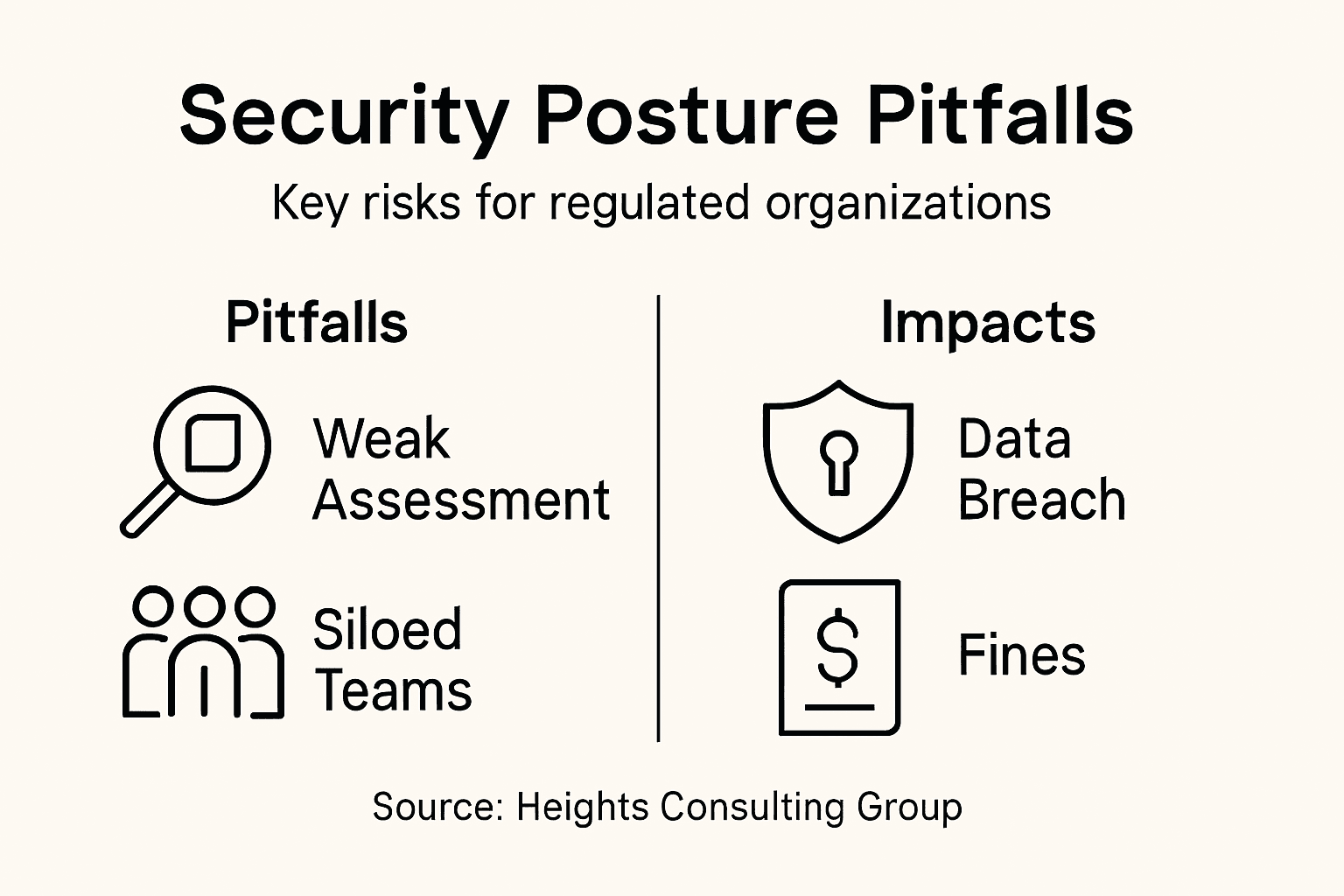
Beyond direct financial implications, cybersecurity incidents with material business impact can create profound downstream consequences that extend well beyond immediate monetary losses. Reputational damage from a significant breach can erode customer trust, trigger regulatory investigations, lead to substantial legal liabilities, and potentially compromise an organization's competitive positioning. Industries handling sensitive information like healthcare and financial services face even more stringent consequences, where a security failure could result in patient harm, financial fraud, or systemic economic disruption.
The following table summarizes how common security pitfalls can impact regulated organizations:
| Pitfall | Example Consequence | Industry With Elevated Risk |
|---|---|---|
| Inadequate risk assessment | Missed vulnerabilities | Financial services |
| Siloed or fragmented security | Delayed incident response | Healthcare |
| Outdated infrastructure | Easy exploitation by attackers | Technology (legacy systems) |
| Insufficient employee training | Increased phishing susceptibility | All regulated industries |
| Weak vendor management | Third-party data exposure | Insurance, banking |
Pro tip: Implement a continuous risk assessment framework that conducts quarterly comprehensive security evaluations, mapping emerging threats against your current defensive capabilities.
Strengthen Your Security Posture with Expert Guidance from Heights Consulting Group
The challenge of maintaining a robust security posture is critical for regulated U.S. organizations facing complex risks like continuous cyber threats, evolving compliance demands, and fragmented security strategies. This article highlights key pain points such as inadequate risk assessment, siloed defenses, and the demand for compliance frameworks like NIST and HIPAA. Heights Consulting Group specializes in transforming these challenges into strategic advantages by delivering tailored cybersecurity advisory, technical implementation, and compliance solutions designed to safeguard your digital assets and ensure regulatory alignment.
Ready to elevate your organization's cybersecurity readiness and build a resilient defense that aligns with your business goals? Partner with Heights Consulting Group to access advanced services including managed cybersecurity, incident response, and integrated compliance management. Visit Heights Consulting Group today to discover how our expert team can help you proactively assess risks, implement adaptive defense strategies, and maintain continuous compliance. Start securing your future now with a trusted partner dedicated to your industry needs and evolving cyber risks.
Frequently Asked Questions
What is a security posture?
A security posture refers to an organization's overall cybersecurity readiness and capability to defend against digital threats, encompassing risk management, strategic planning, and proactive defense mechanisms.
Why is a strong security posture important for regulated organizations?
A strong security posture is crucial for regulated organizations because it helps them meet compliance requirements, protects sensitive data, reduces the risk of cyber incidents, and ensures operational continuity.
What are the core components of an effective security posture?
The core components of an effective security posture include comprehensive risk assessment, robust access management, continuous monitoring, incident response planning, and adherence to regulatory compliance standards.
How can organizations improve their security posture?
Organizations can improve their security posture by conducting regular security assessments, implementing multifactor authentication, developing incident response plans, and ensuring continuous training and awareness programs for employees.
Recommended
- hipaa security rule requirements: Quick path to safeguards - Heights Consulting Group
- Boardroom Cybersecurity: Heights CG's Strategic Governance
- Cybersecurity Insights &Leadership
- Navigating the Evolving Landscape of Regulatory Compliance: Essential Insights for Executives - Heights Consulting Group