

TL;DR:
- Effective breaches are often preceded by identifiable warning signs in logs and network data.
- Strong governance, continuous monitoring, and skilled analysts are essential for cybersecurity resilience.
- Implementing structured workflows and executive oversight improves monitoring outcomes and regulatory compliance.
Major breaches rarely happen without warning. In most documented incidents, the indicators were present in log files, endpoint telemetry, and network anomalies long before damage occurred. The problem was not a lack of data. It was a lack of structured monitoring and executive-level accountability. CISA CPGs 2.0 highlight continuous monitoring and anomaly detection as top priorities for critical infrastructure, reflecting an expectation that security leadership, not just tools, drives resilience. This guide walks C-level executives and security leaders through the full lifecycle: requirements, team assembly, step-by-step implementation, and ongoing verification, so your organization does not become the next avoidable headline.
Table of Contents
- Understand security monitoring requirements for 2025
- Assemble your security monitoring toolkit and team
- Implement continuous monitoring: Step-by-step execution
- Evaluate and verify: Metrics, audits, and continuous improvement
- The missed opportunity: Why most security monitoring programs underperform
- Unlock next-level security monitoring with expert support
- Frequently asked questions
Key Takeaways
| Point | Details |
|---|---|
| Strategy trumps tools | Leadership and skilled analysts are more critical than buying new platforms. |
| Framework alignment is key | Mapping to NIST and CISA standards ensures both compliance and resilience. |
| Continuous improvement | Routine evaluation drives detection accuracy and audit success. |
| Governance matters | Active executive oversight prevents monitoring failures and improves outcomes. |
Understand security monitoring requirements for 2025
Before investing in platforms or personnel, security leaders must understand what frameworks actually require. In 2025, the bar has risen considerably. Both CISA's Cross-Sector Cybersecurity Performance Goals and NIST CSF 2.0 now emphasize leadership governance alongside tactical monitoring, making executive engagement a formal compliance expectation, not just good practice.
The NIST CSF 2.0 introduced the GOVERN function specifically to address this gap. It positions cybersecurity as an enterprise risk management discipline, requiring boards and C-suites to set direction, allocate resources, and review outcomes. This is a structural shift. Previously, many organizations delegated monitoring entirely to operational teams and considered their governance duty fulfilled. That model no longer satisfies leading frameworks.
The strategic advantage of continuous security lies in how it connects real-time threat intelligence to executive decision-making. Continuous monitoring, per authoritative frameworks, means systematic, ongoing observation of network activity, endpoint behavior, user actions, and system configurations, mapped to defined baselines and reviewed at regular intervals.
Here is what the frameworks require across key dimensions:
| Dimension | CISA CPGs 2.0 | NIST CSF 2.0 |
|---|---|---|
| Monitoring scope | Network, endpoint, cloud, OT | All assets and data flows |
| Governance involvement | Recommended for CI operators | Mandatory via GOVERN function |
| Detection method | Anomaly-based, behavioral | Risk-informed, layered detection |
| Reporting cadence | Event-driven plus periodic | Continuous with documented reviews |
Key obligations security leaders should internalize:
- Establish asset visibility across all network segments, including OT and cloud environments
- Define detection use cases aligned to your organization's threat profile
- Formalize governance reporting so boards receive meaningful monitoring outcomes
- Document baselines for user behavior, network traffic, and system configurations
- Link monitoring controls to compliance frameworks for audit readiness
Understanding why continuous monitoring matters from a regulatory standpoint also helps executives justify budget and headcount. Organizations that treat monitoring as a technical checkbox consistently underperform in audits and incident response. The firms that genuinely elevate oversight and compliance are those where leadership owns outcomes, not just approves budgets.
Assemble your security monitoring toolkit and team
With requirements clearly defined, the next step is building the right combination of technology and talent. Tools create visibility. People create security.
Three core platforms form the foundation of any mature monitoring program:
| Platform | Primary function | Compliance alignment |
|---|---|---|
| SIEM (Security Information and Event Management) | Log aggregation, correlation, alerting | NIST DETECT, CISA CPGs |
| EDR (Endpoint Detection and Response) | Endpoint telemetry, behavioral detection | NIST RESPOND, CISA CPGs |
| UEBA (User and Entity Behavior Analytics) | Anomaly detection, insider threat profiling | NIST DETECT/GOVERN |
Each platform has a distinct role. SIEM provides centralized visibility. EDR catches endpoint-level threats that perimeter tools miss. UEBA identifies behavioral anomalies that signature-based tools cannot flag. Integrated correctly, these three create overlapping detection layers that significantly reduce dwell time.
For always-on cyber defense, the recommended team structure in regulated industries typically includes:
- Tier 1 analysts: Alert triage, initial classification, and escalation
- Tier 2 analysts: Deep investigation, root cause analysis, and incident declaration
- Threat hunters: Proactive hypothesis-driven investigation, independent of alert queues
- Security engineer: Tool configuration, detection rule development, and tuning
- vCISO or security governance lead: Framework alignment, executive reporting, and board communication
Skillset matters as much as headcount. Analysts supporting regulated environments need familiarity with behavioral analytics, log forensics, and framework mapping. Threat hunters specifically require experience developing hypotheses from threat intelligence rather than waiting for alerts. Finding experienced security analysts with these capabilities takes intentional recruitment, not just posting a job description.

The data is unambiguous: 90% of success in security monitoring comes from skilled analysts, not tools. Organizations that invest heavily in platforms but underinvest in analyst training and governance consistently generate high alert volumes with low actionable outcomes.
Virtual CISO services provide a practical solution for organizations that need governance leadership without the cost of a full-time hire. A vCISO can own framework alignment, board reporting, and monitoring program maturity without requiring headcount expansion.
Pro Tip: Avoid over-automating your monitoring environment before analysts have established reliable detection baselines. Automation built on poor rules generates alert fatigue, which causes real threats to get buried under false positives. Tune first, automate second.
Implement continuous monitoring: Step-by-step execution
With resources in place, execution becomes the priority. Implementation without a structured workflow produces inconsistent coverage and audit gaps.
"Implement continuous monitoring, anomaly detection, and proactive threat hunting using SIEM, EDR, and UEBA mapped to NIST DETECT to create a detection architecture that is defensible, scalable, and compliant."
Follow this sequence for a rigorous deployment:
-
Map your asset inventory to framework controls. Every monitored asset should link to a NIST CSF or CISA CPG control. This creates traceable, audit-ready coverage documentation from day one.
-
Establish behavioral baselines. Before enabling alerting, allow UEBA and SIEM to observe normal activity for two to four weeks. Baselines for user login patterns, data transfer volumes, and network flows are essential for meaningful anomaly detection.
-
Configure detection use cases by priority. Start with high-impact scenarios: privileged account abuse, lateral movement, data exfiltration patterns, and authentication anomalies. Expand use cases progressively as your team's capacity grows.
-
Integrate advanced threat detection with analyst review workflows. Every automated detection should route to a human analyst for validation before escalation. Automation handles volume; analysts handle judgment.
-
Embed threat hunting into your monthly cadence. The threat hunting process for regulated sectors involves developing hypotheses from threat intelligence reports, searching for indicators of compromise independent of alerts, and documenting findings for governance review.
-
Establish executive reporting cycles. Monthly or quarterly briefings should translate monitoring outcomes into risk language that boards and C-suite leaders can act on. Detection rates, unresolved findings, and audit readiness scores are appropriate KPIs.
Pro Tip: Alert threshold tuning is an ongoing operational responsibility, not a one-time configuration task. Review alert volume and false positive rates weekly during the first 90 days. A ratio above 85% false positives signals that detection rules need refinement before analyst confidence erodes.
A structured implementation converts monitoring from a reactive function into a proactive governance asset.
Evaluate and verify: Metrics, audits, and continuous improvement
Implementation without evaluation produces stagnation. Sustaining an effective monitoring program requires measurable outcomes, routine compliance checks, and a documented improvement cycle.
CISA and NIST both mandate routine assessment, event analysis, and reporting as part of the DETECT function. This is not optional for organizations operating in critical infrastructure or highly regulated sectors. Auditors increasingly expect evidence of detection coverage, not just evidence that tools are running.
Essential metrics for executive-level monitoring reviews:
- Threat detection rate: Percentage of known test scenarios successfully identified by monitoring controls
- Mean time to detect (MTTD): Average elapsed time from threat introduction to alert generation
- Mean time to respond (MTTR): Average time from detection to containment or resolution
- False positive ratio: Share of alerts that do not represent genuine threats, indicating tuning quality
- Audit finding closure rate: Speed at which compliance gaps identified in assessments are remediated
- Coverage gap score: Percentage of assets or data flows not currently covered by active monitoring
The NIST compliance checklist provides a structured way to map monitoring metrics to specific framework controls, making board reporting more defensible and audit preparation more efficient.
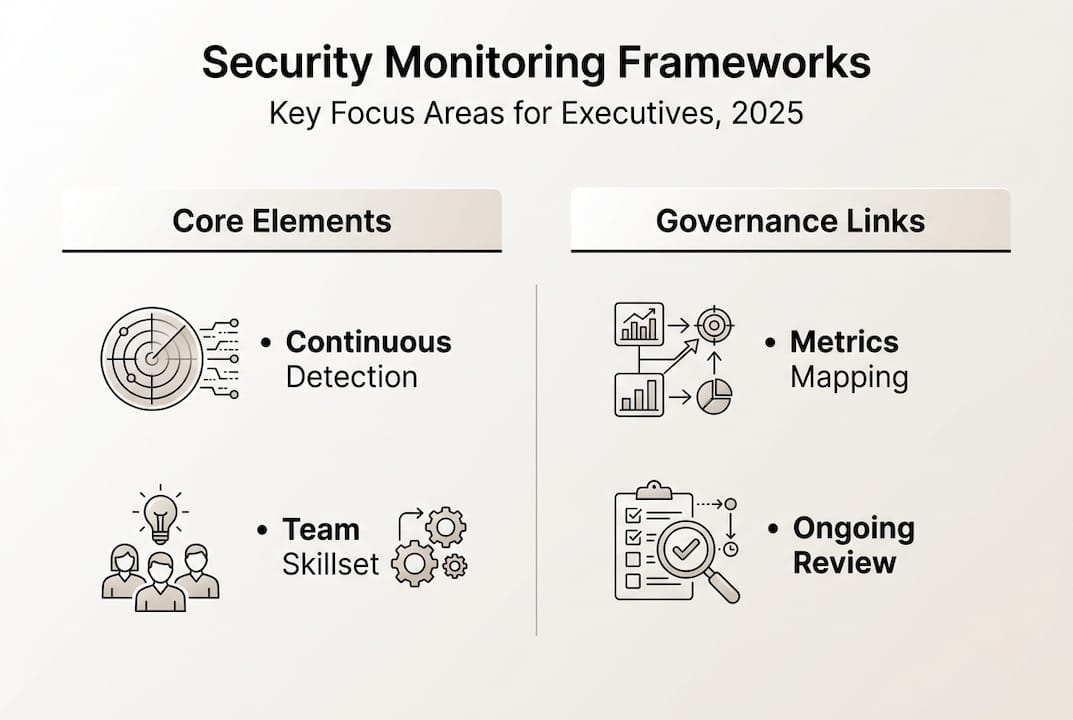
Consider the distinction between reactive and proactive monitoring postures:
| Attribute | Reactive monitoring | Proactive monitoring |
|---|---|---|
| Detection trigger | Alerts only | Alerts plus threat hunting |
| Coverage validation | Annual audit | Continuous self-assessment |
| Executive involvement | Incident-driven | Routine governance cycles |
| Compliance posture | Pass or fail | Demonstrably improving |
| Breach cost exposure | Significantly higher | Substantially reduced |
Organizations reviewing insurance sector best practices will find that proactive monitoring programs are increasingly tied to favorable cyber insurance terms, as underwriters assess both detection capability and governance maturity. Understanding why continuous monitoring matters from a financial risk perspective adds measurable business value to the investment case.
Conduct quarterly reviews that map current metrics to baseline targets, document improvement actions, and escalate unresolved findings to executive leadership with clear remediation timelines.
The missed opportunity: Why most security monitoring programs underperform
Here is an uncomfortable observation from working across regulated industries: most underperforming monitoring programs are not technology problems. They are governance and culture problems wearing the disguise of technology gaps.
Organizations that struggle to demonstrate monitoring value typically share common traits. Leadership treats security reporting as a compliance ritual rather than an operational intelligence function. Analysts operate in isolation, their findings rarely reaching the people with authority to act. Tool procurement decisions happen without input from the analysts who will use them daily.
The most effective C-levels we advise approach virtual CISO governance differently. They create feedback loops where analyst findings directly inform strategic decisions. They hold quarterly security reviews where monitoring outcomes drive resource allocation, not just compliance checkboxes. They treat continuous security as a business performance measure, not a technical obligation.
Tick-box compliance produces tick-box outcomes. The organizations that genuinely reduce risk are those where accountability flows in both directions: from the board down to analysts, and from analyst findings back up to the board.
Unlock next-level security monitoring with expert support
Building a monitoring program that satisfies CISA CPGs 2.0, NIST CSF 2.0, and your organization's own risk tolerance is achievable, but it requires more than deploying tools and hoping for results.
Heights Consulting Group partners with C-level executives and security leaders to design, implement, and continuously improve monitoring programs that translate directly into audit readiness and operational resilience. Our cybersecurity consulting services cover everything from framework alignment and governance structuring to analyst team development. Our continuous monitoring services ensure your organization maintains always-on visibility without sacrificing strategic oversight. If your monitoring program needs a credible upgrade, contact Heights CG to start a focused conversation about where your program stands and where it needs to go.
Frequently asked questions
What is the main difference between CISA and NIST guidance for security monitoring in 2025?
CISA's DETECT function focuses on continuous monitoring and prioritized controls for critical infrastructure operators, while NIST CSF 2.0 introduced a dedicated GOVERN function that formally requires leadership involvement in cybersecurity direction and oversight.
What technologies are essential for continuous security monitoring?
SIEM, EDR, and UEBA are the foundational platforms for continuous monitoring, providing log aggregation, endpoint telemetry, and behavioral anomaly detection when integrated with governance and incident response processes.
Why do most security monitoring deployments fail to deliver ROI?
Most programs overinvest in automation and underinvest in analyst empowerment and governance structure, yet skilled analysts and leadership account for 90% of successful monitoring outcomes, making human capital the decisive variable.
How can executives measure the effectiveness of their security monitoring?
Track detection rates, mean time to detect, false positive ratios, and audit finding closure rates, then map those results to NIST and CISA controls to produce compliance-aligned assurance reporting that satisfies both boards and NIST CSF 2.0 expectations.
Recommended
- Cybersecurity checklist for executives: 2025 strategies
- Security automation: strategic benefits for executives
- Continuous Security: Heights CG's Strategic Advantage
- Endpoint detection strategy guide for executives 2026
- Cybersecurity for Insurers, tools and best practices - Digital Insurance Platform | IBSuite Insurance Software | Modern Insurance System
- Securing Your Business: An In-Depth Look at Access Control Systems and How to Choose the Right One.