

TL;DR:
- Passing a compliance audit does not guarantee organizational security or vulnerability elimination.
- Effective security audits identify actual risks, guide targeted remediation, and align with overarching risk management.
- Integrating audit findings into strategic, continuous monitoring efforts enhances cyber resilience and risk reduction.
Passing a compliance audit feels like a win. For many executives in regulated industries, a clean audit report signals that the organization is protected. But that assumption carries serious risk. The global average cost of a data breach reached $4.44 million in 2025, with U.S. organizations averaging $10.22 million and healthcare organizations absorbing the highest sector cost at $7.42 million. Many of those breached organizations had passed their most recent audits. This guide explains how security audits, when executed with strategic intent, become powerful tools for genuine resilience, measurable compliance, and meaningful cyber risk reduction.
Table of Contents
- Why security audits matter: Beyond box-checking
- Types of security audits and frameworks used
- The security audit process: What leaders should expect
- Nuances, pitfalls, and the future of security audits
- What most executives miss about security audits
- How Heights Consulting Group can help you drive real risk reduction
- Frequently asked questions
Key Takeaways
| Point | Details |
|---|---|
| Audits are not enough | Passing a security audit does not guarantee safety—ongoing risk reduction is essential. |
| Frameworks guide effectiveness | Choosing the right audit frameworks and types is crucial for meeting industry and regulatory needs. |
| Continuous strategies save costs | AI, automation, and continuous monitoring can reduce data breach impact by millions. |
| Leadership drives outcomes | C-level buy-in and translation of audit findings into business strategy create true security improvement. |
Why security audits matter: Beyond box-checking
A security audit is a systematic evaluation of an organization's controls, policies, and operational practices designed to identify vulnerabilities, measure compliance against regulatory requirements, and surface actionable recommendations. For regulated industries, including finance, healthcare, and critical infrastructure, this process is not optional. The consequences of inadequate audit programs range from regulatory fines and operational disruption to reputational damage that takes years to repair.
The business stakes are significant. Security audits are systematic evaluations essential to identify vulnerabilities, ensure regulatory compliance, and recommend improvements, making them critical for regulated industries seeking to mitigate cyber risks and avoid costly penalties. Yet the most common executive misconception is that a passed audit equals a secure organization. It does not. Compliance does not equal security, and a clean audit report does not guarantee the absence of exploitable vulnerabilities.
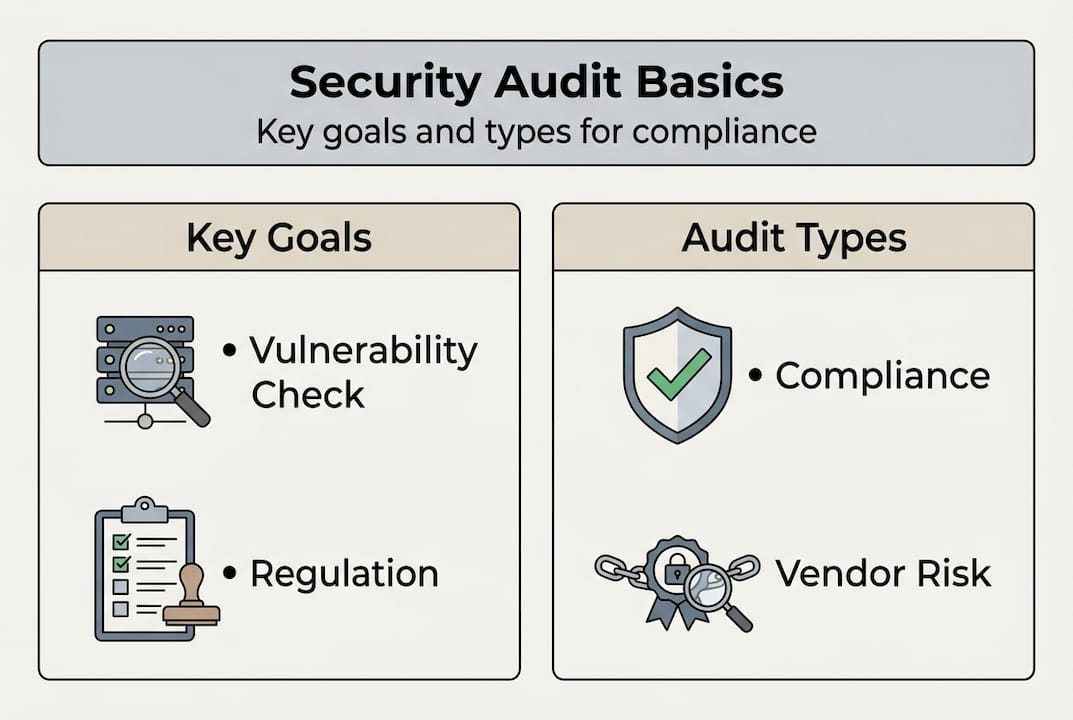
This gap between compliance and true resilience is where organizations remain exposed. Audits conducted as annual checkbox exercises often miss dynamic threats, misconfigured cloud environments, and emerging third-party risks. Leaders who treat compliance as advantage rather than a minimum threshold are the ones who close that gap.
Key questions that effective security audits must address include:
- Are existing controls actually functioning as designed, or just documented?
- Which vulnerabilities would cause the greatest business impact if exploited?
- Are third-party vendors introducing unmanaged risk into the environment?
- Does the organization's security posture align with its actual risk tolerance?
- Where do regulatory requirements and real-world threats diverge?
Organizations that align multi-regulatory compliance best practices with audit strategy consistently demonstrate stronger security outcomes. The audit, in this context, becomes an intelligence-gathering exercise rather than a report card.
Organizations that link audit findings directly to risk mitigation actions reduce breach costs significantly compared to those treating audits as isolated compliance events.
The financial case for rigorous auditing is clear. When audits drive real remediation, they reduce the likelihood and cost of incidents. When they do not, the audit budget becomes sunk cost with no protective return.
Types of security audits and frameworks used
Not all security audits serve the same purpose, and understanding the distinctions helps executives allocate resources effectively. Audit types include compliance audits such as HIPAA and PCI DSS control verification, risk assessment audits, internal versus external audits, SOC 2 Type II engagements, and regulatory examinations conducted by oversight bodies.
| Audit type | Primary purpose | Typical frequency | Common use case |
|---|---|---|---|
| Compliance audit | Verify adherence to regulatory standards | Annual | HIPAA, PCI DSS, CMMC |
| Risk assessment audit | Identify and prioritize vulnerabilities | Semi-annual | Enterprise risk programs |
| Internal audit | Self-assessment of controls and policies | Quarterly or ongoing | Continuous improvement |
| External audit | Independent third-party validation | Annual | Board reporting, M&A due diligence |
| SOC 2 Type II | Operational control assurance over time | Annual | Vendor trust, client contracts |
| Regulatory examination | Mandatory oversight review | As required | Banking, healthcare regulators |
Framework selection is equally important. Key frameworks include NIST CSF, ISO 27001 with 93 controls, PCI DSS, HIPAA, and SOC 2, each carrying distinct requirements, scope, and applicability. Understanding which frameworks apply to your sector is foundational to building a credible audit program.
Leading frameworks and their primary tradeoffs:
- NIST CSF 2.0: Flexible, risk-based, widely adopted across sectors. Excellent for NIST framework implementation as a baseline.
- ISO 27001: Internationally recognized, certification-based, 93 controls covering information security management.
- PCI DSS: Mandatory for payment card environments, prescriptive control requirements, annual validation.
- HIPAA: Healthcare-specific, focuses on protected health information, administrative and technical safeguards.
- SOC 2: Trust services criteria for service organizations, increasingly required by enterprise clients.
For organizations navigating multiple regulatory environments, compliance consulting for healthcare and finance provides structured approaches to managing framework overlap without duplicating effort. Financial institutions specifically benefit from reviewing the finance compliance guide to understand the layered regulatory demands they face.
Third-party and vendor audits deserve special attention. SOC 2 Type II reports from vendors are now frequently required before contract execution in regulated industries, reflecting the growing recognition that organizational security is only as strong as its weakest supplier.

The security audit process: What leaders should expect
Understanding the audit lifecycle helps executives set realistic expectations, allocate internal resources, and extract maximum value from each engagement. Key audit methodologies follow phased processes: planning and scoping, design assessment, control testing, analysis, and reporting with remediation, aligned with frameworks like NIST CSF and ISO 27001.
A well-structured enterprise security audit typically follows these steps:
- Scoping and planning: Define the audit boundary, regulatory requirements, and business context. Executive sponsorship at this stage is critical.
- Policy and documentation review: Assess whether written policies reflect actual operational practices and regulatory requirements.
- Technical control assessment: Evaluate network architecture, access controls, encryption, endpoint security, and logging configurations.
- Procedural and interview-based assessment: Engage staff across functions to verify that controls are understood and consistently applied.
- Evidence collection and sampling: Use judgment-based or block sampling methods to validate control effectiveness across representative data sets.
- Findings analysis: Translate technical findings into business risk language. A misconfigured firewall rule is not just a technical issue; it is a potential $10 million liability.
- Reporting: Deliver prioritized findings with risk ratings, remediation timelines, and executive summaries that support board-level decision-making.
- Remediation planning and tracking: Assign ownership, set deadlines, and track closure. Findings without accountability are findings that persist.
- Continuous improvement: Feed audit outcomes into the broader security program, informing future investments and control enhancements.
Pro Tip: Engage executive leadership during the scoping phase, not just at the reporting stage. Executives who participate in defining audit scope ensure that findings map directly to business priorities, making remediation decisions faster and better funded.
Integrating always-on cyber defense alongside periodic audits creates a stronger overall posture. The strategic advantage of continuous security monitoring becomes clear when audit findings are validated against real-time telemetry rather than point-in-time snapshots. Pairing audits with the right compliance frameworks for cybersecurity ensures that findings drive lasting structural improvements.
Nuances, pitfalls, and the future of security audits
Even experienced security leaders encounter audit challenges that undermine program effectiveness. Framework overlap, snapshot limitations, and third-party risk are among the most common nuances that catch organizations off guard, alongside the growing impact of AI and cloud environments on audit scope.
Audit fatigue is real. Organizations subject to multiple regulatory frameworks often find themselves running parallel audit programs with overlapping evidence requests, duplicated interviews, and conflicting timelines. The result is exhausted internal teams and audits that produce diminishing returns.
| Factor | Impact on breach cost | Notes |
|---|---|---|
| AI and automation use | Reduces breach cost by $2.2M on average | Organizations using AI security tools see measurable savings |
| Law enforcement involvement | Reduces breach cost significantly | Coordinated response shortens containment time |
| Compliance failures | Increases breach cost by $1M or more | Non-compliance amplifies financial exposure |
| Extensive cloud migration | Increases breach cost without proper controls | Cloud misconfigurations remain a top audit finding |
Audits are shifting toward risk-based and proactive approaches.pdf), including continuous assurance models and quantitative risk frameworks like FAIR (Factor Analysis of Information Risk), which translate cyber risk into financial terms that resonate with boards and CFOs.
Pro Tip: Move toward quantitative risk measurement in your audit program. When findings are expressed in dollar-denominated risk rather than severity ratings alone, remediation prioritization becomes a financial decision rather than a technical debate.
Strategies that leading organizations use to address these pitfalls:
- Consolidate overlapping frameworks using a unified control mapping approach to reduce duplication
- Implement vendor audit questionnaires to systematically assess third-party risk at scale
- Automate evidence collection to reduce manual burden and improve audit accuracy
- Align audit scope with business risk priorities rather than regulatory minimums
- Reference resilient cybersecurity frameworks to build programs that adapt to evolving threats
- Treat regulated industries and compliance as a continuous discipline, not an annual event
The organizations that navigate these challenges most effectively are those that treat the audit program as a living component of their security strategy, not a static deliverable.
What most executives miss about security audits
Here is the uncomfortable reality that most audit conversations avoid: a passed audit is a midpoint, not a destination. The organizations that suffered the most damaging breaches in recent years were not organizations that skipped audits. Many had passed them. The failure was in what happened after the report was delivered.
Audit findings that sit in a SharePoint folder without assigned ownership and funded remediation are not findings. They are liabilities waiting to be exploited. The distinction between resilient organizations and vulnerable ones is rarely the quality of the audit itself. It is the executive accountability that follows.
We have observed that organizations integrating audit outcomes into board-level risk reporting, budget cycles, and strategic planning consistently outperform those that treat audits as a compliance function housed entirely within IT. When the CISO presents audit findings alongside financial risk quantification, remediation gets funded. When findings stay technical, they stay unresolved.
The future of effective audit programs lies in pairing periodic assessments with continuous security monitoring and dynamic risk management. Static compliance is not enough in an environment where threat actors move faster than annual audit cycles. The executives who recognize this shift and build programs accordingly are the ones turning audit investment into demonstrable resilience.
How Heights Consulting Group can help you drive real risk reduction
Understanding the audit landscape is the first step. Translating that understanding into a program that actually reduces risk requires expertise, structure, and the right strategic partner.
Heights Consulting Group works with regulated organizations to design and execute security audit programs that go beyond compliance checkboxes. From technical cybersecurity consulting that validates control effectiveness to compliance framework services that align NIST, HIPAA, SOC 2, and other standards with your business objectives, our team brings the depth and experience that executive-level decisions require. If your organization is ready to move from audit as obligation to audit as strategic advantage, contact Heights Consulting Group to begin that conversation.
Frequently asked questions
What is the main purpose of a security audit?
A security audit identifies vulnerabilities, ensures regulatory compliance, and recommends improvements to enhance your organization's security posture and reduce exposure to cyber risk.
Which frameworks are most relevant for financial and healthcare organizations?
NIST CSF, ISO 27001, PCI DSS, HIPAA, and SOC 2 are the leading frameworks for security audits in regulated healthcare and financial industries, each addressing distinct control and reporting requirements.
How often should regulated organizations conduct security audits?
Annual or semi-annual audits are recommended for most regulated industries, with higher-risk sectors or those undergoing significant technology change benefiting from increased frequency.
How do audits differ from continuous monitoring?
Audits are periodic assessments that provide a snapshot of compliance at a point in time, while continuous monitoring delivers real-time detection and assurance that audits alone cannot provide.
Do audits cover third-party and vendor security risks?
Yes. Third-party risk assessment is now a standard component of comprehensive security audits, particularly in cloud-heavy and multi-regulated environments where vendor exposure is significant.