

A technical advisor provides expert, independent guidance that lets leaders make risk-aware decisions without needing to master every underlying technology themselves. The role sits at the intersection of technical depth and business judgment, translating architecture risks, compliance gaps, and AI-driven threats into language that boards and executives can act on. Organizations hire technical advisors primarily to accomplish three things: convert technical findings into prioritized business decisions, design or validate a security or technology strategy that aligns with regulatory requirements, and compress the time between identifying a risk and resolving it.
Common engagement types include:
- Project-based: A fixed-scope engagement (typically two to eight weeks) to assess a specific risk, validate an architecture, or prepare for a compliance audit.
- Retainer: Ongoing monthly access to senior advisory capacity for governance support, board briefings, and escalation review.
- Embedded (fractional): A part-time advisor who functions inside the organization as a fractional CISO or principal technical lead, attending leadership meetings and owning specific risk domains.
Key Takeaways
The role of technical advisory delivers its highest value when advisors translate technical risk into business decisions, operate with direct access to executive authority, and address AI governance as a core deliverable, not an afterthought.
| Point | Details |
|---|---|
| Define the engagement model first | Choose project, retainer, or embedded based on whether you need a one-time assessment or ongoing governance support. |
| Measure from day one | Establish MTTR, compliance coverage, and board-readiness baselines before the engagement begins so improvement is demonstrable. |
| AI governance is now a standard deliverable | Advisors must inventory AI systems, define ownership, and document response authorities as part of every engagement. |
| Governance access determines outcomes | Advisory work produces reports without a named executive who owns findings and controls remediation budget. |
| Heightscg for regulated sectors | Heightscg provides fractional CISO, managed security, and compliance advisory for healthcare, defense, and other regulated organizations. |
Table of Contents
- What the role of technical advisory actually covers day to day
- Skills and qualifications that separate strong advisors from average ones
- How the role shifts across industries
- What advisors deliver and how engagements are structured
- How to evaluate and hire a technical advisor or firm
- Measuring the impact of advisory work with real KPIs
- Why AI is forcing a fundamental shift in what technical advisors must know
- An advisory firm's perspective on what actually works
- Heightscg brings senior advisory capacity to your most critical risk decisions
- Sources
What the role of technical advisory actually covers day to day
Technical advisors operate across two distinct planes simultaneously: operational and strategic. On the operational side, they conduct architecture reviews, run risk assessments, prioritize remediation queues, and produce runbooks that internal teams can execute. On the strategic side, they build cybersecurity roadmaps for executives, quantify risk in financial terms, prepare board briefings, and advise on governance structures.
A short-term engagement looks different from a retainer. In a one-to-three-week sprint, an advisor typically delivers a gap assessment against a framework such as NIST CSF or SOC 2, a prioritized remediation list ranked by business exposure, and an executive summary the CISO can present to the board. A retainer relationship adds ongoing governance review, incident escalation support, and quarterly strategy updates as the threat environment shifts.
Key day-to-day responsibilities include:
- Reviewing security architecture and identifying control gaps before they become incidents
- Translating CVSS scores and vulnerability data into financial and operational risk language
- Advising on vendor selection, contract risk, and third-party security posture
- Preparing board-ready risk briefings that connect technical findings to business outcomes
- Supporting incident response escalation and post-incident review
- Monitoring regulatory developments (NIST, CMMC, HIPAA, SOC 2) and adjusting compliance posture accordingly
Pro Tip: Integrate your advisor into your change management process from day one. Advisors who review architecture changes before deployment catch control gaps that post-deployment assessments miss entirely.
Skills and qualifications that separate strong advisors from average ones
Technical competence is the baseline, not the differentiator. The advisors who deliver the most value combine deep technical knowledge with the ability to influence stakeholders who do not share that background.
Technical competencies
- Security architecture experience: Hands-on design or review of enterprise security controls, network segmentation, identity and access management, and cloud security posture.
- Infrastructure and software depth: Practical experience with the technology stack the client runs, whether on-premises, hybrid, or cloud-native.
- AI and machine learning risk awareness: Understanding of how AI systems introduce new attack surfaces, data governance risks, and model integrity concerns. CISOs are increasingly expected to inventory AI systems and build governance into operations as a core advisory function.
- Regulatory framework fluency: Working knowledge of NIST CSF, NIST 800-53, CMMC, SOC 2, HIPAA, and PCI DSS as they apply to the client's sector.
Advisory and leadership competencies
- Stakeholder influence without authority: the ability to change a CTO's or board member's position using evidence and framing, not rank.
- Risk translation: converting a technical finding into a dollar-denominated exposure or a regulatory consequence a non-technical executive can weigh.
- Prioritization under constraint: knowing which 20% of remediation effort closes 80% of material risk.
- Written and verbal communication calibrated to audience, from engineering teams to audit committees.
Certifications and seniority mapping
Relevant credentials include CISSP (Certified Information Systems Security Professional), CISM (Certified Information Security Manager), and CRISC (Certified in Risk and Information Systems Control). For healthcare engagements, HIPAA-specific training matters. For defense contractors, CMMC Level 2 or 3 familiarity is often required.
Seniority typically maps as follows: an advisor with 7–10 years of experience handles assessment and remediation advisory; a senior advisor with 10–15 years leads governance design and board-level risk quantification; a principal advisor or fractional CISO with 15-plus years, such as the profile described in senior nuclear industry roles at organizations like NEI, manages cross-functional working groups, engages directly with federal regulators, and translates technical issues into policy and strategy.
How the role shifts across industries
The functions of technical advisors remain consistent in principle, but the deliverables, stakeholder sets, and regulatory pressures differ sharply by sector.
Healthcare: Privacy impact assessments (PIAs), HIPAA Security Rule gap analyses, and medical device security reviews dominate. The advisor's primary stakeholders are the CISO, compliance officer, and legal counsel. Regulators and plaintiff attorneys scrutinize whether governance was adequate, making documentation of decision rights critical.
Financial services: Advisors focus on third-party risk management, incident response readiness, and alignment with frameworks such as DORA (for EU-regulated entities) and SEC cybersecurity disclosure rules. Board-level reporting is frequent, and risk quantification in financial terms is non-negotiable.
Energy and critical infrastructure: Senior advisors in this sector engage directly with federal regulatory agencies, manage technical task forces, and translate operational technology (OT) risks into policy positions. Engagements often span years rather than months.
Manufacturing: OT/IT convergence is the central challenge. Advisors assess the security of industrial control systems (ICS) and SCADA environments alongside traditional IT controls, often working with plant operations teams who have limited security vocabulary.
Public sector and defense: CMMC compliance, FedRAMP authorization, and FISMA alignment drive most advisory work. Advisors must navigate procurement constraints and multi-agency stakeholder sets.
Software and technology companies: Product security, secure development lifecycle (SDL) reviews, and AI model governance are the primary focus areas. Advisory timelines tend to be shorter and more iterative, aligned with product release cycles.
| Environment | Primary deliverables | Key stakeholders |
|---|---|---|
| Regulatory-heavy (healthcare, finance, defense) | Gap assessments, compliance roadmaps, board briefings, PIAs | CISO, legal, board audit committee, regulators |
| Product-led organizations (tech, SaaS) | Architecture reviews, SDL assessments, AI risk inventories | CTO, engineering leads, product security team |
What advisors deliver and how engagements are structured
Cybersecurity advisory services focus on strategic guidance, posture assessments, and tailored recommendations. These are distinct from the operational functions of a managed security operations center. Understanding that distinction helps executives set realistic expectations for what an advisory engagement will and will not produce.
Common deliverables:
- Security posture assessment report with risk-ranked findings
- Strategic roadmap (12–36 months) aligned to a recognized framework
- Architecture review memo with control gap analysis
- Board or audit committee briefing deck
- Incident response runbook and tabletop exercise facilitation
- Vendor risk assessment and third-party security scorecard
- AI governance inventory and risk register
Engagement model comparison:
| Model | Typical duration | Best fit |
|---|---|---|
| Fixed-scope project | 2 weeks to 8 weeks | Specific assessment, audit prep, or architecture review |
| Monthly retainer | Ongoing (3–12 months minimum) | Governance support, board briefings, escalation review |
| Embedded / fractional CISO | 6 to 36 months | Organizations without a full-time CISO or with a capability gap |
Retainers and embedded arrangements tend to produce more durable outcomes because advisors accumulate institutional context over time. A one-off assessment identifies gaps; a retained advisor helps close them and prevents new ones from forming.
How to evaluate and hire a technical advisor or firm
Vetting an advisor requires testing three distinct competencies: technical depth, advisory judgment, and governance literacy. Most hiring mistakes happen when organizations test only the first.
- Ask for a risk translation exercise. Present a real or anonymized finding from your environment and ask the candidate to explain it to a non-technical board member. Advisors who default to technical jargon under pressure will do the same in your boardroom.
- Test governance experience. Ask how they have structured decision rights and pre-authorized delegations for incident response. Boards and regulators now evaluate whether governance was adequate and timely, not just whether technical controls existed.
- Probe AI risk fluency. Ask how they would approach an AI system inventory and what governance controls they would recommend. Advisors without a working answer to this question are behind the current threat curve.
- Request a sample deliverable. A redacted board briefing or roadmap reveals communication quality, prioritization logic, and whether findings are framed in business terms.
- Check for board-level experience. An advisor who has never presented to an audit committee will struggle to calibrate the right level of detail and urgency.
Red flags to watch for:
- Leads with tool recommendations before understanding your environment
- Cannot articulate risk in financial or operational terms
- Has no experience with your sector's regulatory framework
- Proposes a generic roadmap without a baseline assessment first
- Avoids questions about prior engagement outcomes or metrics
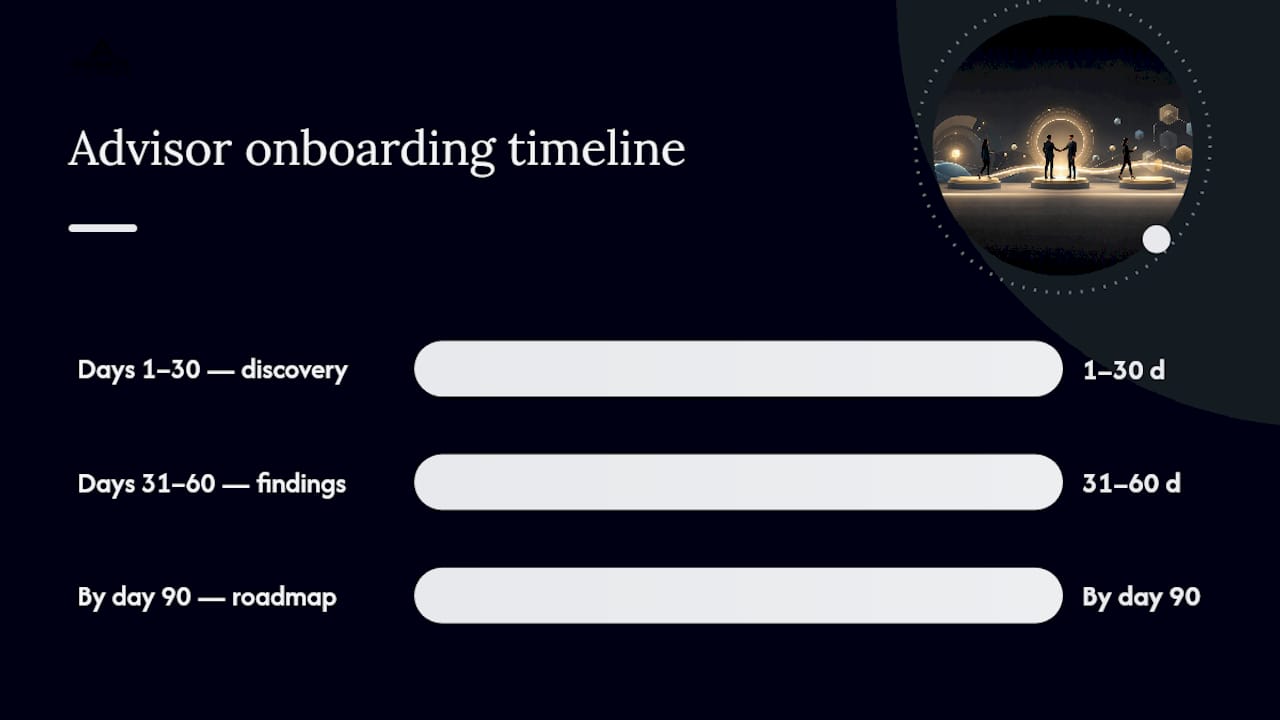
Onboarding guidance: Structure the first 30 days around discovery (stakeholder interviews, documentation review, current-state assessment). Days 31–60 should produce a prioritized findings report. By day 90, the advisor should present a draft roadmap and have established a governance cadence with your leadership team.
For boutique advisors versus larger firms: boutique advisors typically offer more direct senior access and faster decision cycles; larger firms bring broader bench depth and established methodologies. For organizations in highly regulated sectors needing security advisory guidance at the board level, the quality of the individual advisor matters more than firm size.
Measuring the impact of advisory work with real KPIs
Advisory work is measurable. The challenge is that most organizations do not establish baseline metrics before an engagement begins, which makes it impossible to demonstrate improvement afterward.
Suggested KPIs for tracking advisory impact:
- Mean time to remediate (MTTR) critical findings: Track from identification to closure. Advisory-driven prioritization typically reduces MTTR by focusing remediation effort on highest-exposure items first.
- Compliance coverage percentage: Percentage of required controls documented, tested, and evidenced against the applicable framework (NIST, SOC 2, HIPAA, CMMC).
- High-risk vendor reduction: Number of third-party vendors moved from high-risk to medium or low-risk status following advisory-led vendor risk reviews.
- Board-readiness score: A qualitative or structured assessment of whether the board receives timely, accurate, and decision-relevant risk information. Security advisory services that quantify cyber risk in financial and operational terms directly improve this metric.
- Incident and near-miss frequency: Tracked quarterly; a well-advised organization should see a declining trend in high-severity incidents as controls mature.
- Dwell time reduction: Measured from initial compromise to detection. Advisor-driven improvements to detection and threat hunting processes directly affect this figure.
A simple measurement template: define each KPI, assign an owner (typically the CISO or a designated program manager), set a baseline at engagement start, and review quarterly. The advisor should co-own the measurement cadence, not leave it entirely to the internal team.
Why AI is forcing a fundamental shift in what technical advisors must know
AI is not a future consideration for technical advisory. It is a present-day governance problem that most organizations have not yet assigned to anyone with the authority to act on it.

Research on AI's systemic effects in cyber risk management identifies three new feedback loops that AI introduces into the cyber risk environment: AI-augmented attack capabilities that outpace traditional defenses, defensive automation that can be manipulated or deceived, and cascading failure modes that emerge from interconnected AI systems. The study recommends that organizations institutionalize deception-aware governance and use simulation modeling to anticipate these dynamics, rather than relying on point-in-time assessments.
For technical advisors, this means the job description has expanded. Advisors must now:
- Inventory all AI systems in use across the organization, including shadow AI and vendor-embedded models
- Define responsible use policies and governance structures before incidents occur
- Assess AI model integrity and data pipeline security as part of standard architecture reviews
- Advise on AI-specific incident response authorities and pre-authorized delegations
The governance gap is the real risk. Most organizations deploying AI tools have no documented owner for AI risk, no audit trail for model decisions, and no pre-authorized response authority when an AI system behaves unexpectedly. Regulators and courts are already asking whether governance was adequate, not just whether the technology worked. Advisors who cannot address this gap are not equipped for the current environment.
Pro Tip: When onboarding a new advisory engagement, add an AI system inventory to the discovery checklist alongside the standard asset and control inventory. Organizations are often surprised by how many AI tools are already in production without formal governance.
The Norton Rose Fulbright analysis of AI's legal and regulatory implications confirms that courts and regulators now evaluate governance adequacy and the timeliness of board escalation, not just the presence of technical controls. Therefore, advisors must produce traceable decision rights, documented delegations, and rehearsed incident response authorities as standard deliverables, not optional add-ons.
An advisory firm's perspective on what actually works
The most common pattern in advisory engagements that underperform is not a skills gap on the advisor's side. It is a scope gap on the client's side. Organizations engage an advisor to solve a specific technical problem and then discover, three weeks in, that the real problem is a governance structure that cannot act on technical findings even when they are clearly presented.
The engagements that produce durable outcomes share one characteristic: the advisor has a direct line to a decision-maker with budget authority and the mandate to act. When that line runs through three layers of committee approval, remediation stalls regardless of how good the advisory work is.
One practical recommendation you can apply immediately: before signing an advisory engagement, identify the single executive who will own the risk findings and has the authority to approve remediation spend. If that person does not exist or is not committed to the engagement, the advisory work will produce reports, not outcomes. The role of security advisory in strategic cybersecurity depends as much on organizational readiness as on advisor quality.
Heightscg brings senior advisory capacity to your most critical risk decisions
Heightscg works with executive leadership, CISOs, and compliance officers in regulated sectors who need advisory depth without the overhead of building it internally. The firm's advisory capabilities span cybersecurity strategy and technical consulting, managed security operations, incident response, AI security governance, and regulatory compliance across NIST, CMMC, SOC 2, HIPAA, and PCI DSS.
For organizations that need ongoing governance support, Heightscg offers fractional CISO and retainer advisory models that provide senior access without a full-time hire. For those preparing for a specific audit, compliance deadline, or board presentation, fixed-scope engagements deliver a prioritized findings report and roadmap within weeks. The firm's approach connects technical findings directly to business outcomes, so the advice you receive is decision-ready, not just technically accurate.
To discuss your advisory needs and determine the right engagement model, contact Heightscg for an initial consultation.
Sources
- Artificial intelligence is reshaping cybersecurity | Norton Rose Fulbright
- Security Advisory Services: A Boardroom Guide - KingsResearch
- What are Cybersecurity Advisory Services? | CrowdStrike