

More than 60 percent of American healthcare organizations have suffered at least one major cyber incident in the past year. Protecting sensitive patient data takes more than technical solutions. For CISOs and IT security managers, developing a resilient cybersecurity strategy means challenging common myths, aligning with strict regulations, and ensuring that security drives business success. This article spotlights proven approaches and actionable insights to help leaders strengthen their security posture and regulatory compliance.
Table of Contents
- Defining Cybersecurity Strategy And Common Myths
- Aligning Security Strategy With Business Objectives
- Types Of Cybersecurity Strategies In Healthcare
- Regulatory Drivers And Compliance Frameworks
- CISO Responsibilities And Executive Accountability
- Risks, Threats, And Mistakes To Avoid
Key Takeaways
| Point | Details |
|---|---|
| Holistic Cybersecurity Strategy | Healthcare organizations must adopt a comprehensive cybersecurity strategy that integrates technology, processes, and policies to protect against modern threats. |
| Leadership Involvement | Cybersecurity must be a collective responsibility across all levels of healthcare organizations, involving both clinical and administrative leaders. |
| Understanding Regulatory Requirements | Compliance with regulatory frameworks such as HIPAA and NIST is essential, demanding a proactive approach to risk management and continuous monitoring. |
| Creating a Cybersecurity Culture | Fostering a culture of cybersecurity awareness through ongoing training and real-world simulations can significantly enhance organizational resilience against threats. |
Defining Cybersecurity Strategy and Common Myths
A cybersecurity strategy represents a comprehensive framework designed to protect healthcare organizations from evolving digital threats while ensuring patient data privacy and operational continuity. Unlike simplistic technical defenses, this strategic approach integrates technological solutions, human processes, and organizational policies to create a robust security ecosystem.
Healthcare faces unique cybersecurity challenges that extend far beyond traditional IT protection models. Complex healthcare cyber vulnerabilities demonstrate that modern threats target not just technological systems, but patient safety, clinical operations, and institutional reputation. Cybercriminals recognize healthcare's critical infrastructure and sensitive data as high-value targets, making a proactive and holistic strategy essential.
Common myths about healthcare cybersecurity often undermine organizational resilience. Many leaders mistakenly believe that cybersecurity is exclusively an IT department's responsibility or that their organization is too small to be targeted. In reality, healthcare providers of all sizes face persistent risks. Ransomware, data breaches, and sophisticated phishing attacks do not discriminate based on organizational scale. A comprehensive strategy must involve leadership across clinical, administrative, and technological domains, creating a unified defense mechanism.
Pro Tip: Conduct quarterly cybersecurity awareness training that simulates real-world attack scenarios to help staff recognize and respond to potential threats effectively.
Aligning Security Strategy With Business Objectives
Cybersecurity strategy in healthcare must evolve from a purely technical function to a critical business enabler that directly supports organizational objectives. Preventing enterprise-wide cyber risks requires a holistic approach that integrates security initiatives with core business goals, transforming cybersecurity from a cost center to a strategic advantage.
Successful alignment demands breaking down traditional silos between IT security teams and business leadership. Healthcare organizations must create a shared understanding that cybersecurity is not just about technical controls, but about protecting patient trust, maintaining operational continuity, and safeguarding financial performance. This means translating complex technical risks into business language that executives can understand and act upon, demonstrating how robust security directly contributes to organizational resilience and competitive positioning.
Key strategies for effective alignment include developing comprehensive risk assessment frameworks that map cybersecurity threats to specific business impacts, implementing cross-functional governance models that include clinical, administrative, and technological perspectives, and establishing clear metrics that demonstrate the business value of security investments. By treating cybersecurity as a collaborative effort that spans the entire organization, healthcare leaders can create a more adaptive and proactive defense mechanism that supports broader strategic objectives.
Pro Tip: Create a quarterly cybersecurity dashboard that translates technical metrics into clear business impact statements, helping leadership understand the direct relationship between security investments and organizational performance.
Types of Cybersecurity Strategies in Healthcare
Healthcare cybersecurity strategies are not one-size-fits-all solutions, but rather complex, multilayered approaches designed to address the unique vulnerabilities of medical systems. Comprehensive cyber defense frameworks recognize that effective protection requires multiple strategic dimensions addressing technological, human, and organizational risks.
These strategies typically encompass four primary categories: preventive, detective, responsive, and recovery-oriented approaches. Preventive strategies focus on reducing potential entry points for cyber threats through robust access controls, encryption protocols, and network segmentation. Detective strategies involve continuous monitoring systems, threat intelligence platforms, and advanced anomaly detection mechanisms that can identify potential security breaches before they escalate. Responsive strategies concentrate on immediate incident management, including predefined communication protocols, rapid containment procedures, and structured escalation pathways when security events occur.

Recovery-oriented strategies are perhaps the most critical, emphasizing organizational resilience and business continuity. These approaches include comprehensive backup systems, disaster recovery planning, and robust incident response frameworks that enable healthcare organizations to quickly restore critical systems and maintain patient care capabilities during and after potential cyber disruptions. By integrating these strategic types, healthcare organizations can create a holistic cybersecurity approach that protects patient data, maintains operational integrity, and mitigates potential financial and reputational risks.
Here’s a comparison of the four main types of cybersecurity strategies in healthcare and their primary business benefits:
| Strategy Type | Main Focus | Core Benefits | Example Tools/Actions |
|---|---|---|---|
| Preventive | Block attacks before they occur | Minimizes breaches, builds trust | Encryption, multi-factor authentication |
| Detective | Spot threats quickly | Enables timely response | Threat monitoring platforms |
| Responsive | Manage incidents promptly | Reduces damage, ensures safety | Incident response protocols |
| Recovery-Oriented | Restore systems and operations | Supports business continuity | Disaster recovery planning |
Pro Tip: Develop a dynamic, cross-functional cybersecurity playbook that clearly defines roles, responsibilities, and actionable steps for each type of strategic response, ensuring rapid and coordinated organizational action during potential security incidents.
Regulatory Drivers and Compliance Frameworks
Healthcare cybersecurity is fundamentally shaped by a complex network of regulatory requirements designed to protect patient data and ensure organizational security. Federal cybersecurity guidelines mandate comprehensive frameworks that go beyond simple technical compliance, requiring healthcare organizations to implement robust, holistic security strategies that address evolving digital risks.
The primary regulatory drivers include multiple critical frameworks such as HIPAA, which establishes data privacy standards, the FDA's medical device cybersecurity guidelines, and the National Institute of Standards and Technology (NIST) cybersecurity framework. These regulations collectively demand that healthcare organizations develop comprehensive risk management approaches that encompass technological infrastructure, operational processes, and human factors. Each framework introduces specific requirements around data protection, breach notification, risk assessment, and continuous monitoring, compelling healthcare leaders to view cybersecurity as a strategic imperative rather than a mere checkbox exercise.
Implementation of these compliance frameworks requires a multidimensional approach that integrates technological solutions, organizational policies, and ongoing staff education. Healthcare organizations must develop adaptive strategies that not only meet current regulatory standards but anticipate future security challenges. This involves creating dynamic risk management protocols, implementing advanced threat detection mechanisms, ensuring comprehensive staff training, and maintaining detailed documentation of security practices and incident responses.
The table below summarizes major regulatory frameworks in healthcare cybersecurity and what each requires from organizations:
| Framework | Primary Requirement | Impact on Healthcare Organizations |
|---|---|---|
| HIPAA | Protect patient information | Mandates privacy and breach reporting |
| FDA Guidelines | Secure medical devices | Ensures safety of device connectivity |
| NIST CSF | Risk management framework | Guides policy and process development |
Pro Tip: Conduct quarterly comprehensive compliance audits that map your current cybersecurity practices against evolving regulatory requirements, identifying potential gaps and proactively updating your security infrastructure.
CISO Responsibilities and Executive Accountability
The Chief Information Security Officer (CISO) role has dramatically transformed from a purely technical position to a critical strategic leadership function within healthcare organizations. Strategic cybersecurity risk management now requires CISOs to bridge complex technological challenges with broader organizational objectives, translating intricate security risks into actionable business insights.
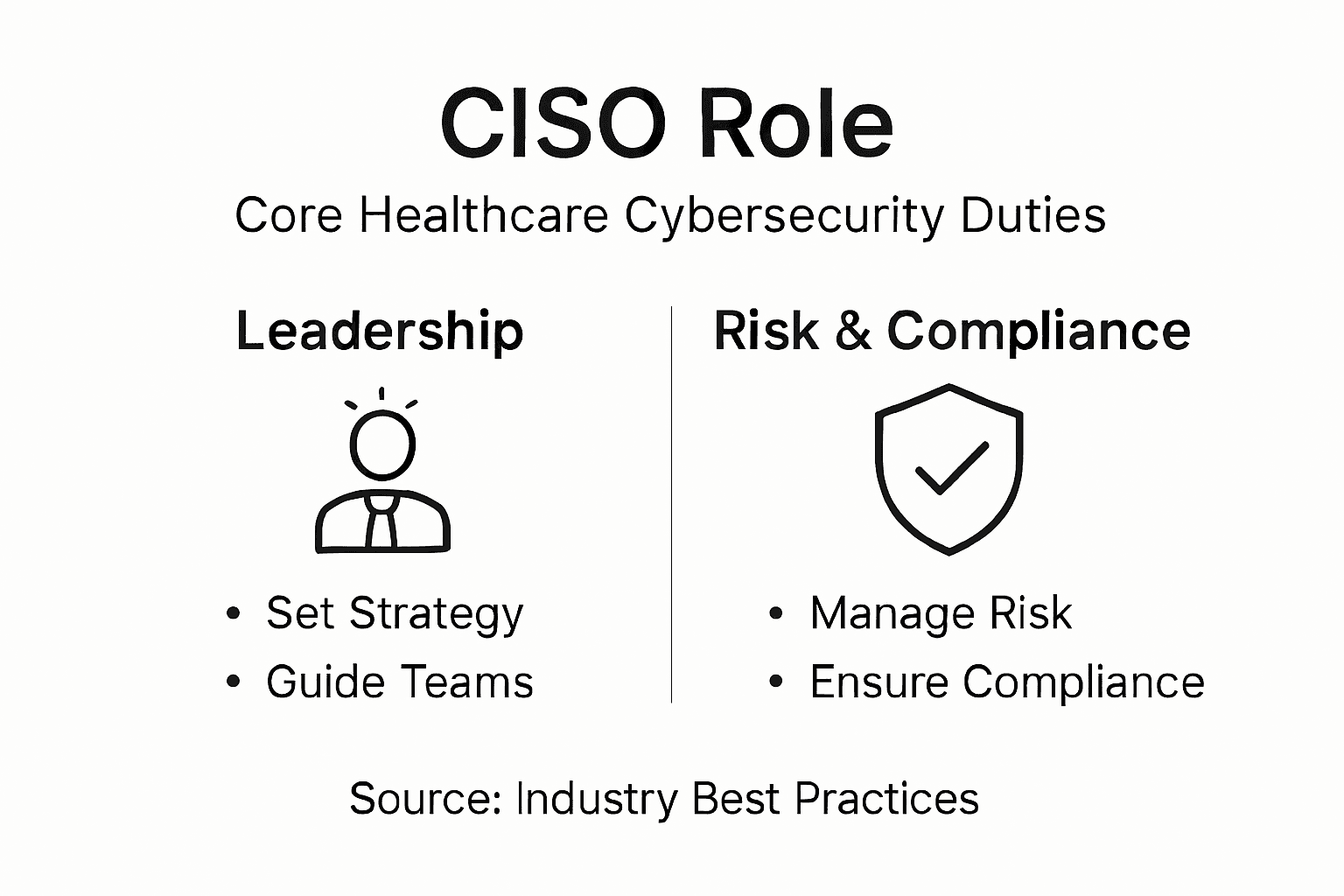
Modern CISOs bear comprehensive responsibilities that extend far beyond traditional IT security parameters. They must develop holistic security strategies, establish robust governance frameworks, ensure regulatory compliance, and create organizational cultures that prioritize cybersecurity as a fundamental business priority. This involves continuous risk assessment, implementing advanced threat detection mechanisms, managing incident response protocols, and maintaining transparent communication channels between technical teams and executive leadership.
Executive accountability in cybersecurity demands that CISOs demonstrate tangible business value and measurable risk mitigation strategies. This requires developing comprehensive reporting mechanisms that articulate cybersecurity investments in terms of financial impact, operational resilience, and potential risk reduction. CISOs must effectively communicate complex technological risks using business-oriented language that resonates with board members and senior executives, transforming cybersecurity from a perceived cost center to a strategic business enabler.
Pro Tip: Develop a quarterly cybersecurity scorecard that translates technical metrics into clear, actionable business performance indicators, enabling more meaningful conversations with executive leadership.
Risks, Threats, and Mistakes to Avoid
Healthcare organizations face an increasingly complex cybersecurity landscape with multifaceted threats that extend beyond traditional technological vulnerabilities. Emerging healthcare cyber threats demonstrate that modern cybersecurity risks are sophisticated, adaptive, and capable of compromising patient safety, operational continuity, and organizational reputation.
The most critical risks in healthcare cybersecurity include ransomware attacks, sophisticated phishing campaigns, social engineering techniques, supply chain vulnerabilities, and targeted attacks on interconnected medical devices. These threats are particularly dangerous because they can disrupt clinical operations, compromise sensitive patient data, and potentially endanger patient lives. Healthcare organizations frequently make fundamental mistakes such as underestimating the complexity of cyber risks, maintaining outdated technological infrastructure, neglecting comprehensive staff training, and failing to develop robust incident response protocols.
Successful risk mitigation requires a holistic approach that goes beyond technological solutions. Organizations must cultivate a proactive cybersecurity culture that emphasizes continuous learning, adaptive defense mechanisms, and integrated risk management strategies. This involves developing comprehensive threat intelligence capabilities, implementing advanced endpoint protection, conducting regular vulnerability assessments, and creating cross-functional incident response teams that can quickly identify, contain, and remediate potential security breaches.
Pro Tip: Implement a continuous cybersecurity awareness program that includes regular simulated phishing exercises and mandatory training modules to help staff recognize and respond to evolving cyber threats effectively.
Strengthen Your Healthcare Cybersecurity Strategy with Trusted Expertise
Healthcare organizations face complex challenges in aligning cybersecurity strategies with strict regulatory requirements and evolving threats. This article highlights the importance of integrating cybersecurity within business objectives to ensure compliance, protect patient data, and maintain operational continuity. If you are a C-level executive or security leader striving to break down silos between IT and business teams or struggling with regulatory compliance demands like HIPAA and NIST frameworks, you are not alone. The right strategic partner can help turn these challenges into competitive advantages.
At Heights Consulting Group, we specialize in delivering tailored cybersecurity consulting and compliance solutions designed specifically for healthcare organizations. Our services include advanced risk management advisory, incident response, endpoint detection, and compliance framework implementation to transform cybersecurity from a technical requirement into a strategic business enabler. Do not wait until threats disrupt patient care or damage your reputation. Take the next step to safeguard your organization by partnering with experts who understand the critical intersection of cybersecurity, compliance, and business goals. Learn more about how we can help you fortify your cybersecurity strategy at Heights Consulting Group and explore our comprehensive managed cybersecurity services designed for highly regulated industries.
Frequently Asked Questions
What is a cybersecurity strategy in healthcare?
A cybersecurity strategy in healthcare is a comprehensive framework designed to protect healthcare organizations from digital threats while ensuring patient data privacy and operational continuity. It involves integrating technology, processes, and policies to create a robust security ecosystem.
Why is compliance important for healthcare cybersecurity?
Compliance ensures that healthcare organizations adhere to relevant regulations and standards, such as HIPAA and FDA guidelines, which are critical for protecting patient information and maintaining trust. It also helps mitigate risks associated with data breaches and cyber incidents.
What are the main components of a cybersecurity strategy?
A comprehensive cybersecurity strategy typically includes preventive measures like access controls, detective tools such as threat monitoring, responsive protocols for incident management, and recovery-oriented plans for maintaining business continuity during cyber disruptions.
How can healthcare organizations improve their cybersecurity compliance?
Healthcare organizations can improve their cybersecurity compliance by conducting regular audits, providing staff training, developing adaptive risk management protocols, and ensuring that their security measures align with regulatory frameworks like HIPAA and NIST.