

Keeping patient data secure while navigating complex regulatory requirements is a constant challenge for healthcare CISOs. The push for stronger protections and evolving compliance standards means every decision can have far-reaching consequences for both security and reputation. Understanding cybersecurity compliance frameworks provides a practical foundation for developing a cohesive strategy that meets the unique demands of the American healthcare sector and supports consistent regulatory adherence.
Table of Contents
- Defining Compliance Frameworks In Cybersecurity
- Key Compliance Frameworks For Healthcare CISOs
- How Frameworks Support Regulatory Requirements
- Integrating Compliance With Risk Management Strategies
- Risks And Penalties For Non-Compliance
- Common Implementation Mistakes To Avoid
Key Takeaways
| Point | Details |
|---|---|
| Importance of Compliance Frameworks | Cybersecurity compliance frameworks provide structured guidelines for organizations to manage and mitigate cyber risks effectively. |
| Role of NIST | The National Institute of Standards and Technology (NIST) offers adaptable frameworks that align with various industry regulations and organizational needs. |
| Risks of Non-Compliance | Non-compliance can result in severe financial, legal, and reputational consequences for organizations, highlighting the importance of adhering to regulatory standards. |
| Dynamic Implementation | Compliance frameworks must be continuously assessed and updated to adapt to evolving technological threats and regulatory requirements. |
Defining compliance frameworks in cybersecurity
Cybersecurity compliance frameworks represent structured guidelines that help organizations establish, implement, and maintain robust security protocols. These strategic blueprints provide comprehensive roadmaps for identifying, managing, and mitigating potential cyber risks across different operational domains.
At their core, cybersecurity compliance frameworks are systematic collections of policies, practices, and procedures designed to:
- Establish clear security standards
- Identify potential vulnerabilities
- Assess organizational risk levels
- Create standardized response mechanisms
- Ensure regulatory adherence
The National Institute of Standards and Technology (NIST) has been instrumental in developing comprehensive frameworks that offer organizations practical guidance. NIST Cybersecurity Framework provides a flexible taxonomy of high-level cybersecurity outcomes applicable across various industries and organizational sizes.
These frameworks are not one-size-fits-all solutions but adaptable strategies that can be customized based on an organization's specific operational context, risk tolerance, and regulatory requirements. They serve as critical tools for translating complex technical security concepts into actionable, strategic plans that executive leadership can understand and implement.
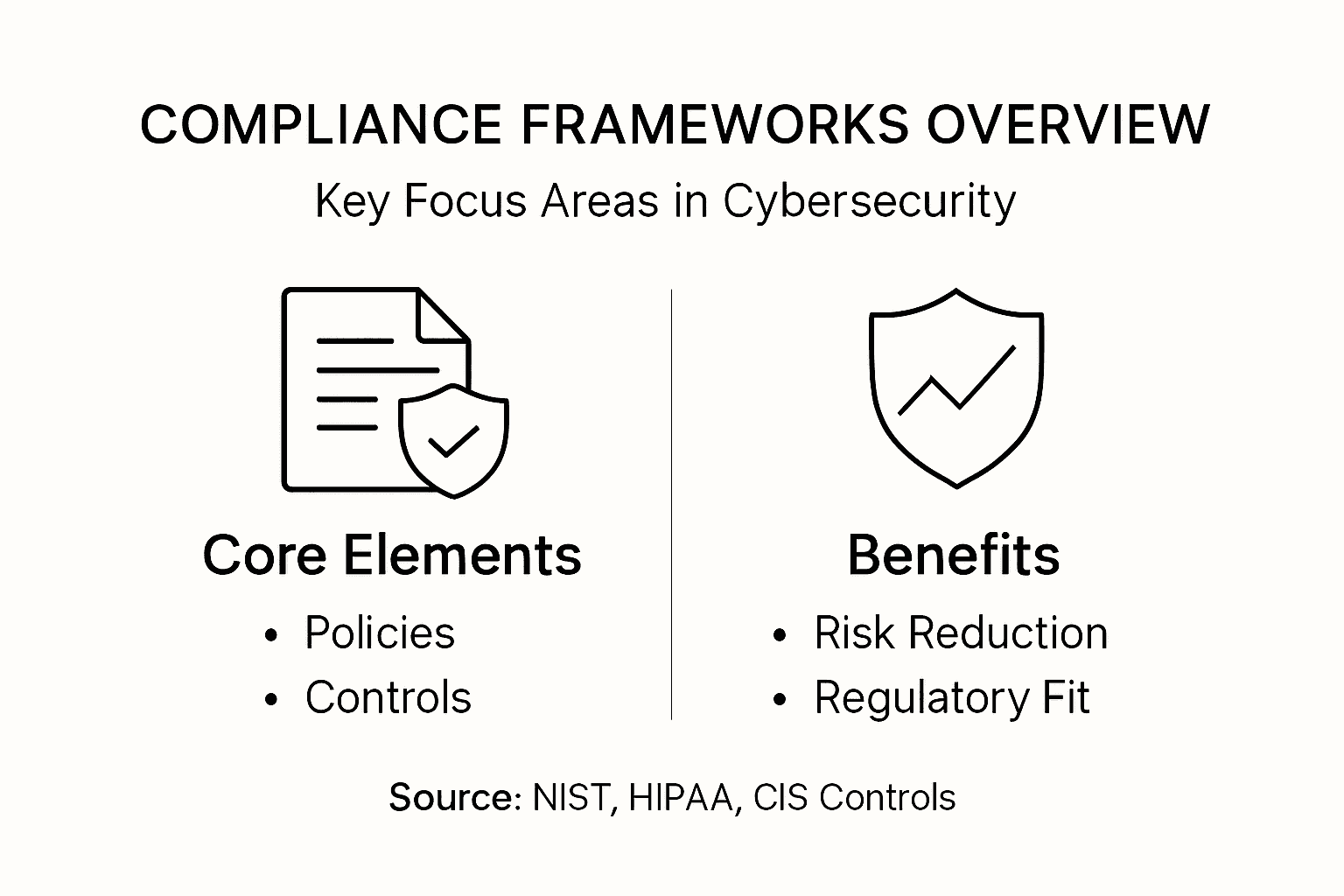
Here's a comparison of leading cybersecurity frameworks and their primary focus:
| Framework | Primary Industry | Key Focus | Typical Use Case |
|---|---|---|---|
| NIST CSF | Cross-industry | Risk management | Enterprise-wide security planning |
| HIPAA | Healthcare | Patient data privacy | Hospital and clinic compliance |
| CIS Controls | Cross-industry | Technical controls | Practical security implementation |
| GDPR | Global/EU | Data protection | Personal data processing compliance |
Pro tip: When selecting a compliance framework, prioritize alignment with your specific industry regulations and organizational risk profile to maximize effectiveness and ensure comprehensive protection.
Key compliance frameworks for healthcare CISOs
Healthcare CISOs navigate a complex landscape of cybersecurity compliance frameworks designed to protect sensitive patient data and maintain robust security infrastructure. These frameworks serve as critical guidelines for managing technological risks and ensuring regulatory adherence across healthcare organizations.
HIPAA Security and Privacy Rules represent the foundational compliance standard for healthcare cybersecurity, establishing comprehensive national protocols for protecting patient health information. Healthcare organizations must implement rigorous safeguards across multiple domains:
- Electronic health record (EHR) protection
- Patient data confidentiality mechanisms
- Access control and authentication protocols
- Network security infrastructure
- Breach notification and response procedures
Beyond HIPAA, healthcare CISOs increasingly rely on additional frameworks to strengthen their security posture. The Center for Internet Security (CIS) Controls provide prioritized cybersecurity best practices that offer practical, actionable guidance for healthcare technology environments.
These frameworks are not static documents but dynamic roadmaps that evolve with emerging technological challenges. They require continuous assessment, adaptation, and strategic implementation to effectively mitigate cybersecurity risks while maintaining operational efficiency and regulatory compliance.
Pro tip: Develop a comprehensive compliance strategy that integrates multiple frameworks, ensuring a holistic approach to healthcare cybersecurity that addresses both regulatory requirements and emerging technological threats.
How frameworks support regulatory requirements
Cybersecurity frameworks serve as essential mechanisms for translating complex regulatory mandates into actionable security strategies. These comprehensive guidelines provide organizations with structured approaches to meeting legal and industry-specific compliance requirements across various sectors.
Security control catalogs enable systematic approaches to implementing regulatory safeguards, helping organizations develop robust defense mechanisms that align with specific legal standards. Key ways frameworks support regulatory requirements include:
- Standardizing security control implementation
- Providing clear documentation for audit processes
- Establishing consistent risk management protocols
- Creating measurable security performance indicators
- Mapping organizational controls to specific regulatory requirements
The National Institute of Standards and Technology (NIST) and other regulatory bodies have developed frameworks that help organizations navigate complex compliance landscapes. These frameworks transform abstract regulatory language into practical, implementable security strategies that can be consistently applied across different operational contexts.
Moreover, compliance frameworks are not static documents but dynamic tools that evolve with changing technological landscapes and emerging regulatory challenges. They provide organizations with flexible yet structured methodologies for maintaining continuous compliance while adapting to new security threats and regulatory expectations.
Pro tip: Conduct regular gap analyses between your current security controls and framework requirements to proactively identify and address potential compliance vulnerabilities.
Integrating compliance with risk management strategies
Successful cybersecurity programs demand a sophisticated approach that seamlessly blends regulatory compliance with strategic risk management. Organizations must develop holistic frameworks that transform compliance from a mere checkbox exercise into a dynamic, strategic advantage.
Governance, Risk, and Compliance (GRC) frameworks create integrated strategies that align legal requirements with organizational risk tolerance. These comprehensive approaches enable businesses to:
- Anticipate potential security vulnerabilities
- Develop proactive mitigation strategies
- Balance regulatory demands with business objectives
- Create measurable risk management metrics
- Establish clear accountability mechanisms
The National Institute of Standards and Technology (NIST) has pioneered approaches for integrating cybersecurity risk management with compliance frameworks. By providing flexible structures that help organizations identify, prioritize, and implement controls, these methodologies transform complex regulatory landscapes into actionable security strategies.

Modern risk management goes beyond traditional compliance models, recognizing that effective security requires continuous adaptation. This means developing agile frameworks that can quickly respond to emerging technological threats while maintaining rigorous adherence to regulatory standards.
Pro tip: Implement a cross-functional governance committee that regularly reviews compliance frameworks and risk management strategies to ensure alignment with evolving business and technological environments.
Risks and penalties for non-compliance
Cybersecurity non-compliance represents a critical vulnerability that can devastate organizations through multifaceted financial, legal, and reputational consequences. The potential risks extend far beyond simple regulatory penalties, threatening an organization's entire operational ecosystem.
Cybersecurity regulatory violations expose organizations to substantial risks that can include:
- Massive financial penalties
- Potential legal litigation
- Significant reputational damage
- Loss of critical business certifications
- Potential operational shutdowns
- Long-term market trust erosion
Regulatory bodies like the Health Insurance Portability and Accountability Act (HIPAA) and the General Data Protection Regulation (GDPR) impose stringent enforcement actions for compliance failures. These penalties can range from substantial monetary fines to comprehensive operational restrictions that can effectively cripple an organization's ability to conduct business.
The financial implications of non-compliance extend beyond immediate penalties. Organizations may face increased insurance costs, reduced investor confidence, and potential long-term economic impact from diminished market reputation. Small and medium-sized businesses are particularly vulnerable, as these penalties can represent proportionally larger financial challenges.
This summary highlights common regulatory penalties for cybersecurity non-compliance:
| Violation Type | Potential Penalty | Long-Term Impact |
|---|---|---|
| HIPAA breach | Fines up to $1.5M/year | Loss of patient trust |
| GDPR violation | Fines up to €20M or 4% of revenue | Reduced investor confidence |
| Certification loss | Revocation of industry certifications | Operational restrictions |
| Legal litigation | Lawsuits and settlements | Reputation and financial damage |
Pro tip: Develop a comprehensive compliance tracking system that provides real-time monitoring and immediate alerts for potential regulatory deviations, enabling proactive risk mitigation.
Common implementation mistakes to avoid
Cybersecurity compliance frameworks demand strategic implementation that goes far beyond simple box-checking. Organizations frequently encounter critical pitfalls that can undermine their entire security infrastructure and regulatory alignment.
Cybersecurity framework mapping represents a critical area where organizations consistently make fundamental errors. The most significant implementation mistakes include:
- Treating compliance as a one-time event
- Insufficient organizational risk assessment
- Lack of continuous monitoring mechanisms
- Inadequate employee training and awareness
- Failing to customize frameworks to specific organizational needs
- Overlooking interdepartmental communication
Many organizations struggle with adopting comprehensive cybersecurity strategies that require nuanced understanding and strategic integration. The most dangerous misconception is viewing compliance frameworks as static documents rather than dynamic, evolving strategic tools that demand ongoing attention and adaptation.
Successful implementation requires a holistic approach that integrates technical controls, organizational processes, and human factors. This means developing a robust framework that is flexible enough to adapt to changing technological landscapes while maintaining rigorous standards of security and regulatory compliance.
Pro tip: Conduct quarterly comprehensive reviews of your compliance framework, involving cross-functional teams to ensure ongoing relevance and effectiveness.
Elevate Your Cybersecurity Compliance with Expert Strategic Guidance
Navigating the complexities of cybersecurity compliance frameworks like NIST, HIPAA, and CIS Controls can feel overwhelming. Many organizations struggle to transform these dynamic standards into actionable, integrated strategies that not only satisfy regulatory requirements but also advance organizational risk management and operational resilience. If you are facing challenges such as continuous monitoring gaps, regulatory non-compliance risks, or difficulty aligning compliance with business objectives, you are not alone. These pain points highlight the need for a trusted partner with deep expertise in both technical implementation and strategic advisory.
Heights Consulting Group specializes in empowering C-level executives and security leaders to convert compliance frameworks into competitive advantages through tailored solutions. Our comprehensive services range from compliance framework integration to AI-driven threat hunting and incident response, all designed to fortify your security posture in regulated industries and complex IT environments. By partnering with us, you gain access to proven methodologies that continuously adapt to evolving cyber threats and regulatory landscapes.
Unlock the full potential of your cybersecurity compliance strategy today.
Experience how strategic compliance management drives success with Heights Consulting Group.
Start transforming compliance challenges into lasting business value now. Visit https://heightscg.com to explore our managed cybersecurity and compliance framework solutions and schedule a consultation with our experts.
Frequently Asked Questions
What are cybersecurity compliance frameworks?
Cybersecurity compliance frameworks are structured guidelines that help organizations establish, implement, and maintain effective security protocols to manage and mitigate cyber risks.
How do compliance frameworks assist in regulatory adherence?
Compliance frameworks provide organizations with a systematic approach to meet legal and industry-specific requirements by standardizing security controls, establishing documentation for audits, and creating measurable security performance indicators.
What common mistakes should organizations avoid when implementing compliance frameworks?
Common mistakes include treating compliance as a one-time event, conducting insufficient risk assessments, neglecting continuous monitoring, and failing to provide adequate employee training.
Why is it important to integrate compliance with risk management strategies?
Integrating compliance with risk management allows organizations to proactively identify vulnerabilities, develop mitigation strategies, and align regulatory demands with their business objectives, transforming compliance into a strategic advantage.
Recommended
- Cybersecurity Insights &Leadership
- Building Resilient Cybersecurity Frameworks for Regulated Industries: A Strategic Guide - Heights Consulting Group
- Building Resilient Cybersecurity Frameworks for Regulated Industries: A Strategic Guide - Heights Consulting Group
- Benefits of Cybersecurity Frameworks for Healthcare