

TL;DR:
- Most organizations discover breaches days or months after initial intrusion, increasing the risk of severe damage and penalties in regulated industries. Proactive threat detection actively searches for threats before they execute malicious actions, shifting security from reactive responses to strategic prevention. Implementing layered methodologies within structured frameworks enhances detection capabilities, but success requires executive support, skilled analysts, and balanced human-AI collaboration.
Most organizations discover a breach not in real time, but days, weeks, or even months after the initial intrusion. By then, the attacker has already moved laterally, exfiltrated data, and potentially embedded persistent backdoors across critical systems. For regulated industries, where a single compliance violation can trigger seven-figure fines and irreparable reputational damage, that lag is not a technical inconvenience. It is an existential risk. Proactive threat detection changes the equation entirely, shifting security from a reactive cleanup effort to a strategic posture that intercepts threats before they cause harm.
Table of Contents
- What is proactive threat detection?
- Key methodologies for proactive detection
- Frameworks and compliance in regulated industries
- Challenges and limitations of proactive detection
- Integrating proactive detection: Executive best practices
- Perspective: Why most proactive threat detection programs underperform
- How Heights Consulting Group empowers proactive security
- Frequently asked questions
Key Takeaways
| Point | Details |
|---|---|
| Proactive vs. reactive | Proactive threat detection finds risks before damage occurs while reactive methods only respond after threats have breached controls. |
| Critical methodologies | Threat hunting, EDR, and advanced analytics combine to provide layered, active defense for sensitive industries. |
| Framework-driven compliance | Structured frameworks like PROID align proactive detection with regulatory standards, reducing risk and breach costs. |
| Human insight required | True effectiveness comes from integrating AI with skilled analysts—automation alone cannot solve the complexities of modern threats. |
What is proactive threat detection?
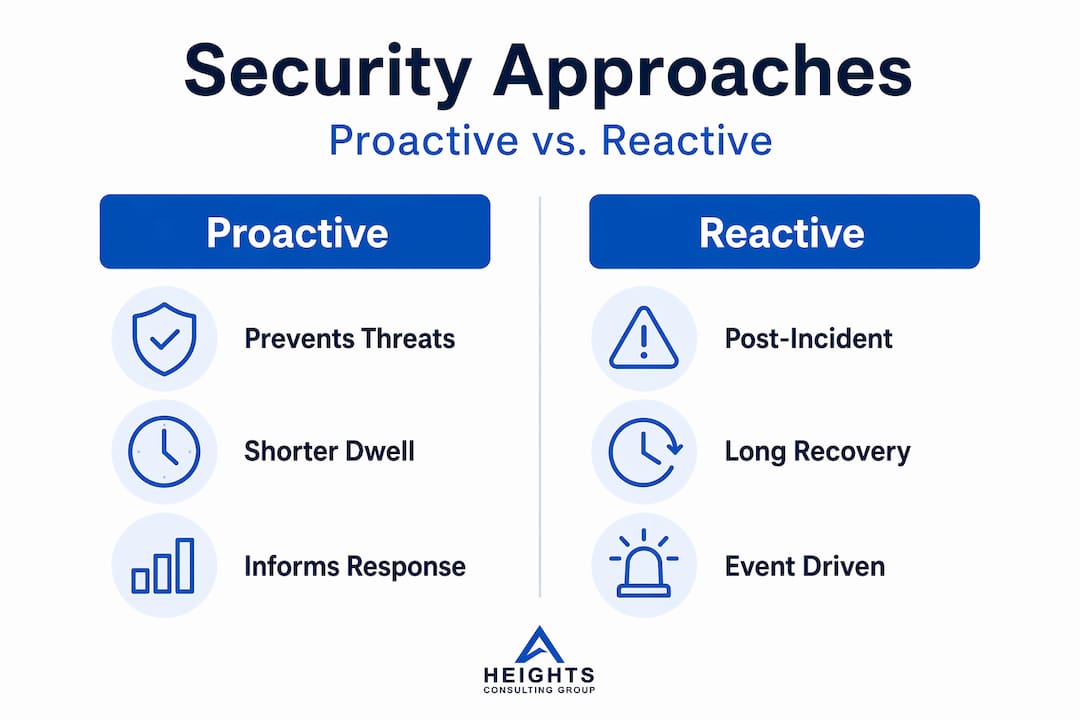
Reactive cybersecurity is built around alerts. Something triggers a rule, an analyst investigates, and the team responds. The fundamental problem is that this model assumes the threat has already acted. Proactive threat detection inverts that assumption entirely.
As defined in leading security research, proactive threat detection is a preemptive cybersecurity strategy that actively searches networks, endpoints, and environments for threats before they execute malicious payloads, using behavioral analysis, threat hunting, and AI rather than waiting for alerts. The difference is not merely technical. It is philosophical.
"Proactive detection treats the absence of an alert not as proof of safety, but as an invitation to look harder."
This matters most in highly regulated environments, such as healthcare, financial services, defense contracting, and critical infrastructure, where the cost of a breach extends far beyond technical remediation. Regulatory penalties, mandatory disclosure requirements, litigation, and loss of customer trust compound quickly. In these sectors, catching a threat two weeks earlier is not a convenience. It is a material business outcome.
The contrast between approaches is stark:
- Reactive detection waits for known attack signatures, logs anomalies after the fact, and measures success by response time.
- Proactive detection hunts for indicators of behavior, searches for attacker presence before execution, and measures success by threats neutralized before impact.
- Reactive relies on predefined rules that attackers learn to circumvent.
- Proactive uses behavioral baselines and threat intelligence to detect novel tactics that bypass standard signatures.
- Reactive requires attackers to make a visible move before defenders respond.
- Proactive assumes attackers are already present and actively searches for evidence.
Organizations that have adopted threat hunting for resilience consistently report shorter dwell times and lower breach costs. Understanding why starts with understanding how proactive detection is actually executed, and why DMARC monitoring's role in detection is an often-overlooked entry point into proactive email threat prevention.
Key methodologies for proactive detection
Proactive threat detection is not a single tool or technology. It is a layered discipline that draws on multiple methodologies, each addressing a distinct layer of the threat landscape.
Key methodologies include threat hunting (hypothesis-driven searches), vulnerability management, endpoint detection and response (EDR), behavioral analytics, threat intelligence integration, and machine learning for anomaly detection. Each plays a specific role, and the most effective programs integrate them systematically rather than deploying them in isolation.
| Methodology | Primary Focus | Key Strength |
|---|---|---|
| Threat hunting | Hypothesis-driven network and endpoint search | Finds threats that evade automated detection |
| EDR | Endpoint activity monitoring and response | Real-time visibility into device-level behavior |
| Behavioral analytics | Baselining normal activity to detect deviation | Catches insider threats and lateral movement |
| Machine learning | Pattern recognition across large data sets | Scales detection across high-volume environments |
| Threat intelligence | Contextual data on known attacker tactics | Prioritizes hunt hypotheses based on current threat actors |
| Vulnerability management | Identifying and remediating exploitable weaknesses | Reduces attack surface before exploitation occurs |
These methodologies are most powerful when they inform one another. Threat intelligence feeds hypothesis formation for threat hunters. EDR data provides the raw telemetry that behavioral analytics engines analyze. Machine learning flags anomalies that human analysts then enrich with context. The result is a layered defense that is far more resilient than any single tool could achieve independently.
One critical dimension that forward-looking security programs are incorporating is the shift from IoB vs. reactive signatures, where indicators of behavior (IoB) replace or augment static indicators of compromise (IoC). This distinction matters because sophisticated attackers routinely modify their tools to bypass signature-based detection. Behavioral indicators, by contrast, capture how an attacker operates regardless of what tool they use.
Pro Tip: The most common mistake organizations make is deploying advanced tools without first establishing behavioral baselines. Without a clear picture of what "normal" looks like in your environment, machine learning models generate noise rather than insight. Invest in baselining before tuning detection logic. Effective threat hunting strategies, AI advantages in cybersecurity, and a disciplined endpoint detection guide all reinforce this foundational principle.
Frameworks and compliance in regulated industries
Knowing which tools to deploy is only part of the challenge. Regulated industries require structured, auditable, and repeatable security programs. Frameworks provide the architecture that turns individual methodologies into coherent, scalable operations.
One of the most rigorous structured approaches available is the PROID framework. The PROID framework for regulated industries provides structured compromise assessments with distinct phases: preparation, planning, deployment, analysis (covering both signature-based and signature-less detection, as well as automated and human-led review), and reporting. This phased approach ensures that security programs can be audited, iterated upon, and aligned with regulatory requirements without sacrificing operational effectiveness.
The business case for this level of structure is compelling. IBM reports that credential-based breaches take an average of 292 days to identify and contain, at an average cost of $4.88 million per incident. Early detection, enabled by structured proactive programs, directly compresses that timeline and the associated cost.
A practical proactive assessment, informed by the PROID methodology, follows a disciplined sequence:
- Preparation: Define the scope of the assessment, inventory critical assets, and establish the threat models most relevant to your regulatory environment and industry sector.
- Planning: Develop specific hunt hypotheses grounded in current threat intelligence, identify data sources required for analysis, and assign analyst responsibilities.
- Deployment: Instrument the environment with appropriate telemetry collection, activate behavioral monitoring tools, and confirm that data pipelines are functioning correctly.
- Analysis: Execute both automated detection sweeps and human-led hypothesis testing, using signature-based and signature-less techniques to surface both known and novel threats.
- Reporting: Document findings in terms of business risk, map them to relevant compliance frameworks such as NIST CSF, CMMC, or HIPAA, and develop a prioritized remediation roadmap.
| PROID phase | Business outcome |
|---|---|
| Preparation | Reduced scope ambiguity, faster execution |
| Planning | Higher-confidence hunt hypotheses, fewer wasted cycles |
| Deployment | Comprehensive telemetry coverage across regulated assets |
| Analysis | Earlier threat identification, lower dwell time |
| Reporting | Audit-ready documentation, compliance alignment |
Organizations that adopt proactive monitoring tactics aligned with structured frameworks report measurable improvements in both threat detection rates and compliance audit outcomes. The framework does not just improve security. It produces evidence that your security posture meets regulatory expectations.
Challenges and limitations of proactive detection
Proactive threat detection is not without its difficulties. Understanding the real-world limitations is essential for security leaders who want to build programs that deliver on their promise rather than disappoint after significant investment.
The most technically demanding challenge involves living-off-the-land (LOTL) attacks that evade signature detection entirely, because attackers use legitimate system tools rather than custom malware. Detecting these requires User and Entity Behavior Analytics (UEBA), identity monitoring, and Network Detection and Response (NDR), all operating in concert. Additionally, slow-paced autonomous attacks can deliberately stay beneath speed-based detection thresholds, and machine learning alerts frequently require human enrichment to avoid generating unmanageable volumes of false positives.
The organizational challenges are equally significant:
- Analyst skill gaps: Effective threat hunting requires analysts capable of forming and testing hypotheses, a skill set that is significantly scarcer than standard SOC analyst competencies.
- Tool proliferation without integration: Many organizations accumulate detection tools that generate redundant alerts rather than correlated intelligence, increasing noise and reducing analyst effectiveness.
- False positive fatigue: Overly aggressive detection tuning leads to alert overload, causing analysts to deprioritize or dismiss alerts that may be genuine threats.
- Insufficient telemetry coverage: Proactive detection is only as good as the data available. Gaps in logging, particularly across cloud environments and OT/ICS systems, create blind spots.
- Leadership misalignment: Security teams frequently lack the executive sponsorship needed to sustain proactive programs through periods of low visible threat activity.
"Pure automation is insufficient. Effective proactive detection requires the integration of AI with human oversight, and the maturity to progress from reactive alerting to predictive hunting." This expert perspective on proactive detection underscores why technology investment alone does not produce results.
Pro Tip: When scaling proactive detection, resist the temptation to expand tool coverage before validating analyst capacity. A program staffed by two skilled analysts with focused tooling consistently outperforms a large technology stack with insufficient human expertise to interpret its output. Prioritize analyst capability development alongside technology investment. AI for cyber risk management and structured threat hunting workflows are two areas where pairing technology with trained human judgment consistently produces superior outcomes.
Integrating proactive detection: Executive best practices
Security leaders who successfully institutionalize proactive detection share a common trait. They treat it as a strategic program, not a technical project. The organizational changes required are as important as the technical ones.

Proactive demands upfront investment in tools and skills but lowers long-term costs. Reactive security is essential for addressing truly unknown threats, but it allows initial damage to occur. A hybrid approach, leveraging the MITRE ATT&CK framework to inform both prevention and response, is the model that most closely matches the threat realities facing regulated organizations in 2026.
Embedding that hybrid approach into an enterprise security program requires deliberate action across people, process, and technology:
- Secure executive sponsorship before initiating any proactive program. Without C-suite commitment, proactive detection initiatives stall when they fail to generate immediate, visible results.
- Conduct a maturity assessment to establish your current detection posture, identify telemetry gaps, and define realistic milestones for advancing from reactive alerting to proactive hunting.
- Align hunt priorities to business risk, using threat intelligence specific to your sector. A healthcare organization faces different adversarial priorities than a defense contractor. Hypotheses should reflect that reality.
- Invest in analyst development through structured threat hunting training, red team exercises, and exposure to industry threat intelligence sharing communities such as ISACs.
- Integrate MITRE ATT&CK as a common language across security operations, enabling consistent hypothesis formation, detection mapping, and communication with non-technical stakeholders.
- Establish measurable outcomes that connect detection performance to business metrics: mean time to detect (MTTD), mean time to respond (MTTR), dwell time reduction, and compliance audit pass rates.
The strategic advantages of threat hunting for CISOs extend beyond risk reduction. Organizations with mature proactive programs demonstrate stronger audit performance, more credible board reporting, and a more defensible security posture during regulatory examinations.
Perspective: Why most proactive threat detection programs underperform
In our experience working with organizations across highly regulated sectors, the most common reason proactive detection programs fail to deliver is not a technology problem. It is a sequencing problem.
Organizations purchase EDR platforms, behavioral analytics engines, and threat intelligence subscriptions, then expect the investment alone to produce proactive capability. It rarely does. The technology is sound, but without a hypothesis-first methodology driving how analysts engage with it, the output is indistinguishable from a reactive alert queue. The tools surface anomalies. Analysts need to know what questions to ask of those anomalies before the data becomes actionable intelligence.
The second most common failure mode is underestimating analyst capability as a program variable. Proactive threat hunting is a skilled discipline, closer in nature to investigative analysis than to traditional SOC monitoring. Organizations that staff their hunting programs with analysts accustomed to alert triage find that the program defaults back to reactive behavior within months, regardless of the tooling in place. The hypothesis-first approach requires analysts who can think like adversaries, not just respond to system-generated alerts.
What seasoned consulting teams do differently is start with the threat model rather than the tool catalog. Understanding which adversary groups target your sector, what their preferred tactics and techniques are, and where your environment provides the highest-value targets, shapes every subsequent technology and staffing decision. Continuous framework tuning, revisiting and refining hunt hypotheses based on evolving intelligence, prevents programs from calcifying around outdated assumptions.
One final point that is rarely discussed openly: executive support is not a soft success factor. It is the hardest technical requirement of a proactive program. When leadership treats proactive detection as an overhead cost rather than a strategic capability, programs are defunded or deprioritized precisely when they require sustained investment to mature. The technical consulting guidance available for business resilience consistently identifies executive alignment as the variable that separates programs that scale from those that stagnate.
How Heights Consulting Group empowers proactive security
Security leaders who are ready to move from reactive posture to proactive resilience need more than technology. They need a strategic partner with the industry-specific expertise to design, implement, and continuously refine a detection program that aligns with both business objectives and regulatory requirements.
Heights Consulting Group partners with executive and security leadership teams to build layered, framework-driven proactive security programs tailored to the compliance demands of regulated industries. From threat hunting advisory services to structured implementation of EDR, behavioral analytics, and AI-augmented detection, our approach is grounded in operational experience and regulatory fluency. We bring the hypothesis-first methodology, analyst expertise, and executive communication discipline that proactive programs require to deliver measurable outcomes. If you are ready to build a detection strategy that gets ahead of threats rather than responding to their aftermath, contact Heights Consulting Group to discuss a custom proactive detection roadmap for your organization. Explore our cybersecurity consulting services to learn more about how we support security leaders at every stage of program maturity.
Frequently asked questions
How does proactive threat detection reduce business risk?
By identifying threats before execution, proactive detection minimizes breach impact, reduces operational downtime, and prevents the regulatory penalties that follow confirmed incidents. IBM's breach cost data demonstrates that early detection directly compresses the 292-day average identification timeline and the $4.88 million average cost associated with credential breaches.
Can proactive threat detection fully replace reactive security measures?
No. A hybrid approach is the recognized best practice, where proactive detection reduces risk exposure while reactive systems address novel threats that breach initial defenses. Effective programs integrate AI automation with human analyst oversight, progressing in maturity from reactive alerting toward predictive hunting over time.
What frameworks support proactive threat detection in regulated industries?
The PROID framework provides a structured, phased approach covering preparation, planning, deployment, analysis, and reporting, making it particularly well-suited to compliance-driven sectors that require auditable and repeatable security programs.
What is the role of AI and human analysts in proactive detection?
AI automates large-scale threat identification and anomaly detection, but skilled analysts provide the context, hypothesis generation, and interpretive judgment that prevent false positive overload and ensure machine-generated alerts translate into accurate, actionable intelligence.
Recommended
- Proactive Cybersecurity: Key Strategies for Defense - Heights Consulting Group
- Proactive Cybersecurity Monitoring Tactics for Threat Prevention in 2026: Heights Consulting Group.
- Transforming Cybersecurity: Prevent Costly Breaches - Heights Consulting Group
- Proactive Cybersecurity: Stay Ahead of Threats - Heights Consulting Group