

Effective phishing prevention for healthcare requires three actions above all others: harden your email gateway with SPF/DKIM/DMARC and advanced threat filtering, deploy phishing-resistant MFA (FIDO/WebAuthn or PKI-based) on every high-risk account, and run monthly simulated phishing campaigns with immediate, targeted remediation for staff who click. These three controls address the majority of the attack surface that healthcare threat actors exploit today.
Your 24–72 hour priority checklist:
- Assign: Designate an owner for each control (SOC lead for email gateway, IT/IAM team for MFA, HR/training coordinator for simulations) and confirm executive sponsorship.
- Measure: Pull your current email gateway block rate, MFA enrollment percentage across clinical and administrative staff, and the last known simulation click rate. If you do not have these numbers, that gap is itself the first finding.
- First artifact to produce: A one-page risk register entry documenting current state, target state, and a 90-day remediation timeline for each of the three controls. This becomes your audit evidence and your executive briefing anchor.
The rest of this guide builds the full program around those three pillars, with compliance mapping, KPIs, AI governance, and a time-bound roadmap.
Key Takeaways
Effective phishing prevention for healthcare requires a closed loop of technical controls, workforce training, continuous measurement, and executive governance, all documented as audit evidence.
| Point | Details |
|---|---|
| Three highest-impact controls | Email gateway hardening, phishing-resistant MFA, and monthly simulated phishing with targeted remediation stop the majority of healthcare phishing risk. |
| Simulation cadence | Monthly simulations for high-risk roles; 6–12 per year for general staff, with immediate microlearning for staff who click. |
| KPIs to demand | Low click and credential submission rates, high report rate, and rapid median time-to-containment for high-privilege accounts. |
| AI governance is required | Any AI email security tool must be covered by a BAA, provide explainability, and be governed by an AI-specific incident playbook per HSCC guidance. |
| Heightscg engagement | Heightscg provides technical implementation, managed SOC coverage, and tabletop facilitation to accelerate program design for healthcare organizations. |
Table of Contents
- Why phishing is uniquely dangerous to healthcare operations
- Email and gateway protections every healthcare organization must implement
- Access controls that stop credential-based phishing from spreading
- Training, phishing simulations, and targeted remediation
- Detecting phishing failures and responding fast
- Risk-based governance: mapping controls to HIPAA, NIST, and CISA
- KPIs to track and how to use them for continuous improvement
- AI, governance, and advanced program design for security leaders
- Your 90-day roadmap to a defensible phishing program
- An advisory perspective on what actually moves the needle
- How Heightscg helps healthcare organizations reduce phishing risk
- Sources
Why phishing is uniquely dangerous to healthcare operations
Phishing in healthcare is not primarily a data-confidentiality problem. It is a patient-safety problem. A credential-harvesting campaign that compromises an EHR administrator account can trigger a full system outage, delay medication orders, divert ambulances, and force clinical staff to revert to paper workflows. The downstream harm to patients is direct and measurable in ways that a breach at a financial institution simply is not.
According to the HICP Technical Volume 2, phishing was present in 36% of breaches analyzed in the Verizon Data Breach Investigations Report, and email delivered 23% of malware across the healthcare sector. Those figures explain why email-focused protections consistently appear at the top of every authoritative framework's mitigation list.
The most common attack vectors in healthcare follow predictable patterns. Credential harvesting targets EHR login pages and Microsoft 365 or Google Workspace portals, often through convincing spoofed login screens. Malware droppers arrive as invoice attachments or shared-document links. Business email compromise (BEC) impersonates CFOs, department heads, or payer representatives to redirect payments or authorize fraudulent wire transfers. Smishing and QR-code quishing (quishing) exploit the mobile devices nurses and physicians carry throughout the clinical environment. Vendor-targeted spear phishing exploits the trusted relationships healthcare organizations maintain with medical device manufacturers, billing services, and EHR vendors.
Every one of these vectors creates HIPAA exposure. A successful phish that touches protected health information (ePHI) triggers the HIPAA Breach Notification Rule, potentially requiring notification to affected patients, HHS, and in some cases the media, regardless of whether the data was exfiltrated or merely accessed without authorization.
Email and gateway protections every healthcare organization must implement
The minimum baseline for email security for healthcare organizations consists of four authentication records and a secure email gateway (SEG) covered by a Business Associate Agreement (BAA). Without a BAA, your SEG vendor is an unmanaged business associate with access to ePHI in transit, which is a HIPAA violation waiting for an audit.
Baseline controls (implement first):
- SPF: Publish a Sender Policy Framework record for every domain that sends mail, including subdomains used by EHR systems, patient portals, and billing platforms. A missing SPF record on a subdomain is a common gap auditors find.
- DKIM: Enable DomainKeys Identified Mail signing on all outbound mail streams. Verify that third-party senders (EHR vendors, billing services) are either included in your SPF record or signing with their own DKIM key under your domain.
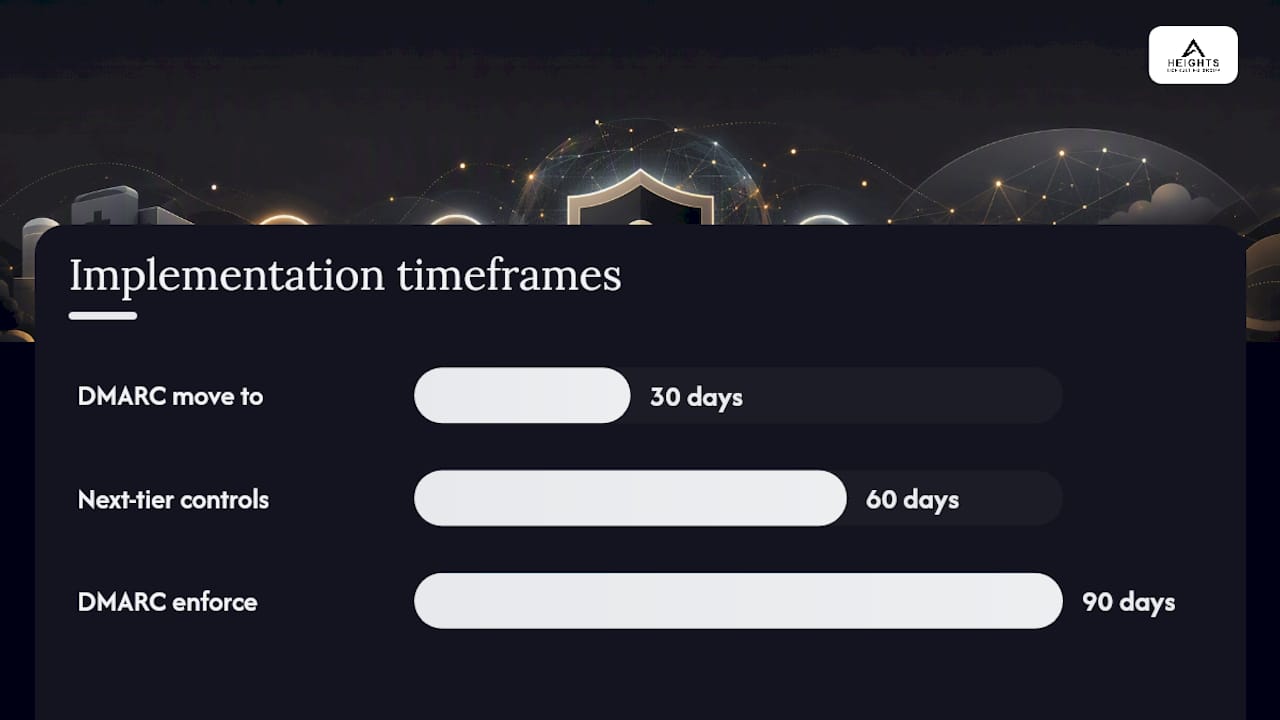
- DMARC: Start with
p=noneto collect telemetry, move top=quarantinewithin 30 days, and enforcep=rejectwithin 90 days. DMARC enforcement is the single control that stops domain spoofing of your organization's identity. - Anti-spam and anti-malware filtering: Configure your SEG to block known malicious senders, scan attachments, and quarantine suspicious messages. Tune aggressiveness by user group: clinical staff who receive external lab results and referrals need different thresholds than administrative staff.
- Secure email gateway with BAA: Select a vendor that will sign a BAA and that integrates with your SIEM for telemetry. Latency matters in clinical environments; validate that the SEG does not add perceptible delay to time-sensitive communications.
Next-tier controls (implement within 60 days):
- URL click protection and link rewriting: Every URL in inbound email is rewritten through a proxy that checks the destination at click time. This catches phishing links that were clean at delivery but became malicious after the fact.
- Attachment sandboxing: Suspicious attachments are detonated in an isolated environment before delivery. Configure sandbox policies to hold attachments from external senders for clinical-non-urgent workflows; coordinate with clinical operations to identify message types that cannot tolerate delay.
- Content disarm and reconstruction (CDR): CDR strips active content (macros, embedded scripts) from Office and PDF documents and reconstructs a clean version. It is particularly effective against macro-based malware droppers.
- Outbound filtering: Scan outbound mail for ePHI patterns (MRN formats, SSN patterns, diagnosis codes) to detect exfiltration and misconfigured automated reports.
Pro Tip: Link rewriting creates a tradeoff worth discussing with clinical leadership. Clinicians who hover over links to verify destinations before clicking will see the rewriting proxy URL, not the original. Some interpret this as suspicious and report the email, generating false positives. Brief clinical champions on what rewritten URLs look like, and configure your SEG to display the original destination URL in the hover tooltip where the vendor supports it.
Vendor selection criteria beyond the BAA: evaluate whether the platform exports structured telemetry to your SIEM, whether it supports role-based policy application (so you can apply stricter controls to billing and executive accounts), and whether the vendor's support model includes healthcare-specific SLAs.
Access controls that stop credential-based phishing from spreading
Deploy phishing-resistant MFA on every privileged account, every EHR administrator account, and every remote-access entry point before you address anything else in the access management stack. The CISA HPH Sector Mitigation Guide identifies phishing-resistant MFA as a core mitigation for healthcare organizations handling ePHI, and the distinction between "phishing-resistant" and "phishing-aware" MFA matters enormously in practice.
Traditional SMS one-time passwords and authenticator app push notifications are vulnerable to two well-documented bypass techniques. MFA fatigue attacks flood a user with push notifications until they approve one out of frustration or confusion. Adversary-in-the-middle (AitM) proxies intercept the session token in real time, rendering the OTP useless as a protection. FIDO/WebAuthn hardware keys (YubiKey, Google Titan) and PKI-based smart cards are bound to the specific origin domain, so an AitM proxy cannot replay the credential against a different site.
Practical configuration priorities:
- Inventory all privileged accounts, service accounts, and machine identities before you configure MFA policies. Accounts you do not know about cannot be protected.
- Apply FIDO/WebAuthn or PKI-based authentication to: domain administrators, EHR super-users, security operations accounts, payroll and financial system administrators, and any account with access to bulk ePHI exports.
- For break-glass (emergency access) accounts, store hardware tokens in a physically secured location with dual-person access controls, and log every use. These accounts are high-value targets precisely because they bypass normal controls.
- Service accounts and machine identities should use certificate-based authentication or managed identity solutions rather than shared passwords. Rotate credentials on a defined schedule and alert on any out-of-cycle use.
- Extend phishing-resistant MFA to remote access (VPN, remote desktop) and patient portal administrative interfaces within 60 days of the initial deployment.
Pro Tip: Role-based access reviews tied to EHR systems are often neglected after initial provisioning. Run a quarterly access certification for any account with write access to clinical records or the ability to export patient data. Accounts belonging to former employees or contractors that remain active in the EHR are a persistent finding in HIPAA audits and a ready-made entry point for phishing-enabled account takeover.
Least-privilege principles apply at the application layer, not just the network layer. An EHR user who needs to view records for their unit should not have system-wide query access. Segment access by department, location, and role, and document the segmentation as evidence for your HIPAA Security Rule risk analysis.
Training, phishing simulations, and targeted remediation
The most technically complete email security stack will still pass some phishing messages. The 405(d) Email Phishing guidance is direct: simulated phishing campaigns with targeted remediation are an effective method for reducing click and credential-submission rates, and they produce the documentation auditors expect for HIPAA and HITRUST assessments.
A defensible program follows this sequence:
- Define scope and risk tiers. Segment staff into high-risk roles (billing, executive assistants, IT administrators, EHR super-users, HR) and general staff. High-risk roles receive monthly simulations; general staff receive simulations on a 6–12 per year cadence, adjusted based on click-rate trends.
- Design healthcare-specific simulation templates. Generic "your package is delayed" templates do not reflect the actual threat environment. Use scenarios that mirror real healthcare workflows: EHR login prompts requesting re-authentication, release-of-information requests from unfamiliar fax numbers, payer or claims invoices with urgent payment links, telehealth schedule changes with embedded links, and QR-code quishing embedded in what appears to be a compliance training notice.
- Configure immediate microlearning. When a staff member clicks a simulated phishing link, the redirect should serve a 2–3 minute targeted lesson explaining exactly what the phishing indicator was and what to do instead. Delayed training (a module assigned days later) has measurably lower retention.
- Build a reporting workflow. Deploy a one-click "Report Phishing" button integrated with your email client (Microsoft 365 or Google Workspace). Route reported messages to your SOC for triage. Track the report rate alongside the click rate; a rising report rate is a leading indicator that the program is working.
- Document everything for auditors. Retain simulation schedules, participation rates, click rates by department, remediation completion rates, and trend data. This documentation satisfies HIPAA Security Rule §164.308(a)(5) (Security Awareness and Training) and supports HITRUST and NIST CSF audit evidence requirements. A practical compliance guide for healthcare staff confirms that 6–12 simulations per year for general staff, with monthly cadence for high-risk roles, is the standard auditors expect.
- Use simulation results to tune technical controls. If a specific department consistently shows elevated click rates, that is a signal to apply stricter email filtering policies to that group, not just more training.
Pro Tip: Culture determines whether your reporting loop works. Staff who fear punishment for clicking a simulated phish will not report real suspicious emails. Frame the program explicitly as a no-shame learning exercise from the start, with visible leadership participation. When executives receive and report simulated phishing, it signals that the program applies to everyone and that reporting is the right behavior, not an admission of failure.
Detecting phishing failures and responding fast
Assume some phishing messages will reach inboxes and some users will click. The program's value is not in achieving a zero-click rate; it is in detecting the failure quickly, containing the compromise before ePHI is accessed or exfiltrated, and recovering without disrupting clinical operations.
Detection signals to monitor continuously:
- Post-delivery analytics from your SEG or Microsoft 365 Defender / Google Workspace security center, flagging messages that were delivered but later identified as malicious.
- User-reported phishing volume and time-to-report (the faster staff report, the faster you can pull the message from all inboxes).
- Suspicious login patterns: logins from new geographies, impossible travel, off-hours access to EHR systems, and multiple failed MFA attempts followed by a success.
- Large-volume record access: a user account querying significantly more patient records than their baseline is a strong indicator of post-compromise data staging.
- Cross-system correlation: an email delivery event followed within minutes by a new device registration and an EHR access spike is a high-confidence compromise signal.
Incident response playbook for a phishing-triggered EHR compromise: Detect: SOC receives a user-reported phishing alert or post-delivery analytics flag. Triage: automated triage scores the incident by account privilege level and data access scope. Contain: quarantine the compromised account, reset credentials, revoke active sessions, and pull the phishing message from all inboxes via admin purge. Recover: forensic triage of the account's activity log to identify all ePHI accessed; patient-impact assessment to determine breach notification obligations under HIPAA; restore normal access only after credential hygiene is confirmed.
For tabletop exercises, a phishing-triggered EHR outage scenario is the most operationally relevant test for healthcare organizations. The exercise should assign explicit roles: SOC lead (detection and containment), clinical operations lead (care continuity decisions), CISO (executive communication and breach notification trigger), legal counsel (notification obligations), and vendor management (EHR vendor escalation). The goal is not to simulate a perfect response but to surface the gaps in communication, decision authority, and documentation that only appear under pressure. Heightscg's incident response practice supports tabletop facilitation for exactly this scenario.
The CISA HPH Sector Mitigation Guide recommends integrating email security telemetry with endpoint detection and SIEM correlation to reduce time-to-containment. Median time-to-containment is one of the KPIs that matters most to regulators reviewing a breach notification.
Risk-based governance: mapping controls to HIPAA, NIST, and CISA
Phishing prevention is not a technical project. It is a risk-managed program that requires an executive sponsor, documented controls, measurable evidence, and clear ownership across multiple organizational functions. Without that governance structure, even well-configured technical controls fail audits because the organization cannot demonstrate they are managed, monitored, and improved over time.
The table below maps core phishing controls to their regulatory and framework anchors. For a deeper look at NIST framework alignment in healthcare, Heightscg's published guidance covers the full control mapping in detail.
| Control | HIPAA Security Rule | NIST CSF | CISA HPH Guidance |
|---|---|---|---|
| Email gateway (SPF/DKIM/DMARC, SEG) | Encryption/Integrity | PR.DS-2, DE.CM-3 | Email security baseline |
| Advanced threat protection (sandbox, CDR, URL rewrite) | §164.308(a)(1) Risk Management | PR.DS-2, DE.CM-3 | Advanced email controls |
| Phishing-resistant MFA | Authentication | PR.AC-7 | Phishing-resistant MFA |
| Security awareness and simulations | §164.308(a)(5) Training | PR.AT-1 | Workforce training |
| SOC monitoring and IR playbooks | §164.308(a)(6) Incident Procedures | DE.CM-1, RS.RP-1 | Detection and response |
| Vendor BAAs and flow-down | §164.308(b)(1) Business Associates | ID.SC-2 | Supply chain risk |
Roles and responsibilities:
- CISO: Program ownership, executive reporting, breach notification decisions, and vendor risk oversight.
- Compliance officer: HIPAA risk analysis documentation, audit evidence retention, and regulatory liaison.
- SOC lead: Email gateway configuration, alert triage, incident response execution, and KPI reporting.
- HR and training coordinator: Simulation scheduling, remediation tracking, and training completion documentation.
- Legal counsel: Breach notification trigger review, BAA negotiation, and regulatory correspondence.
- Vendor management: BAA inventory, business associate risk assessments, and flow-down clause enforcement.
- Clinical leadership: Care continuity planning for phishing-triggered outages and clinical champion designation for training programs.
Vendor risk deserves specific attention. Every business associate with access to ePHI, including EHR vendors, billing services, medical device manufacturers, and telehealth platforms, must sign a BAA that includes flow-down requirements for phishing protections. The CISA HPH Sector Mitigation Guide identifies vendor risk management as a core mitigation, and supply-chain phishing attacks that exploit trusted vendor relationships are among the most difficult to detect. Require evidence of equivalent controls (simulation programs, MFA deployment, email authentication records) from high-risk business associates as part of your annual vendor risk assessment. For HIPAA compliance solutions that extend to vendor documentation and accessibility of training materials, partner resources can supplement your internal program.
KPIs to track and how to use them for continuous improvement
Measure both prevention effectiveness and user behavior. A program that only tracks click rates misses the detection side of the equation; a program that only tracks blocked emails cannot demonstrate workforce improvement to auditors or the board.
| KPI | Why It Matters | Target Threshold | Reporting Cadence |
|---|---|---|---|
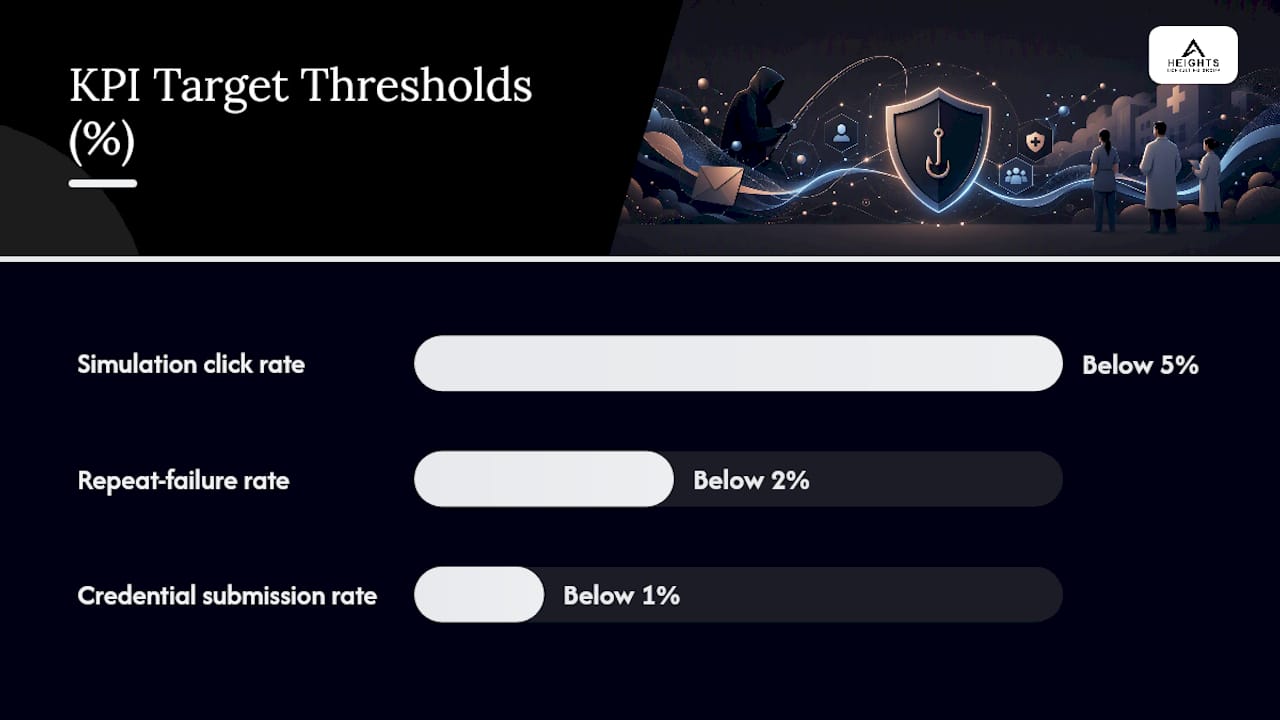
| Simulation click rate | Measures workforce susceptibility; primary training outcome metric | Below 5% organization-wide | Monthly (by department) |
| Credential submission rate | Measures highest-risk behavior (entering credentials on a phishing page) | Below 1% | Monthly |
| Phishing report rate | Measures active detection behavior; rising rate indicates culture improvement | High report rate of simulated phish | Monthly |
| Prevented attacks per million emails | Measures gateway effectiveness; tracks vendor performance | Establish baseline; track trend | Monthly |
| Median time-to-containment | Measures IR speed; directly relevant to breach notification risk | Under 4 hours for high-privilege accounts | Per incident; quarterly trend |
| Repeat-failure rate | Identifies staff who need individualized intervention beyond standard remediation | Below 2% after two remediation cycles | Quarterly |
Segment every KPI by role, location, shift, and device type. Night-shift clinical staff on shared workstations often show different click patterns than day-shift administrative staff on dedicated devices. Surfacing those differences lets you apply targeted controls (stricter filtering on shared workstations, additional training for specific shifts) rather than blanket policies that create friction everywhere.
Dashboards should export audit-ready artifacts: simulation participation logs, click-rate trend charts, remediation completion records, and incident response timelines. Retain these artifacts for a minimum of six years to satisfy HIPAA documentation requirements. A cyber risk assessment process that feeds KPI baselines into your risk register creates a closed loop between measurement and program governance.
AI, governance, and advanced program design for security leaders
AI improves phishing detection and response speed, but it introduces governance, explainability, and machine-identity risks that healthcare organizations must manage deliberately. Deploying AI-powered email security without ownership, model monitoring, and vendor accountability is a governance gap that regulators and auditors are beginning to scrutinize.
The most effective detection architecture combines pre-delivery AI filtering with post-delivery behavioral analytics and automated triage, and includes human-in-the-loop escalation for high-stakes decisions. Pre-delivery models analyze message content, sender reputation, and structural anomalies to block or quarantine before the message reaches the inbox. Post-delivery analytics monitor user behavior after delivery, flagging messages that were initially passed but triggered suspicious downstream activity (credential entry, file download, lateral movement). Automated triage scores incidents by severity and routes them to the SOC, but the decision to quarantine an account used by a clinician mid-shift should require human confirmation, not fully automated action. Over-automation in clinical environments can interrupt care.
HSCC AI Cyber Governance Framework guidance: Healthcare CISOs should implement AI lifecycle governance, maintain an inventory of machine identities, and include AI-specific incident playbooks to manage risks introduced by AI systems. Agentic AI introduces intent-drift and machine-identity risks that require human-in-the-loop verification for any AI action affecting clinical or financial systems.
The HSCC AI Cyber Governance Framework Implementation Guide provides a practical governance checklist for healthcare CISOs deploying AI security tools. Key elements include:
- AI asset inventory: Document every AI model in use for email security, including vendor-hosted models. Record the model version, training data scope, and update cadence.
- Explainability requirements: Require vendors to provide human-readable explanations for quarantine and block decisions. A model that cannot explain why it blocked a message from a legitimate lab partner creates clinical risk.
- Machine identity governance: Inventory all non-human identities (service accounts, API keys, AI agents) that interact with email systems or EHR platforms. Apply the same least-privilege and credential-rotation standards as human accounts.
- AI-specific incident playbook: Define what happens when an AI model makes a consequential error, such as blocking a critical patient-transfer communication or failing to detect a sophisticated spear phish. Who reviews the decision? Who resets the model's configuration? What is the notification chain?
- Vendor contract clauses: Require BAAs, telemetry access for your SIEM, model-change notification (with advance notice before updates that could affect detection behavior), and the right to audit model performance data.
Vendors like Paubox are advancing generative-AI approaches to inbound email security for healthcare, claiming improved detection of sophisticated phishing. The governance requirements above apply regardless of vendor: BAA, explainability, telemetry, and model-change notification are non-negotiable for any AI system that touches ePHI.
As John Riggi of the American Hospital Association has stated, "mitigating AI cybersecurity risk is part of cyber safety, and cyber safety is patient safety." That framing should anchor every AI governance decision your organization makes.
Your 90-day roadmap to a defensible phishing program
A defensible program does not require perfection at day 90. It requires documented controls, measurable baselines, and evidence that the organization is actively managing risk. The roadmap below is structured around that standard.
Days 0–30: Quick wins and baseline establishment
- CISO/IT lead: Audit current email authentication records (SPF, DKIM, DMARC) across all sending domains. Set DMARC to
p=quarantineon all domains not already enforced. - SOC lead: Pull current email gateway block rate, false-positive rate, and any available click-rate data from prior simulations. Document as the program baseline.
- IAM/IT lead: Complete a privileged account inventory. Enroll all domain administrators and EHR super-users in FIDO/WebAuthn or PKI-based MFA.
- HR/training coordinator: Schedule the first phishing simulation for high-risk roles within 30 days. Select healthcare-specific templates (EHR login prompt, payer invoice).
- Compliance officer: Create a risk register entry for phishing risk, documenting current state, target state, and the 90-day remediation plan. This is your first audit artifact.
Days 31–60: Core program controls
- SOC lead: Enable URL click protection and attachment sandboxing on the SEG. Configure post-delivery analytics and integrate alerts with the SIEM.
- IAM/IT lead: Extend phishing-resistant MFA to remote access (VPN, RDP) and patient portal administrative interfaces. Begin quarterly access certification for EHR write-access accounts.
- HR/training coordinator: Run the first simulation, review results by department, and deliver targeted microlearning to staff who clicked. Document participation and remediation completion.
- Vendor management: Audit BAA inventory for all business associates with ePHI access. Identify gaps and initiate BAA remediation for any vendor missing a signed agreement.
- CISO: Conduct or commission a tabletop exercise for a phishing-triggered EHR outage scenario. Document gaps and assign remediation owners.
Days 61–90: Foundational program elements
- SOC lead: Enforce DMARC
p=rejecton all primary domains. Publish KPI dashboard with click rate, report rate, and time-to-containment trends for executive review. - HR/training coordinator: Establish the ongoing simulation schedule (monthly for high-risk roles, 6–12 per year for general staff). Confirm documentation retention policy (six-year minimum).
- CISO/compliance officer: Map all implemented controls to HIPAA Security Rule citations and NIST CSF functions. Submit updated risk register to executive leadership and the board.
- Vendor management: Require evidence of equivalent phishing controls from high-risk business associates. Add flow-down clauses to new and renewing BAAs.
- All owners: Review KPIs against targets. Identify the highest-risk cohort (department, shift, or role) and apply targeted technical controls (stricter filtering, additional training) to that group.
When internal capacity limits execution speed, engaging an external partner for program design, managed SOC augmentation, or tabletop facilitation can compress this timeline without disrupting clinical operations. The cybersecurity risk management framework Heightscg applies to healthcare clients is built around exactly this kind of time-bound, evidence-driven program design.
An advisory perspective on what actually moves the needle
Many healthcare organizations that struggle with phishing risk often face governance and culture challenges beyond technical controls. The email gateway is configured, the MFA policy exists on paper, and the simulation program ran once last year. What is missing is the closed loop: KPIs reviewed monthly, simulation results feeding back into technical controls, and an executive sponsor who treats the click rate as a business metric, not an IT metric.
The second pattern worth naming is the AI governance gap. Healthcare organizations are adopting AI-powered email security tools faster than they are building the governance structures to manage them. A model that blocks a critical patient-transfer communication because it matched a phishing pattern is not a theoretical risk; it is a patient-safety event. The governance checklist in this guide is not optional overhead. It is the difference between AI that makes your program more resilient and AI that introduces a new category of operational risk.
External engagement makes the most sense when the organization lacks the internal capacity to run the closed loop: monthly KPI review, simulation analysis, control tuning, and executive reporting. A managed SOC or a structured consulting engagement can provide that capacity without requiring the organization to build a full internal security team from scratch.
How Heightscg helps healthcare organizations reduce phishing risk
Healthcare security leaders who need to move faster than internal capacity allows have a practical option. Heightscg provides technical cybersecurity consulting that covers the full phishing prevention program: email gateway configuration and hardening, phishing-resistant MFA deployment, simulation program design, and compliance mapping to HIPAA, NIST, and CISA frameworks.
For organizations that need ongoing coverage, Heightscg's managed cybersecurity services provide 24/7 SOC monitoring, post-delivery analytics, and incident response with healthcare-specific playbooks. Tabletop facilitation for phishing-triggered EHR outage scenarios is a standard engagement component for clients who need to validate their response before an actual incident tests it.
The starting point is a structured conversation about where your program stands against the controls in this guide. Contact Heightscg through the cybersecurity assessment intake to schedule that conversation and receive a gap analysis against the 90-day roadmap.
Sources
The sources below are the canonical references for building and auditing a healthcare phishing prevention program. Each one is cited in this guide and should be on file as supporting documentation for your HIPAA risk analysis.
- HICP Technical Volume 2: Cybersecurity Practices for Medium and Large Healthcare Organizations: 2022 Edition
- HPH Sector Mitigation Guide (CISA)