

New York's cybersecurity regulation, 23 NYCRR Part 500, requires financial services companies licensed in New York to build, document, and certify a cybersecurity program that protects consumer data and keeps the firm operationally sound. Banks, insurers, mortgage servicers, and licensed fintechs regulated by New York's Department of Financial Services all qualify as covered entities.
Three priorities dominate compliance conversations right now. First, update your risk assessment to account for AI use, both your own and any deployed by third-party vendors. Second, confirm multi-factor authentication covers every access point required under the amended rule. Third, make sure your asset inventory is current and documented, since both MFA and asset inventory obligations became fully enforceable as final provisions.
- Refresh the risk assessment whenever a material technology change occurs, not just annually
- Verify MFA coverage across all systems that touch nonpublic information
- Confirm asset inventory procedures are written, not informal
- Prepare board and CISO sign-off for the annual certification cycle
Compliance snapshot: the final MFA and asset inventory provisions of the Second Amendment took effect November 1, 2025, meaning every covered entity now operates under the full, staged rule set.
Key Takeaways
Sustained compliance with 23 NYCRR Part 500 depends on treating the risk assessment as a living document that gets updated before, not after, every material technology or AI adoption decision.
| Point | Details |
|---|---|
| MFA and asset inventory are now mandatory | Final provisions took effect November 1, 2025, and require documented coverage and written procedures. |
| Update risk assessments before adopting AI | DFS guidance treats pre-deployment risk assessment updates as the exam benchmark, not an afterthought. |
| Third-party oversight is a lifecycle | Section 500.11 expects due diligence, contract clauses, and ongoing monitoring, not a one-time vendor review. |
| 72-hour notice starts at determination | The clock begins when you determine an incident occurred, not when the investigation concludes. |
| Executive-led programs fare better in exams | Heightscg's advisory work focuses on evidence-based gap assessments and board-ready documentation for CISOs. |
Table of Contents
- What Does NYDFS Cybersecurity Regulation Require Section by Section?
- Who Qualifies as a Covered Entity Under Part 500?
- When Did NYDFS Cybersecurity Compliance Deadlines Take Effect?
- How Should Compliance Officers Prioritize the First 90 Days?
- What Does NYDFS Expect From Third-Party Service Provider Oversight?
- Why Must AI Risk Live Inside Your Part 500 Risk Assessment?
- What Must a 72-Hour Incident Notice Include?
- What Training Does Part 500 Require for Personnel?
- How Often Should You Test and Audit Your Cybersecurity Program?
- What Happens if Your Organization Falls Out of Compliance?
- How Do You Sustain Compliance After the Initial Buildout?
- Primary Sources for NYDFS Compliance Documentation
- Sources
What Does NYDFS Cybersecurity Regulation Require Section by Section?
Part 500 reads like a checklist because it was written to be audited against. Each section maps to a specific control and a specific piece of paper you need to produce during an exam. Compliance officers who treat the regulation as a series of standalone requirements, rather than an integrated program, tend to struggle when examiners ask how the pieces connect.
- 500.2 (Cybersecurity Program): a documented program based on the entity's risk assessment, covering identification, protection, detection, response, and recovery
- 500.3 (Policy): a written cybersecurity policy approved by senior officers or the board, updated at least annually
- 500.4 (Governance): a designated CISO who reports in writing to the board or senior governing body at least annually
- 500.5 (Testing): continuous monitoring or periodic penetration testing and vulnerability assessments
- 500.6 (Audit Trail): logs sufficient to reconstruct material transactions and detect/respond to incidents
- 500.7 (Access Privileges): limiting user access based on role, reviewed periodically
- 500.8 (Application Security): secure development practices and code review for in-house applications
- 500.9 (Risk Assessment): a documented, periodically updated assessment that drives the entire program
- 500.10 (Personnel and Intelligence): qualified cybersecurity personnel and ongoing threat intelligence
- 500.11 (Third-Party Service Provider Security): written policies governing vendor access to systems and data
- 500.12 (MFA): multi-factor authentication for remote access and privileged accounts
- 500.13 (Asset Management): a documented, maintained inventory of information systems
- 500.14 (Monitoring and Training): anti-malware controls, awareness training, and phishing simulations
- 500.15 (Encryption): encryption of nonpublic information at rest and in transit, or documented compensating controls
- 500.16 (Incident Response and BCDR): a written plan for incident response, business continuity, and disaster recovery
- 500.17 (Notices): the 72-hour breach notice and annual certification to the superintendent
| Part 500 Section | Core Obligation | Documentation to Produce |
|---|---|---|
| 500.4 Governance | CISO designation and board reporting | Written annual CISO report to the board |
| 500.9 Risk Assessment | Periodic, risk-based evaluation | Updated risk-assessment record, revision log |
| 500.11 Third-Party Security | Vendor due diligence and contract terms | TPSP policy plus signed contract addenda |
| 500.12 MFA | Multi-factor authentication coverage | MFA coverage map and exception log |
| 500.13 Asset Management | Current information-systems inventory | Exportable asset-inventory report |
Pro Tip: Keep a single "compliance evidence folder" mapped to each Part 500 section number. When examiners ask for proof of a control, you should be able to produce the document in under five minutes, not five days.
Who Qualifies as a Covered Entity Under Part 500?
A Covered Entity is any organization operating under a license, registration, or charter issued under New York's Banking Law, Insurance Law, or Financial Services Law. That definition sweeps in community banks, life and property insurers, mortgage originators and servicers, money transmitters, and fintech firms holding a DFS license.
- Community banks and credit unions chartered or licensed in New York
- Insurance carriers, agents, and brokers licensed by DFS
- Mortgage bankers, brokers, and servicers operating under DFS supervision
- Fintech and virtual currency businesses holding a BitLicense or similar registration
Narrow exemptions exist for entities with fewer than a specified number of employees, limited revenue, or minimal information systems that hold no nonpublic information, along with employees or agents already covered under a parent company's program. The exemption criteria and required filing are detailed on the NYDFS Cybersecurity Resource Center, which every compliance officer should bookmark rather than rely on secondhand summaries.
When Did NYDFS Cybersecurity Compliance Deadlines Take Effect?
Part 500 first took effect March 1, 2017, with transitional periods for early requirements like the CISO designation and penetration testing. The Second Amendment, adopted in 2023, restructured several sections and introduced staged compliance windows rather than a single deadline, giving firms time to build MFA coverage, formal governance structures, and asset-inventory procedures in sequence.
- Original Part 500: effective March 1, 2017, with phased transitional periods through 2019
- Second Amendment: adopted 2023, with staggered effective dates across sections
- Final provisions, including expanded MFA and written asset-inventory procedures: effective November 1, 2025
- Annual certification: due in the next certification cycle following each phase
DFS examiners have made MFA adoption and asset-inventory maturity central exam focus areas, and enforcement actions have followed firms that treated these controls as optional or perpetually "in progress."
Enforcement has followed a consistent pattern: consent orders cite gaps in MFA deployment, incomplete or outdated asset inventories, and inadequate oversight of third-party service providers under 500.11. Firms that can show a documented remediation timeline tend to fare better than firms that cannot show any timeline at all.
How Should Compliance Officers Prioritize the First 90 Days?
A gap assessment tells you where you stand, but it doesn't tell you what to fix first. Sequence matters, because some gaps expose the firm to material operational risk while others are procedural. Work risk-first, starting with exposures that could lead to a reportable incident or NPI compromise.
- Days 1 to 30: Designate a CISO or engage a virtual CISO if you lack in-house expertise; launch an updated risk assessment focused on AI adoption and third-party technology; run an MFA gap analysis across remote access and privileged accounts; start compiling a baseline asset inventory.
- Days 31 to 60: Close MFA gaps or document compensating controls with CISO sign-off; formalize a third-party service provider oversight checklist with contract clauses covering breach notification and audit rights; expand log retention and monitoring to meet Section 500.6 expectations.
- Days 61 to 90: Finalize asset-inventory procedures and recovery time objectives; run a tabletop incident-response exercise with executive participation; build board-reporting templates for the CISO's annual report; schedule any required independent audit.
Pro Tip: Treat the 90-day checklist like a fire drill, not a paperwork exercise. A tabletop scenario that surfaces a real gap in your incident-response plan is worth more than a perfectly worded policy nobody has tested.
A virtual CISO engagement can compress this timeline substantially for firms without dedicated security leadership, particularly when the risk assessment needs to reflect AI-specific threats the internal team hasn't evaluated before.
What Does NYDFS Expect From Third-Party Service Provider Oversight?
Section 500.11 treats vendor risk as a lifecycle, not a one-time checkbox. Due diligence happens before signing, monitoring continues throughout the relationship, and offboarding needs the same rigor as onboarding.
- Contract clauses should require MFA on any vendor access point, breach notification within a defined window, audit rights, and remediation SLAs for discovered vulnerabilities
- Segment vendor network access so a TPSP compromise cannot reach core systems
- Request proof-of-controls artifacts (SOC 2 reports, penetration test summaries) rather than accepting a vendor's self-attestation alone
Pro Tip: Ask vendors for their most recent penetration test summary, not just a compliance certificate. Certificates show intent; test results show reality.
Why Must AI Risk Live Inside Your Part 500 Risk Assessment?
DFS has been explicit: AI-related risks belong inside the mandatory annual Risk Assessment, and the assessment must be updated whenever a material technology change occurs, including adopting a new AI tool internally or through a vendor. The department's industry letter on AI cybersecurity risks names deepfakes and AI-driven data extraction as concrete threat categories, not theoretical ones.
- Document model provenance for any AI tool touching nonpublic information
- Map data exposure vectors created by AI queries, including what gets logged and where
- Require human-review gates before AI-generated code reaches production
- Test for prompt-injection and data-exfiltration scenarios as part of vulnerability management
A Sidley Data Matters analysis identified the single most common Part 500 failure: firms adopt new AI technology before updating the risk assessment that's supposed to govern it. DFS has since issued additional guidance on frontier AI models, urging faster vulnerability remediation and phishing-resistant MFA in heightened threat environments. Treat these letters as functional exam benchmarks, not optional reading, since examiners cite them directly when evaluating whether a program is "reasonably designed."
Pro Tip: Before your next AI tool goes live, whether it's a chatbot, a coding assistant, or a vendor-embedded model, run it through the risk assessment first. Sequencing it after deployment is the mistake DFS keeps finding.
What Must a 72-Hour Incident Notice Include?
The clock starts the moment your organization determines a cybersecurity incident has occurred, whether it affects your systems directly, an affiliate, or a third-party service provider holding your data. Waiting for a full forensic picture before notifying the superintendent is a common and costly mistake.
- Submit the electronic notice through the DFS portal once you determine an incident occurred, even with incomplete facts
- Include the incident description, affected systems, and whether nonpublic information was exposed
- Document mitigation steps taken so far and designate an internal contact point
- Provide supplemental updates to the superintendent as the investigation develops
- Keep remediation records organized for post-incident review
- Prepare an internal after-action report for the board and executive team
- Update the risk assessment if the incident reveals a gap the assessment missed
Building this workflow before an incident happens, rather than during one, is the difference between a clean 72-hour filing and a scramble. A structured incident response program with pre-built notice templates removes most of the pressure from that window.
What Training Does Part 500 Require for Personnel?
Section 500.14 requires cybersecurity awareness training for all personnel, updated to reflect risks identified in the current risk assessment rather than a generic annual module. That distinction matters more than most firms realize: training content that hasn't changed in three years won't reflect AI-related phishing tactics, deepfake-based social engineering, or new third-party access patterns your risk assessment just flagged.

Training needs to cover phishing recognition, social engineering (including AI-generated voice and video impersonation), secure handling of nonpublic information, and incident-reporting procedures so employees know who to notify and how fast. Regular phishing simulations aren't explicitly named as mandatory in the same way annual training is, but examiners treat them as evidence that awareness training is actually working rather than just checked off.
Beyond general staff training, Section 500.10 requires that personnel responsible for cybersecurity functions receive updates on emerging threats and sufficient training to manage the risks the organization actually faces. That means your security team needs training specific to your technology stack, not a vendor's generic curriculum. If your organization has deployed AI tools in customer service, underwriting, or claims processing, the people managing those systems need training on the specific risks those tools introduce, including data leakage through prompts and model manipulation.
Document every training session: attendance records, content summaries, and completion rates. During an exam, "we trained employees" without records is functionally the same as not training them at all.
How Often Should You Test and Audit Your Cybersecurity Program?
Part 500 splits testing obligations into two tracks, and mixing them up is a common documentation error. Section 500.5 requires either continuous monitoring or periodic penetration testing at least annually, combined with vulnerability assessments at least twice a year. Firms without continuous monitoring in place need both an annual penetration test and biannual vulnerability scans to satisfy the section.
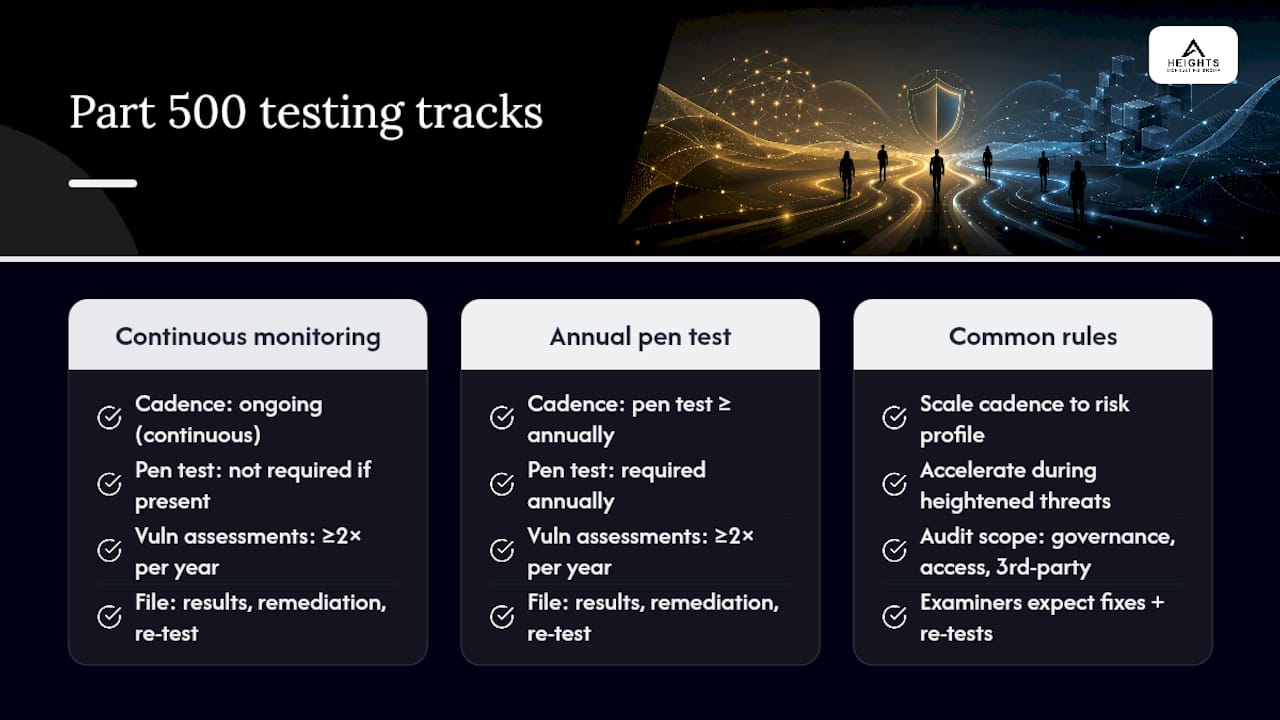
Independent audits, where required based on risk assessment findings, go further than a vulnerability scan. They evaluate whether the entire program, not just individual controls, functions as documented. The scope should cover governance effectiveness, access control enforcement, third-party oversight, and whether the risk assessment itself has kept pace with the organization's technology changes.
Testing cadence should scale with your risk profile, not just the regulatory floor. A firm that added a customer-facing AI chatbot or opened a new third-party data pipeline in the last quarter has a stronger case for testing that specific exposure sooner than the annual cycle allows. DFS guidance on frontier AI risks recommends accelerated vulnerability management in heightened threat periods, which effectively raises the bar above the statutory minimum when the threat environment warrants it.
Keep test results, remediation timelines, and re-test confirmation in one file per testing cycle. Examiners want to see that a finding led to a fix, not just that a finding was logged.
What Happens if Your Organization Falls Out of Compliance?
Penalties for Part 500 violations extend well beyond the headline consent-order fines that make legal-industry newsletters. DFS has statutory authority to impose monetary penalties, but the more consequential exposure for most firms is what a finding does to their regulatory standing, their insurance costs, and their ability to close M&A deals.
A consent order becomes part of the public record, which insurers and business partners can and do review. Cyber-insurance underwriters increasingly ask directly about Part 500 compliance status during renewal, and a documented finding can raise premiums or narrow coverage. Firms in the middle of an acquisition or capital raise face additional scrutiny when a DFS finding surfaces during due diligence, sometimes stalling deals entirely.
There's also the compounding cost of remediation under a consent order, which typically requires independent monitors, expanded reporting obligations to DFS, and a fixed remediation timeline that pulls security and compliance staff away from other priorities for months. Firms that self-identify gaps and remediate before an exam almost always fare better than firms that wait for DFS to find the gap first. Voluntary disclosure combined with a credible remediation plan is treated very differently from a finding uncovered during a routine exam.
The reputational cost is harder to quantify but often larger. Board members and executives whose names appear on a public consent order carry that association into future roles, and customers in regulated industries increasingly ask vendors and partners about their compliance history before signing contracts.
How Do You Sustain Compliance After the Initial Buildout?
Passing your first exam or completing your initial gap remediation isn't the finish line. Part 500 assumes your program evolves as your technology, vendor relationships, and threat landscape change, which means static documentation ages out of compliance even if nothing else changes.
Build a recurring cadence: quarterly reviews of the asset inventory, quarterly MFA coverage audits as new systems come online, and a standing agenda item for AI tool adoption so nothing gets deployed without touching the risk assessment first. Log retention and monitoring tools should feed into a regular review process, not just sit as passive infrastructure waiting for an incident to trigger a look.
Assign clear ownership for each recurring task. A risk assessment that's "everyone's responsibility" tends to become nobody's responsibility until an examiner asks for the last update date. The CISO's annual board report should include a section on what changed in the environment since the last report, not just a restatement of existing controls.
Finally, revisit vendor contracts on a schedule, not just at renewal. A third-party service provider's security posture can degrade between contract cycles, and Section 500.11 expects ongoing monitoring, not a one-time due-diligence check at signing.
Why Compliance Must Be Risk-Forward and Executive-Led
Part 500 was never designed as a paperwork exercise. Senior governing bodies and CISOs bear direct accountability, and every tradeoff, security against usability, cost against resilience, needs a documented rationale. Compliance that isn't executive-owned is compliance that won't survive its first real incident.
Where an Advisory Partner Accelerates Evidence-Based Compliance
Building a defensible Part 500 program while running daily operations is a resourcing problem as much as a technical one. An advisory partner can compress that timeline: running the gap assessment, updating the risk assessment to reflect AI adoption, reviewing third-party contracts against Section 500.11 expectations, and facilitating the tabletop exercises examiners want to see documented.
Heightscg works with regulated financial institutions on exactly this kind of evidence-based remediation, from technical cybersecurity consulting covering MFA implementation and asset inventory buildout, to board-reporting templates that give your CISO a clear, defensible annual report. Where AI adoption has outpaced your documentation, Heightscg helps integrate that risk into your Part 500 records and runs technical validation exercises to confirm controls hold up under exam scrutiny. If your team needs a second set of eyes on where the program stands today, reach out to Heights Consulting Group to scope a gap assessment.
Primary Sources for NYDFS Compliance Documentation
- 23 NYCRR Part 500 regulatory text and Cybersecurity Resource Center (official regulation)
- Second Amendment full text (official amendment)
- DFS industry letter on AI cybersecurity risks (regulatory guidance)
- Greenberg Traurig analysis of final MFA and asset-inventory rules (legal commentary)
This article is general information, not a substitute for advice from a qualified financial advisor. Consult a qualified financial professional about your own circumstances before acting on anything here.
Sources
- Cybersecurity Risks Arising from Artificial Intelligence and Strategies to Combat Related Risks | Department of Financial Services
- Cybersecurity Regulation (23 NYCRR Part 500) - NY DFS
- NEW YORK STATE DEPARTMENT OF FINANCIAL SERVICES SECOND AMENDMENT TO 23 NYCRR 500
- NYDFS Final Cybersecurity Rules – MFA, Asset Inventory, and Third-Party Risk | Greenberg Traurig LLP
- New York Department of Financial Services issues coordinated guidance on frontier AI cybersecurity risks | Sidley Data Matters
Recommended
- NYDFS Cybersecurity Regulation 2023 Amendments: Leadership Requirements Explained | Heights Consulting Group
- SEC Cybersecurity Disclosure Rules: Material Incident Reporting Requirements Explained | Heights Consulting Group
- Data protection best practices: The CISO's guide
- Cybersecurity Compliance Checklist: What Executives Need