

For healthcare CISOs, choosing the right cybersecurity framework goes far beyond compliance checklists. Every day, your systems support vital patient care, process sensitive data, and confront unique threats that generic solutions cannot address. The National Institute of Standards and Technology (NIST) Cybersecurity Framework delivers risk-based guidance tailored for the American healthcare sector, helping organizations align technical security goals with business needs and regulatory demands. Understanding how its functions, Profiles, and Tiers work can move your security program from fragmented efforts to a unified, resilient approach.
Table of Contents
- NIST Framework Defined For Healthcare Organizations
- Components And Functions Of The NIST Cybersecurity Framework
- Types Of NIST Framework Profiles And Their Purposes
- Legal And Regulatory Role In U.S. Healthcare Compliance
- Responsibilities, Challenges, And Risk Management Strategies
- Comparing NIST To Other Cybersecurity Frameworks
Key Takeaways
| Point | Details |
|---|---|
| Utilize the NIST Framework for Risk Management | The NIST Cybersecurity Framework helps healthcare organizations align security strategies with operational demands and regulatory compliance like HIPAA. |
| Customize Profiles for Organizational Needs | Create tailored Profiles that map cybersecurity functions to specific risk environments and business objectives to enhance communication among stakeholders. |
| Distribute Cybersecurity Responsibility | Ensure cybersecurity ownership is spread across the organization, involving the board, IT, compliance, and clinical leadership for effective implementation. |
| Prioritize Based on Real Risks | Focus risk management strategies on critical assets and threats directly impacting patient safety and operational continuity, rather than general vulnerabilities. |
NIST Framework Defined for Healthcare Organizations
The National Institute of Standards and Technology (NIST) Cybersecurity Framework is a structured approach to managing and reducing cybersecurity risk, developed specifically with input from government and private sector organizations. For healthcare, this framework goes beyond generic guidance. It addresses the specific operational demands of hospitals, clinics, and health systems where downtime costs lives and data breaches expose protected patient information. The NIST Framework provides a common language for healthcare organizations to communicate about cybersecurity risk, enabling CISOs and compliance officers to align technical safeguards with business objectives and regulatory requirements.
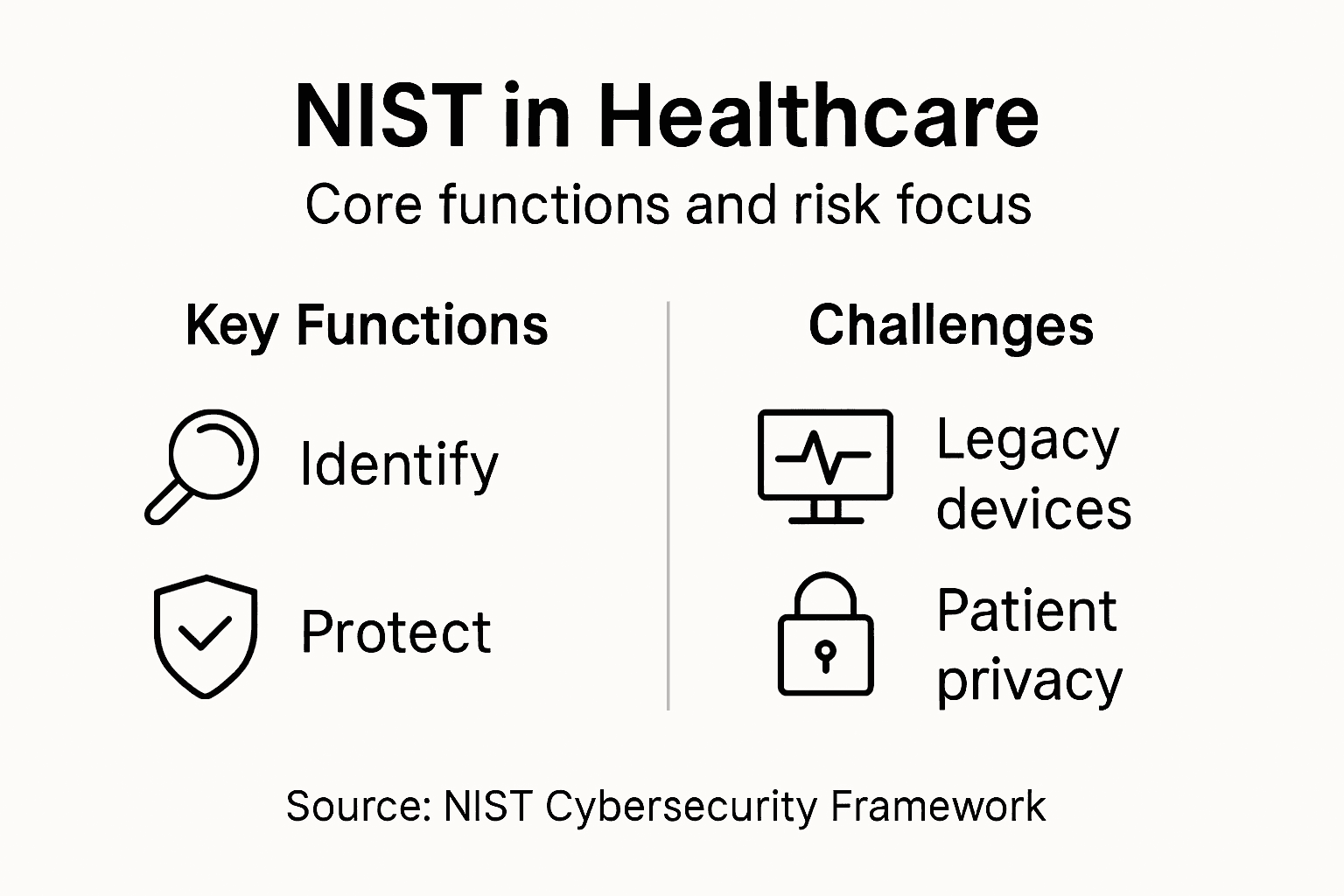
At its core, the NIST Framework organizes cybersecurity activities into five functional areas: Identify, Protect, Detect, Respond, and Recover. The Identify function requires healthcare organizations to develop a complete asset inventory and understand where electronic protected health information (ePHI) flows. This is critical in healthcare environments where legacy systems, medical devices, and interconnected clinical networks create complex attack surfaces. The Protect function applies technical and administrative controls to strengthen defenses. Detect establishes monitoring capabilities to spot unauthorized access or suspicious behavior in real-time. Respond details the incident management procedures your organization executes when a security event occurs. Recover ensures your systems can return to normal operations after an incident. When you map these functions against your existing compliance obligations like HIPAA, you discover significant overlap. The HIPAA Security Rule aligns directly with NIST Framework categories, meaning your implementation effort strengthens both your compliance posture and your operational security simultaneously.
What makes the NIST Framework particularly valuable for healthcare is its risk-based approach. Rather than prescribing one-size-fits-all solutions, it asks you to assess your organization's risk tolerance and current state, then prioritize improvements accordingly. A critical access hospital with limited IT resources makes different tradeoffs than a large health system with dedicated security teams. The framework supports this flexibility while maintaining rigor. This is why many healthcare organizations use cybersecurity frameworks to prioritize their security investments and demonstrate to board members that security spending aligns with actual risk and regulatory requirements.
Pro tip: Begin your NIST Framework implementation by mapping your current security controls to the framework's categories using a simple spreadsheet, documenting which controls address each function. This baseline assessment takes 2-3 weeks but eliminates months of confusion about what you already have versus what you still need to build.
Components and Functions of the NIST Cybersecurity Framework
The NIST Cybersecurity Framework operates as an integrated system with three interconnected structural components: the Core, Profiles, and Tiers. Think of these three pieces as working together like a building's foundation, floor plan, and construction stages. The Core contains the actual cybersecurity activities your organization needs to execute. The Profiles allow you to customize which elements matter most for your specific risk environment. The Tiers measure your maturity level and readiness across those activities. Understanding how these components relate to one another is essential for CISOs tasked with implementing a framework that aligns with both operational reality and board-level expectations.
At the heart of the framework sit the five to six functional areas that guide your security posture. The Identify function starts everything. You cannot protect what you do not know you have, which is why this function requires a comprehensive inventory of assets, systems, and data flows throughout your organization. Healthcare organizations particularly struggle here because medical devices, legacy clinical systems, and interconnected networks create sprawling attack surfaces that span physical and virtual infrastructure. The Protect function applies controls to reduce vulnerability and limit the impact of potential breaches. The Detect function establishes continuous monitoring to spot unauthorized activity or security anomalies in real-time. The Respond function details your incident management procedures, ensuring your team knows exactly what to do when a breach occurs. The Recover function focuses on restoring systems to normal operations and learning from the incident. A newer addition, the Govern function, addresses organizational oversight and decision-making structures that support cybersecurity across the enterprise. When you map cybersecurity risk management frameworks against these functions, you see how they provide flexibility while maintaining structural rigor.

What makes this framework powerful for healthcare is its ability to scale. A small clinic operates with different constraints than a large academic medical center, yet both use the same functional language to discuss risk. Your organization defines a Profile by selecting which framework functions and categories apply to your risk tolerance and business context. Then you assess your current state against that Profile using the Tiers, which range from Partial (reactive, ad-hoc security) to Optimized (proactive, data-driven security with continuous improvement). This maturity perspective prevents organizations from over-investing in controls that exceed their actual risk needs while identifying critical gaps. The framework's voluntary risk-based approach means you prioritize spending where it matters most to your operations and your patients.
Pro tip: Select 3-5 critical assets or processes in your organization first (like your EHR system or patient database access controls), map them against the framework functions, and measure your current Tier level for just those areas before attempting enterprise-wide implementation, which reduces overwhelm and creates early momentum.
Types of NIST Framework Profiles and Their Purposes
NIST Framework Profiles serve as translation documents between the abstract framework and your organization's specific reality. A Profile is essentially your organization's customized version of the framework, created by selecting which functions, categories, and subcategories matter most to your business context and risk environment. Think of it this way: the Core framework is the complete menu of all possible cybersecurity activities. Your Profile is what you actually order based on your appetite, budget, and dietary restrictions. For healthcare organizations, this customization is critical because a community hospital's Profile looks nothing like a research medical center's Profile, yet both can claim alignment with NIST. The current cybersecurity implementations documented by NIST show how organizations across sectors tailor Profiles to their operational needs while maintaining consistent language with stakeholders.
When developing your Profile, you map business requirements directly to framework categories. This creates alignment between what your board cares about (patient safety, regulatory compliance, operational resilience) and what your security team actually builds. Start by identifying your organization's risk tolerance. A critical access hospital serving a rural population may prioritize availability and business continuity differently than an urban health system with redundant infrastructure. Your current state Profile documents what controls and processes you have today. Your target state Profile describes where you want to be in 12 to 24 months. The gap between these two profiles becomes your implementation roadmap. This approach prevents security spending that does not address actual organizational needs. Within healthcare, NIST Profiles assess your cybersecurity maturity relative to your desired risk tolerance, helping you identify which gaps pose the greatest threat to patient care and organizational operations.
Profiles also function as communication tools. When your CISO presents security improvements to the board, a Profile shows exactly which framework functions those improvements address and how they align with organizational strategy. This visibility transforms security from a cost center into a strategic enabler. Your compliance officer can demonstrate to auditors precisely how your controls map to regulatory requirements like HIPAA. Your operational teams understand not just what security controls exist, but why they exist and what business outcome they protect. Many healthcare organizations struggle with cybersecurity frameworks because they treat them as technical requirements rather than business tools. When you build resilient cybersecurity frameworks with clear profiles, you create a shared language that connects security investments directly to organizational goals, making it far easier to secure budget and executive support for your multiyear implementation.
The following table highlights how NIST Framework Profiles customize cybersecurity for healthcare organizations:
| Profile Type | Definition | Customization Purpose |
|---|---|---|
| Current State Profile | Snapshot of existing controls and practices | Identifies maturity and immediate gaps |
| Target State Profile | Desired future state in 12-24 months | Guides strategic improvement roadmap |
| Regulatory Profile | Integrated legal and compliance mapping | Aligns controls to HIPAA and state laws |
Pro tip: Create your current state Profile first by conducting a half-day workshop with representatives from IT, compliance, clinical operations, and risk management, documenting what controls already exist and where they map to NIST functions, then use that baseline to define your target Profile with 30 percent more maturity, which is typically achievable in 18 months without external resources.
Legal and Regulatory Role in U.S. Healthcare Compliance
U.S. healthcare operates in a uniquely regulated environment where federal mandates like the Health Insurance Portability and Accountability Act (HIPAA) establish minimum security requirements for protecting patient data. HIPAA does not exist in a vacuum. It works in concert with state privacy laws, breach notification requirements, and emerging regulations like those from the FDA and state attorneys general. For CISOs and compliance officers, understanding this regulatory landscape is essential because your cybersecurity investments must satisfy these legal requirements while also building organizational resilience. The challenge is that HIPAA focuses on administrative, physical, and technical safeguards but does not prescribe exactly how to achieve them. This is where the NIST Framework becomes your operational guide. The HIPAA Security Rule crosswalk with NIST Framework demonstrates precisely how each HIPAA requirement maps to specific NIST functions and categories, eliminating guesswork about compliance alignment.
When you implement NIST in a healthcare setting, you are building a security program that satisfies HIPAA while simultaneously addressing broader cybersecurity threats. HIPAA requires safeguards for protected health information (PHI), but healthcare organizations today face ransomware, supply chain attacks, and insider threats that HIPAA does not explicitly address. By adopting NIST, you layer voluntary best practices on top of regulatory minimums. This creates what regulators call a "defense-in-depth" posture. Your risk analysis process under HIPAA becomes more sophisticated when informed by NIST's Identify and Protect functions. Your incident response plan required by HIPAA gains structure and measurability when aligned with NIST's Detect and Respond functions. Federal resources including the Health Information Technology privacy and security guidance explicitly encourage healthcare providers to integrate regulatory compliance with NIST-aligned cybersecurity practices, recognizing that legal compliance alone is insufficient protection against evolving threats.
State-level regulations add another layer of complexity. California's CCPA, Florida's data privacy laws, and state breach notification statutes all impose notification timelines and consumer rights that exceed HIPAA's minimums. Your NIST implementation must accommodate these variations without fragmenting your security architecture. This is where your Profile becomes critical. Your target state Profile documents not just NIST alignment, but also which additional controls address state-specific requirements. Your board needs to understand that compliance is not a one-time checkbox but an ongoing integration of regulatory requirements with operational risk management. When you address regulatory compliance strategically, you demonstrate that your security program serves both legal and business objectives. Your auditors, whether internal, external, or regulatory, will evaluate your NIST implementation against HIPAA requirements and state-specific mandates. A well-documented NIST Profile that explicitly maps to these requirements provides the evidence trail that proves compliance intent and execution.
Pro tip: During your annual HIPAA risk analysis, add a column to your assessment spreadsheet showing which NIST functions address each identified risk, then map those functions to your current Profile maturity level, which creates concrete evidence for auditors that your security investments directly address documented risks and regulatory requirements.
Responsibilities, Challenges, and Risk Management Strategies
When you commit to NIST Framework implementation in healthcare, you are distributing cybersecurity responsibility across your entire organization, not just your security team. Your board and C-suite bear accountability for governance and resource allocation. Your clinical leadership must understand how security decisions impact patient workflows. Your IT operations team owns technical implementation. Your privacy officer manages regulatory alignment. Your facilities team addresses physical security. This distributed responsibility model is where many healthcare organizations stumble. NIST requires clear ownership, documented decision-making, and ongoing communication between these silos. Your CISO becomes the orchestrator, not the sole decision-maker. The risk management process outlined in NIST risk management frameworks explicitly describes how leadership, operational teams, and stakeholders share responsibility for assessing risk, approving mitigation strategies, and monitoring implementation effectiveness. Without this clarity, your NIST effort becomes a technical project rather than an organizational transformation.
Healthcare faces specific challenges that make NIST implementation more complex than in other sectors. You cannot simply shut down systems for patching because patients depend on continuous availability. Legacy clinical systems running unsupported software cannot be immediately replaced due to regulatory approval requirements and integration complexity. Medical devices connected to your network lack the processing power for advanced security controls. Your workforce includes clinicians with minimal cybersecurity training who must balance security requirements with patient care speed. Budget constraints mean you cannot implement everything simultaneously. Staffing shortages mean your security team is perpetually stretched thin. Ransomware attacks targeting healthcare have become existential threats, with attackers exploiting the sector's known dependence on system availability. These realities mean your risk management strategy cannot follow textbook approaches. You must prioritize ruthlessly. Risk assessment and mitigation processes in healthcare demand specific focus on threats that could directly impact patient safety and operational continuity, not just data confidentiality.
Your risk management strategy must account for these constraints explicitly. Start by identifying critical assets: your EHR, pharmacy systems, medical devices connected to your network, and backup infrastructure. Assess threats specific to those assets, not threats in general. Evaluate the likelihood and impact of each threat in your environment. Your small critical access hospital faces different threats than your large academic medical center. Your rural clinic without redundant internet connectivity has different risk tolerance than your urban facility. Build your mitigation roadmap by addressing risks that pose the greatest threat to patient safety and operational continuity first. Then layer in compliance requirements and general best practices. This prioritization is not skipping security. It is allocating limited resources where they create the most measurable risk reduction. When you establish comprehensive cyber risk management steps, you ensure your security investments align with your organization's actual threat landscape and operational constraints, making it far more likely your initiatives will succeed and sustain.
Pro tip: Create a simple risk register with columns for Asset, Threat, Current Controls, Likelihood, Impact, and Responsible Owner, then sort by impact times likelihood to identify your top five risks, and assign one NIST function ownership to each risk so every team member understands exactly which security activities address the threats your organization actually faces.
Comparing NIST to Other Cybersecurity Frameworks
Healthcare organizations often ask whether NIST is the right framework or whether they should consider alternatives like ISO 27001, CIS Controls, or COBIT. The answer depends on your organizational context, but NIST has significant advantages for the U.S. healthcare sector. HIPAA is mandatory. ISO 27001 is voluntary but widely recognized internationally. CIS Controls offer prescriptive, actionable security controls. COBIT focuses on IT governance and risk. NIST occupies a unique position as a voluntary, risk-based framework that complements rather than conflicts with these other standards. Unlike HIPAA, which establishes regulatory minimums, NIST provides the structured approach to exceeding those minimums. Unlike ISO 27001, which requires formal certification processes, NIST allows self-assessment and flexible implementation timelines. The key distinction is that NIST complements HIPAA requirements by providing a scalable, risk-focused methodology for implementing the administrative, physical, and technical safeguards HIPAA mandates, giving you the operational flexibility healthcare organizations desperately need.
When comparing frameworks directly, NIST's functional approach differs fundamentally from ISO 27001's control-based approach. ISO 27001 provides a checklist of specific controls you must implement and document for certification. This rigidity works well for organizations seeking formal validation from external auditors. NIST starts with business outcomes and risk tolerance, then guides you to select appropriate controls. For healthcare, this matters because your EHR system faces different threats than your medical device network, which faces different threats than your administrative systems. NIST allows you to tailor your approach to each asset class. ISO 27001 expects similar control implementation across all systems. CIS Controls, conversely, provide highly prescriptive, ranked controls organized by implementation difficulty. CIS works well for organizations wanting clear step-by-step guidance. NIST requires more organizational maturity to translate framework categories into actual technical requirements. The comprehensive, adaptable nature of NIST particularly suits healthcare organizations of varying sizes and maturity levels, making it the baseline framework for critical infrastructure sectors including hospitals and health systems.
For most U.S. healthcare organizations, NIST is not a replacement for HIPAA compliance but rather your operational roadmap for exceeding HIPAA minimums while building resilience against threats beyond HIPAA's scope. Your compliance officer still needs HIPAA for regulatory alignment. Your CISO uses NIST to structure the security program and communicate progress to leadership. You can simultaneously align with ISO 27001 if you have international operations or customer requirements. Many health systems adopt NIST as their primary framework while mapping to HIPAA for compliance reporting and ISO 27001 for any international facilities. This multi-framework approach sounds complex but is actually more efficient than choosing a single framework that forces compromises. When you build resilient cybersecurity frameworks tailored for regulated industries, you recognize that no single framework addresses every organizational need, and the most successful healthcare organizations integrate NIST's risk-management approach with their specific regulatory and operational requirements.
Here's a summary comparing the main U.S. healthcare cybersecurity frameworks discussed:
| Framework | Core Focus | Strength in Healthcare | Typical Use Case |
|---|---|---|---|
| NIST CSF | Risk management and flexibility | Maps to HIPAA, scalable, adaptable | Program development and maturity assessments |
| HIPAA Security Rule | Regulatory minimums | Legal requirement for PHI protection | Compliance and audit readiness |
| ISO 27001 | Certification and detailed controls | Recognized internationally, strong structure | Global operations, formal validation |
| CIS Controls | Prescriptive, prioritized practices | Practical, actionable security actions | Stepwise security implementation |
| COBIT | IT governance and process optimization | Aligns IT with business goals | IT management and process control |
Pro tip: Create a simple three-column spreadsheet mapping HIPAA Security Rule requirements to NIST functions and to ISO 27001 controls if applicable, which demonstrates to auditors and board members how your security program simultaneously satisfies legal obligations, implements industry best practices, and addresses your actual threat landscape without redundant or contradictory efforts.
Accelerate Your Healthcare Cybersecurity with Proven NIST Expertise
Healthcare organizations face complex challenges when implementing the NIST Framework. From securing legacy medical devices to aligning with strict HIPAA regulations healthcare leaders need a strategic partner who understands the unique risks and operational demands discussed in "NIST Framework: Driving Healthcare Cybersecurity Progress." Heights Consulting Group offers tailored solutions that translate the NIST Framework functions—Identify Protect Detect Respond Recover—into actionable security programs that protect patient data and ensure compliance.
Unlock the power of a risk-based adaptive strategy supported by comprehensive advisory services managed cybersecurity and incident response tailored for healthcare environments. Do not wait until vulnerabilities threaten patient safety or regulatory obligations. Visit Heights Consulting Group now to learn how our experts can help you create a NIST-aligned security program that turns compliance into a competitive advantage. Explore our strategic consulting and technical implementation services developed specifically for regulated industries and complex IT environments to start your transformation today.
Frequently Asked Questions
What is the NIST Cybersecurity Framework for healthcare organizations?
The NIST Cybersecurity Framework is a structured approach designed to help healthcare organizations manage and reduce cybersecurity risks. It focuses on five main functions: Identify, Protect, Detect, Respond, and Recover, which align with legal requirements like HIPAA to enhance operational security.
How can healthcare organizations implement the NIST Framework effectively?
Healthcare organizations can implement the NIST Framework by mapping their current security controls to its functional areas, assessing their existing assets, and identifying gaps. Starting with a small set of critical assets can reduce complexity and create momentum for broader implementation.
What is the purpose of NIST Framework Profiles in healthcare?
NIST Framework Profiles are customized versions of the NIST Framework that allow healthcare organizations to align cybersecurity activities with their specific business objectives and risk environment. They help bridge the gap between technical security measures and organizational goals, facilitating better communication with stakeholders.
How does the NIST Framework support compliance with HIPAA and other regulations?
The NIST Framework complements HIPAA by providing a structured methodology to meet its minimum security requirements. By aligning cybersecurity practices with NIST’s functions, healthcare organizations can better manage risks and demonstrate compliance with legal regulations such as HIPAA and state laws.
Recommended
- Benefits of Cybersecurity Frameworks for Healthcare
- Cybersecurity Compliance: Impact on U.S. Healthcare CISOs
- Defining Cyber Maturity for Healthcare Executives
- Role of Risk Assessment in Healthcare Cybersecurity
- How Substance Abuse Impacts Patient Safety - 12PanelNow | 12 Panel Drug Test | Free Shipping