

TL;DR:
- Network security hardening is an ongoing process that reduces attack surfaces by implementing architectural controls, policies, and automation. It begins with comprehensive asset inventory and threat modeling to tailor defenses effectively, emphasizing principles like least privilege, default deny policies, and MFA. Continuous measurement using SLIs and SLOs, combined with automated policy enforcement, sustains a resilient security posture and prevents program degradation over time.
Network security hardening is the deliberate process of reducing your network's attack surface through strategic controls, automation, and continuous validation. The industry term for this discipline is network hardening, and it extends well beyond one-time configuration changes. A mature hardening program combines architecture design, policy enforcement, CI/CD-gated automation, and measurable service level indicators to prevent lateral propagation and limit the blast radius of any breach. This guide covers the foundational steps, architectural strategies, automation practices, and common pitfalls that IT security professionals and network administrators must understand to build and sustain a defensible network.
What is network security hardening and where do you start?
Network hardening is a continuous program involving architecture, policy, automation, and measurement aimed at reducing attack surface and preventing lateral propagation. That definition matters because it rules out the most common failure mode: treating hardening as a project with a completion date rather than an ongoing operational discipline.
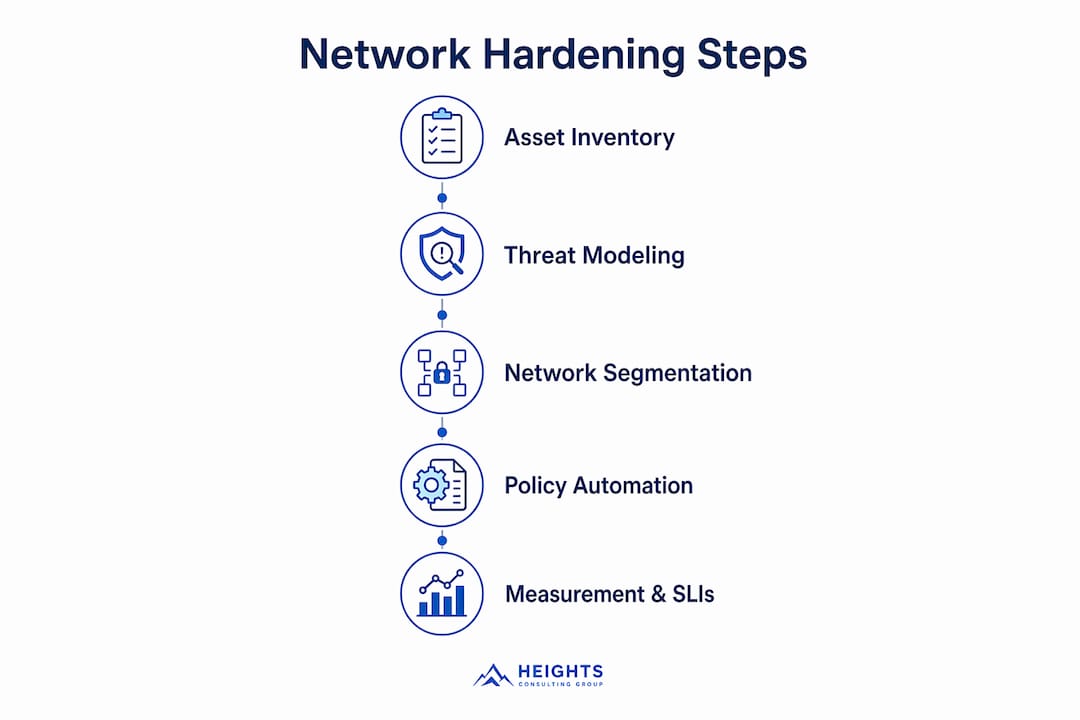
The starting point is always asset inventory. You cannot protect what you have not cataloged. Every device, service, API endpoint, and network appliance must be identified and assigned a trust boundary before any control is applied. Without this map, threat modeling is guesswork, and controls get applied inconsistently across the environment.
Threat modeling is the second prerequisite, and many teams skip it, wasting effort on controls that do not align with actual threats. A financial services organization faces different adversary profiles than a healthcare provider. The controls selected must reflect the specific threat actors, attack vectors, and data assets relevant to your environment.
Core principles every administrator must enforce
The foundational principles of network hardening techniques are well established:
- Least privilege access: Every user, service account, and system should have only the permissions required for its defined function. Scope creep in permissions is one of the most exploited conditions in lateral movement attacks.
- Default deny policies: All traffic should be blocked unless explicitly permitted. This applies to both North-South perimeter traffic and East-West internal traffic between segments.
- Allow-listing over deny-listing: Allow lists are stronger than deny lists because deny lists can only block known threats, leaving gaps for novel attack patterns. The UK's National Cyber Security Centre recommends allow-listing as the more effective approach to uphold least privilege.
- Multi-factor authentication (MFA): MFA must be enforced on all administrative interfaces, VPN gateways, and privileged access workstations without exception.
- VPN and appliance lifecycle management: VPN security requires ongoing lifecycle maintenance and patching. A set-and-forget approach to VPN configuration is one of the most exploited vulnerabilities in enterprise networks today.
Pro Tip: Build your asset inventory into a configuration management database (CMDB) and automate discovery with tools like Nmap, Qualys, or Tenable Nessus. Manual inventories decay within weeks in dynamic environments.
How can network architecture design reduce lateral movement risk?
Network segmentation is the architectural control that limits how far an attacker can move after gaining initial access. Without segmentation, a compromised endpoint has line-of-sight to every other system on the same flat network. With it, the blast radius shrinks to the segment containing the compromised asset.

VLAN separation is the baseline implementation. Separate segments for user workstations, servers, management interfaces, IoT devices, and guest networks are the minimum viable architecture for any organization with more than a handful of systems. Each VLAN should have explicit firewall rules governing inter-VLAN traffic, with default deny as the baseline posture.
Zero Trust architecture and microsegmentation
Zero Trust architecture shifts trust from network location to identity and device context. Under a traditional perimeter model, a device inside the network is implicitly trusted. Under Zero Trust, every access request is verified regardless of where it originates. NIST SP 800-207 provides the authoritative framework, with 19 documented example implementations demonstrating cost-effective approaches for hybrid and multi-cloud environments.
Microsegmentation takes this further by applying policy at the workload level rather than the subnet level. Service meshes like Istio enforce mutual TLS between microservices, while host-based enforcement tools apply per-process network policies. This granularity means a compromised container cannot communicate laterally to adjacent workloads without explicit policy permission.
| Architecture approach | Primary control mechanism | Best suited for |
|---|---|---|
| VLAN segmentation | Layer 2/3 separation with ACLs | On-premises environments with defined user groups |
| Zero Trust (NIST SP 800-207) | Identity and device context verification | Hybrid and multi-cloud environments |
| Microsegmentation | Workload-level policy enforcement | Containerized and microservices architectures |
| Service mesh (Istio, Linkerd) | Mutual TLS and traffic policy | Kubernetes and cloud-native deployments |
For organizations operating in hybrid or multi-cloud environments, Zero Trust implementation requires consistent policy enforcement across AWS, Azure, and on-premises infrastructure simultaneously. Cloud-native tools like Azure Network Security Groups (NSGs) and Application Security Groups (ASGs) provide subnet-level protection, but new subnets are unprotected by default and require explicit NSG assignment before they carry any production traffic.
Pro Tip: When implementing microsegmentation, start with your highest-value assets and work outward. Attempting to microsegment the entire environment simultaneously creates operational paralysis. Prioritize crown-jewel systems first, then expand the policy perimeter incrementally.
What policies, automation, and tools enforce hardening continuously?
A hardening program that relies on manual configuration reviews will drift. Policy drift occurs when changes made outside a formal review process introduce misconfigurations that erode the security posture over time. The solution is policy-as-code integrated into CI/CD pipelines, where firewall rules, ACLs, and service mesh configurations are defined in version-controlled code and validated automatically before deployment.
The CI/CD integration workflow for network policy typically follows this sequence:
- Static linting: Policy files are checked for syntax errors and known misconfigurations before any deployment begins. Tools like Open Policy Agent (OPA) and Terraform Sentinel perform this check automatically on every commit.
- Unit testing: Individual policy rules are tested in isolation against known traffic scenarios to verify they produce the expected permit or deny outcome.
- Policy simulation: The full policy set is simulated against representative traffic flows in a staging environment before promotion to production.
- Automated deployment with rollback: Changes are deployed with automated rollback triggers. If a policy change causes a defined error budget breach, the system reverts to the previous known-good state without human intervention.
- Telemetry validation: Post-deployment, flow logs and network telemetry confirm that traffic patterns match the expected policy behavior.
Measuring network security with SLIs and SLOs
Measurement is what separates a mature hardening program from a compliance checkbox exercise. Setting SLIs and SLOs for connectivity, latency, and policy violation rates gives security teams an objective basis for evaluating program effectiveness. A policy violation rate SLI, for example, tracks the percentage of traffic flows that trigger an unexpected deny rule. Spikes in this metric indicate either a misconfiguration or an active reconnaissance attempt.
| Metric type | Example SLI | What it signals |
|---|---|---|
| Connectivity | Percentage of authorized flows successfully established | Policy gaps or over-blocking |
| Latency | P99 latency for inter-segment traffic | Inspection overhead or misconfigured routing |
| Policy violations | Rate of unexpected deny events per hour | Misconfigurations or active threat activity |
| Patch compliance | Percentage of appliances at current firmware | Lifecycle management gaps |
AI-enabled monitoring tools now play a meaningful role in this layer. Platforms like Darktrace and Vectra AI apply behavioral baselines to network telemetry, surfacing anomalies that static threshold alerts miss. The practical value is not replacing human analysts but reducing the volume of noise they must process before identifying genuine threats. Organizations that deploy AI-assisted anomaly detection alongside traditional SIEM platforms report faster mean time to detect (MTTD) for lateral movement events.
What are the most common pitfalls in network hardening implementation?
The most damaging mistakes in network hardening are not exotic. They are predictable failures that occur when foundational controls are implemented incorrectly or maintained poorly.
- Misordered firewall rules: Firewall rule evaluation order in distributed environments like VMware NSX follows left-to-right category precedence and top-down rule precedence within categories. Ignoring this order causes rules to evaluate in unintended sequences, permitting traffic that should be blocked. This is a particularly common error in East-West traffic control for virtualized environments.
- Overly broad allow rules: Microsoft Azure's security documentation explicitly warns against broad allow rules that create a false sense of security. An allow rule permitting all traffic from a /16 subnet to a production database defeats the purpose of segmentation entirely.
- Neglected VPN lifecycle management: VPN appliances that are not patched on a regular cadence become the most accessible entry point for threat actors. The NCSC's guidance on network security fundamentals treats ongoing maintenance as equally critical as initial configuration.
- Unsegregated management traffic: Management interfaces for switches, routers, and firewalls must operate on a dedicated out-of-band management network. When management traffic shares the same network as user traffic, a compromised user endpoint can reach administrative interfaces directly.
- Telemetry blind spots: Restrictive egress policies sometimes block the flow logs and telemetry streams that security teams depend on for visibility. Verify that your hardening policies do not inadvertently suppress the observability data needed to detect threats.
Pro Tip: Run a quarterly firewall rule audit using tools like AlgoSec or Tufin to identify shadowed rules, overly permissive entries, and rules that have not matched traffic in 90 days. Unused rules are not harmless. They are attack surface waiting to be exploited.
Key takeaways
Effective network security hardening requires a continuous program that integrates asset inventory, Zero Trust architecture, policy-as-code automation, and measurable SLIs to reduce attack surface and prevent lateral movement.
| Point | Details |
|---|---|
| Start with asset inventory | Catalog every device and service before applying any control to avoid coverage gaps. |
| Adopt allow-listing over deny-listing | Allow lists block unknown threats; deny lists only address what you already know. |
| Implement Zero Trust architecture | Enforce identity and device verification per NIST SP 800-207 across hybrid environments. |
| Automate policy with CI/CD | Use OPA or Terraform Sentinel to prevent policy drift through version-controlled enforcement. |
| Measure with SLIs and SLOs | Track policy violation rates and connectivity SLIs to objectively assess hardening effectiveness. |
Why most hardening programs stall before they mature
After working with organizations across regulated industries, the pattern is consistent. Teams execute the initial hardening sprint well. Asset inventories get built, VLANs get configured, MFA gets deployed. Then the program stalls because no one owns the measurement layer.
The teams that sustain hardening programs over time are the ones that treat security posture as an operational metric, not a project deliverable. They define error budgets for policy violation rates the same way a platform engineering team defines error budgets for availability. When the budget is breached, it triggers a formal review. When it is healthy, it gates the deployment of new changes. That discipline is what separates a hardening program from a hardening event.
The second consistent gap is the separation between security hardening and incident response. These two disciplines inform each other. Incident response findings should feed directly back into hardening priorities. If a tabletop exercise reveals that lateral movement between the finance and engineering VLANs is possible, that finding should generate a hardening ticket within the same sprint cycle, not a recommendation buried in a report.
AI-assisted monitoring is changing the measurement equation. Behavioral anomaly detection now surfaces lateral movement patterns that would previously require weeks of manual log analysis. The organizations that integrate these tools into their hardening measurement framework gain a material advantage in detection speed. The ones that treat AI tools as standalone products, disconnected from their SLI framework, get the noise without the signal.
The honest advice is this: build the measurement layer before you build the controls. If you cannot measure whether a control is working, you cannot know whether the hardening program is improving or degrading over time.
— Dan
Strengthen your network hardening program with Heightscg

Building a network hardening program that sustains itself requires more than technical controls. It requires architecture expertise, policy governance, and the operational discipline to measure and iterate continuously. Heightscg's technical cybersecurity consulting services are designed specifically for organizations operating in complex, regulated environments where the cost of a misconfigured policy or an unpatched appliance is measured in breach exposure and compliance liability. From Zero Trust architecture design to CI/CD-integrated policy enforcement and AI-assisted monitoring, Heightscg provides the structured oversight that turns a hardening initiative into a durable security program. Organizations ready to move from reactive patching to a measurable, continuously improving posture can contact Heightscg to discuss a tailored engagement.
FAQ
What is network security hardening?
Network security hardening is the process of reducing a network's attack surface by enforcing least privilege access, segmenting traffic, disabling unused services, and continuously validating policy controls. It is a continuous program, not a one-time configuration task.
How does Zero Trust relate to network hardening?
Zero Trust architecture enforces identity and device verification for every access request, replacing implicit trust based on network location. NIST SP 800-207 provides the implementation framework, and microsegmentation is the primary technical control that operationalizes Zero Trust at the workload level.
What is the difference between allow-listing and deny-listing?
Allow-listing permits only explicitly approved traffic and blocks everything else, while deny-listing blocks only known threats and permits everything else by default. The NCSC recommends allow-listing because it addresses unknown threats that deny lists cannot anticipate.
How do you measure whether a hardening program is working?
Effective programs define service level indicators (SLIs) for policy violation rates, connectivity success rates, and patch compliance percentages. Error budgets tied to these SLIs provide an objective trigger for remediation and gate the deployment of new changes.
What is the most common mistake in firewall rule configuration?
Incorrect rule evaluation order is the most operationally damaging mistake, particularly in distributed firewall environments like VMware NSX. Rules that evaluate in the wrong sequence can permit traffic that the policy intends to block, creating exploitable gaps in East-West traffic control.