

Cybersecurity is still widely treated as an IT responsibility, something to be managed below the executive floor and surfaced only during audits or incidents. That framing is costly. Cybersecurity as a strategic enabler aligns cyber risk directly with enterprise objectives, transforming it from a siloed function into a driver of business agility, regulatory confidence, and competitive positioning. For C-level leaders in regulated industries, the question is no longer whether to integrate cybersecurity with business strategy. It is how to do it in a way that produces measurable outcomes across risk management, compliance, and operational resilience.
Table of Contents
- Why integrating cybersecurity and business matters
- Key frameworks for integrating cybersecurity in business
- From compliance to strategic enablement
- How to drive integration in your organization
- What most leaders get wrong about integrating cybersecurity and business
- Ready to strategically integrate cybersecurity and business?
- Frequently asked questions
Key Takeaways
| Point | Details |
|---|---|
| Cyber integration is strategic | Aligning cybersecurity with business objectives shifts it from IT silo to growth driver. |
| Leverage proven frameworks | NIST CSF 2.0, CISA CPGs, and ERM tools streamline organization-wide integration. |
| Move beyond compliance | Strategic cyber integration improves resilience, audit outcomes, and financial performance. |
| Executive leadership required | Visible C-suite ownership and unified risk language are essential for success. |
| Take action for advantage | Modern threats demand continuous assurance and integration—timely action creates competitive edge. |
Why integrating cybersecurity and business matters
Regulated industries operate under a level of scrutiny that makes security failures far more than a technical problem. A breach in financial services, healthcare, or defense contracting carries regulatory penalties, reputational damage, and operational disruption that can take years to recover from. The business case for integration is not abstract.
When cybersecurity operates as a standalone IT function, it competes for budget rather than contributing to strategy. Priorities become misaligned. Security teams patch vulnerabilities without understanding which systems are most critical to revenue. Business leaders make digital transformation decisions without accounting for the risk exposure they are creating. The result is wasted spend and preventable exposure.
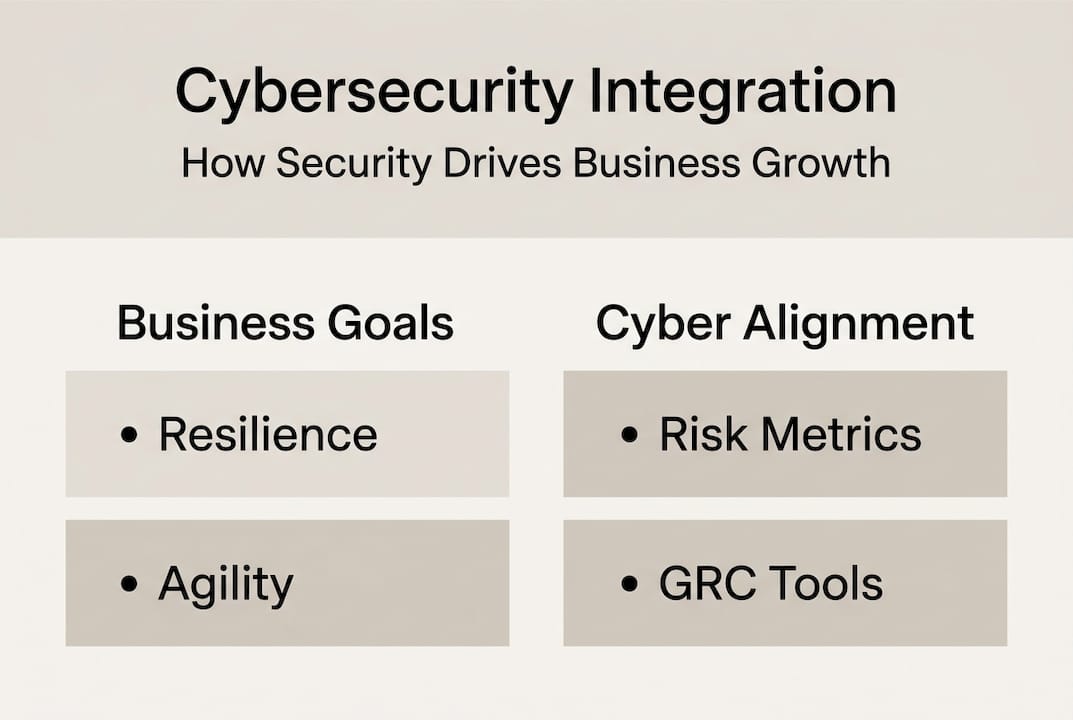
Integrating cybersecurity into business operations changes that dynamic. It means security considerations are embedded in product development, vendor selection, M&A due diligence, and workforce planning. It means risk is communicated in financial and operational terms that boards and investors understand. As cyber risk aligns with enterprise objectives, security becomes a strategic enabler rather than a compliance burden.
The benefits are concrete:
- Improved business continuity through proactive risk identification before disruptions occur
- Faster digital transformation because security is built in, not bolted on
- Stronger regulatory standing through consistent, documented risk management practices
- Cross-functional decision-making that accounts for cyber risk at every level
"Organizations that treat cybersecurity as a business function, not just a technical one, are better positioned to grow, adapt, and withstand disruption."
Pro Tip: If your security team cannot explain a cyber risk in terms of revenue impact or operational downtime, that is a sign integration has not yet taken hold. Start by requiring risk reports in business language.
Moving cybersecurity from a cost center to competitive edge requires deliberate structural changes. Executives who understand aligning cybersecurity with business objectives gain a clear roadmap for making that shift.
Key frameworks for integrating cybersecurity in business
Frameworks give integration structure. Without them, cybersecurity alignment becomes a series of well-intentioned conversations that never produce consistent outcomes. Three frameworks stand out for regulated industries: NIST ERM, NIST CSF 2.0, and CISA Cross-Sector CPGs.
NIST frameworks for ERM integration use risk registers to roll up cyber risks enterprise-wide, enabling CSF 2.0 for risk communication and workforce planning. This approach gives executives a structured method for connecting cybersecurity risk to the broader enterprise risk management process. Risk registers capture specific threats, assign ownership, and quantify potential impact, making cyber risk visible at the board level.
CISA Cross-Sector CPGs provide prioritized baseline practices with a governance pillar specifically designed for leadership oversight in critical infrastructure. They are practical, sequenced, and built for organizations that need to demonstrate security maturity to regulators and auditors.

| Framework | Primary focus | Executive visibility | Best for |
|---|---|---|---|
| NIST ERM | Enterprise risk integration | High | Risk-mature organizations |
| NIST CSF 2.0 | Risk communication and workforce | Medium-High | Broad industry adoption |
| CISA CPGs | Baseline governance practices | High | Critical infrastructure sectors |
To operationalize these frameworks, follow a sequenced approach:
- Conduct a gap analysis against your chosen framework to identify where current security practices fall short of business risk requirements.
- Build or update your risk register to capture cyber risks in financial and operational terms.
- Assign executive ownership for each risk category, not just IT ownership.
- Align workforce planning with CSF 2.0 roles and responsibilities to ensure the right skills are in place.
- Establish governance cadence using CISA CPG pillars to structure board-level reporting.
Knowing how to implement the NIST framework is a practical starting point. For organizations ready to go further, strategic asset governance provides a C-suite blueprint for full integration.
From compliance to strategic enablement
Compliance is the floor, not the ceiling. Boards, investors, and regulators increasingly expect organizations to demonstrate risk-informed strategies, not just audit-ready documentation. Passing a SOC 2 audit or achieving CMMC certification matters. But it does not, by itself, tell stakeholders how well the organization manages cyber risk as a business variable.
Strategic integration enhances compliance, resilience, and agility by quantifying risks financially, automating GRC processes, and using unified platforms that connect security data to business outcomes. Governance, risk, and compliance (GRC) automation reduces manual effort, improves audit accuracy, and frees security teams to focus on higher-value risk management activities.
| Maturity level | Compliance posture | Business impact | Risk visibility |
|---|---|---|---|
| Reactive | Audit-driven | Minimal | Low |
| Proactive | Framework-aligned | Moderate | Medium |
| Strategic | Risk-informed | High | Full |
Organizations at the strategic maturity level consistently outperform peers on business continuity metrics, regulatory outcomes, and investor confidence. The shift requires practical changes:
- Quantify risk in financial terms so leadership can make informed investment decisions
- Automate GRC workflows to reduce compliance overhead and improve consistency
- Unify security and business data on integrated platforms that support real-time decision-making
- Tie security metrics to business KPIs such as uptime, customer trust scores, and contract win rates
Pro Tip: Use cyber risk quantification tools to translate technical vulnerabilities into dollar-value exposure. This single step often changes how quickly executives act on security recommendations.
For regulated industries, treating compliance as advantage rather than overhead is a mindset shift that pays dividends in both market positioning and operational efficiency.
How to drive integration in your organization
Strategy without execution is noise. Embedding cybersecurity into business processes requires deliberate leadership action, structural changes, and sustained accountability. The following seven-step playbook gives executives a practical path forward.
- Establish executive ownership. Assign a senior leader, such as a CISO or vCISO, with explicit authority and accountability for cyber risk across the organization, not just within IT.
- Conduct a cross-functional gap analysis. Identify where cybersecurity considerations are absent from business processes, vendor contracts, and strategic planning.
- Unify risk language. Develop a shared vocabulary for cyber risk that business leaders, legal, finance, and security teams all use consistently.
- Integrate TPRM. Third-party risk management (TPRM) must be embedded in procurement and vendor governance, not treated as a separate compliance task.
- Implement continuous controls monitoring (CCM). CCM replaces point-in-time audits with ongoing assurance, giving leadership real-time visibility into control effectiveness.
- Align security roadmap with business strategy. Security investments should map directly to business priorities, growth plans, and risk appetite statements.
- Measure and report outcomes. Define metrics that connect security performance to business results and report them at the board level on a regular cadence.
For regulated sectors, prioritizing TPRM, CCM, and NIST/CSF integration while shifting to continuous assurance is essential as audit frequency increases and threats from AI and quantum computing evolve.
Pro Tip: Avoid the trap of treating integration as a one-time project. Assign a quarterly review cycle where business and security leaders jointly assess whether the security roadmap still reflects current business priorities.
Reviewing executive best practices and strengthening cyber risk communication with boards are two areas where many organizations find the fastest early wins.
What most leaders get wrong about integrating cybersecurity and business
The most common integration failure is not technical. It is cultural. Leaders launch integration initiatives by updating policies, selecting frameworks, and briefing the board once. Then they move on. What they miss is that integration requires sustained behavioral change across every function, not a project plan with a completion date.
A second critical error is treating integration as a compliance exercise. When the goal is passing an audit, the organization optimizes for documentation. When the goal is genuine risk reduction, the organization optimizes for outcomes. Those are fundamentally different operating models.
Boards also underestimate their own role. Visible executive ownership is not symbolic. It signals to every business unit that cyber risk is a shared responsibility. Without that signal, integration stalls at the IT boundary.
The organizations that get this right build a unified risk language, create cross-silo accountability structures, and measure success through business outcomes rather than security metrics alone. They treat competitive edge with security as a real, achievable goal, not a marketing phrase. That mindset is what separates organizations that integrate successfully from those that simply check boxes.
Ready to strategically integrate cybersecurity and business?
The gap between knowing integration matters and actually executing it is where most organizations stall. Frameworks, playbooks, and best practices only produce results when they are applied with precision to your specific business context, regulatory environment, and risk profile.
Heights Consulting Group works directly with C-level executives and IT leaders to design and implement cybersecurity integration strategies that align with business objectives and regulatory requirements. Whether you are starting with a gap analysis or ready to operationalize a full risk management program, our team provides the cybersecurity consulting for resilience you need to move forward with confidence. Explore how we approach cybersecurity as business opportunity or contact Heights CG to start the conversation.
Frequently asked questions
What are the risks of NOT integrating cybersecurity with business strategy?
Without integration, cybersecurity operates in isolation, creating gaps in risk management, inflated compliance costs, and higher exposure to business disruptions. Aligning cyber risk with enterprise objectives is what prevents operational and financial losses from becoming systemic.
Which framework should we start with for integration in regulated industries?
Most regulated industries benefit from beginning with NIST CSF 2.0 and layering in CISA CPGs for governance-focused oversight. NIST frameworks and CISA CPGs together provide both the risk communication structure and the baseline practices needed for audit readiness.
How can we measure ROI on cybersecurity integration?
Track risk reduction in financial terms, automate GRC workflows to reduce overhead, and monitor improvements in business continuity and audit outcomes. Quantifying risks financially gives leadership the data needed to justify and sustain security investment.
What operational changes do executives need to make for integration?
Executives must establish visible leadership accountability, create a unified risk language across functions, and drive cross-functional alignment between business and IT. CISA CPG governance pillars provide a practical structure for building that leadership oversight.
Is integrating cybersecurity only necessary for heavily regulated sectors?
No. While integration is essential for regulated industries, any organization facing digital threats or compliance pressure gains measurable value from it. Integration transforms cybersecurity into a strategic enabler regardless of sector, improving resilience, investor confidence, and operational efficiency.
Recommended
- From Cost Center to Competitive Edge with Security - Heights Consulting Group
- From Shield to Strategy: An Executive Guide to Aligning Cybersecurity With Business Growth - Heights Consulting Group
- Align Cybersecurity with Business Goals for Growth in 2026 - Heights Consulting Group.
- Aligning Cybersecurity with Business Objectives for Growth - Heights Consulting Group