

A slow or uncoordinated response to a security breach can leave American healthcare and financial organizations exposed to costly regulatory penalties and serious operational disruptions. For CISOs and IT security managers working under strict compliance frameworks, a structured process for incident response is not just a technical necessity—it is a business imperative. This article breaks down the key elements of incident response, showing how clear roles, tested procedures, and regulatory integration support stronger resilience and reduce compliance risk.
Table of Contents
- Defining Incident Response In Cybersecurity
- Phases And Key Elements Of Incident Response
- Regulatory Demands For Incident Response Plans
- Strategic Role For CISOs And Security Leaders
- Risks Of Unpreparedness And Common Pitfalls
Key Takeaways
| Point | Details |
|---|---|
| Structured Incident Response is Essential | Organizations must have a defined incident response capability to minimize damage and ensure compliance with regulations. |
| Holistic Coordination is Critical | Effective incident response requires collaboration between security, operations, and compliance teams to prevent communication gaps. |
| Regulatory Compliance is Non-Negotiable | Incident response plans should incorporate industry-specific regulatory obligations to prevent costly penalties and ensure timely reporting. |
| Post-Incident Review is Vital | Conducting thorough post-incident reviews helps organizations learn from breaches and strengthens future response capabilities. |
Defining Incident Response in Cybersecurity
Incident response is a structured process for identifying, managing, and mitigating the effects of cybersecurity incidents. It's not reactive panic—it's deliberate action designed to minimize damage, recover operations, and prevent future breaches. For regulated organizations in healthcare and finance, this discipline is no longer optional.
At its core, incident response involves coordinated efforts across specialized teams using frameworks, tools, and processes to address security events effectively. Think of it as a playbook your organization executes when a breach, malware attack, or data theft occurs.
Why Incident Response Matters for Your Organization
Without a defined incident response capability, organizations face compounding consequences. Detection delays stretch into days. Response actions conflict or overlap. Critical evidence disappears. Regulatory notification deadlines slip.
Consider the business impact:
- Detection and containment time directly affects breach cost and regulatory exposure
- Coordination failures cause communications gaps that amplify damage and extend recovery
- Lack of documentation creates compliance violations and evidentiary gaps during investigations
- Undefined roles mean no one owns critical decisions when incidents occur
For CISOs and security leaders, incident response is where cybersecurity strategy becomes operational reality.
Core Components of Effective Incident Response
A functional incident response program includes several essential elements that work together:
- Preparation — Teams, tools, and playbooks are established before an incident occurs
- Detection and analysis — Security monitoring identifies and validates security events
- Containment — Actions limit the scope and impact of an active threat
- Eradication — Malware, unauthorized access, and attacker persistence are removed
- Recovery — Systems and data are restored to normal operations
- Post-incident review — Lessons are documented to prevent recurrence
Each phase requires different expertise, tools, and decision-making authority. When these elements align, response times compress and business resilience improves.

Incident Response vs. Business Continuity: Know the Difference
Incident response addresses the immediate threat—stopping the attack, containing compromise, and removing attackers. Business continuity plans keep critical operations running during and after an incident. Both are necessary, but they serve different functions.
Incident response teams focus on the security problem. Business continuity teams focus on operational continuity. Your organization needs both working in parallel.
Here's a quick summary of the key differences between incident response and business continuity:
| Aspect | Incident Response | Business Continuity |
|---|---|---|
| Focus | Stopping security threats | Maintaining operations during disruptions |
| Responsibility | Security teams | Operations teams |
| Objective | Contain and remove attackers | Ensure critical business functions run |
| Priority | Restore security and trust | Minimize business downtime |
Incident response is about stopping the threat. Business continuity is about keeping your business running while you stop the threat.
AI systems introduce new complexity here. Automated response actions triggered by AI-driven detection tools can inadvertently disrupt legitimate operations if not properly tested and constrained. When AI identifies a suspicious pattern and automatically isolates systems, your business continuity teams need to know immediately.
Pro tip: Start by documenting which systems, data, and operations are most critical to your organization. Your incident response plan should prioritize protecting and recovering these assets first—this is your containment and recovery roadmap.
Phases and Key Elements of Incident Response
Incident response unfolds across distinct phases, each with specific objectives and actions. Understanding these phases helps your team move efficiently from detection through recovery without skipping critical steps. CISA's framework outlines key phases including preparation, detection, containment, eradication, and recovery, plus post-incident activities that strengthen future responses.
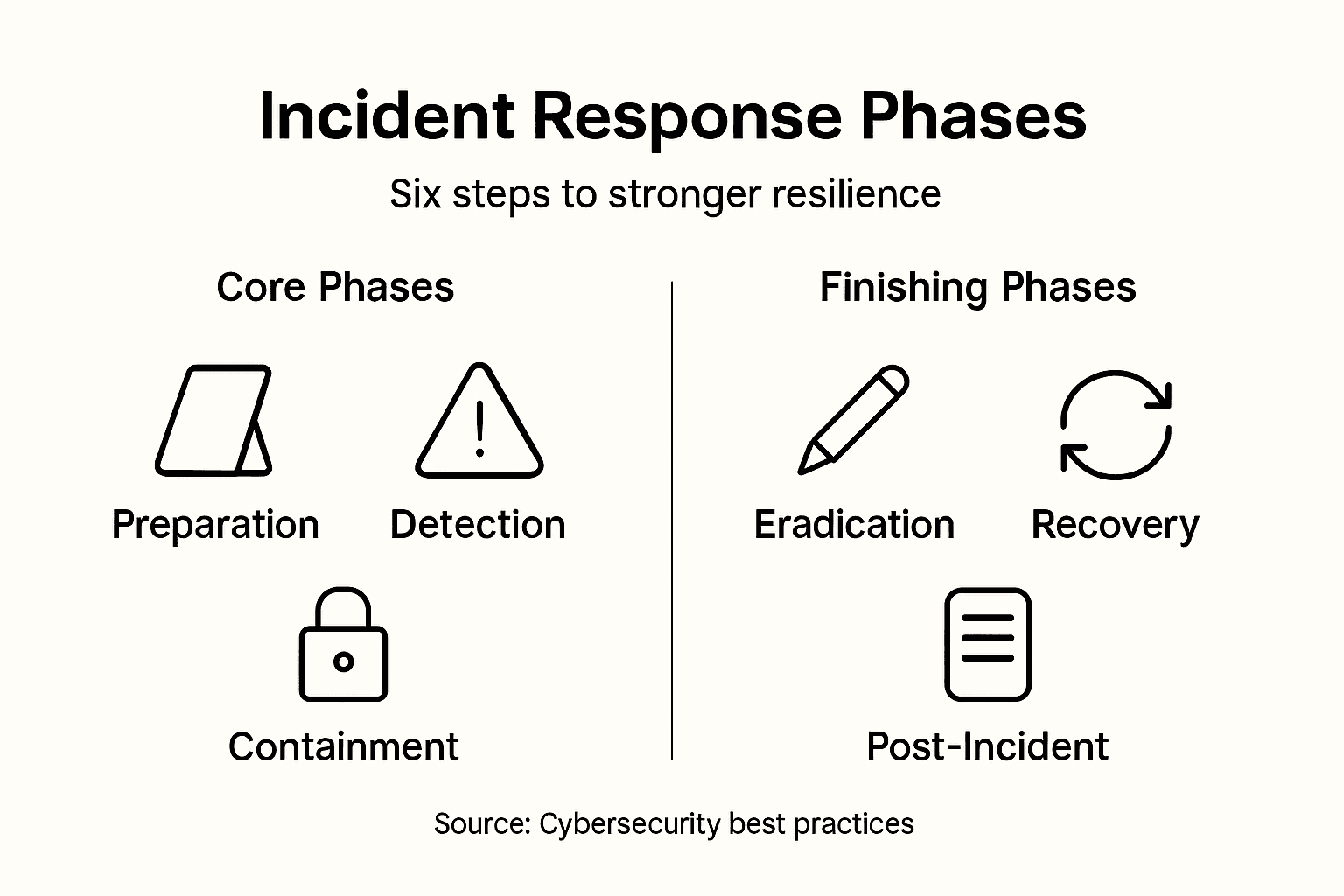
Each phase is a gate. You don't skip ahead. You execute systematically.
Phase 1: Preparation
Preparation happens before an incident occurs. This is where you build your defensive capabilities and response infrastructure.
Key preparation activities include:
- Establishing incident response teams with clear roles and responsibilities
- Creating playbooks and procedures for common scenarios
- Deploying monitoring and detection tools across your environment
- Conducting tabletop exercises to test response capabilities
- Documenting critical systems, data flows, and recovery procedures
For financial institutions and healthcare organizations, preparation also means ensuring your incident response team understands regulatory notification requirements, breach reporting timelines, and compliance obligations under HIPAA, GLBA, or other applicable rules.
Weak preparation extends your response time by weeks. Strong preparation compresses it to hours.
Phase 2: Detection and Analysis
This phase begins when security monitoring identifies a potential security event. Your team must distinguish real threats from false alarms—a critical skill that prevents wasted response resources.
Detection and analysis includes:
- Reviewing alerts from security tools and log sources
- Validating whether an event represents an actual security incident
- Collecting initial evidence and documentation
- Assessing scope, severity, and type of incident
- Alerting senior leadership and stakeholders
AI-driven monitoring systems can accelerate detection but introduce new risks. If your AI detection tool flags anomalies and your team doesn't understand why, you'll spend response time investigating tool behavior instead of the actual threat. Transparency in how detection decisions are made matters enormously.
Phase 3: Containment
Containment stops the bleeding. Your goal is to limit the scope and impact of an active threat.
Containment actions vary by incident type:
- Malware incident: Isolate affected systems, disable network access, block command-and-control communications
- Unauthorized access: Reset compromised credentials, terminate active sessions, revoke API tokens
- Data exfiltration: Identify which data was accessed, block external data transfers, preserve evidence
Containment requires speed and decisiveness. The longer an attacker has network access, the more damage spreads and the harder recovery becomes.
Phase 4: Eradication and Recovery
Eradication removes the attacker and eliminates vulnerabilities they exploited. Recovery restores systems to normal operations.
These actions include:
- Removing malware, backdoors, and unauthorized accounts
- Patching vulnerabilities that were exploited
- Restoring systems from clean backups or rebuilding from known-good configurations
- Validating system integrity before returning to production
- Testing business applications to confirm functionality
Recovery timelines depend heavily on your preparation. Organizations with documented recovery procedures and tested backups recover in days. Organizations without these recover in weeks.
Phase 5: Post-Incident Activities
After systems are restored, the work isn't finished. Post-incident activities capture lessons and prevent recurrence.
Actions include:
- Conducting a comprehensive incident review with all teams involved
- Documenting what happened, why, and how the response was executed
- Identifying root causes and contributing factors
- Updating playbooks, procedures, and security controls based on findings
- Communicating lessons learned across the organization
The difference between mature incident response and immature response is post-incident discipline. Organizations that skip this phase repeat the same breaches.
Regulatory compliance mandates post-incident documentation. For healthcare organizations, HIPAA breach notification rules require incident investigation and mitigation reporting. For financial services, regulators expect evidence of effective incident response and corrective action.
Pro tip: Schedule your post-incident review within two weeks of incident closure while details are fresh. Assign one person to document findings in writing—verbal memories diverge, but written records create institutional memory and regulatory evidence.
Regulatory Demands for Incident Response Plans
Regulatory requirements aren't optional add-ons to incident response—they're foundational obligations. For healthcare and financial services organizations, breach notification timelines, reporting mandates, and compliance investigations are non-negotiable. Your incident response plan must embed these requirements directly into operational procedures.
CISA's incident response framework requires integration of legal and regulatory obligations to ensure timely breach notifications and alignment with security policies. Without this integration, your response team will scramble to understand what you owe regulators while containing an active incident.
Understanding Your Regulatory Obligations
Different industries face different rules. Your obligation is to know yours precisely.
For healthcare organizations covered by HIPAA:
- Notify affected individuals within 60 calendar days of discovery of a breach
- Report breaches to the U.S. Department of Health and Human Services
- Document breach investigation findings and mitigation steps
- Maintain incident records for audits and regulatory inquiries
For financial institutions under GLBA and Gramm-Leach-Bliley regulations:
- Notify customers without unreasonable delay of breaches affecting financial information
- Report incidents to federal banking regulators
- Demonstrate incident response effectiveness during compliance examinations
- Maintain forensic evidence for regulatory review
For organizations handling payment card data under PCI-DSS:
Below is a reference table highlighting regulatory reporting requirements across major industries:
| Industry | Regulator or Law | Notification Timeline | Key Evidence Required |
|---|---|---|---|
| Healthcare | HIPAA | 60 days from breach discovery | Investigation report, mitigation steps |
| Financial Services | GLBA, SEC | No unreasonable delay | Forensic evidence, response effectiveness |
| Payment Card | PCI-DSS | As specified by card network | Forensic reports, corrective action |
- Report breaches to payment card networks within specific timeframes
- Conduct forensic investigations and provide detailed findings
- Implement corrective controls to prevent recurrence
Building Regulatory Requirements into Your Plan
Your incident response plan should directly reference regulatory timelines and obligations. Generic playbooks fail when the stakes are regulatory enforcement.
Key elements to incorporate:
- Notification thresholds and timelines for each applicable regulation
- Roles responsible for regulatory reporting with backup designations
- Documentation requirements including what must be preserved for regulators
- Escalation procedures to legal counsel and compliance teams
- Record retention policies for incident investigations and evidence
When an incident occurs, your incident commander should immediately consult a timeline checklist showing breach notification deadlines. Regulatory reporting shouldn't be an afterthought discussed during post-incident review.
The Compliance Investigation Component
Breaches trigger mandatory investigations. Regulators expect evidence that you investigated thoroughly and identified root causes.
Investigation standards include:
- Identifying exactly what data was accessed or compromised
- Determining who accessed it and when
- Preserving forensic evidence from affected systems
- Documenting investigation findings in writing
- Demonstrating remediation and preventive measures
Regulatory investigators don't accept "we don't know" as an answer. They expect incident response teams to preserve evidence, conduct thorough analysis, and document findings methodically.
This means your forensic capabilities matter. If you can't preserve and analyze evidence from compromised systems, you can't satisfy regulatory investigation requirements. Organizations without forensic expertise often hire external consultants during incidents, adding weeks to investigation timelines.
The AI Compliance Risk
Automated response systems create new compliance documentation challenges. If your AI-driven security tools automatically isolate systems or block users during an incident, those actions must be logged, justified, and documented for regulators.
Regulators will ask: Who authorized this action? How was it validated? What safeguards prevent false positives from disrupting legitimate operations? If you can't answer these questions, the action—however effective—creates liability.
Pro tip: Assign one team member to be the compliance notification owner before an incident occurs. This person maintains the regulatory checklist, tracks notification deadlines, and coordinates with legal counsel. During an active incident, compliance reporting happens in parallel with technical response—not after the fact.
Strategic Role for CISOs and Security Leaders
Your role as a CISO or security leader extends far beyond managing tools and patching systems. You're responsible for building organizational resilience—the capability to survive a breach, recover quickly, and emerge stronger. This requires strategic vision aligned with business objectives, not just technical execution.
CISOs and security leaders play a critical strategic role by developing incident response frameworks that foster transparent communication during crises and align security initiatives with business goals. When an incident occurs, your leadership determines whether the organization responds with coordination or chaos.
Leadership During Incident Response
Incident response reveals leadership gaps. When systems are compromised and executives are panicking, your credibility is tested.
Effective CISO leadership during incidents includes:
- Making rapid, confident decisions on containment actions despite incomplete information
- Communicating clearly with executives about impact, timeline, and recovery costs
- Coordinating across teams so forensics, legal, communications, and operations work in parallel
- Managing stakeholder expectations by setting realistic recovery timelines
- Documenting decisions to satisfy regulatory investigations later
Weaker leaders defer to vendors, avoid difficult calls, or allow technical teams to make business decisions without executive input. Your job is different.
Translating Security into Business Value
Most CISOs struggle with executive communication. You know incident response matters, but executives want to know: How much will this cost if we're breached? How long will we be down? What's the competitive damage?
Incident response capability should be framed as business resilience—the ability to recover faster than competitors and maintain customer trust. When you can prove you'll recover in 24 hours instead of weeks, that's a competitive advantage worth measuring.
This requires you to:
- Quantify breach costs in your industry using real data
- Calculate recovery timelines based on your actual capabilities
- Show insurance implications of weak incident response
- Demonstrate regulatory exposure and fines
- Connect security spending to business continuity outcomes
Managing the Regulatory and Compliance Burden
You operate in a constrained environment. HIPAA, GLBA, PCI-DSS, and emerging regulations all mandate incident response capabilities. Regulators don't accept excuses for slow breaches or poor investigations.
Your responsibilities include:
- Staying current on regulatory requirements in your industry
- Embedding compliance into incident response procedures, not bolting it on later
- Maintaining audit trails of incident decisions and actions
- Coordinating with legal counsel to manage regulatory reporting
- Demonstrating improvement through post-incident reviews
Regulators judge CISOs by what went wrong, how you responded, and what you fixed. Incident response is where your leadership credibility is tested.
The AI Governance Challenge
Artificial intelligence introduces new complexities to your leadership role. Automated security tools make decisions in real time—isolating systems, blocking users, restricting network access. You're responsible for ensuring these decisions are defensible, effective, and don't disrupt legitimate operations.
AI governance requires you to:
- Understand how AI tools make decisions, not just trust vendor promises
- Test automated responses before they execute in production
- Document the reasoning behind AI-driven containment actions
- Maintain human oversight of critical security decisions
- Address transparency gaps when regulators ask why an action was taken
If your incident response relies on AI systems you don't fully understand, you've created a liability, not a capability.
Pro tip: Document your incident response strategy and expectations in a charter signed by your CEO and board before an incident occurs. This gives you authority to make fast decisions during crises and removes second-guessing after the fact.
Risks of Unpreparedness and Common Pitfalls
Unpreparedness isn't a minor weakness. It's a business catastrophe waiting to happen. Organizations without incident response plans face exponentially higher costs, longer recovery times, and regulatory penalties when breaches occur. The difference between prepared and unprepared organizations during a crisis is measured in weeks of downtime and millions in damages.
Many organizations suffer from unclear roles, siloed communication, and inadequate response strategies that lead to slow or ineffective responses. These weaknesses increase financial damage, extend recovery timelines, and compound reputational harm. Without structured planning, your team will improvise under pressure—and improvisation during crises is how critical mistakes happen.
The Cost of No Plan
Organizations without incident response plans face catastrophic consequences. Detection takes weeks instead of days. Containment fails because no one knows what authority they have. Recovery is chaotic because procedures don't exist.
When a breach occurs without a plan in place:
- Detection delays extend from days to weeks, allowing attackers deeper access
- Confusion about authority paralyzes decision-making during critical moments
- Lack of forensic evidence prevents regulators from understanding what happened
- Communication breakdowns create multiple versions of events told to customers
- Regulatory fines multiply because you can't prove compliance or investigation quality
A healthcare organization without a breach response plan may miss the 60-day HIPAA notification deadline entirely. A financial institution without forensic procedures can't satisfy SEC investigation requirements. These aren't theoretical risks—they're regulatory violations with seven-figure consequences.
Common Structural Pitfalls
Organizations that have incident response plans often undermine them through predictable mistakes.
Unclear role assignments create gaps during crises. You document that "someone" handles forensics, but no specific person is named. When an incident occurs, three people think it's someone else's job. Evidence disappears.
Siloed teams prevent parallel response. Forensics investigates independently. Communications drafts statements without security input. Legal counsel negotiates with regulators without understanding technical facts. Each team acts separately instead of coordinating.
Plans that are never tested don't work when needed. Procedures that looked good on paper fail under pressure. Teams discover missing contact information, incorrect system access, or procedures that rely on retired employees.
Outdated documentation creates confusion. Your plan references systems that no longer exist. Contact lists have wrong phone numbers. Network diagrams are years old. When speed matters, outdated information costs you hours.
The AI False Confidence Trap
New risks emerge from automated incident response. Organizations deploy AI-driven security tools expecting them to handle incidents automatically. But automated decisions create new problems.
If your AI detection system flags an anomaly and automatically isolates critical systems without human authorization, you've solved one problem and created two others. Your business continuity teams don't know why systems went offline. Your legal team can't explain the action to regulators. Your customers lose access to services based on an automated decision you didn't fully understand.
Unpreparedness doesn't just slow your response—it multiplies costs, extends damage, and creates regulatory liability you can't escape.
What Preparedness Actually Requires
Effective incident response requires more than a document gathering dust. It requires:
- Documented roles with specific names, not generic titles
- Tested procedures executed at least annually
- Clear decision authority for containment and communication
- Forensic capabilities you've validated before an incident
- Communication plans that balance transparency with legal constraints
- Regular updates reflecting your actual environment and regulatory changes
Pro tip: Schedule a tabletop exercise for your incident response team twice annually. Use realistic scenarios for your industry—a data exfiltration for financial services, a ransomware attack for healthcare. These exercises reveal gaps in your actual capability before a real incident exposes them.
Strengthen Your Incident Response with Strategic Cybersecurity Partnership
Effective incident response is critical to building business resilience in the face of evolving cyber threats. This article highlights the challenges organizations face such as delayed detection, poor coordination, lack of forensic readiness, and regulatory compliance pressures. Key terms like containment, forensic evidence preservation, breach notification, and AI-driven response reveal the complexity security leaders navigate daily. If your organization struggles with unclear roles or untested procedures, you risk extended downtime and costly regulatory penalties.
Heights Consulting Group understands these pain points and offers tailored solutions to integrate incident response seamlessly into your cybersecurity strategy. Our expert team helps you prepare with documented response plans, advanced endpoint detection, threat hunting capabilities, and compliance frameworks that meet stringent requirements like HIPAA and GLBA. With proven leadership and AI governance strategies, we empower CISOs to transform incident response from a reactive burden into a competitive advantage.
Managed Cybersecurity Solutions provide the foundation your team needs to act decisively during incidents
Do not wait for a breach to expose gaps in your incident response capabilities. Visit Heights Consulting Group today and partner with seasoned professionals ready to fortify your business resilience. Start building a rapid, compliant, and coordinated incident response program that protects your critical assets and ensures regulatory confidence.
Frequently Asked Questions
What is incident response in cybersecurity?
Incident response is a structured process designed to identify, manage, and mitigate the effects of cybersecurity incidents to minimize damage and ensure a swift recovery.
Why is incident response important for organizations?
Incident response is critical because it helps organizations detect and contain breaches quickly, reducing the impact of incidents, ensuring compliance with regulations, and restoring operations efficiently.
What are the main phases of incident response?
The main phases of incident response include preparation, detection and analysis, containment, eradication, recovery, and post-incident activities. Each phase has specific objectives that contribute to an organization's overall security posture.
How can organizations ensure effective incident response plans?
Organizations can ensure effective incident response plans by clearly defining roles, conducting regular training and tabletop exercises, maintaining up-to-date documentation, and incorporating regulatory compliance into their plans.
Recommended
- Incident Response: Build Effective Cybersecurity Teams
- Incident Response Readiness Assessment for Security - Heights Consulting Group
- Improve Incident Response for Financial Firms: Heights Consulting Group.
- Your Essential Data Breach Response Plan Template - Heights Consulting Group
- Backup och dataräddning - Datasupport Stockholm