

TL;DR:
- Integrating AI security involves deploying autonomous agents with layered controls and governance frameworks. Effective implementation starts with establishing strict access controls, continuous validation, and thorough environment-specific evaluation.
Integrating AI security means deploying autonomous AI agents with layered controls and governance frameworks to improve threat detection, accelerate response, and reduce analyst workload at scale. Security operations centers face up to 14,000 incidents daily, a volume no human team can triage alone. Organizations that know how to integrate AI security correctly report over 90% autonomous alert resolution, cutting mean time to response from hours to minutes. The industry term for this discipline is AI security implementation, and it requires more than deploying a tool. It demands governance frameworks like ISO/IEC 42001, scoped access controls, and continuous validation before any AI agent touches production data.
What prerequisites and foundational controls are necessary before integrating AI in security operations?
The foundation of any AI security implementation is access control, not technology selection. Without it, AI agents inherit the same over-permissioned risks that plague human accounts, but they act faster and at greater scale.

The AWS AI Security Framework defines three layers that must be secured simultaneously: infrastructure, identity and data, and the AI application itself. Gaps in any single layer create exposure across all three. This layered model gives security leaders a concrete architecture to audit rather than an abstract checklist.
Before deploying any AI-driven security solution, IT leaders must establish the following controls:
- Zero-trust access for AI agents. Treat every AI workload as untrusted by default. Require explicit authorization for each action, not blanket session permissions.
- Least-privilege credentials. Restrict AI agent access to the specific APIs or functions it needs. Broad, human-like privileges amplify errors and create lateral movement risk.
- Data classification and governance. Identify and label every data source the AI will access. Map those classifications to your compliance requirements, whether NIST, CMMC, HIPAA, or SOC 2.
- Scoped identity for AI workloads. Issue dedicated service identities for AI agents. Shared credentials make audit trails unreliable and incident attribution nearly impossible.
- Policy boundaries and approval gates. Define which actions an AI agent can take autonomously and which require human sign-off before deployment begins, not after.
Pro Tip: Before selecting any AI security tool, document the exact data flows the agent will touch. If you cannot map those flows to a compliance framework, the tool is not ready for production.
Governance documentation must exist before the first test run. Organizations that skip this step often discover compliance gaps only after an AI agent has already processed regulated data.
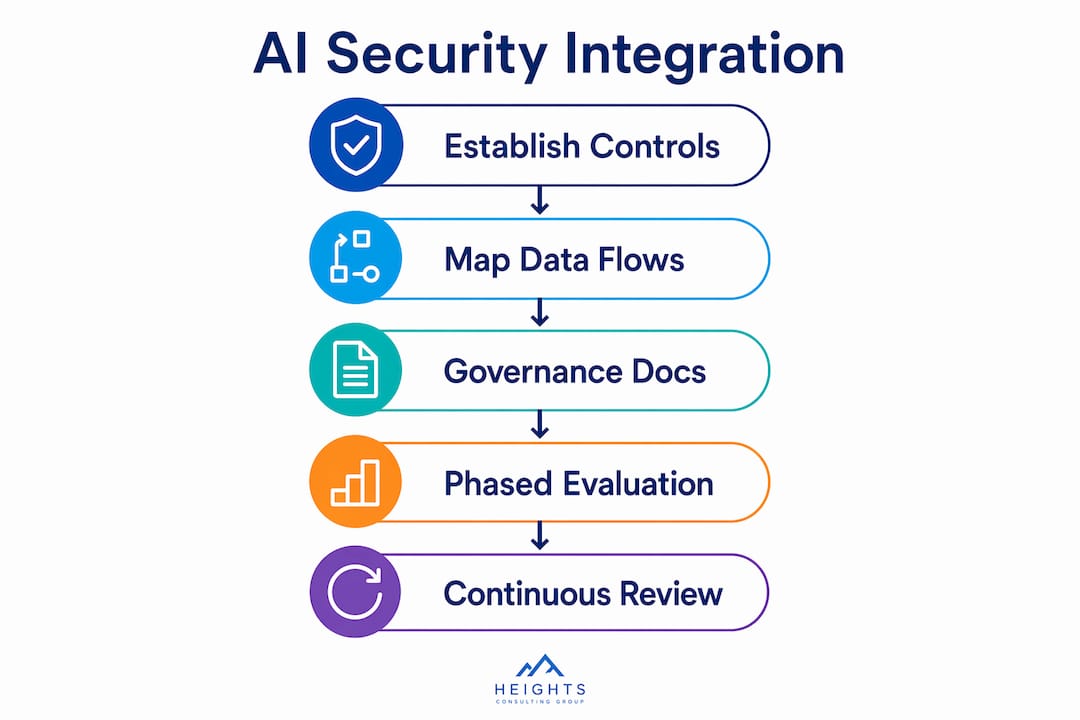
How to conduct a phased, environment-specific evaluation of AI security tools
A phased evaluation is the single most reliable method for separating vendor claims from real-world performance. Vendor benchmarks frequently do not reflect the alert mix, data quality, or workflow complexity of your specific environment.
The evaluation process should follow this sequence:
- Define success metrics before testing begins. Set targets for false positive reduction, alert volume change, and mean time to resolution improvement. Without pre-defined metrics, evaluation becomes subjective.
- Run a 30-day parallel test on live data. Parallel evaluation against live traffic reveals performance gaps that sandbox environments hide. Run the AI tool alongside your existing controls, not instead of them.
- Require confidence scores on every AI finding. AI-generated findings must include confidence scores and pass dual verification before triggering any automated action. A finding without a confidence score is an opinion, not a signal.
- Gate automated actions behind human approval. During the first deployment phase, require analyst sign-off on any AI-recommended action. This builds institutional trust in the tool's output and catches systematic errors early.
- Limit AI scope to specific APIs or functions. Avoid granting broad access during evaluation. Scope the agent to one detection use case, measure it thoroughly, then expand.
- Distinguish between AI bolt-ons and autonomous platforms. A SIEM with an AI feature is not the same as an autonomous AI security platform with a shared memory layer connecting SOC alerts, threat hunts, and pentest data. Evaluate them against different criteria.
| Evaluation Criterion | What to Measure | Acceptable Threshold |
|---|---|---|
| False positive rate | Alerts requiring no analyst action | Measurable reduction from baseline |
| Alert volume change | Total alerts processed vs. escalated | Significant reduction in escalations |
| Mean time to resolution | Time from detection to closure | Reduction from current baseline |
| Confidence score accuracy | Verified findings vs. total flagged | High correlation with analyst judgment |
| Scope adherence | Actions taken outside defined boundaries | Zero tolerance |
Pro Tip: Ask vendors to provide reference customers in your industry with comparable data environments. Generic case studies from different sectors tell you almost nothing about how the tool will perform for you.
The evaluation phase is where most AI security implementations succeed or fail. Organizations that compress this phase to meet a deployment deadline consistently report higher false positive rates and analyst fatigue within 90 days.
What operational practices ensure secure and effective AI usage in cybersecurity workflows?
Deploying an AI security tool is not the end of the governance obligation. It is the beginning of a continuous oversight cycle. Responsible AI integration requires continuous validation rather than one-time policy reviews, and that principle must be built into daily operations.
Effective operational practices for AI security include:
- Behavioral monitoring for AI agents. Log every action an AI agent takes and flag out-of-scope behavior immediately. An agent that begins querying data outside its defined scope is a security event, not a configuration issue.
- Prompt injection and adversarial input validation. AI systems that process external data are vulnerable to manipulation. Apply input validation at every ingestion point and test regularly with adversarial inputs.
- Audit trails aligned with ISO/IEC 42001. Continuous auditability is a core requirement of the ISO/IEC 42001 AI Management System standard. Every AI decision that affects a security outcome must be logged and attributable.
- Human-in-the-loop controls for high-risk decisions. Automated containment of a compromised endpoint is acceptable. Automated deletion of user accounts or network isolation of production systems requires human authorization.
- Authentication, rate limiting, and network segmentation for AI components. Treat AI agents as network-connected services. Apply the same perimeter controls you would to any privileged application. AWS Bedrock Guardrails and WAF provide application-layer defenses against prompt injection and accidental PII exposure.
"Security leaders must move from static AI policies to continuous validation. An AI system that was safe at deployment can become a liability within weeks if the threat environment shifts and the model's behavior is not re-evaluated."
Aligning AI outputs with regulatory requirements is an ongoing task. Security teams should schedule quarterly reviews of AI agent behavior against current compliance obligations, particularly in regulated industries where requirements change frequently.
What common pitfalls should IT leaders anticipate when integrating AI security?
The most dangerous assumption in AI security implementation is that a validated tool stays validated. AI systems operate in dynamic threat environments, and their behavior drifts when inputs change.
The following pitfalls account for the majority of operational failures in AI security programs:
- Ignoring adversarial input risks. AI systems face a 97% multi-turn jailbreak success rate as of Q2 2026. That figure means adversarial input validation is not optional. Any AI tool processing attacker-influenced data without input validation is a liability.
- Over-relying on unvalidated AI output. Sole reliance on AI findings without dual verification is a documented operational failure risk. Analysts who treat AI output as ground truth rather than a high-confidence signal create blind spots that attackers exploit.
- Overprovisioning AI agent permissions. AI agents granted broad access violate the least-privilege principle and create compounding risk. An agent that can read, write, and execute across multiple systems can cause significant damage if manipulated.
- Underestimating data privacy exposure. AI tools that process logs, communications, or endpoint telemetry may inadvertently handle regulated personal data. Organizations must include data classification and vendor security reviews in their AI governance program.
- Treating the AI tool as a trusted internal system. AI security tools are themselves an attack surface. Continuous security assessment of the tool, its integrations, and its data access must be part of the ongoing program.
- Accepting vendor benchmarks without self-conducted evaluation. Benchmark results from a vendor's controlled environment rarely translate to your environment. The 30-day parallel evaluation described earlier is the only reliable method for measuring real utility.
The AI security best practices that survive contact with real environments share one characteristic: they treat AI as a powerful but fallible component that requires the same skepticism applied to any third-party system.
Key Takeaways
Effective AI security integration requires layered controls, phased evaluation, and continuous governance, not a single deployment decision.
| Point | Details |
|---|---|
| Establish controls before deployment | Zero-trust access, least-privilege credentials, and data classification must exist before any AI agent touches production data. |
| Run environment-specific evaluations | A 30-day parallel test on live data is the only reliable way to measure AI tool performance in your environment. |
| Require confidence scores and dual verification | AI findings without confidence scores and analyst verification create operational blind spots that attackers exploit. |
| Treat AI tools as an attack surface | Continuous behavioral monitoring, input validation, and security assessment of AI agents are non-negotiable operational requirements. |
| Align with ISO/IEC 42001 for auditability | Continuous validation aligned with ISO/IEC 42001 builds the defensible security posture regulators and auditors require. |
What I've learned from watching AI security integrations succeed and fail
After working through AI security implementations across regulated industries, the pattern that separates successful programs from expensive failures is not the tool selected. It is the governance discipline applied before, during, and after deployment.
The organizations that struggle most are those that treat AI security as a procurement decision. They select a tool based on a vendor demo, skip the parallel evaluation phase, and grant the agent broad access because scoping takes time. Within months, they face alert fatigue from false positives, compliance questions from auditors, and an AI agent that has become a shadow IT risk rather than a security asset.
The teams that get it right start with a documented AI security strategy that includes explicit policy boundaries, defined success metrics, and a clear escalation path for anomalous AI behavior. They involve legal and compliance from the first planning session, not after the tool is live. That early collaboration prevents the data privacy and regulatory exposure issues that derail programs at the worst possible moment.
The hardest cultural shift is accepting that trust in AI output must be earned incrementally. Security teams that have spent years building confidence in their SIEM rules and detection logic are understandably skeptical of a model they cannot fully inspect. That skepticism is healthy. The dual-verification requirement and confidence score standards exist precisely because AI outputs deserve scrutiny, not deference. Organizations that build that scrutiny into their workflows from day one develop AI security programs that hold up under both adversarial pressure and regulatory review.
— Dan
How Heightscg supports AI security integration for IT leaders
Heightscg works with IT leaders and security teams to build AI security programs that hold up under real-world conditions. That means governance frameworks aligned with NIST, CMMC, and ISO/IEC 42001, phased deployment support, and continuous validation built into the operating model from the start.
The firm's technical cybersecurity consulting practice covers the full AI security lifecycle, from prerequisite controls and evaluation design through operational oversight and compliance alignment. For organizations navigating the governance and implementation challenges described in this guide, Heightscg provides the structured, executive-led support that turns AI security from a risk into a measurable operational advantage. Connect with the team through the Heightscg contact page to discuss your specific environment and objectives.
FAQ
What does it mean to integrate AI security?
Integrating AI security means deploying autonomous AI agents with layered controls, governance frameworks, and continuous validation to improve threat detection and response across security operations.
How long should an AI security evaluation take?
A 30-day parallel evaluation on live data is the minimum required to measure false positive rates, alert volume changes, and mean time to resolution improvements in your specific environment.
What is the biggest risk of deploying AI security tools?
The greatest risk is overprovisioning AI agent permissions combined with sole reliance on unvalidated AI output. Both conditions create exploitable blind spots and violate least-privilege principles.
Which governance framework applies to AI security integration?
ISO/IEC 42001 is the recognized AI Management System standard for continuous auditability and defensible security posture. The AWS AI Security Framework provides a complementary layered control model covering infrastructure, identity, and AI application layers.
How do you prevent AI security tools from becoming an attack surface?
Apply continuous behavioral monitoring, adversarial input validation, and regular security assessments to AI agents. Treat every AI component as a privileged network-connected service subject to the same controls as any third-party system.