

TL;DR:
- A comprehensive data protection strategy integrates privacy, governance, and security to reduce risk and ensure compliance. It relies on continuous visibility, accurate data classification, clear policies, and layered controls, with ongoing monitoring to adapt to changing threats and regulations. Effective programs treat data protection as an operational, living process that connects all organizational functions seamlessly.
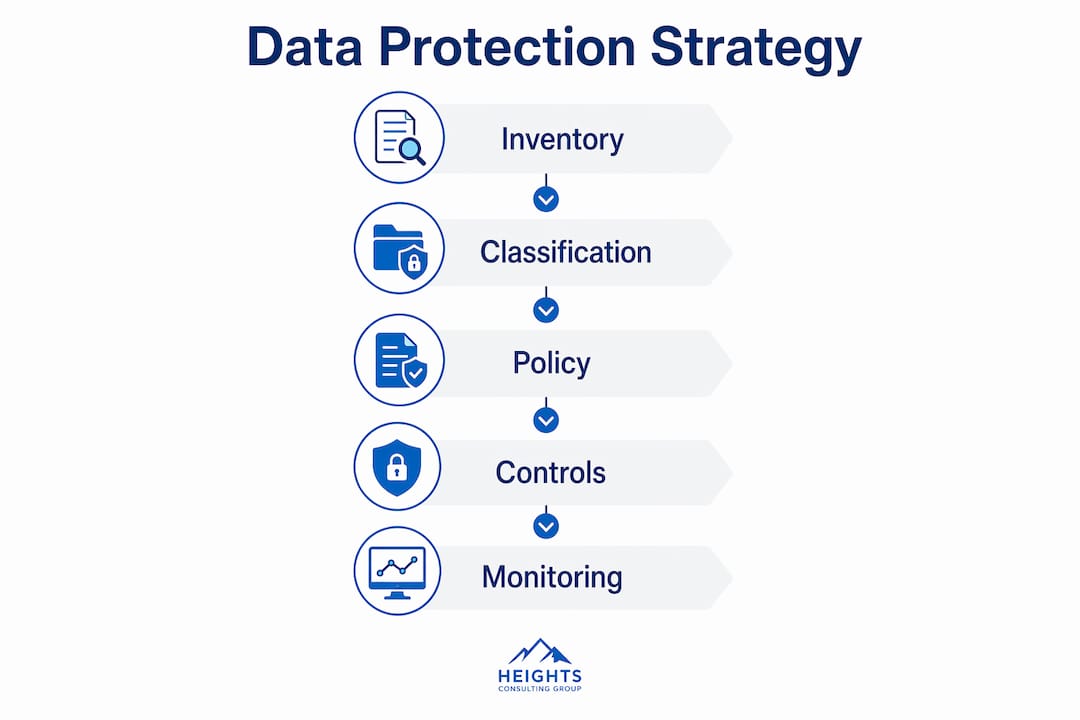
A data protection strategy is a structured program that connects privacy, governance, and security to minimize risk and ensure regulatory compliance across your organization. Unlike a simple IT policy, a mature strategy integrates three distinct domains: data privacy (how personal information is collected and used), data governance (who owns and controls data assets), and information security (how data is protected from threats). Business leaders who understand how to develop a data protection strategy position their organizations to meet GDPR, HIPAA, and CCPA requirements while building the operational resilience that regulators and customers now expect. This guide walks through each phase, from discovery to continuous monitoring, with frameworks and tools that translate directly into practice.
What you need before developing a data protection strategy
The foundation of any effective data security framework is visibility. You cannot protect what you cannot see, and most organizations discover significant blind spots the moment they begin a formal inventory.
Before drafting a single policy, establish these prerequisites:
- Data discovery tools. Data Security Posture Management (DSPM) tools automate continuous inventory of sensitive data across cloud and on-premises environments, including dark and shadow data that standard audits miss. Continuous data visibility is the prerequisite for identifying unmanaged risks.
- Automated classification capability. AI-driven classification allows accurate assignment of sensitivity tiers based on regulatory requirements and business value, producing more consistent labeling than manual methods at any scale.
- Stakeholder alignment. Legal, compliance, IT, and business unit leaders must agree on objectives before controls are designed. Misalignment at this stage creates policy gaps that auditors find quickly.
- Regulatory inventory. Map every applicable framework: GDPR for EU personal data, HIPAA for protected health information, CCPA for California consumer data, and CMMC for defense contractors. Each carries distinct control requirements.
- Monitoring commitment. Static annual reviews are insufficient for modern threat environments. Plan for continuous monitoring from day one, not as an afterthought.
Pro Tip: Before purchasing any new security platform, audit what your existing Microsoft 365 or cloud provider license already includes. Microsoft Purview, for example, offers sensitivity labeling, DLP, and compliance reporting that many organizations have already paid for but never activated.
How do you inventory and classify data assets?
Data inventory is the process of cataloging every data asset your organization creates, stores, processes, or transmits, then assigning a sensitivity classification to each. This step directly determines which controls you apply and where you spend your security budget.
Follow this sequence:
- Scope the environment. List every system that stores or processes data: cloud platforms (AWS, Azure, Google Cloud), SaaS applications (Salesforce, Workday), on-premises servers, endpoint devices, and third-party integrations.
- Run automated discovery. Deploy a DSPM tool to scan each environment. These tools surface structured data (databases), unstructured data (email, SharePoint), and shadow data (unsanctioned apps employees use without IT approval).
- Classify by sensitivity tier. Assign each data type to a tier: public, internal, confidential, or restricted. Regulatory data such as Social Security numbers, protected health information, or payment card data always lands in the restricted tier.
- Conduct a risk assessment. For each data category, evaluate likelihood of exposure and potential business impact. Use a simple risk matrix: likelihood (low, medium, high) multiplied by impact (low, medium, high) produces a priority score.
- Identify gaps. Compare your current controls against the requirements for each sensitivity tier. Document every gap as a finding with an assigned owner and remediation timeline.
The table below illustrates how classification maps to control requirements:
| Sensitivity Tier | Example Data Types | Minimum Controls Required |
|---|---|---|
| Public | Marketing materials, press releases | No special controls |
| Internal | Employee directories, internal memos | Access controls, basic encryption |
| Confidential | Financial reports, contracts | Encryption, RBAC, audit logging |
| Restricted | PHI, PII, payment card data | MFA, DLP, encryption at rest and in transit |
Pro Tip: Pay particular attention to AI-generated outputs. If your organization uses large language models like GPT-4 or Claude for internal work, those outputs may contain sensitive data that was never formally classified. Add AI system outputs to your inventory scope explicitly.
How do you set goals and draft data protection policies?
Goals without policies are intentions. Policies without goals are bureaucracy. Effective data privacy strategy development requires both to be tightly linked.

Start by translating your risk assessment findings into measurable objectives. A goal like "reduce unauthorized access to restricted data" becomes measurable when paired with a target: "achieve zero standing privileged access accounts by Q3 2026." Aligning goals to business objectives, not just compliance checkboxes, secures executive sponsorship and budget.
When drafting policies, follow these best practices for data protection policy language:
- Write for the enforcer, not the auditor. Policies must be clear enough for a system administrator or HR manager to act on without legal interpretation. Avoid passive constructions and vague directives.
- Define scope explicitly. Every policy must state which systems, data types, roles, and geographic locations it covers. Ambiguous scope is the most common reason policies fail during audits.
- Assign roles and responsibilities. Name the data owner, data custodian, and data steward for each data category. Ownership without accountability produces no results.
- Link policies to controls. Each policy statement should reference the specific administrative, technical, or physical control that enforces it. "All restricted data must be encrypted" links directly to your encryption standard and the tool that enforces it.
- Anchor to recognized frameworks. Frameworks like NIST CSF and ISO 27001 help structure policies and map controls for compliance and operational effectiveness. Policies linked to these frameworks facilitate audits and align with evolving regulations.
Effective security policies must balance clarity and operational applicability, linking policy language explicitly to controls that teams can enforce daily. A policy that cannot be enforced is a liability, not a protection.
What technical and administrative controls enforce your strategy?
Controls are the mechanisms that make policies real. An effective data protection program requires both administrative controls (policies, roles, and processes defining security responsibilities) and technical controls (tools such as MFA, encryption, and monitoring systems). Physical controls, including data center access restrictions and device management, complete the picture.
The comparison below clarifies the three control categories and their primary tools:
| Control Category | Purpose | Key Tools and Methods |
|---|---|---|
| Administrative | Define responsibilities and procedures | Security policies, role assignments, training programs |
| Technical | Enforce policies through technology | MFA, encryption, DLP, RBAC, DSPM |
| Physical | Restrict physical access to data and systems | Badge access, CCTV, locked server rooms, device disposal |
For most organizations, the highest-impact technical controls are access management and data loss prevention. Role-based access control (RBAC), least privilege enforcement, and phishing-resistant MFA methods are foundational for access management. Use just-in-time privileged access and FIDO2 security keys wherever possible to reduce breach exposure. These measures directly limit the blast radius of a compromised credential.
Data loss prevention (DLP) tools monitor and block unauthorized data transfers across email, cloud storage, and endpoint devices. When integrated with sensitivity labels from a tool like Microsoft Purview, DLP rules apply automatically based on classification tier, removing the dependency on user judgment.
Backup strategy is equally non-negotiable. The 3-2-1 backup methodology, strongly recommended by the Australian Cyber Security Centre, requires maintaining at least 3 copies of data on 2 different media types, with 1 copy off-site. This approach directly counters ransomware attacks that target both primary data and local backups simultaneously.
For organizations already using Microsoft 365 or major cloud platforms, a credible data protection posture can be built quickly by configuring existing native tools rather than procuring costly third-party solutions. Microsoft Purview and cloud provider security suites can establish audit-ready programs within a week when configured correctly.
Pro Tip: AI governance is now a control category in its own right. If your organization uses AI tools that process customer or employee data, add AI system access logs, model output audits, and data retention policies for AI-generated content to your technical control inventory.
How do you maintain and monitor your strategy over time?
A data protection strategy is not a document you file and revisit annually. Continuous monitoring is preferred over annual audits alone for modern threat environments. The threat landscape, your data environment, and applicable regulations all change faster than a 12-month review cycle can accommodate.
Build your maintenance program around these practices:
- Schedule formal reviews annually at minimum. Data security policies should be reviewed at least annually, with out-of-cycle reviews triggered by significant changes or incidents such as a breach, a new regulatory requirement, or a major system migration.
- Deploy behavioral analytics. User and entity behavior analytics (UEBA) tools detect anomalous access patterns that signature-based tools miss. An employee downloading 10,000 files at 2 a.m. is a signal that rule-based DLP may not catch.
- Use DSPM for continuous asset visibility. As your cloud environment grows, new data stores appear constantly. DSPM tools maintain a live inventory, flagging new repositories that fall outside your classification and control framework.
- Integrate AI oversight. AI systems that process sensitive data require their own monitoring layer. Log what data each AI tool accesses, what outputs it generates, and who reviews those outputs. Unmonitored AI use is a governance gap that regulators are beginning to scrutinize directly.
- Prepare evidence continuously. Compliance audits under frameworks like SOC 2, HIPAA, or CMMC require documented evidence of control operation. Collecting that evidence continuously, rather than scrambling before an audit, produces more accurate records and reduces preparation time significantly.
For organizations operating in regulated industries, the executive guide to cybersecurity compliance provides additional context on adapting security architectures as regulatory requirements evolve.
Key takeaways
An effective data protection strategy integrates privacy, governance, and security into a single program, anchored by continuous monitoring, clear policy ownership, and controls that enforce classification decisions automatically.
| Point | Details |
|---|---|
| Integration is the foundation | Treat privacy, governance, and security as one program, not three separate functions. |
| Inventory before you protect | Deploy DSPM tools to discover dark and shadow data before drafting any policy. |
| Link policies to controls | Every policy statement must reference the specific tool or process that enforces it. |
| Use what you already own | Configure Microsoft Purview or cloud-native tools before purchasing new platforms. |
| Monitor continuously | Annual reviews alone are insufficient; use DSPM and UEBA for ongoing visibility. |
Where most data protection programs actually break down
Most organizations I work with do not fail at the strategy level. They fail at the integration level. Privacy, governance, and security are often treated as separate silos, each with its own team, budget, and reporting line. The result is a privacy policy that legal wrote, a governance framework that IT manages, and a security program that the SOC runs, with none of the three connected to each other. Auditors find these gaps immediately.
The second failure point is tool procurement over tool configuration. I have seen organizations spend six figures on a new DLP platform while their existing Microsoft Purview licenses sat unconfigured. The gap was not capability. It was execution. Before you approve any new security budget line, ask whether your current tools are fully deployed and correctly configured.
The third issue, and the one I expect to dominate conversations through 2026, is AI governance. Organizations are deploying AI tools at a pace that outstrips their ability to classify the data those tools touch, audit the outputs they generate, or assign ownership for the decisions they influence. That is not a technology problem. It is a governance problem, and it belongs inside your data protection strategy, not in a separate AI ethics document that no one enforces.
The organizations that build resilient programs treat data protection as a living operational function, not a compliance deliverable. They assign owners, connect policies to controls, monitor continuously, and revisit assumptions when the environment changes. That discipline is what separates programs that survive audits from programs that prevent breaches.
— Dan
How Heightscg supports your data protection program
Building a data protection program that holds up under regulatory scrutiny and real-world threats requires more than a policy template. Heightscg works with business leaders and IT decision-makers to develop resilient cybersecurity frameworks that connect privacy, governance, and security into a single, auditable program.
From data classification and policy development to AI governance controls and compliance readiness, Heightscg's advisory and technical teams translate strategy into operational programs that work. Whether your organization is starting from scratch or closing gaps in an existing framework, the team at Heightscg brings the structured methodology and regulatory expertise to accelerate your progress. Contact Heightscg to discuss your data protection requirements and build a program designed for 2026 and beyond.
FAQ
What is a data protection strategy?
A data protection strategy is a structured program that integrates privacy, governance, and security controls to protect sensitive data and meet regulatory requirements. It connects policy, classification, access management, and monitoring into a single operational framework.
How do you classify data for a security framework?
Assign each data type to a sensitivity tier (public, internal, confidential, or restricted) based on regulatory status and business impact. AI-powered classification tools like those in Microsoft Purview automate this process and produce more consistent results than manual labeling.
Which frameworks should guide data protection policies?
NIST CSF and ISO 27001 are the most widely adopted frameworks for structuring data protection policies and mapping controls. GDPR, HIPAA, CCPA, and CMMC add regulatory-specific requirements depending on your industry and geography.
How often should a data protection strategy be reviewed?
Policies require formal review at least annually, with out-of-cycle reviews triggered by incidents, new regulations, or significant system changes. Continuous monitoring through DSPM and UEBA tools supplements scheduled reviews with real-time visibility.
Where does AI fit into a data protection strategy?
AI systems that process sensitive data require classification, access logging, output auditing, and assigned ownership within your existing data protection framework. Treating AI governance as a separate initiative creates accountability gaps that regulators are increasingly targeting.