

TL;DR:
- Building a strong cybersecurity culture requires continuous programs with executive support and multidisciplinary ownership. Regular role-based training and behaviors tracking improve defenses against human errors and social engineering risks. Effective culture fosters employee engagement, lasting change, and organizational resilience against evolving AI-driven threats.
Security culture is defined as the collective behaviors, values, and norms that determine how every person in an organization thinks about and acts on cybersecurity risk. Human error, social engineering, or misuse account for 60% of data breaches. That single figure explains why technology controls alone cannot protect an organization. Building a cybersecurity culture requires structured programs, visible leadership, and measurable behavioral change across every level of the workforce. The industry standard for this work is NIST SP 800-50r1, which frames security awareness as a lifecycle capability rather than an annual event. Organizations that treat culture as a continuous program reduce incidents, build resilience, and earn greater trust from customers and regulators alike.
What foundational elements are needed to build security culture?
A security culture program fails without three prerequisites: executive commitment, documented governance, and multidisciplinary ownership. NIST CSF 2.0 redefines cybersecurity as an enterprise risk and governance function, embedding security culture into corporate strategy rather than confining it to IT. That shift matters because culture is set from the top. When executives treat security as a compliance burden, employees follow their lead.

CISA guidance establishes that effective insider threat programs require multidisciplinary teams including Security, HR, Legal, IT, and Operations. Each function brings a different lens. HR understands behavioral norms and onboarding. Legal owns regulatory obligations. Operations knows where workflows create exposure. Security culture programs that exclude any of these functions produce gaps that attackers exploit.
The table below outlines the core building blocks and their organizational owners.
| Foundation element | Primary owner | Purpose |
|---|---|---|
| Executive sponsorship | C-suite and board | Visible commitment and resource allocation |
| Documented policies | Legal and Security | Clear rules, roles, and accountability |
| Multidisciplinary team | HR, Legal, IT, Operations | Aligned cultural and compliance objectives |
| Role-based training | Security and HR | Targeted awareness by job function and risk profile |
| Technology platform | IT and Security | Continuous learning delivery and behavioral tracking |
Pro Tip: Assign a named executive sponsor to the security culture program and require that sponsor to communicate program results in quarterly all-hands meetings. Visibility from leadership is the single fastest way to signal that security behavior is a professional expectation, not an IT preference.
Role-based training segmentation is the most underused tool in this space. A finance analyst faces different threats than a software engineer or a warehouse supervisor. Generic annual training fails all three. Designing content by employee role and threat profile, especially for AI-era social engineering risks, significantly raises training efficacy. The goal is relevance. Relevant training gets completed, retained, and applied.
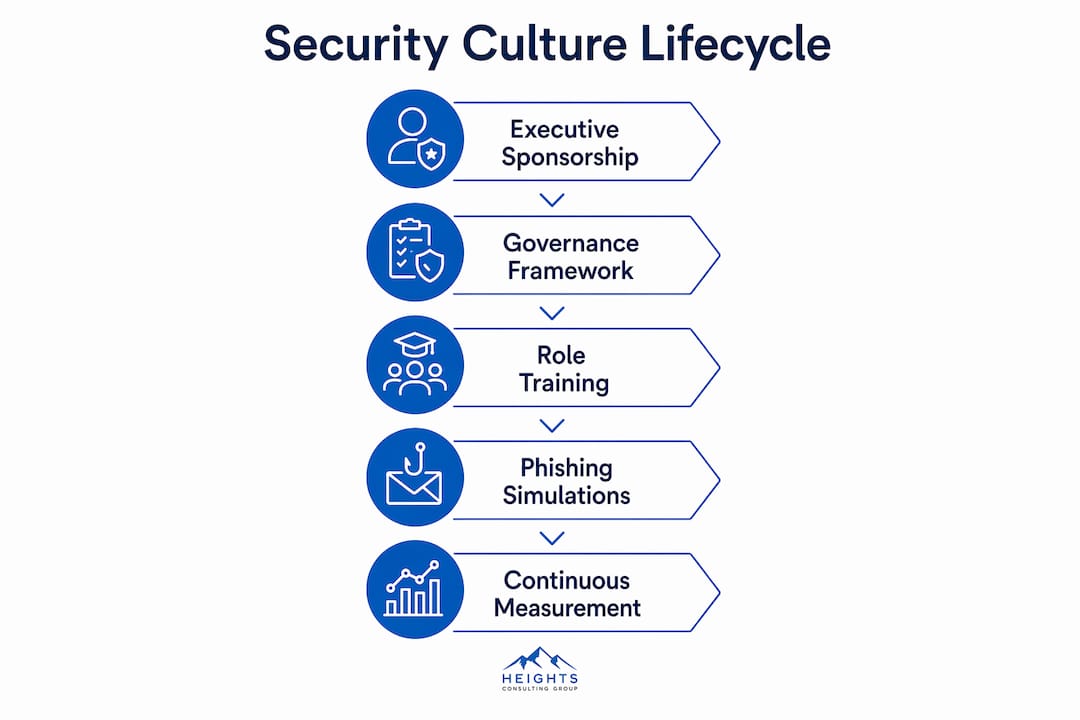
How to implement a lifecycle approach to building security culture
Mature security culture programs run continuous cycles rather than focusing on one-time events. The six phases are Assess, Plan, Design, Deploy, Measure, and Improve. Each phase feeds the next, creating a program that adapts to new threats and workforce changes rather than going stale.
-
Assess. Map your organization's risk environment, workforce composition, and current security behaviors. Identify which roles carry the highest exposure to phishing, social engineering, and AI-generated deception. Baseline metrics here set the benchmark for everything that follows.
-
Plan. Define measurable objectives tied to specific timeframes. A concrete target, such as a 30% reduction in phishing click rates within six months, gives the program accountability and gives leadership a clear return on investment to evaluate.
-
Design. Build role-specific content and simulations that reflect the actual threat environment employees face. AI-generated phishing emails now mimic internal communication styles with high accuracy. Training content must address this reality, not the threat landscape of five years ago.
-
Deploy. Deliver training across all workforce models: on-site, remote, and hybrid. Remote employees require different delivery cadences and formats than those in a shared office. A single deployment method creates coverage gaps.
-
Measure. Track behavioral metrics, not just completion rates. Completion tells you who clicked through a module. Behavioral data tells you whether anyone changed how they handle a suspicious email. Executive dashboards should report both.
-
Improve. Use feedback loops and updated threat intelligence to refine content. AI-driven threats evolve monthly. A program that updates annually is already behind.
Pro Tip: Run quarterly phishing simulations and share the results with department heads, not just the security team. When managers see their team's click rates, they become invested in improving them. That peer accountability accelerates behavioral change faster than any training module alone.
For organizations building or auditing their compliance posture alongside culture programs, a NIST compliance checklist provides a structured starting point for aligning program design with NIST SP 800-53 controls.
How can organizations engage employees as active defenders?
The most durable security cultures reframe employees as the first line of defense, not the primary source of risk. That reframing is not semantic. It changes how people respond when they encounter a suspicious situation. An employee who believes they are a defender reports the phishing email. An employee who fears punishment deletes it and says nothing.
Transparent, blame-free error reporting improves voluntary disclosure and strengthens risk management. Organizations that punish mistakes drive incidents underground. The breach that gets reported in the first hour costs far less than the one discovered three months later.
Practical engagement methods that work include:
- Security champion networks. Embed trained peer advocates across departments. Champions answer questions, model secure behavior, and surface emerging risks before they escalate.
- Live simulations and shared threat stories. Real examples from within the industry carry more weight than hypothetical scenarios. When employees hear about a breach that hit a peer organization, the risk becomes concrete.
- Continuous microlearning modules under 10 minutes. Short, behavior-triggered learning maintains engagement and improves retention far better than annual four-hour sessions.
- Recognition programs. Publicly acknowledge employees who report threats or demonstrate strong security behavior. Recognition reinforces the identity of "security defender" across the workforce.
A successful security culture integrates behavioral analytics, peer networks, and frequent microlearning to build durable risk awareness. The organizations that achieve this treat security not as a policy to enforce but as a professional standard to model.
The C-suite accountability guide from Heightscg details how executive-level ownership translates directly into workforce-level behavior, which is the link most programs fail to make explicit.
What are common pitfalls when building security culture?
The most common failure mode is treating security culture as a static, annual checkbox event. One training session per year does not change behavior. It satisfies a compliance requirement and nothing more. Organizations that confuse compliance with culture consistently underperform on incident metrics.
-
Weak or absent metrics. Programs without behavioral measurement cannot demonstrate value or identify failure points. Completion rates are not behavioral metrics. Track phishing simulation results, reporting rates, and policy exception requests over time.
-
Siloed ownership. When security culture lives only in the IT department, it lacks the HR, Legal, and Operations perspectives that shape actual employee behavior. Multidisciplinary ownership is not optional.
-
Underestimating the timeline. Behavioral security culture change takes 3–5 years of sustained effort. Deep culture change often requires 5–10 years. Leaders who expect results in 90 days will defund programs before they produce outcomes.
-
Ignoring workforce modality. Remote and hybrid employees need tailored delivery methods. A program designed for an office environment leaves distributed workers without adequate coverage, and distributed workers are often the highest-value targets for social engineering.
-
Loss of executive sponsorship. Programs that lose their executive champion stall within months. Maintain sponsorship through regular governance meetings, transparent reporting, and clear connections between security culture metrics and business risk outcomes.
Pro Tip: Treat security awareness as a strategic capability integrated across functions rather than a compliance task siloed in IT. Budget for it accordingly, staff it adequately, and report on it at the board level.
For organizations in regulated industries, aligning the security culture program with a formal compliance framework prevents duplication of effort and strengthens both the cultural and regulatory outcomes simultaneously. Tactical guidance on current data security controls is also available through a 2026 data security field guide that maps practical controls to current threat conditions.
Key Takeaways
Building a security culture requires a continuous, measurable lifecycle program with executive sponsorship, multidisciplinary ownership, and role-based training that evolves with the threat environment.
| Point | Details |
|---|---|
| Human risk drives breaches | 60% of breaches involve human elements, making culture programs a primary risk control. |
| Lifecycle over events | The Assess, Plan, Design, Deploy, Measure, Improve cycle outperforms annual training. |
| Multidisciplinary ownership | Security, HR, Legal, IT, and Operations must all co-own the culture program. |
| Employees as defenders | Blame-free reporting and peer champion networks improve voluntary disclosure and risk detection. |
| Culture change takes time | Behavioral change requires 3–5 years; deep culture change requires 5–10 years of sustained investment. |
What I've learned about security culture that most programs get wrong
After working with organizations across regulated industries, the pattern is consistent. Leaders invest in technology, then treat culture as the afterthought. They buy endpoint detection, deploy a SIEM, and then run a 45-minute annual awareness video. The technology is excellent. The culture work is not.
The uncomfortable truth is that leadership must make security culture a visible priority with consistent communication to embed security as a cultural norm. That means executives speaking about security in town halls, not just in board decks. It means managers asking about security behaviors in performance conversations. Technology cannot substitute for that.
AI has complicated this further. Generative AI now produces phishing emails that pass basic literacy checks and mimic internal communication styles. The threat is no longer a Nigerian prince. It is a convincing message from what appears to be your CFO, asking for an urgent wire transfer. Employees need training that reflects this reality, and that training must update as the threat updates, not on an annual calendar cycle.
The organizations I respect most treat security culture as a competitive asset. They recognize that fewer incidents, faster reporting, and stronger resilience translate directly into lower insurance premiums, smoother audits, and greater customer confidence. Culture is not a soft initiative. It is a measurable business outcome. The leaders who understand that invest accordingly, and the results show up in their incident data within years, not decades.
A virtual CISO can accelerate this work significantly by providing the governance structure and executive communication that most internal teams lack the bandwidth to sustain alone.
— Dan
How Heightscg supports security culture programs
Heightscg works with organizational leaders to design, implement, and govern security culture programs that align with enterprise risk objectives and compliance frameworks including NIST, CMMC, and SOC 2. The firm's technical cybersecurity consulting services cover program architecture, role-based training design, behavioral metrics, and executive reporting. Heightscg's virtual CISO practice provides the ongoing governance structure that keeps culture programs funded, measured, and connected to board-level risk priorities. Organizations that need to move from annual compliance events to a continuous, measurable security culture program can contact Heightscg to discuss a program design tailored to their workforce, industry, and risk profile.
FAQ
What is security culture in an organization?
Security culture is the collective set of behaviors, values, and norms that shape how employees recognize and respond to cybersecurity risk. A strong security culture produces consistent secure behavior without requiring constant enforcement.
How long does it take to build a security culture?
Measurable behavioral change typically takes 3–5 years of sustained effort. Deep, organization-wide culture change often requires 5–10 years, which is why continuous program investment and executive sponsorship are non-negotiable.
What role does leadership play in building a cybersecurity culture?
Leadership sets the behavioral standard for the entire organization. When executives communicate security priorities consistently and visibly, employees treat security as a professional expectation rather than an IT department concern.
How do you measure security culture program effectiveness?
Track behavioral metrics including phishing simulation click rates, voluntary incident reporting rates, and policy exception requests over time. Completion rates alone do not indicate behavioral change.
How does AI affect security culture programs?
AI-generated phishing and social engineering attacks are now sophisticated enough to mimic internal communications. Security culture programs must update training content continuously to reflect AI-era threats, not rely on annual curriculum cycles.